Get Replies in 15 to 20 Minutes: Networking Email Templates for Executives
Use a short, personalized email with a clear 15 to 20 minute ask, and copy one of the consulting-specific outreach templates below to start. The structure that works is simple: a specific subject line, a warm greeting, one or two sentences of context, and a single clear call to action with a suggested meeting length. Offer two or three time windows, or say you will send a calendar invite, so the recipient has nothing to figure out.
Key Takeaways:
- Personalize outreach by referencing a specific detail such as an article, talk, or mutual contact to build trust and credibility.
- Offer two or three specific time windows or a calendar invite to simplify scheduling and increase response rates.
- Keep your initial email concise under 150 words, focusing on a clear, one-sentence ask for a 15 to 20-minute conversation.
- Follow up after one week with a brief, polite reminder that emphasizes your continued interest without pressuring.
- Send a thank-you note within 24 hours of the conversation, highlighting a specific point discussed and any action taken.
Table of Contents
- Core structure of an effective networking email
- How to personalize templates fast
- Subject lines, timing, and scheduling best practices
- Follow-up, thank-you, and referral-request etiquette
- Ready-to-use templates for five networking scenarios
- Author perspective and how Resume Wiz helps
- What most networking advice gets wrong
- Sources
- FAQ
Core structure of an effective networking email
Every networking email that gets a reply shares the same bones. The subject line tells the recipient exactly why you are writing, the greeting ties you to a real connection, a sentence of context explains your interest, and the call to action asks for one specific thing. According to Mailchimp’s networking email guidance, a strong message contains four parts: a specific subject line, a personalized greeting, brief context on who you are and why you chose this person, and one clear ask, kept to 15 to 20 minutes.
Opening with the connection source matters more than most people think. Naming a mutual contact, a recent article, or a conference talk gives the recipient an immediate reason to trust you. Follow that with one sentence linking your background or interest to their actual work, not a general compliment.
- State the connection source or a specific detail about their work in the first line.
- Keep the background sentence to one line that ties your ask to their expertise.
- End with a single, unambiguous request, not multiple options to consider.
- Suggest a meeting length (15 to 20 minutes) and offer to handle scheduling.
How to personalize templates fast
Personalization does not require a long rewrite. Swap in one concrete reference, a shared project, a recent talk, an article they wrote, or a mutual contact, and the email reads as if you wrote it from scratch. Generic praise (“I admire your career”) reads as filler and gets skimmed past; specific praise (“your talk on supply chain resilience”) signals you actually did the homework. WordStream’s introduction email guidance notes that leading with a real connection and a specific reason for reaching out increases credibility more than any other single edit.
For executives, trim your own background to a single line focused on scope: what you managed, not your full history. Hamilton College’s networking email guidance recommends foregrounding relevant scope and one precise topic, such as a function or a leadership challenge, rather than a full resume. Peers can handle a bit more detail, but the same rule applies: one topic, not three.
Pro Tip: Before sending, check for one ambiguous phrase, one missing availability window, and one unclear ask. Fix those three things and the email is ready.
- Reference one concrete detail: an article, a talk, a shared project, or a mutual contact.
- For senior contacts, swap your resume for a one-line scope statement and a narrow topic.
- Always include your availability or offer to send a calendar invite.
Subject lines, timing, and scheduling best practices
A good subject line states the reason for writing and hints at the ask, so the recipient knows what they are opening before they click. Patterns like “Question about [topic]” or “Referred by [mutual contact], quick [topic] question” work because they are specific, not vague.
- “Question about your work on [topic]”
- “Referred by [mutual contact], quick question”
- “Fellow [school/employer] alum, 15-minute favor”
- “Following your talk at [event], one quick question”
Timing matters as much as wording. Western Washington University’s informational interview guidance recommends reaching out 2 to 4 weeks ahead of when you’d like the conversation to happen, and framing the request as career learning rather than job solicitation.
A short, specific ask with a built-in scheduling offer, two or three time windows or a calendar invite, removes friction and tends to raise response rates, according to the same guidance. Offer the windows yourself instead of asking “what works for you,” which forces the recipient to do the scheduling work.
Follow-up, thank-you, and referral-request etiquette
What happens after the first email, or after the meeting, often determines whether the relationship continues. Three situations come up again and again.
- Thank-you note: Send it within 24 hours of the conversation. Reference one specific point discussed and report any action you already took on their advice, according to Boston University’s networking follow-up guidance.
- No-response follow-up: If you haven’t heard back in a week or so, send a brief, useful reminder rather than repeating your original email word for word. Limit yourself to one follow-up so the outreach doesn’t start to feel like pressure.
- Referral request: When asking someone to introduce you to another person, ask permission first, name exactly who you’d like to meet, and explain the relevance in one sentence. Make it easy for them to say no, and update them if the introduction leads anywhere, a practice referral etiquette guidance recommends for any introduction request.
Reporting a completed action in your thank-you note does more than show gratitude: it signals that the recipient’s time had a real effect, which is often what turns a single conversation into an ongoing contact.
Ready-to-use templates for five networking scenarios
Copy any of these, then personalize the bracketed detail with the specific reference points covered above.
Cold outreach with a mutual contact: Subject: Referred by [mutual contact], quick question about [topic] “Hi [Name], [Mutual contact] suggested I reach out given your work on [specific project or topic]. I’m exploring a move into [field] and would value 15 to 20 minutes of your perspective. Would any of these work: [window 1], [window 2], or [window 3]? Happy to send a calendar invite once you pick a time.”
Brief meeting request: Subject: 15-minute question about your role at [company] “Hi [Name], I came across your [talk/article] on [topic] and had a specific question about [narrow issue]. Could we grab 15 to 20 minutes sometime in the next couple of weeks? I’m free [window 1], [window 2], or [window 3], and I’ll send an invite for whichever works.”
No-response follow-up: Subject: Following up: quick [topic] question “Hi [Name], Wanted to float this back to the top of your inbox in case it got buried. I’d still love 15 minutes on [topic] if you have the time in the next couple of weeks. No worries if not.”
Thank-you after the meeting: Subject: Thank you, and a quick update “Hi [Name], Thanks again for the time yesterday. Your point about [specific insight] stuck with me, and I already reached out to [action taken, such as a contact or resource they mentioned]. I’ll keep you posted on how it goes.”
Referral request to an intermediary: Subject: Would you be open to an introduction? “Hi [Name], Would you be comfortable introducing me to [person] at [company]? I’m hoping to learn more about [specific topic relevant to that person’s role]. Totally understand if the timing isn’t right, no pressure either way.”
- Keep every template under 150 words.
- Personalize one line per template, the connection source or the specific topic.
- Match the ask size to the relationship: cold contacts get a smaller, more specific ask.
Author perspective and how Resume Wiz helps
Kim Taynor, founder of Resume Wiz, spent over 10 years in recruiting before building these templates, time spent on the other side of the inbox reading hundreds of outreach attempts. The ones that got replies were short, specific, and made scheduling effortless. That recruiter's-eye view shaped every template above.
For readers who want outreach built around their specific situation rather than adapted from a template, Resume Wiz offers a few paths:
- Evolution, which pairs resume and LinkedIn updates to support outreach credibility.
- The Elevate packages, which include personalized outreach coaching.
- Elevate and Land, for a more hands-on, managed outreach approach.
Browse the full Resume Wiz resource hub for additional templates and guides.
What most networking advice gets wrong
Most networking advice treats the email as the whole job, polish the subject line, perfect the opener, and the reply will follow. In practice, the email is just the door. What actually determines whether a relationship goes anywhere is what happens after someone says yes: showing up with one sharp question instead of five vague ones, and following up with proof that the conversation mattered.
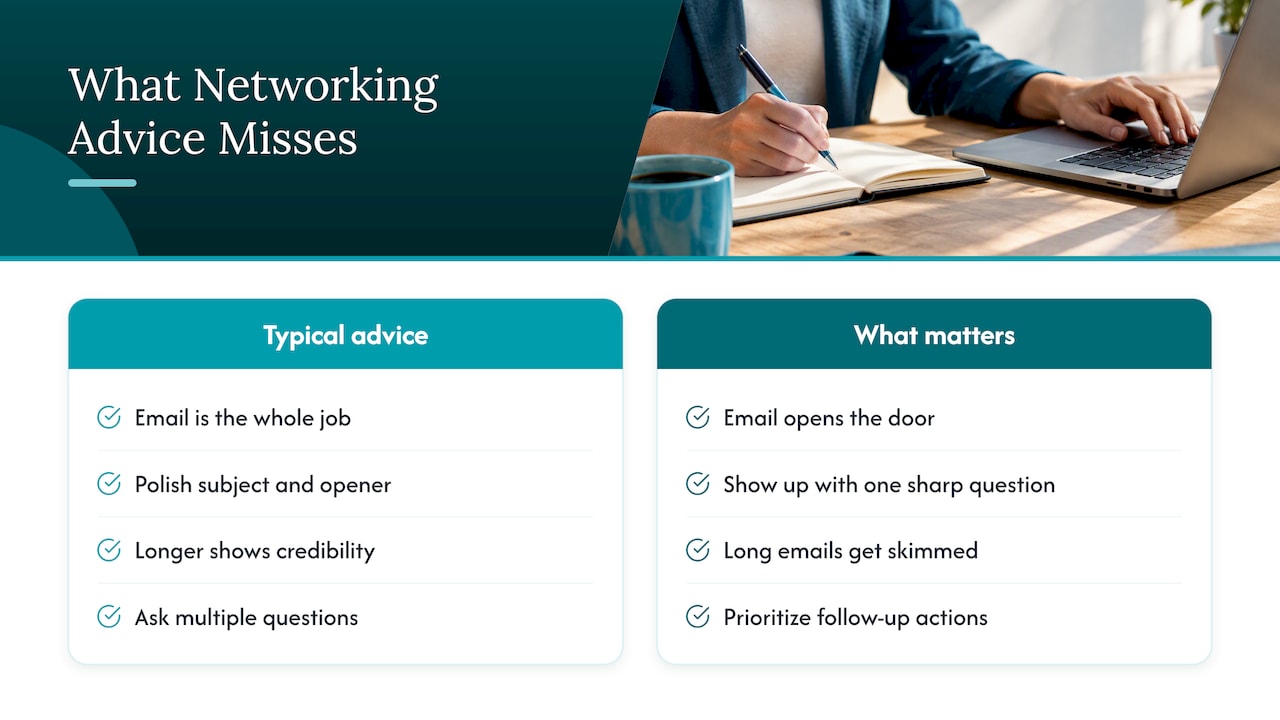
The overrated piece of advice is length. Longer emails that try to establish full credibility before asking for anything tend to get skimmed, not read. The underrated piece is the thank-you note that reports an action taken. It costs two sentences and it is the single biggest lever for turning a 15-minute favor into a standing contact.
If you take one thing from this, prioritize the follow-up over the opener. A mediocre first email with a great thank-you beats a perfect first email that goes nowhere afterward.
Kim
Want a recruiter in your corner for your next senior role? Book a free call with Resume Wiz and we will map out your next move together.
Sources
- How to write a networking email (Mailchimp)
- Informational interviews (Western Washington University)
- Introduction email templates and advice (WordStream)
- Networking: Follow up (Boston University Center for Career Development)
- Networking email guidance (Hamilton College)
FAQ
How to write a good networking email?
Use a specific subject line, open with how you know of the person (a mutual contact, an article, a talk), add one sentence connecting your interest to their work, and close with a single clear ask for 15 to 20 minutes. Offer two or three time windows or say you’ll send a calendar invite, a structure Mailchimp recommends for exactly this reason.
What is the 30/30/50 rule for cold emails?
This isn’t a standard that career centers or the sourcing behind this article define, so treat any specific percentage breakdown with caution. The consistent principle across networking guidance is simpler: spend your limited words on research, personalization, and a single clear ask rather than a long self-introduction.
What are the 5 C’s of email etiquette?
Definitions of this framework vary across sources, and no single version appears consistently in career-center guidance. The themes that do show up repeatedly, being clear, concise, and specific about your ask, hold true for any networking email regardless of which naming convention you use.
What is email networking?
Email networking is the practice of reaching out to people, often ones you don’t know well, to build a professional relationship or request a short conversation such as an informational interview. The goal is learning and connection rather than a direct job ask, a framing career center guidance consistently recommends because it lowers the burden on the recipient.
When should I send a follow-up if I get no response?
Wait about a week, then send one brief, useful reminder rather than repeating your original message. Boston University’s follow-up guidance recommends keeping follow-ups short and limiting yourself to one so the outreach doesn’t start to feel like pressure.
