No Callbacks After Applying to Jobs: Senior Level Fix
Getting no callbacks after applying to jobs at the senior level is a structural problem, not a personal one. Between 75% and 89% of job applications receive no response at all, regardless of candidate quality. At the senior level, that silence hits harder because the roles are fewer, the competition is more experienced, and the hiring process is built differently. Understanding why silence happens is the first step toward doing something about it.
Why do senior candidates get no callbacks after applying?
The absence of a response is not random. Senior candidates face a specific set of filters that most job search advice never addresses.
Recruiters apply what hiring researchers call implicit risk assessments. These are invisible filters not listed in any job description. A recruiter reviewing a VP-level resume asks: Will this person accept the salary? Will they stay? Will they challenge the current leadership? If any answer feels uncertain, the resume goes into the rejection pile, often in under 30 seconds.
Ghost jobs compound the problem. Between 18% and 22% of senior-level postings have no real hiring intent behind them. Companies post roles to build talent pipelines, satisfy internal HR requirements, or gauge market compensation. Applying to these roles produces silence by design.
Volume-based applying makes things worse, not better. Applying more does not equal better results at the senior level. The math is brutal: only 2.4% of applicants for a given senior role proceed to the interview stage. Sending 50 applications instead of 10 does not move that number. It just multiplies the silence.
The core reasons senior candidates get screened out break down into four categories:
Compensation mismatch signals. A resume showing a $250,000 total compensation history applying for a $160,000 role triggers an automatic assumption of misalignment, even if you are open to it.
Overqualification fears. Hiring managers worry you will leave the moment something better appears. Without a clear explanation, they screen you out to protect their own time.
Title and scope mismatches. Applications with lateral moves or title changes are often discarded quickly when no context is provided.
Resume-to-role keyword gaps. If your resume does not mirror the language of the job description, ATS systems filter it before a human ever reads it.
Pro Tip: Before applying to any role, spend 10 minutes mapping your resume’s language directly to the job description’s exact phrasing. This single step addresses both ATS filtering and recruiter pattern matching.
How does senior hiring differ from mid-level hiring?
Senior hiring operates on a completely different timeline and logic than mid-level or junior hiring. Recognizing this difference changes how you allocate your time and energy.
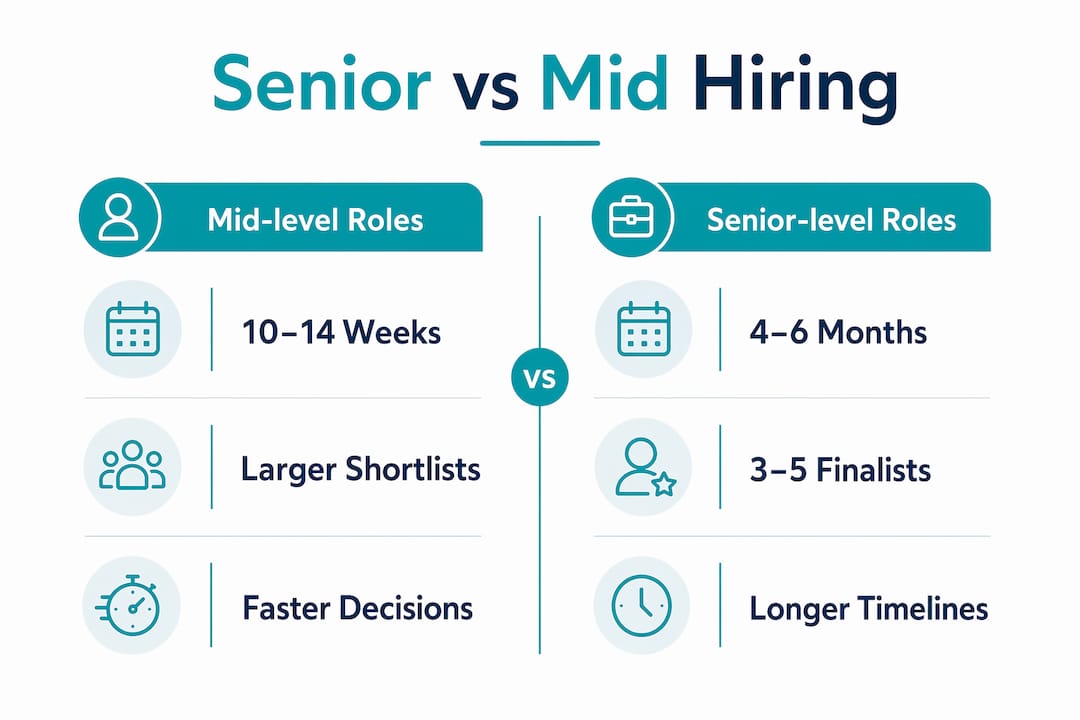
The table below shows the key structural differences:
FactorMid-level rolesSenior-level rolesTypical process length10 to 14 weeks4 to 6 monthsShortlist size10 to 20 candidates3 to 5 candidatesPrimary access routeJob boards and applicationsReferrals and networksDecision-maker involvementHR and direct managerC-suite and boardResume review timeUnder 30 secondsUnder 30 seconds
The 4 to 6 month timeline for senior roles is not a sign that your application is failing. It reflects the reality that senior hires carry more organizational risk and require more stakeholder alignment. A mid-level manager can be replaced in a quarter. A Chief Operating Officer cannot.
The shortlist size matters most. When only 3 to 5 candidates make it to the final round, the selection process is far more relationship-driven than credential-driven. Hiring managers at the senior level often already have someone in mind before the role is posted. Your application competes not just with other resumes but with internal candidates and warm referrals.
Career intelligence is the term used to describe the deep company and market knowledge that drives successful senior searches. It means knowing which companies are growing, which leadership teams have gaps, and which executives are connected to your network. This approach consistently outperforms volume-based applying.
Can being “too senior” cause rejection, and how do you fix it?
Being labeled overqualified is one of the most common causes of senior job application rejections, and it is almost always fixable with the right framing.
Recruiters screening an overqualified candidate run through three concerns automatically. First, they assume you will leave once something better appears. Second, they assume your salary expectations exceed the budget. Third, they worry you will resist direction from a manager who is less experienced than you. None of these concerns require evidence to trigger a rejection. The assumption alone is enough.
The fix is to explain your motivation explicitly in your cover letter or introductory message. Recruiters screen out overqualified candidates because they lack information. Give them the information.
Effective rationale statements address all three concerns directly:
On tenure: “I am seeking a role where I can build something for the long term rather than manage an already-mature function. This position aligns with that goal.”
On compensation: “My salary expectations are flexible and aligned with the posted range. I am prioritizing fit and growth trajectory over total compensation.”
On authority: “I have worked effectively under leaders at every level and understand that organizational success depends on respecting the chain of decision-making.”
These statements do not need to be long. Two to three sentences in a cover letter or LinkedIn message neutralize the recruiter’s default assumptions. Cover letters or intro messages that address recruiter concerns directly increase callback chances. The candidate who explains their motivation gets the call. The one who does not gets silence.
Pro Tip: If you are applying for a role below your last title, add a one-line note in your resume summary that signals intent. Something like: “Seeking a focused individual-contributor leadership role after a decade of broad executive scope” tells the recruiter exactly what they need to know.
What practical steps increase callbacks for senior job seekers?
The most effective approach to senior job searching is depth over breadth. Here is a specific sequence that works.
Audit your resume against each job description before applying. Recruiters decide in under 30 seconds whether a resume matches the role. Your resume must show a clear title match, quantified results, and role-aligned skills. If it does not, rewrite the summary and top bullet points before submitting.
Limit applications to roles where you meet at least 80% of the stated requirements. Applying broadly at the senior level wastes time. Application volume is a tax on senior job seekers’ time. Ten well-targeted applications outperform 50 generic ones every time.
Send one targeted follow-up message 5 to 7 business days after applying. Address it to a named recruiter or hiring manager. Include one specific reason why your background fits the role. Multiple follow-ups hurt your chances by signaling desperation. One message, sent once, is the rule.
Activate your network before applying, not after. A warm introduction from a mutual connection moves your application from the cold pile to the shortlist. Identify second-degree connections at target companies on LinkedIn and ask for a brief introduction before the role closes.
Add context for any career gaps or unusual transitions. A two-year gap or a step-down in title raises flags that recruiters will not ask you to explain. Address them proactively in your resume summary or cover letter with a single factual sentence.
Build your personal brand on LinkedIn. Senior hiring managers and executive recruiters actively search LinkedIn for candidates who are not applying. Publishing one substantive post per week on your area of expertise puts you in front of decision-makers without a single application.
Pro Tip: Use the job description’s exact language in your resume summary. If the role says “P&L accountability” and your resume says “budget management,” a recruiter’s keyword scan may miss you entirely, even if your experience is identical.
Key takeaways
Senior candidates who get no callbacks are almost always facing structural hiring filters, not a skills deficit. Fixing the process requires targeting, clarity, and relationship-driven access rather than more applications.
PointDetailsGhost jobs are commonUp to 22% of senior postings have no real hiring intent, so research companies before applying.Volume hurts more than it helpsOnly 2.4% of senior applicants reach interview stage; 10 targeted applications beat 50 generic ones.Overqualification is fixableA two-sentence explanation of your motivation in a cover letter neutralizes the most common rejection trigger.Follow up once, strategicallyOne targeted message to a named contact, sent 5 to 7 days after applying, improves callbacks without appearing desperate.Relationships beat cold applicationsSenior roles are filled through networks and referrals far more often than through job board submissions.
What I have learned after 10 years on both sides of the hiring table
The silence that senior candidates experience is genuinely demoralizing. I have watched talented executives send out 80 applications and hear nothing back, then land a VP role in three weeks through a single LinkedIn conversation. That contrast is not luck. It reflects how senior hiring actually works.
The hardest thing to accept is that the job board is not your primary market at this level. It is a secondary channel at best. The primary market is the conversation you have not had yet with the person who already trusts your work. Most senior candidates spend 90% of their time on applications and 10% on relationships. The ratio should be reversed.
I also want to name the emotional weight of this process. Silence from employers is not feedback. It is noise. Do not let it tell you something about your value. Let it tell you something about your strategy. The candidates who break through are not the ones with the best resumes. They are the ones who stopped treating the job search as a numbers game and started treating it as a relationship-building exercise with a very specific goal.
If you are three months into a senior search with no traction, the answer is not more applications. The answer is a sharper target list, a stronger network activation plan, and a resume that speaks directly to the role in front of it.
Kim
How Resumewiz helps senior professionals get more callbacks
Senior job searches require a different level of precision than most career tools provide.
Resumewiz was built specifically for executives, managers, and senior professionals who need more than a polished document. The platform offers tailored resume development that aligns your experience with the exact language and expectations of senior-level roles, ATS-compliant formatting that clears automated filters, and LinkedIn profile optimization that puts you in front of executive recruiters who are actively searching. Kim Taynor and the Resumewiz team also provide personalized outreach templates and interview coaching, so every step of your application process works together. If your applications are producing silence, Resumewiz gives you the tools and support to change that.
Want a recruiter in your corner for your next senior role? Book a free call with Resume Wiz and we will map out your next move together.
FAQ
Why am I getting no response after job applications at the senior level?
Between 75% and 89% of all job applications receive no response, and senior roles face additional filters around compensation, retention risk, and overqualification. Ghost job postings, which make up 18 to 22% of senior listings, also produce silence by design.
How long does a senior-level job search typically take?
Senior hiring processes typically run 4 to 6 months from application to offer. This is significantly longer than the 10 to 14 week timeline common for mid-level roles, reflecting the higher stakes and more complex stakeholder decisions involved.
Does applying to more jobs increase my chances at the senior level?
No. Application volume is not effective at the senior level. Only 2.4% of applicants for a given senior role reach the interview stage, and strategic targeting consistently outperforms mass applying.
How do I address being seen as overqualified in my application?
Include a two-to-three sentence explanation of your motivation in your cover letter or introductory message. Address salary flexibility, your reason for the role change, and your commitment to the position directly. Recruiters screen out overqualified candidates because of missing information, not because of your experience.
When should I follow up after submitting a senior job application?
Send one follow-up message 5 to 7 business days after applying. Address it to a named recruiter or hiring manager and include one specific reason your background fits the role. Sending multiple follow-ups reduces your chances by signaling desperation.
