4 Questions That Decide One Page or Two Page Resume
Use one page if your relevant experience is thin enough to fit in tight, quantified bullets. Use two pages once you need room for measurable impact, leadership scope, or technical depth that a single page would force you to cut. The decision hinges on relevance and clarity, not a fixed page count, and any explicit instruction in a job posting overrides both defaults.
Key Takeaways:
- Resumes longer than two pages are generally unnecessary unless the content justifies it with measurable impact and clear scope.
- For candidates with under seven years of experience, a one-page resume is usually sufficient; beyond ten years or at senior levels, two pages often work better.
- Industry norms vary significantly, with academia and technical fields expecting longer documents, while corporate roles typically follow experience-based guidelines.
- A well-structured two-page resume prioritizes recent achievements on page one and supporting details, like older roles and projects, on page two.
- Recruiter interest depends more on relevance and quantified results than page count, so focus on impactful, outcome-driven content.
Table of Contents
- One Page vs Two Page Resume: Weighing the Trade-Offs
- How Do You Decide Between One and Two Pages Right Now?
- How to Format a One-Page Resume for Maximum Impact
- How to Structure Page Two of a Two-Page Resume
- What Does the Research Actually Say About Resume Length?
- Mistakes That Undercut Either Resume Format
- Matching Resume Length to Industry Expectations
- What Do Strong One-Page and Two-Page Resumes Actually Look Like?
- Should Your Resume Length Depend on Your Cover Letter or LinkedIn Profile?
- What I Tell Clients When They Ask About Resume Length
- How Resumewiz Builds the Right Length for Your Career Stage
- Sources
One Page vs Two Page Resume: Weighing the Trade-Offs
Neither length is inherently better. Each solves a different problem, and picking the wrong one for your situation is what actually hurts your candidacy.
A one-page resume forces discipline. Every line has to earn its place, which makes the document easy to scan and hard to pad. That works in your favor when you have three to seven years of experience or less, because there simply isn’t enough history yet to justify more real estate. It also works for career changers who are leaning on transferable skills rather than a long track record in one field.
A two-page resume buys you space, but only space you use well. Monster’s guidance notes that applicant tracking systems generally accept two-page documents without penalty, so the old fear that a second page gets you auto-rejected doesn’t hold up in most hiring pipelines. What matters is whether that second page carries content a recruiter actually needs.
Here’s where each format tends to break:
- One-page failure mode: cramming 15 years of work history into margins so tight the resume becomes a wall of 9-point text.
- Two-page failure mode: stretching a thin career into two pages by listing every task you ever performed, relevant or not.
- One-page strength: a hiring manager can absorb your whole story in one glance, which suits entry-level and early-career roles.
- Two-page strength: room to show scope, like budget size, team headcount, or a multi-year project arc, that a single page can’t hold without shrinking to unreadable type.
- Industry exception: academic, scientific, and some technical roles routinely expect longer documents (often closer to a CV format) because publications and certifications need full listing.
A rough threshold worth keeping in your head: under 7 years of relevant experience, default to one page. Past 10 years, or if you’re in a technical or executive role where scope and metrics matter, two pages usually serves you better. Between those points, let content density decide, not a rule of thumb.
How Do You Decide Between One and Two Pages Right Now?
Run through these four questions in order. By the time you finish, you’ll have your answer.
- Does the job posting specify a page limit? If it does, that instruction wins over every guideline in this article. Some government, academic, and certain corporate applications state a hard limit, and ignoring it signals you don’t read instructions closely.
- Would cutting to one page force you to remove measurable achievements? If trimming means deleting the line where you cut costs by a specific percentage or led a specific team size, that’s a signal you need the second page.
- Is the extra content clearly relevant? Projects, certifications, and leadership scope belong on page two. Filler like unrelated volunteer work from a decade ago doesn’t.
- Will page two be balanced and intentional, or will it be half-empty? A second page with four lines on it looks worse than a tight one-pager. If you can’t fill at least half the second page with substance, cut back to one.
Once you’ve answered all four, pick a length and commit. Then do one more pass and strip anything that doesn’t directly support the job you’re targeting.
Pro Tip: Print both versions and hold them at arm’s length. If your eye goes straight to a wall of text with no white space, that’s the version to cut, regardless of which page count it is.
How to Format a One-Page Resume for Maximum Impact
A one-page resume lives or dies on prioritization. You’re not writing a shorter version of your career. You’re writing the sharpest possible summary of what actually matters to this employer.
Start with a concise headline and a two- or three-line summary that states your target role and your biggest differentiator. Follow it immediately with your most recent role, using three to six accomplishment bullets that lead with results, not duties. “Managed a team” says nothing.
- Cut or compress roles older than 10 to 15 years into a single line unless they’re directly relevant to the job you want.
- Keep your font at 10 to 11 point minimum. Shrinking text to 8 point to force a fit is one of the fastest ways to signal you didn’t edit, you just squeezed.
- Pull keywords straight from the job description, but don’t let keyword matching replace substance. A bullet with a number in it beats a bullet with a buzzword every time.
- Move education and certifications to the bottom of the page, or drop them entirely if they’re not relevant to the role you’re applying for now.
The goal isn’t brevity for its own sake. It’s making sure the one page you send contains nothing a recruiter has to skip over to find what matters.
How to Structure Page Two of a Two-Page Resume
The mistake most two-page resumes make isn’t length. It’s sequencing. If your strongest material sits on page two, you’ve built the document backward.
Page one still has to carry your best, most recent, most quantified achievements. Treat it exactly like a one-page resume would demand. Page two is where supporting material goes: older roles, side projects, technical skill inventories, publications, or detailed descriptions of work that adds context but isn’t your headline.
- Add a compact header on page two with just your name and “Page 2 of 2.” Skip repeating your full phone number, email, and address again.
- Keep bullet formatting identical across both pages. A shift in style between page one and two makes the document look stitched together rather than deliberately written.
- Every bullet, on either page, should still lean on outcomes. “Assisted with reporting” belongs nowhere; “Built a reporting process that cut monthly close time by two days” belongs everywhere.
- If page two ends up half-empty, you have two honest choices: trim page one further so content flows evenly, or add legitimately relevant detail like a certification list or notable project. Never stretch margins or line spacing just to make four lines look like a full page.
Pro Tip: If you’re not sure whether an old role belongs on page two, ask whether it explains a skill or credential the job posting mentions. If it doesn’t, cut it, even if it was a job you loved.
What Does the Research Actually Say About Resume Length?
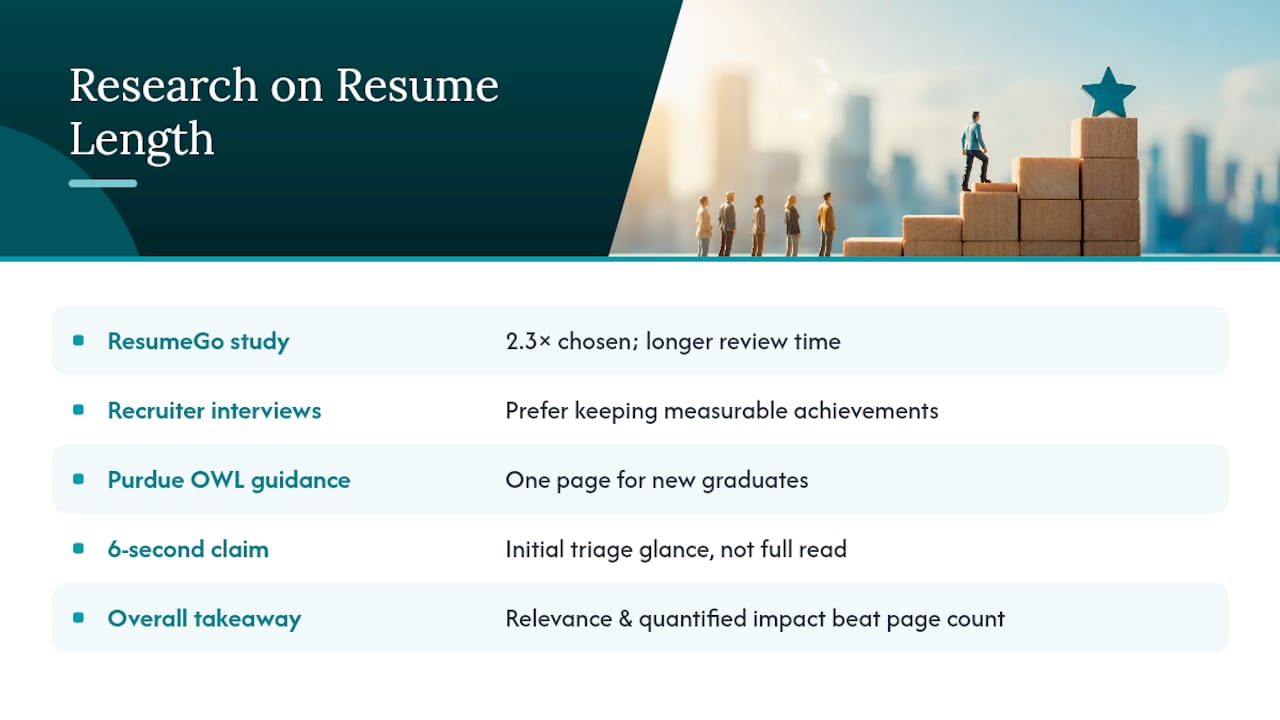
The most cited data point in this debate comes from a hiring simulation run by ResumeGo, which found that recruiters selected two-page resumes 2.3 times more often than one-page versions, and spent noticeably longer reviewing them. That preference grew stronger as the seniority of the simulated role increased.
That finding is real, but it comes with a catch worth stating plainly: ResumeGo sells resume-writing services, and the study’s sample and design haven’t been independently replicated at scale. Treat it as a strong data point in favor of two pages for experienced candidates, not as settled science.
Recruiters interviewed by CNBC, including career experts Vicki Salemi and Amanda Augustine, made a consistent point: cutting a resume to one page often means deleting the exact metrics that separate a strong candidate from an average one. Their advice leaned toward keeping measurable achievements intact over forcing brevity.
Institutional guidance pulls in a different direction for a different audience. Purdue OWL still recommends one page for new graduates, reserving two pages for applicants with enough justified experience to fill it. That’s not a contradiction of the ResumeGo finding. It’s a difference in who each guideline is written for.
One more stat worth handling carefully: the claim that recruiters spend just six seconds scanning a resume traces back to small, commercially run eye-tracking studies. That number describes an initial triage glance, not a full read, and it shouldn’t be used as a reason to obsess over page count. What it actually argues for is putting your strongest material at the very top of page one, regardless of whether the document runs one page or two.
The takeaway across all of it: relevance and quantified impact drive recruiter interest more than page count does. Two pages help when you have the substance to justify them.
Mistakes That Undercut Either Resume Format
Both formats fail for the same underlying reason: the length stops matching the content. Watch for these specific patterns.
- Padding to reach two pages. Adding a “Skills” section with 40 generic terms, or listing every task from a job you held eight years ago, is padding dressed up as thoroughness.
- Shrinking fonts and margins to force a fit. If you’re at 8-point type and 0.3-inch margins, you didn’t write a one-page resume. You wrote a two-page resume and hid half of it.
- Leaving a half-empty second page. A page with three lines on it reads as an editing failure, not a stylistic choice.
- Ignoring explicit posting instructions. If a listing says “one page maximum” and you send two, some ATS or human screener may not even open the second page, and you’ve made yourself look like you can’t follow directions.
- Ignoring industry norms. Academic and scientific roles often expect longer documents by convention. Sending a one-page resume there can read as underprepared rather than concise.
Matching Resume Length to Industry Expectations
Page count isn’t a universal standard. It shifts by field, and treating every industry the same way is a quiet mistake a lot of job seekers make.
Corporate and business roles, from marketing to operations to finance, generally follow the experience-based rule laid out earlier: one page under roughly 7 years, two pages beyond that when the content justifies it. Resume points to a similar threshold, suggesting two pages becomes reasonable around the 10-year mark or when technical and certification detail piles up.
Technical fields, including engineering, IT, and data roles, often run longer even at moderate experience levels, because certifications, tools, and project lists add up fast. A software engineer with six years of experience and four relevant certifications may legitimately need two pages where a marketing coordinator with the same tenure doesn’t.
Academic, research, and scientific roles operate on an entirely different scale. Publications, grants, and speaking engagements routinely push these documents into full CV territory, often several pages, and that’s the accepted norm rather than an exception.
Creative fields sometimes flip the whole framework by leaning on portfolios instead of dense text, which can justify a shorter resume even at senior levels because the work sample carries the weight the bullets would otherwise carry.
Recruiter surveys back up the idea that there’s no universal answer.
What Do Strong One-Page and Two-Page Resumes Actually Look Like?
An effective one-page resume for a mid-level marketing coordinator with five years of experience might lead with a two-line summary, then three roles with four bullets each, all metric-driven: campaigns launched, budget managed, conversion lift achieved. Education sits at the bottom in two lines. Nothing older than the first job appears at all.
An effective two-page resume for a director-level operations candidate with 14 years of experience looks different by design. Page one carries the two most recent roles with five to six bullets each, heavy on scope: team size, budget authority, cost savings achieved. Page two picks up two earlier roles in condensed form, a “Key Projects” section highlighting two major initiatives, and a certifications list. The header on page two is one line: name and “Page 2 of 2.”
The weak version of each format is the mirror image of the strong one. A weak one-pager crams the director’s whole 14-year history into 9-point font with no white space. A weak two-pager takes the marketing coordinator’s five years and stretches it across two pages with inflated line spacing and generic duty-based bullets instead of achievements. Length isn’t the variable that separates strong from weak here. Density and relevance are.
Should Your Resume Length Depend on Your Cover Letter or LinkedIn Profile?
Your resume doesn’t have to carry every piece of your professional story alone. A cover letter and a well-built LinkedIn profile can absorb detail that would otherwise tempt you to overload page two.
If you’re weighing whether to add a third bullet about a niche project just to make sure it gets seen, consider putting that story in your cover letter instead, where you have room to explain context a resume bullet can’t hold. That keeps your resume tight while still surfacing the detail somewhere a hiring manager will see it.
LinkedIn plays a similar role, especially for recommendations, full project portfolios, or a longer narrative about a career pivot. Recruiters increasingly cross-reference a resume against a LinkedIn profile before or after a phone screen, so treating the two as one connected story, rather than duplicating the same content twice, gives you more total space to work with without bloating either document. If a hiring manager wants to see how candidates get consumed at scale, tools built for structured video screening, like Facecruit, are part of why clarity in the written resume still matters even after you get past the initial screen. A cluttered resume creates a worse first impression before a recruiter even gets to watch you speak.
Use your resume for the tightest, most quantified version of your story. Let the cover letter and LinkedIn carry the parts that need more room to breathe.
What I Tell Clients When They Ask About Resume Length
Most people ask me the wrong question. They ask “one page or two?” when the real question is “what’s the strongest version of my story, and how much space does it need?” Once you flip the question, the page count usually answers itself.
The clients who struggle most aren’t the ones with too little experience to fill a page. They’re the ones with 12 years of solid work who keep trying to force it into one page because somebody told them that’s the “professional” thing to do. That advice is stale. If you’ve got measurable wins, quantified budgets, teams you’ve led, put them on the page and let the length follow the content.
My one non-negotiable: whatever length you land on, your strongest, most metric-driven bullet goes at the very top of page one. Everything else is secondary to that.
Kim
How Resumewiz Builds the Right Length for Your Career Stage
Some career services offer ATS-compliant formatting, length decisions based on your experience and target role, and LinkedIn optimization that carries the parts of your story your resume doesn’t need to repeat.

If you’re an experienced professional trying to figure out whether your background justifies one page or two, that’s a decision that benefits from expert judgment backed by recruiting experience. Start with a resume review through Resumewiz and get a length decision built around your specific experience instead of a generic rule you found online.
Want a recruiter in your corner for your next senior role? Book a free call with Resume Wiz and we will map out your next move together.
