Overqualified but No Interviews? Here's Why
Overqualified but No Interviews? Here’s Why
Being labeled “overqualified” is not a compliment. It is a hiring risk label that signals to employers you might leave, demand too much, or disrupt the team. Senior professionals who are overqualified but no interviews are coming their way face a specific, solvable problem. The barrier is not your skill set. It is how your application triggers fear in hiring managers before you ever speak to one. The good news is that proactive framing and resume strategy can neutralize these fears at every stage of the process.
Why overqualified candidates get no interviews
Employers reject highly experienced candidates not because of missing skills, but because of perceived risk. Research shows that high-capability candidates are less likely to be hired due to fears about retention, compensation demands, and hierarchy disruption. That finding reframes the entire problem. You are not being rejected for what you cannot do. You are being rejected for what employers assume you will do next.
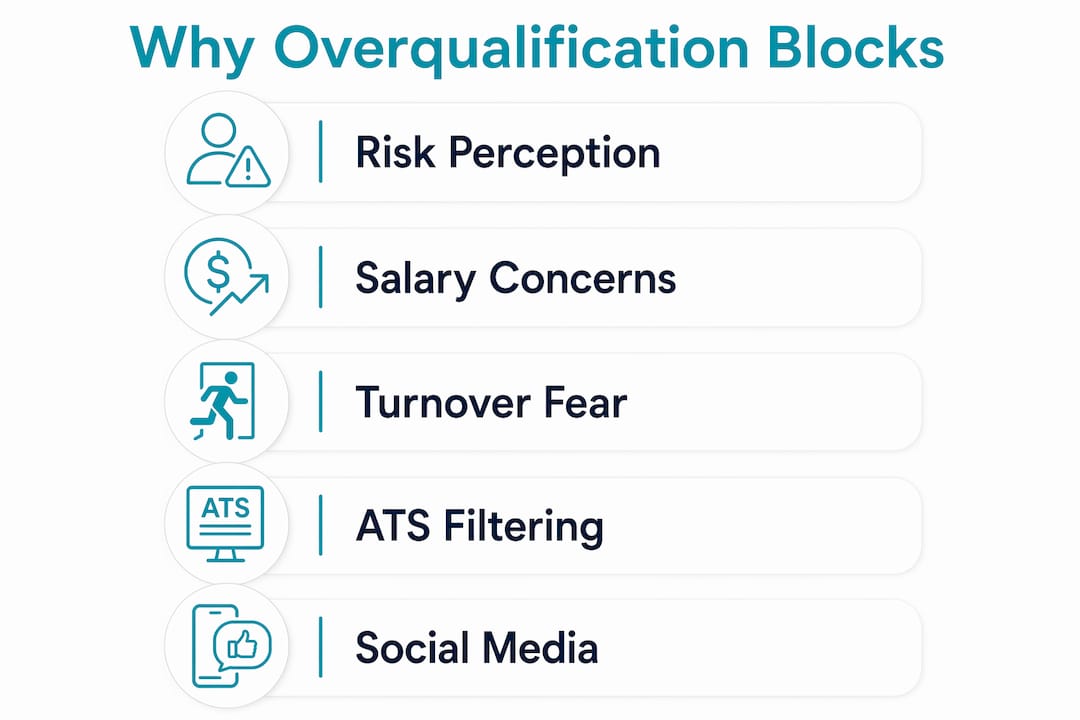
Three fears drive most of these rejections. Hiring managers worry you will leave the moment a better offer appears. They assume your salary expectations exceed the budget. They fear you will undermine or bypass the existing management structure. None of these fears require evidence. They activate automatically when a recruiter sees a title like “VP of Operations” on an application for a director-level role.
“Overqualified” is rarely about qualifications at all. Career experts identify it as a cover for emotional biases, including age discrimination and concerns about cultural fit. That means the rejection is often less rational than it feels, and more reversible than most candidates realize.
The bias compounds at the screening stage. Automated applicant tracking systems flag profiles where title seniority or compensation history exceeds the posted role. Many candidates never reach a human reviewer. AI-driven rejection systems filter out the most qualified applicants before any human sees the resume. The result is a rejection loop that feels invisible because it is.
- Retention risk: Employers assume senior candidates will leave within months for a better title.
- Salary mismatch: Past compensation signals future expectations, even when you are willing to accept less.
- Hierarchy threat: Managers fear a more experienced report will challenge their authority.
- ATS filtering: Automated systems flag seniority gaps and remove profiles before human review.
- Age bias: The overqualified label frequently masks unconscious discrimination based on career stage.
Resume strategies that fix the overqualified problem
The resume is where most overqualified job seekers lose the interview before the conversation starts. The fix requires deliberate editing, not just formatting.
Start by pruning your career history. Removing early-career roles and consolidating older positions reduces the visual weight of a 25-year career and limits the signals that trigger age bias. A resume covering the last 10 to 15 years of experience is almost always stronger than one that documents every role since graduation. Move your education section to the bottom of the document and remove graduation years entirely.
Next, reframe your language. Senior professionals default to ownership verbs: “led,” “directed,” “oversaw.” These signal authority, which is exactly what triggers hierarchy fears. Replace them with collaborative verbs: “partnered,” “contributed,” “supported,” “built alongside.” The substance of your achievement stays the same. The perceived threat level drops significantly.
- Cut roles older than 15 years. List them under a single “Early Career” line if needed, with no bullet points.
- Remove graduation dates. The year you finished college is irrelevant to your candidacy and invites bias.
- Rewrite your summary. Open with the specific function you want to perform, not your most senior title.
- Use collaborative language. Swap “managed a team of 40” for “worked alongside a 40-person team to deliver.”
- Address salary expectations directly. A one-line note in your cover letter stating your salary range eliminates one of the three core fears before the interview.
- Tailor every application. Generic resumes read as spray-and-pray. A tailored document signals genuine interest in this specific role.
Pro Tip: Write your resume summary as if you are applying for this exact role for the first time. Drop all references to your highest title and focus entirely on what you want to do next and why this company is the right place to do it.
The cover letter is your first opportunity to address overqualification directly. Candidates who proactively address employer fears about tenure, salary, and motivation substantially improve their chances of reaching the interview stage. One paragraph that explains why you want this role, at this level, with this company, does more work than three pages of credentials.
How to handle the overqualified question in interviews
Getting the interview is only half the problem. Once you are in the room, the overqualification concern does not disappear. It shifts from a screening filter to a direct question.
The most effective approach is to answer before you are asked. Open your interview with a brief, confident statement about why you want this specific role. Do not wait for the hiring manager to raise the concern. Candidates who signal commitment and cultural alignment early in the conversation eliminate the bias before it has time to settle.
- Prepare your “why this role” story. It should be two to three sentences, specific to the company, and focused on what you want to contribute rather than what you want to gain.
- Acknowledge the experience gap directly. Say something like: “I know my background looks senior for this role. I am here because I want to do this work, at this company, and I am not looking for a stepping stone.”
- Demonstrate cultural fit through questions. Ask about team dynamics, collaboration norms, and how success is measured. These questions signal that you care about fitting in, not standing out.
- Avoid salary negotiation in the first interview. If you have already addressed it in your cover letter, you do not need to revisit it unless asked.
Pro Tip: Reframe overqualification as a benefit to the team, not a risk to the employer. A line like “You get someone who has already made the expensive mistakes” lands better than any credential on your resume.
Storytelling is the most underused tool in this conversation. A specific example of a time you chose depth over advancement, or took a lateral move to learn something new, makes your motivation credible. Abstract claims of passion are easy to dismiss. A concrete story is not.
How screening technology affects overqualified applicants
Modern hiring runs on two layers of screening: automated systems and social media review. Both create specific problems for overqualified professionals.
Automated hiring systems act as gatekeepers that reject most applications before a human reviews them. These systems match keywords, title levels, and compensation signals against the job description. A resume with a C-suite title applying for a manager role often fails the automated match before any human sees the experience behind it. Worse, AI rejection systems provide no feedback and offer no appeal mechanism. You simply never hear back.
Social media screening adds a second filter. Research shows that 58% of hiring professionals screen candidates via social media, and 1 in 5 employers has rejected an applicant based on what they found online. That number means your LinkedIn profile, public posts, and professional presence are active screening criteria, not passive background.
| Screening type | What it flags | How to fix it |
|---|---|---|
| ATS keyword match | Title seniority above role level | Use the exact job title from the posting in your resume summary |
| Compensation signals | Past salary history in profile | Remove salary data from all public profiles |
| LinkedIn headline | Senior titles that mismatch the application | Rewrite headline to reflect the role you want, not the one you left |
| Social media content | Posts that signal disengagement or negativity | Audit and remove any content that reads as bitter or disengaged |
| Profile photo and activity | Signals of career stage | Keep activity current and professionally focused |
The fix for ATS filtering is precise language alignment. Mirror the exact phrasing from the job description in your resume. If the posting says “project coordinator,” your resume should say “project coordinator,” not “program director.” The system does not interpret. It matches.
Key takeaways
Overqualified professionals lose interviews primarily because of employer fear, not skill gaps. Addressing those fears directly, in the resume, cover letter, and interview, is the most effective path to changing the outcome.
| Point | Details |
|---|---|
| Overqualification signals risk, not skill | Employers fear turnover, salary demands, and hierarchy disruption more than they value extra experience. |
| Resume editing reduces bias | Cutting early roles, removing graduation dates, and using collaborative language lowers perceived threat. |
| Proactive framing wins interviews | Addressing salary, tenure, and motivation in the cover letter eliminates fears before the interview begins. |
| ATS systems filter senior profiles | Matching exact job description language improves pass-through rates on automated screening. |
| Social media is an active filter | 58% of employers screen online, and 1 in 5 has rejected a candidate based on what they found. |
What I have learned after a decade of watching this play out
I have spent over 10 years on the recruiting side of this equation, and the pattern I see most often is not a skills gap. It is a positioning gap. Senior professionals apply to roles with resumes that were built for the job they are leaving, not the job they want. The document screams seniority when the role calls for contribution.
The emotional toll of repeated rejections is real. Getting no response after submitting a strong application is genuinely demoralizing, especially when you know you could do the job in your sleep. But that confidence, if it shows up unfiltered in your resume or your interview, is exactly what triggers the rejection. Hiring managers do not want someone who can do the job in their sleep. They want someone who is genuinely excited to do it.
The shift I recommend to every client in this situation is simple: stop leading with what you have done and start leading with what you want to do. That reframe changes the entire read of your application. It moves you from “flight risk” to “committed contributor” without changing a single credential.
Persistence matters here, but so does iteration. If you are sending the same resume to 50 roles and hearing nothing, the resume is the problem. Refine it. Test different summaries. Change the language in your opening paragraph. The candidates who break through are the ones who treat each application cycle as a data point, not a verdict.
Kim
How Resumewiz helps overqualified professionals land interviews
Overqualified professionals face a specific set of barriers that generic resume advice does not address. Resumewiz was built for exactly this situation.

Resumewiz founder Kim Taynor brings over 10 years of recruiting experience to every client engagement. The service covers ATS-compliant resume formatting, LinkedIn profile optimization, and personalized cover letter templates designed to neutralize the overqualified label before it costs you an interview. For senior professionals who need a fully managed approach, Resumewiz offers a fully managed search with tailored applications and outreach. If your experience is strong but your interview rate is not, the positioning is the problem. Resumewiz fixes that.
Want a recruiter in your corner for your next senior role? Book a free call with Resume Wiz and we will map out your next move together.
FAQ
Why am I overqualified but getting no interviews?
Employers treat overqualified candidates as retention and salary risks, not skill gaps. Automated screening systems also filter senior profiles before a human reviewer ever sees the application.
How do I fix my resume when I am overqualified?
Remove roles older than 15 years, cut graduation dates, rewrite your summary around the role you want, and replace authority verbs with collaborative language to reduce perceived hierarchy threat.
Should I address overqualification in my cover letter?
Yes. Proactively addressing salary expectations, tenure intentions, and your specific motivation for the role substantially reduces employer bias before the interview begins.
Does social media affect my chances as an overqualified candidate?
Research shows 58% of hiring professionals screen candidates via social media, and 1 in 5 has rejected an applicant based on online findings. Audit your profiles and remove any content that signals disengagement or negativity.
Can I overcome the overqualified label in an interview?
Yes. Candidates who signal commitment and cultural fit early in the conversation can fully neutralize the bias. Prepare a specific, two-sentence answer to “why this role” before you walk in.
