4 Copy Ready Executive Referral Emails You Can Send in 1 Minute
Ask for exactly one thing: an employee referral or a direct intro to the hiring manager, stated in the first sentence. Attach a two to four sentence forwardable blurb plus a link to a one-page résumé, so the referrer can paste and send in under a minute. Close with a genuine out, something like “no worries if this isn’t a good time,” and stop there.
Key Takeaways:
- A referral request email to an executive should be a simple, one-sentence favor with a clear role, minimal proof points, and a transferable blurb, all under 125 words.
- Using a direct and outcome-focused subject line like “Referral ask: [Role] at [Company]” significantly increases open rates among busy executives.
- The proof point in the blurb must be a specific, quantifiable result tailored to the role’s priorities, not a broad resume summary.
- Follow up once after five to seven business days if there’s no response, and always close the loop by reporting the outcome, whether successful or not.
- Tailoring tone and language to the executive’s personality and industry norms improves the likelihood of a helpful referral, with formal or conservative styles for finance or legal sectors, and more conversational approaches for startups or tech firms.
Table of Contents
- How to Write a Referral Request Email for an Executive
- Copy-Ready Referral Email and Blurb Templates
- Subject Lines and Opening Lines That Get Read
- Choosing the Right Proof Point and Personal Detail
- When and How to Follow Up Without Being Pushy
- Common Mistakes and Executive Etiquette to Follow
- Matching Tone to Different Executive Personalities
- What Recruiters Notice in Referral Intro Emails
- Where Resumewiz Fits Into Your Referral Strategy
- Sources
- FAQ
How to Write a Referral Request Email for an Executive
A referral request email to an executive works when it reads like a favor, not a pitch. The strongest version names the role, states the connection in one clause, and hands over language the executive can forward without editing. That’s the whole job.
Career guides converge on the same skeleton: a subject line that identifies the ask, a sentence on shared context, the role or a link to the posting, one proof point, a forwardable blurb, and a clean exit. PitchHired’s referral email framework lays this structure out explicitly, and it holds up whether you’re messaging a former manager or a board member you met twice.
The standard industry term for this is a warm referral request, distinct from a cold outreach or a networking check-in. Executives get dozens of cold pitches a week. A warm referral request signals you already have a foot in the door and just need a small push. Treat it that way in every line you write.
Copy-Ready Referral Email and Blurb Templates
Here’s the forwardable blurb an executive can paste straight into Slack or email, no rewriting required:
“Quick intro: [Your Name] is a [Title] with [X years] in [industry/function], most recently [one achievement]. They’re exploring [Role Type] opportunities and I think they’d be a strong fit for your team. Happy to share their résumé if useful.”
Four templates cover most real situations:
- Former colleague, now senior at the target company. “Hi [Name], hope things are going well at [Company]. I’m exploring [Role Type] roles and saw [Company] is hiring for [Role]. Would you be open to forwarding my note to [Hiring Manager] or the recruiting team? Here’s a blurb you can paste:. My résumé is here: [link]. Totally fine if now isn’t a good time.”
- C-suite contact you don’t know well. “Hi [Name], we met at [event/context]. I’m reaching out because I’m targeting [Role] positions and admire [Company]'s work in [specific area]. If you know the right person to flag my background to, I’d appreciate a quick intro. Blurb attached below for ease. No pressure either way.”
- Partner or vendor contact. “Hi [Name], given our work together on [project], I wanted to flag that I’m exploring [Role Type] roles. If [Company] or your network has openings, would you mind forwarding this? [Blurb]. Résumé: [link].”
- Follow-up after no response. “Hi [Name], following up in case this got buried. No worries if it’s not the right time. If it’s easier, I’m happy to send the blurb again or hop on a two-minute call.”
Every template stays under 125 words in the body, which matters more than it sounds. PitchHired’s guidance and multiple recruiting sources agree that short, mobile-readable asks get forwarded more often than anything resembling a cover letter. For executive audiences specifically, swap casual phrasing (“just wanted to reach out”) for direct, outcome-framed language (“targeting VP-level Finance roles at growth-stage companies”).
Subject Lines and Opening Lines That Get Read
Two subject formulas consistently outperform vague asks: “Referral ask: [Role] at [Company]” and “Quick favor, intro to [Hiring Manager Title].” Both tell the executive exactly what’s being asked before they open the email, which matters when their inbox is triaged by an assistant or scanned in ten seconds between meetings.
Skip incentive language entirely at this level. HubSpot’s research on referral asks found that incentive-first subject lines underperform with executive stakeholders, who respond better to relationship or outcome framing than to a gift card mention.
Opening lines that work:
- “I’m reaching out because you’re one of the few people who’d know if this role is a fit.”
- “Quick context before the ask: I’ve been in [function] for [X years], most recently at [Company].”
- “You mentioned [specific detail] last time we spoke, and it reminded me to reach out about something.”
- “I’ll keep this short because I know your inbox is brutal.”
Pro Tip: Open with a sentence that proves you remember something specific about them, not a generic compliment. Executives can tell the difference in one line.
Choosing the Right Proof Point and Personal Detail
Pick one result, not a résumé summary. A single metric tied directly to the target role carries more weight than three vague accomplishments stacked together.
Write it as one or two sentences, never a paragraph. The referrer is going to paste this into their own message, so anything longer gets trimmed or, worse, skipped entirely. PitchHired’s checklist recommends exactly this: one concise proof point embedded in the forwardable blurb rather than a separate bio attachment.
A few rules for picking the right detail:
- Match the proof point to the target role’s actual priorities, not your favorite accomplishment.
- Use a number when you have one; a specific outcome without a number still beats a general claim.
- Cut anything that requires context the referrer doesn’t have.
- If your background needs more explaining than two sentences allow, offer a short call instead of cramming it into the email.
That last point matters more for senior roles. A fifteen-minute call lets an executive ask the two or three questions that actually determine whether they’ll make the intro, and it takes pressure off the written blurb to do everything at once.
When and How to Follow Up Without Being Pushy
Send one follow-up, five to seven business days after the original message, then stop. A second bump after that window reads as pressure, not persistence, especially with senior contacts who are already fielding requests from a dozen directions.
Close the loop twice, not once:
- When the intro actually lands. A one-line thank-you the same day, even if nothing happens after.
- When the outcome is known. Whether you got the interview, the offer, or a polite no, tell the referrer. This is the step almost everyone skips, and it’s the one that determines whether they’ll refer you again.
Endearist’s research on referral follow-through found that reporting outcomes, signed or not, materially increases the odds a referrer makes an introduction the next time you ask. Keep a simple tracking note, even a spreadsheet row, logging asked, intro made, outcome, and thanked. It takes thirty seconds and it’s the difference between a one-time favor and a repeat resource.
Common Mistakes and Executive Etiquette to Follow
Vague asks kill momentum. “Let me know if you hear of anything” gives the executive nothing to act on and nothing to forward. Be specific about the role, the company, and what you need them to do.
Never share someone’s contact information without asking first, and never imply an introduction happened when it didn’t. Both erode trust fast, and executives talk to each other more than job seekers assume.
- Keep the email short. If it takes more than 30 seconds to read, it’s too long.
- Always include an easy opt-out. “No worries if this isn’t a good time” removes the guilt tax that makes people ignore requests instead of declining them.
- Don’t ask the same executive for multiple intros in one message. One clear ask per email.
- Skip the incentive pitch with senior contacts. Frame the ask around outcome or shared network value instead.
Pro Tip: If an executive doesn’t respond within your follow-up window, resist the urge to escalate through a mutual contact. Let it go. A quiet no is still useful information.
Matching Tone to Different Executive Personalities
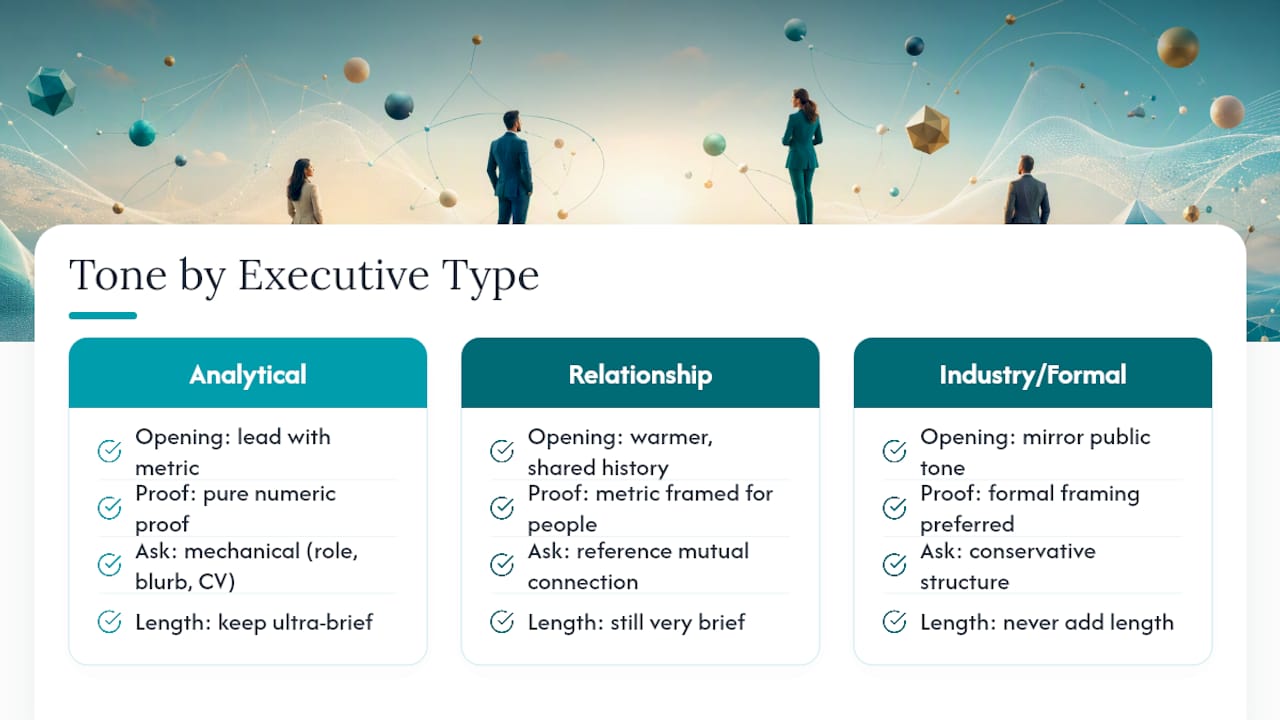
A referral email to a data-driven CFO reads differently than one to a relationship-first CMO, even though the structure stays identical. The blurb, the proof point, and the opt-out don’t change. The word choice around them does.
For analytical executives (finance, operations, engineering leadership), lead with the metric. Cut adjectives entirely and let the number carry the sentence: “Reduced quarterly close time by six days across three business units.” Skip the story, skip the context beyond one line, and keep the ask mechanical: role, blurb, résumé link, done.
For relationship-oriented executives (sales, marketing, HR leadership), a slightly warmer opening earns its place. Referencing shared history, a mutual connection, or a specific conversation works better here than it would with a numbers-first CFO. The proof point can still be a metric, but frame it around impact on people or teams rather than pure output.
Industry norms matter too. A referral request into a legal or financial services firm should read more formal and slightly more conservative in structure than one going into a startup or a consumer tech company, where a more conversational tone won’t cost you credibility. When in doubt, mirror the tone of the executive’s own public writing. LinkedIn posts, interviews, or internal newsletters usually signal exactly how formal to go.
The one constant across every version: never let tone adjustments add length. A warmer opening still needs to land the ask within the first three sentences.
What Recruiters Notice in Referral Intro Emails
Recruiters read dozens of forwarded intros a week, and the ones that get action share a pattern: they’re short, specific, and don’t make the hiring manager do any translation work. A forwardable blurb with a clear proof point signals the candidate did the thinking already, which matters more to a hiring team than most job seekers realize.
The exec referral play of ghostwriting the intro for a busy executive applies just as well to job seekers. Small friction points, a missing résumé link, an unclear role title, are often why a warm intro stalls before it reaches the hiring manager at all.
Kim
Where Resumewiz Fits Into Your Referral Strategy
Templates get you most of the way there, but the proof point in your blurb is only as strong as the résumé backing it up. Resumewiz built its entire model around that gap: over ten years of recruiting experience translated into documents and outreach language that hold up when an executive actually forwards your name.

If you’re rewriting your résumé and LinkedIn profile before you start sending referral asks, the Evolution package covers both for a one-time $699, giving you a document worth linking in every blurb you send. For readers who want the outreach handled alongside the resume work, the Elevate packages include personalized templates built for executive-level outreach, not just entry-level networking notes (see the page for details). If your priority is landing interviews fast off intros you already have in motion, the Elevate and Land service is built for exactly that turnaround. Browse the full range of services at Resumewiz and pick the package that matches how much of this process you want to run yourself.
Want a recruiter in your corner for your next senior role? Book a free call with Resume Wiz and we will map out your next move together.
Sources
The templates and cadence in this guide draw on PitchHired’s referral email breakdown, HubSpot’s research on executive-facing referral asks, Endearist’s follow-through and outcome-reporting framework, and the exec referral scaling play from SalesBytes. For a shorter, apply-through-referral variant of the blurb format, ResumeMatch’s copy-ready pitch guide is worth a look too.
- How to Ask for a Referral by Email | PitchHired
- How to ask for referrals | HubSpot
- How to ask for a referral without the cringe | Endearist
- Executive Referrals: Your Hidden Sales Channel
FAQ
How Long Should a Referral Request Email Be?
Keep the full email under 125 words, short enough to read on a phone in under 30 seconds. The PitchHired referral framework recommends this length specifically because longer emails get skimmed or ignored by busy contacts.
What Should I Include in the Forwardable Blurb?
Include your title, years of experience, one proof point, and the type of role you’re targeting, all in two to four sentences. The goal is language the referrer can paste directly into their own message without editing.
When Should I Follow Up After a Referral Request?
Wait five to seven business days, then send one polite follow-up. If there’s no response after that, stop. Sending multiple follow-ups risks damaging the relationship more than a missed referral ever would.
Should I Offer an Incentive When Asking Executives for Referrals?
No. Incentive-led language underperforms with senior contacts, according to HubSpot’s referral research. Frame the ask around outcome, team fit, or shared network value instead.
Does Resumewiz Help With Referral Outreach, Not Just Resumes?
Yes. The Elevate packages include personalized outreach templates alongside resume and LinkedIn work, built specifically for executive-level referral asks rather than generic networking notes.
