Resume Keywords and ATS Rejection: What Really Happens
You sent in a strong application, heard nothing back, and assumed you were underqualified. But the role of resume keywords in ATS rejection is almost certainly the real culprit. 82% of rejected resumes had fewer than 50% of the target job’s required keywords, despite the candidates having matching experience. That’s not a qualifications problem. That’s a translation problem. This article breaks down exactly how ATS systems process resumes, why keyword mismatches kill your visibility, and what you can do right now to fix it.
Table of Contents
- Key takeaways
- The role of resume keywords in ATS rejection
- Common keyword mistakes that hurt your chances
- Strategies to avoid ATS rejection with keywords
- Understanding ATS statistics and recruiter search behavior
- Practical keyword tools and a keyword gap sheet
- My honest take on keyword strategy
- Let Resumewiz do the keyword work for you
- FAQ
Key takeaways
| Point | Details |
|---|---|
| Keywords cause most ATS invisibility | Missing exact-match keywords is the top reason qualified candidates never get seen by recruiters. |
| ATS stores, recruiters search | Most ATS platforms don’t auto-reject resumes. Recruiters search the database and keyword mismatches hide you from results. |
| Hard skills outperform soft skills | Words like “Python” or “Jira” carry significant ATS weight. “Leadership” and “communication” score near zero. |
| Spread keywords across sections | Place critical keywords in your summary, skills list, and at least one experience bullet for maximum scoring impact. |
| Match the job posting’s exact phrasing | Use the precise language from the posting for job titles, tools, and certifications. Synonyms often go undetected. |
The role of resume keywords in ATS rejection
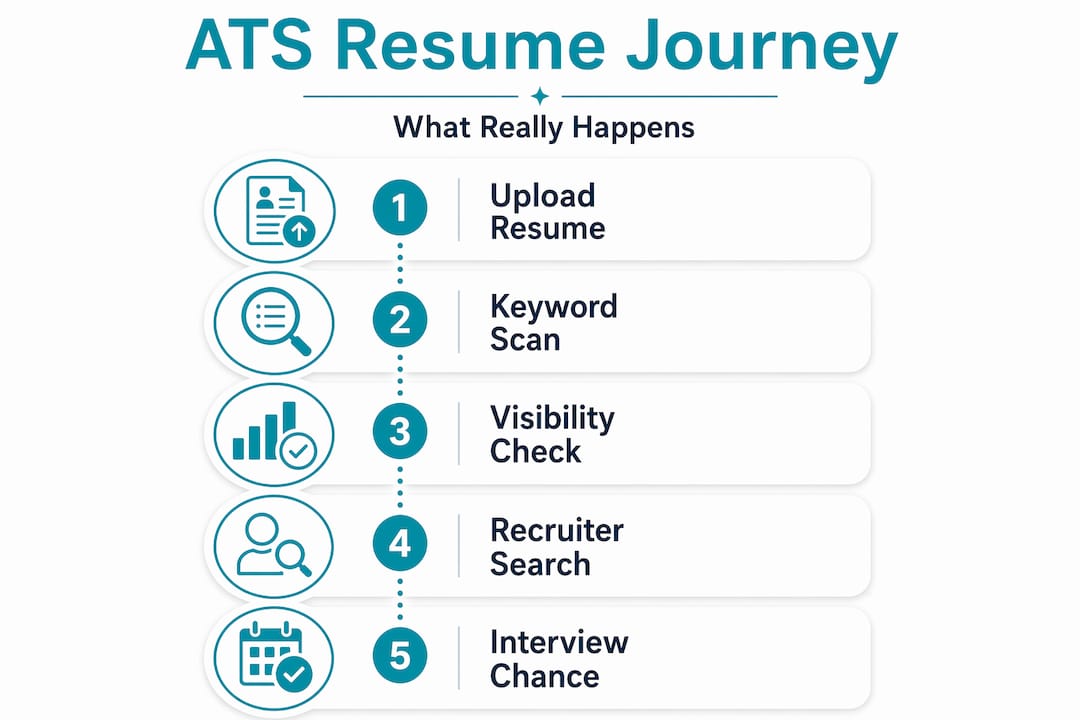
Here’s what most people get wrong: ATS does not read your resume the way a recruiter does. It does not evaluate whether you’re qualified. It parses your resume into a searchable database, and then a recruiter searches that database using specific keywords and filters. If your resume doesn’t contain those terms, you simply don’t show up.
Keyword vocabulary mismatch accounts for about 40% of visibility failures in ATS systems. A candidate might have five years of experience managing supply chains, but if their resume says “inventory coordination” and the recruiter searches for “supply chain management,” those resumes never meet.
So when people say ATS “rejected” their resume, what usually happened is the recruiter never saw it. That distinction matters because the fix isn’t rewriting your entire career history. It’s about using the right vocabulary.
Modern ATS platforms also weight keywords differently depending on where they appear. A keyword buried in an education section carries less scoring value than the same keyword appearing in your professional summary or a core skills list. Parsers weight keyword occurrences differently by section context, which means placement is just as important as presence.
The role of keywords in job search success comes down to this: even when your experience is genuinely relevant, the system won’t connect the dots unless you use the words the system was built to recognize.
Common keyword mistakes that hurt your chances
Most keyword-related resume mistakes fall into a small set of predictable patterns. Knowing them in advance can save you months of frustrating rejections.
- The translation gap. You have the experience but you describe it in your own words instead of the job posting’s language. You write “managed client relationships” when the posting says “account management.” Both mean the same thing to a human. An ATS may not make that connection.
- Over-relying on soft skills. Soft skills like “leadership” score near zero compared to hard skills, tools, and certifications in ATS scoring. A resume packed with “team player,” “results-driven,” and “effective communicator” fails to register in the searches that matter most.
- Keyword stuffing. This one backfires on two levels. Repeating keywords five or more times can reduce your scoring in AI-enhanced ATS platforms. And when a recruiter does pull up your resume, a keyword-stuffed document looks suspicious and unprofessional.
- Concentrating keywords only in the skills section. Spreading keywords across sections improves reliability in ATS scoring. If “Salesforce” only appears once in your skills list and nowhere else, you’re leaving ATS match points on the table.
- Ignoring acronyms and full forms. If the job posting uses both “Search Engine Optimization (SEO),” your resume should include both the full term and the acronym. Some systems match one but not the other depending on how they were configured.
Pro Tip: Copy the job posting into a plain text document and highlight every specific tool, skill, certification, and job title mentioned. That highlighted list is the foundation of your keyword strategy for that application.
Strategies to avoid ATS rejection with keywords
Getting this right is less about guessing and more about being systematic. Here’s a step-by-step approach that works for both professionals with decades of experience and recent graduates applying for their first role.
-
Pull keywords directly from the job description. Keywords extracted from the “Requirements” and “Qualifications” sections carry the highest scoring weight. Start there. Don’t rely on industry intuition. Use the actual words the employer chose.
-
Prioritize required skills over preferred ones. If a skill is listed as “required,” it almost certainly carries more ATS scoring weight than something listed as “a plus.” Required terms listed first in the job posting should appear multiple times across your resume sections for best effect.
-
Place each critical keyword at least two to three times. Multiple keyword placements increase match reliability when spread across your summary, skills section, and experience bullets. Don’t cluster them. Let each placement do work in a different section.
-
Anchor keywords inside accomplishments with numbers. Instead of listing “project management” in your skills section alone, write an experience bullet that reads: “Led cross-functional project management across five departments, delivering a $2M initiative 10% under budget.” This strategy satisfies both ATS keyword detection and the human recruiter who reads it next.
-
Use exact phrasing for titles, tools, and certifications. Avoid synonym-only substitutions on high-priority terms. If the job posting says “AWS,” don’t just write “cloud computing.” Write “AWS” specifically. A recruiter searching for “AWS” won’t see your resume otherwise.
-
Include both the acronym and the full term for certifications and tools. Write “Project Management Professional (PMP)” at least once. Some ATS systems search for the acronym; others search for the full term.
Pro Tip: After updating your resume for a specific posting, read it aloud. If a section sounds like a list of random terms with no human context, it needs more narrative around the keywords. Good ATS optimization reads naturally. If it sounds robotic, a recruiter will notice.
The issue of rewriting your CV for every application is one that catches many job seekers off guard. The smarter approach is building a master resume with all your relevant keywords and experience, then tailoring the language of two or three sections to match each specific job posting.
Understanding ATS statistics and recruiter search behavior
You’ve probably seen the statistic that “75% of resumes are rejected by ATS before a human sees them.” It gets cited constantly. But many viral ATS rejection statistics lack transparent methodology, and the number varies wildly depending on the ATS platform, the company size, and how the recruiter has configured their search filters.
What’s more reliable and more useful for your strategy is understanding how recruiters actually use ATS on a daily basis.
Most recruiters search ATS databases using 3 to 5 targeted keywords, apply filters for location or experience level, and then review the top 20 to 30 results. They spend under 2 minutes on ATS search query formation. If your resume doesn’t appear in those top results, you don’t exist in that recruiter’s process, regardless of how strong your background actually is.
This is the more accurate picture of “ATS rejection.” Your resume isn’t deleted. It’s stored. But it’s invisible. And that invisibility is almost always a keyword problem.
AI layers in modern ATS reduce false negatives by enabling some degree of semantic interpretation, but early evidence shows keyword optimization remains the highest-priority step. AI-enhanced parsing sits on top of keyword scoring, not in place of it. The underlying logic still rewards exact matches.
The takeaway is practical: focus your energy on matching the recruiter’s exact search vocabulary. That is where your application wins or disappears.
Practical keyword tools and a keyword gap sheet
The most effective thing you can do before submitting any resume is build a keyword gap sheet for that specific job posting. It takes about 15 minutes and consistently improves your results.
Here’s how to do it:
- Step 1: List every required and preferred skill from the job posting in a two-column sheet. Column one: the exact term from the posting. Column two: where it currently appears in your resume (or “missing” if it doesn’t).
- Step 2: Identify the gaps. Any term listed as “missing” either needs to be added honestly, reworded from a synonym you’re currently using, or addressed in a cover letter if you don’t have direct experience.
- Step 3: Map each keyword to a specific resume section. Mapping must-have terms to skills and experience bullets improves both ATS matching and the honesty of your presentation.
Here’s a quick reference for where different keyword types perform best:
| Keyword type | Best placement | Notes |
|---|---|---|
| Hard skills and tools | Skills section + experience bullets | Use exact terminology from the posting |
| Job titles | Summary and experience headers | Match posting language even if your title was slightly different |
| Certifications | Summary, skills, and education | Include both acronym and full name |
| Soft skills | Experience bullets only | Demonstrate them with results, never just list them |
| Industry terms | Summary and experience | Repeat 2 to 3 times across sections for best effect |
Several online tools can help you cross-check your keyword match rate before you submit. Some platforms scan your resume against a specific job description and produce a match score with a list of missing terms. These tools are most useful as a gap-checking step, not as the primary strategy. Always use your own judgment alongside them.
My honest take on keyword strategy
I’ve reviewed thousands of resumes over the course of my recruiting career, and I’ll tell you something that most articles won’t: the candidates who get it wrong are almost never lazy. They’re thoughtful, experienced professionals who wrote their resumes in their own voice. That’s actually the problem.
Your voice isn’t what the ATS is listening for. The recruiter’s search query is. And when those two don’t match, your credentials don’t matter in that moment.
What I’ve learned is that exact phrasing matters more than most people expect, even as AI parsing improves. Yes, modern ATS can sometimes recognize that “revenue generation” and “sales growth” are related. But a recruiter searching for “business development” still types “business development” into the search bar. If your resume doesn’t say it anywhere, you still lose.
The other thing I’ve seen cause real damage is over-optimization. A resume that reads like it was built for a robot doesn’t get past the recruiter. After ATS surfaces your resume, a real person reads it. If it’s a wall of keywords with no storytelling, no metrics, and no evidence of a real career, it goes in the no pile.
The goal is to write something that is both findable by the system and genuinely compelling to the human on the other side. Those two goals are not in conflict. A well-placed keyword inside a strong accomplishment statement serves both audiences at once.
Kim
Let Resumewiz do the keyword work for you

Knowing the strategy and executing it perfectly on every single application are two different challenges. At Resumewiz, we analyze the specific job descriptions you’re targeting, identify the exact keywords recruiters are searching for, and integrate them throughout your resume in a way that satisfies ATS scoring and reads like a compelling professional narrative. Whether you’re a senior manager navigating a career change or a recent graduate trying to break through, our ATS-compliant resume services are built to get your resume in front of the right people, not lost in a database.
Want a recruiter in your corner for your next senior role? Book a free call with Resume Wiz and we will map out your next move together.
FAQ
What is the role of resume keywords in ATS rejection?
Keywords determine whether your resume appears in recruiter searches inside ATS platforms. If your resume doesn’t contain the exact terms recruiters use to search, it stays stored but invisible, which functions as a practical rejection.
How do keywords affect ATS scoring?
ATS systems parse resumes for specific keyword matches and weight them by section. Keywords in your summary, skills list, and experience bullets carry more scoring value than those buried in later sections.
Which keywords should I include in my resume?
Prioritize hard skills, specific tools, certifications, and job titles pulled directly from the “Requirements” section of the job posting. Soft skills like “leadership” score near zero in ATS systems and should be demonstrated with accomplishments instead.
How many times should a keyword appear on my resume?
Place each critical keyword two to three times across different sections. Appearing in the summary, skills section, and an experience bullet provides the strongest ATS match without triggering penalties for over-repetition.
Can ATS understand synonyms and related terms?
Some modern ATS platforms use AI-assisted semantic parsing to recognize related terms, but AI sits on top of keyword scoring, not in place of it. Using exact phrasing from the job posting remains the safest and most effective approach.
