Resume Strategy for Senior Professionals in 2026
A successful resume strategy for senior professionals treats the executive resume as a marketing document, not a career biography. Your resume must signal leadership alignment, measurable impact, and strategic value within the first few seconds of a recruiter’s scan. At the senior level, you are competing against candidates with similar titles, comparable tenure, and overlapping keywords. The differentiator is clear evidence of business results. This guide covers how to build a baseline executive resume, tailor it to specific roles, structure it for both ATS systems and human readers, and extend your leadership brand beyond the page.
What makes a strong resume strategy for senior professionals?
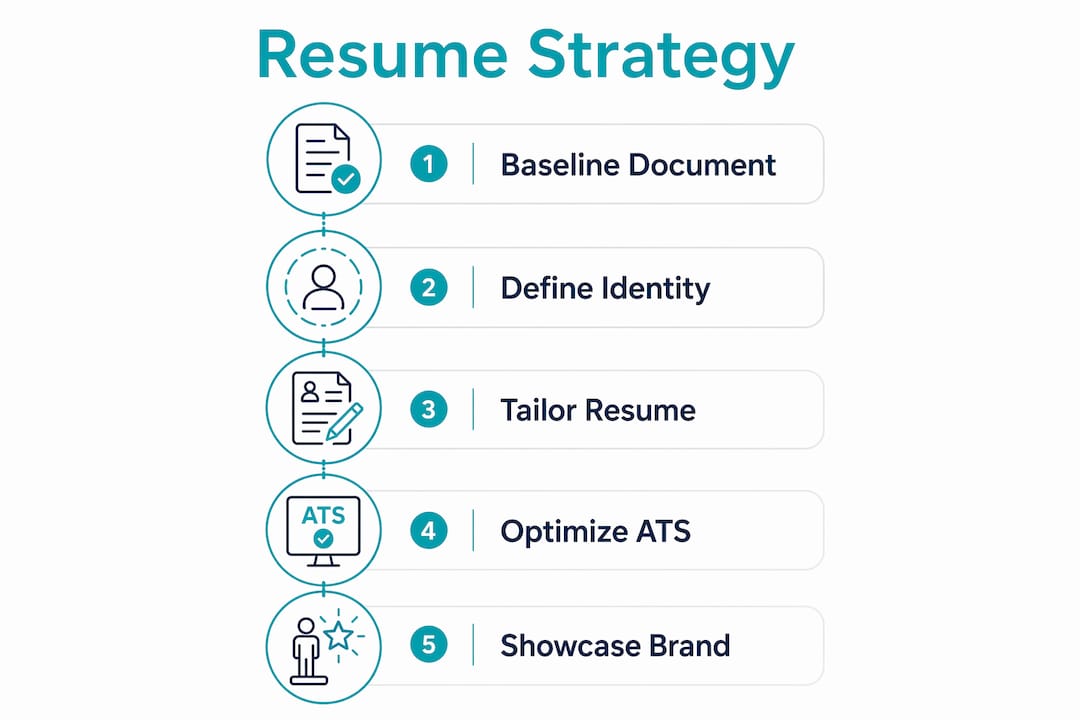
An executive resume strategy starts with a single, reusable baseline document that captures your full leadership identity. Robert Half recommends treating the resume as a marketing tool rather than a full career biography, focusing on recent, relevant leadership experience and outcomes delivered. That framing changes everything about how you write, structure, and position your content.
Your baseline document serves one purpose: to capture your leadership scope, core strengths, and quantified outcomes in a format you can quickly adapt for each application. Building this foundation once saves hours of rewriting and produces more consistent, targeted applications over time.
Define your leadership identity first
Before writing a single bullet point, define your professional brand. Ask yourself: What type of leader am I? What scale have I operated at? What are my two or three signature capabilities? The answers form the backbone of your executive summary, which is the most read section of any senior-level CV.
Indeed recommends concise executive summaries focused on skills and achievements relevant to the role. Your summary should answer four questions in four to six lines: who you are as a leader, the scale at which you have operated, your most relevant capabilities, and the value you bring to the next organization.
Pro Tip: Write your executive summary last. Once you have drafted your full baseline document, you will have a much clearer picture of the three or four themes that define your leadership story.
Formatting and length that work at the senior level
Executive resumes should run 2 to 3 pages, justified by relevance and impact rather than tenure. Every line must earn its place. Use clear section headers, consistent font sizing, and generous white space so a recruiter can scan the document in a structured way.
Your core competencies section belongs directly below the executive summary. List eight to twelve skills that map directly to the roles you are targeting. Use industry-standard terminology rather than internal jargon, since ATS systems match against the language in job descriptions, not the language your last employer used internally.
- Use a clean, single-column layout for ATS compatibility
- Set margins between 0.75 and 1 inch for readability
- Stick to fonts like Calibri, Garamond, or Arial at 10 to 12 points
- Include month and year date ranges for every role
- Save and submit as a PDF unless the application specifically requests a DOCX file
How to tailor your executive resume to specific senior roles
Tailoring is the single highest-return activity in any job search strategy for leaders. The job description is the blueprint for showing proof of success. Most senior professionals skip this step or do it superficially, which is why generic resumes fail even when the candidate is genuinely qualified.
Effective tailoring does not mean rewriting the entire document for every application. It means adjusting the critical first third of the page, which is where recruiters spend the majority of their attention, to mirror the priorities of each specific role.
Follow this process for every application:
- Read the job description three times. On the first pass, note the leadership scope. On the second, identify the three to five outcomes the role is expected to deliver. On the third, extract the exact language used for skills and competencies.
- Rewrite your executive summary to reflect those priorities. If the role emphasizes P&L ownership and organizational transformation, your summary should open with evidence of both. If it emphasizes market expansion, lead with that.
- Reorder your top three to five bullet points under your most recent role. Place the achievements that most closely match the role’s stated outcomes at the top, where they will be read first.
- Embed keywords naturally into impact statements. Write “Led a cross-functional team of 120 to deliver a $40M digital transformation program” rather than listing “digital transformation” as a standalone keyword.
- Remove or condense roles older than 15 years. At the senior level, depth in recent roles matters far more than breadth across decades.
Pro Tip: Run a side-by-side comparison of your tailored executive summary and the job description’s first paragraph. If the language and priorities do not mirror each other closely, revise until they do.
Leading with evidence-backed leadership snapshots in your executive summary increases recruiter engagement. Ask a peer who does not know your career to read your summary for six seconds and tell you what kind of leader you are. If they cannot answer clearly, rewrite.
How should you structure resume content for ATS and recruiter scanning?
Recruiters spend about 6 to 8 seconds deciding whether a resume merits a closer look, scanning for scope, impact, relevance, and leadership outcomes. That time constraint defines every structural decision you make.
Each bullet point should confirm personal ownership, operational scale, and business outcome. The formula is simple: what you owned, how large the operation was, and what changed as a result of your leadership. Eliminate any bullet that describes a task without an outcome.
| Weak bullet | Strong bullet |
|---|---|
| Responsible for managing the sales team | Led a 45-person sales organization across three regions, growing annual revenue from $80M to $130M in 24 months |
| Oversaw digital transformation project | Directed a $22M digital transformation initiative, reducing operational costs by 18% and cutting time-to-market by 30% |
| Managed P&L for business unit | Owned full P&L for a $200M consumer goods division, delivering 12% EBITDA improvement over two fiscal years |
Strong action verbs signal executive ownership immediately. Use words like led, scaled, transformed, restructured, negotiated, and launched. Avoid passive constructions like “was responsible for” or “assisted with,” which dilute the sense of ownership.
Avoid common ATS mistakes such as creative job titles, image uploads, tables within the body of the document, and long paragraphs without metrics. ATS systems parse text sequentially, and anything that interrupts clean text flow risks being misread or dropped entirely.
How to showcase leadership impact and personal brand beyond the resume
Your executive resume and your LinkedIn profile must tell the same story. LinkedIn profiles serve as an extension of your executive brand and should mirror your resume for consistent messaging. Search firms and boards routinely review LinkedIn before requesting a CV, so inconsistency between the two documents creates doubt rather than confidence.
Maintaining consistency across LinkedIn and your resume strengthens credibility with search firms and boards. Your LinkedIn About section should open with the same core leadership narrative as your executive summary, using the same metrics and the same framing.
Beyond consistency, your profile and resume should both reflect external validation of your leadership. Consider including:
- Board memberships and advisory roles, listed with the organization name and your contribution
- Speaking engagements at recognized industry conferences or associations
- Published articles, white papers, or media appearances that demonstrate thought leadership
- Awards and recognitions tied to measurable business outcomes, not just tenure
- Professional affiliations with bodies like the Young Presidents’ Organization, the National Association of Corporate Directors, or relevant industry councils
Gaps and lateral moves require direct, confident framing. A two-year gap for a family obligation or a deliberate lateral move into a new sector is not a liability if you explain it with a single, clear line. Recruiters respond to honesty and self-awareness. What they cannot work with is ambiguity.
For resume and interview prep tips that address senior-level positioning, the guidance from executive search firms consistently reinforces one point: your narrative coherence across all touchpoints matters as much as the content of any single document.
Key takeaways
A resume strategy for senior professionals works when it combines a strong baseline document, purposeful tailoring, ATS-compatible structure, and a consistent leadership brand across both the resume and LinkedIn.
| Point | Details |
|---|---|
| Build a baseline document first | Capture your full leadership scope, strengths, and outcomes once before tailoring for specific roles. |
| Tailor the first third for every role | Rewrite your executive summary and top achievements to mirror each job description’s stated priorities. |
| Write bullets with ownership and outcomes | Every bullet must confirm what you owned, the scale you operated at, and the measurable result you delivered. |
| Align LinkedIn with your resume | Your LinkedIn About section should open with the same narrative and metrics as your executive summary. |
| Avoid ATS formatting errors | Remove images, creative titles, and dense paragraphs to protect clean text parsing by applicant tracking systems. |
What I have learned after 10 years of placing senior professionals
The most common mistake I see from senior professionals is confusing comprehensiveness with credibility. A 6-page resume packed with every project, committee, and initiative does not signal depth. It signals an inability to prioritize, which is the one thing a senior leader cannot afford to communicate.
The executives who get called back fastest are the ones who make the recruiter’s job easy. Their resume answers the three questions a hiring manager is actually asking: Can this person operate at the scale we need? Have they delivered results in a context similar to ours? Do they understand what this role actually requires? Everything else is noise.
I also see senior professionals underestimate the power of the baseline document approach. When you have a well-constructed master resume that captures your full leadership story, tailoring becomes a 30-minute exercise rather than a 3-hour ordeal. You are not rewriting. You are repositioning. That distinction matters enormously when you are managing a job search alongside a demanding current role.
One more thing: do not wait until you are actively searching to update your resume. The best time to capture a major win is the week it happens, when the numbers are fresh and the context is clear. A resume that is updated quarterly is always ready. A resume that has not been touched in three years requires an archaeology project before it can be submitted anywhere.
Kim
How Resumewiz helps senior professionals get results

Senior-level job searches require more than a polished document. They require a strategy. Resumewiz offers executive resume development, ATS-compliant formatting, and LinkedIn profile optimization built specifically for professionals at the director, VP, and C-suite level. Kim Taynor brings over 10 years of recruiting experience to every engagement, which means your resume is built with the recruiter’s perspective in mind from the first draft. Whether you need a complete executive resume overhaul, a tailored application package, or a fully managed job search with tailored applications and outreach, Resumewiz delivers the tools and expertise to accelerate your next career move.
Want a recruiter in your corner for your next senior role? Book a free call with Resume Wiz and we will map out your next move together.
FAQ
How long should an executive resume be?
Executive resumes should be 2 to 3 pages, with every line justified by relevance and impact rather than tenure. Longer documents are acceptable only when the additional content directly supports the target role.
What goes in an executive summary?
Your executive summary should answer who you are as a leader, the scale at which you have operated, your core capabilities, and the value you bring to the next organization, all within four to six lines. Indeed advises keeping it focused on skills and achievements directly relevant to the role.
How do I pass ATS screening at the senior level?
Use clean, single-column formatting, standard section headers, and industry-standard job titles. Avoid ATS pitfalls like image uploads, creative titles, and dense paragraphs without metrics, since these disrupt how applicant tracking systems parse your document.
Should my LinkedIn profile match my resume exactly?
Your LinkedIn profile should mirror the core narrative, metrics, and leadership framing of your resume without being a word-for-word copy. Consistent messaging across both platforms strengthens your credibility with search firms and executive recruiters who review both before making contact.
How often should I tailor my resume for each application?
Tailor the first third of your resume, specifically the executive summary and top achievements, for every application. The body of the document can remain consistent across applications as long as the most relevant results are positioned prominently for each specific role.
