Cross-Functional Leadership Promotion: Win the Role
If you’re a mid-to-senior manager ready to move into a cross-functional leadership role, the single most effective move you can make this week is to reframe your resume and LinkedIn profile to show who you influenced, not just what you managed. Hiring managers and internal decision-makers are looking for evidence of cross-departmental trust and named stakeholder impact. Most candidates bury that evidence or omit it entirely.
Start here, in this order:
- Rewrite your resume summary using the formula below (Role + scope + partners + business impact).
- Update your LinkedIn About to open with your leadership philosophy in one sentence, then one concrete cross-functional story.
- Draft one panel-ready story using the C-STAR format: Context, Stakeholders, Tension, Action, Result.
Do those three things in the next seven days and you’ll have the foundation for every conversation that follows. Expect inbound recruiter messages to increase and internal sponsors to start framing you differently in talent conversations over a few weeks.
Key Takeaways
Winning a cross-functional leadership promotion requires making your influence visible, not just your output, across your resume, LinkedIn profile, and interview stories.
| Point | Details |
|---|---|
| Resume bullet structure | Use action + who you worked with + what you navigated + measurable outcome to make collaboration credible. |
| LinkedIn About length | Aim for 250 to 300 words: leadership philosophy, one cross-functional story, and a closing line. |
| Story bank size | Build 6 to 8 distinct stories covering conflict, trade-off, alignment, failure recovery, and influence without authority. |
| Outreach targeting | For internal promotions, contact the hiring manager, a senior sponsor, and your HR business partner. |
| Resumewiz | Offers ATS-compliant executive resumes, LinkedIn optimization, and a fully managed job search with tailored applications and outreach. |
Table of Contents
- How to rewrite your resume for cross-functional leadership promotion
- What should your LinkedIn profile say to attract cross-functional leadership roles?
- How do you prepare interview stories that prove cross-functional influence?
- Targeted outreach for internal promotions and external searches
- What’s a realistic timeline and cost for landing a cross-functional leadership role?
- What recruiters actually look for, according to Kim Taynor
- Resumewiz helps you win cross-functional leadership roles faster
- Sources
How to rewrite your resume for cross-functional leadership promotion
The core problem with most manager resumes is that they describe outputs without showing how those outputs required cross-functional influence. A hiring manager reading your resume should be able to answer: Who did you have to convince? What did you trade off? What changed because of you?
According to guidance on cross-functional resume writing, the most credible bullets follow a four-part structure: action + who you worked with + what you navigated + measurable outcome. That structure makes collaboration visible rather than implied.
Summary formula: “Senior [Role] with [X] years leading cross-functional initiatives across [functions], partnering with [named teams or stakeholders] to [business impact].”
Here are before-and-after bullet examples:
-
Before: “Led product launch across teams.”
-
After: “Partnered with Engineering, Legal, and Marketing to launch a regulated product in three markets, cutting time-to-approval by six weeks.”
-
Before: “Managed stakeholder relationships.”
-
After: “Aligned Sales, Finance, and Operations on a pricing model change, resolving a six-month escalation cycle and protecting $2.4M in pipeline.”
For internal promotion packets, Eztrackr’s internal promotion guidance recommends stacking roles under one employer header when scope has grown incrementally, and using separate entries only when the title change represents a genuine function shift. Match your language directly to the internal job posting. One strong line that ties your existing work to the target role is worth more than three generic bullets.
Pro Tip: When direct financial metrics are absent, quantify influence differently: reduced escalations, shortened decision cycles, or the number of functions you aligned. “Reduced cross-team approval cycle from 14 days to 5” is a credible metric even without a dollar figure.
Resumewiz offers ATS-compliant resume templates and executive resume writing services built specifically for this kind of positioning. Founder Kim Taynor has spent over 10 years in recruiting and knows exactly which signals hiring managers look for in cross-functional candidates.
What should your LinkedIn profile say to attract cross-functional leadership roles?
Your LinkedIn headline should state your role, signal your leadership style, and hint at the value you create. Two effective formats include internal promotion targets and external hire targets.
- Internal promotion target: “Director of Product Operations | Cross-Functional Alignment | Turning Complex Stakeholder Problems into Scalable Decisions”
- External hire target: “Senior Program Manager | Trust-First Leadership Across Engineering, Finance & GTM | Driving Decisions at Scale”
For the About section, research on executive LinkedIn profiles recommends a structure of: leadership philosophy sentence, one compact story, and a closing line about what drives you. Aim for 250 to 300 words. Two sample openings:
“I lead by building trust before building plans. In my experience, the fastest path to a cross-functional decision is making every stakeholder feel heard before the meeting starts.”
“Cross-functional leadership is mostly a listening problem. I’ve spent a decade helping Engineering, Finance, and Operations find the version of a decision they can all defend.”
For the Featured section, pin artifacts that show leadership scope: a one-page case study snapshot, a presentation excerpt from a cross-departmental initiative, or a brief written memo that shows how you framed a complex tradeoff. These signal that you operate at a strategic level, not just an execution level. Embedded leadership framing from Solano Advisory Group offers practical exercises for translating leadership behavior into visible profile examples.
Keyword checklist for headline, About, and Experience sections:
- Cross-functional leadership
- Stakeholder alignment
- Program management
- Organizational influence
- Change management
- Executive communication
- Cross-departmental collaboration
- Strategic decision-making
How do you prepare interview stories that prove cross-functional influence?
Interviewers for cross-functional roles use scoring rubrics. They expect you to name specific stakeholders, identify multiple functional teams, and describe the tension you navigated, not just the outcome you delivered. Weak answers omit those details and read as single-function execution stories.
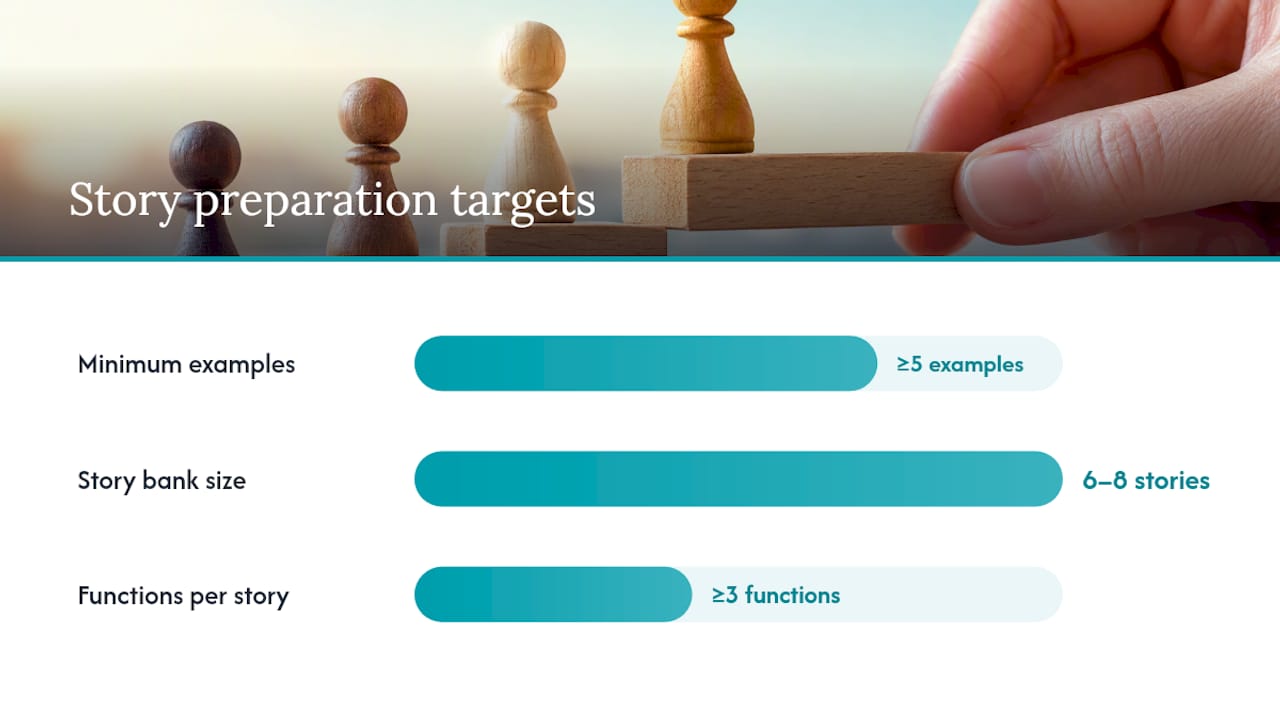
Interview preparation guidance for cross-functional roles recommends preparing at least five concrete examples, each involving three or more functions. The C-STAR framework (Context, Stakeholders, Tension, Action, Result) adapts STAR specifically for cross-functional scenarios by forcing you to name the people and the friction.
Build a story bank of 6 to 8 distinct stories covering:
- Conflict resolution across functions
- Trade-off negotiation with competing priorities
- Alignment without authority
- Failure recovery and what you changed
- Influencing a decision you didn’t own
- Onboarding a skeptical stakeholder
- Delivering under ambiguity
- Scaling a cross-functional pilot into a repeatable process
For panel interviews, map each panelist to their function and adapt your story emphasis accordingly. A CFO panelist wants to hear about trade-offs and financial discipline. A CHRO wants to hear about team dynamics and communication. You can use the same story with different emphasis points, but never repeat the identical version twice in the same panel.
Pro Tip: After each story, ask the panel a question that shows you’ve thought about their function: “How does your team typically weigh in on decisions like this?” It signals cross-functional curiosity and shifts the dynamic from interrogation to conversation.
Dos and don’ts:
- Do anchor your answer to a named stakeholder and a specific outcome.
- Do acknowledge the other function’s perspective before describing your action.
- Don’t blame another team for the problem, even indirectly.
- Don’t describe yourself as the sole decision-maker in a cross-functional story.
Targeted outreach for internal promotions and external searches
Who you contact matters as much as what you say. For internal promotions, your three targets are: the hiring manager for the role, a senior sponsor who can advocate for you in talent discussions, and your HR business partner who controls the promotion packet process.
For external roles, prioritize: recruiters who specialize in your function, hiring managers at target companies, and peers in adjacent roles who can refer you.
Three outreach templates:
-
Internal pitch email: “Hi [Name], I’ve been thinking about the [Role] opening and wanted to share how my work on [Project] with [Teams] maps directly to what that role needs. Could we find 20 minutes to talk through it?”
-
LinkedIn recruiter message: “Hi [Name], I lead cross-functional programs across [functions] and I’m exploring [Role] opportunities at [Company type]. My recent work [brief outcome] might be relevant. Open to a quick call?”
-
Follow-up after informational conversation: “Thanks for the conversation last week. Based on what you shared about [specific challenge], I think my experience aligning [teams] on [outcome] could be directly useful. Happy to send a one-pager if that helps.”
For sponsorship, be direct: “I’m targeting a cross-functional leadership role in the next six months. Would you be willing to advocate for me in talent conversations, not just advise me?” That distinction matters. A sponsor speaks for you when you’re not in the room. A mentor gives you advice when you are.
LinkedIn voice messages can significantly increase response rates from recruiters compared to text-only messages, particularly for senior roles where standing out in a crowded inbox is the primary challenge.
What’s a realistic timeline and cost for landing a cross-functional leadership role?
Internal promotion sprint: 8 to 12 weeks from profile update to formal nomination. Key milestones: sponsor conversation in week 2, updated promotion packet by week 4, hiring manager alignment by week 8.
External search: 12 to 20 weeks from resume rewrite to offer, depending on seniority and market. Expect 4 to 6 weeks of active outreach before first-round interviews begin.
Cost considerations:
- DIY: 15 to 20 hours to rewrite resume, optimize LinkedIn, and build a story bank. No cash cost, but opportunity cost is real if the process stalls.
- Resume + LinkedIn package: Typically $500 to $1,500 for professional services. Pays back quickly if it accelerates an offer by even one month at a senior salary.
- Fully managed search: Higher investment, but includes outreach and coaching. Best suited for executives who want a structured, supported process.
ATS screening behavior means that resumes not formatted for applicant tracking systems often don’t reach a human reviewer. ATS-compliant formatting is not optional for external searches.
What recruiters actually look for, according to Kim Taynor
Most candidates I see come in with strong execution records and weak influence narratives. They can tell me what they built. They struggle to tell me who they had to bring along, what they gave up to get there, and how the organization changed because of them. That gap is what separates a strong individual contributor from a credible cross-functional leader in a recruiter’s eyes.
The 15-minute diagnostic: pull up your LinkedIn About and your top three resume bullets. Ask yourself: does each one name a stakeholder outside your direct team? Does it describe a tension or trade-off? Does it show a measurable outcome? If the answer to any of those is no, that’s where you start.
Resumewiz packages are built around exactly this gap. The executive resume writing, LinkedIn optimization, and interview coaching services are designed to surface the influence work candidates already have and present it in the language hiring managers and recruiters respond to.
Resumewiz helps you win cross-functional leadership roles faster
Rewriting your profile and stories on your own is possible. The problem is that most managers underestimate how invisible their cross-functional work looks to an outside reader, and they don’t catch it until after a rejection.

Resumewiz offers executive resume writing, LinkedIn profile optimization, personalized outreach templates, interview coaching, and a fully managed job search with tailored applications and outreach for qualified executives and managers. Kim Taynor’s 10+ years of recruiting experience goes directly into every engagement, not a template.
Free resume templates and outreach scripts are available at Resumewiz if you want to start there. For a faster, more supported path, look for a clear, written process and verifiable results, and a clear timeline from kickoff to first interviews. Visit Resumewiz to review service options and take the next step.
Want a recruiter in your corner for your next senior role? Book a free call with Resume Wiz and we will map out your next move together.
Sources
- 7 Ways Executive Leaders Can Showcase Leadership on LinkedIn So Recruiters Find Them
- Cross-Functional Leadership Interview Questions: How to Ace the Cross-Functional PM Interview at Top Tech Companies | Johnny Mai
- How to Write a Resume Showcasing Cross-Functional Skills
- Elevate Your Career: Craft a Resume for Promotion - Eztrackr Blog
