Publishing Articles for Executives: The Credibility Payoff
Publishing articles is a measurable tool senior leaders use to convert experience into trusted public authority, but only when the position is clear and the evidence holds up. The verdict: publishing strengthens executive credibility when it’s tied to a specific point of view and backed by real proof, not just a byline for its own sake. That works because it stacks three things at once: visibility with the right audience, third-party validation from a respected outlet, and a permanent, indexed record that outlasts a single news cycle.
Start small. Pick one position you actually believe in, then choose one outlet that reaches the people who need to hear it.
Key Takeaways
Publishing articles builds executive credibility only when a clear position, real evidence, and a credible outlet combine, and the effect compounds over 9 to 18 months rather than after a single piece.
| Point | Details |
|---|---|
| Position before content | State your defensible claim in one sentence before choosing a format or outlet. |
| Outlet choice drives transfer | Match audience alignment and editorial fit to the outlet, not just raw reach. |
| Delegate drafting, not the position | Hand off outline and drafting work, but keep the core claim and voice review yourself. |
| Track three metric tiers | Measure early engagement, medium-term inbound requests, and long-term citations separately. |
| Promotion doubles article life | Repost around related news events to extend reach beyond the initial publish date. |
Table of Contents
- What Is the Role of Publishing Articles in Executive Credibility?
- Why Publishing Articles Matters for Business Leaders
- Which Formats and Platforms Build the Most Credibility?
- How Does a Published Article Turn Into Business Opportunity?
- What’s the Fastest Way to Publish an Executive Article?
- How Do You Measure the Impact of a Published Article?
- What Are the Biggest Pitfalls in Executive Publishing?
- How Should Publishing Fit Into a Long-Term Leadership Strategy?
- How Do You Align Article Topics With Business Goals and Personal Brand?
- How Do You Use Published Articles in Stakeholder Communications?
- What’s the Best Way to Promote a Published Article?
- How Do You Build Publishing Into Long-Term Reputation Management?
- From Article to Interview: Making Your Executive Brand Work Together
- Executive Publishing: How This Editorial Playbook Holds Up
- Frequently Asked Questions
- Sources
What Is the Role of Publishing Articles in Executive Credibility?
Publishing works because it forces a claim into the open where it can be checked, cited, and remembered. An unpublished opinion lives in a meeting room. A published one lives in a search index, a LinkedIn feed, and eventually in someone else’s pitch deck when they reference your framework.
Why Publishing Articles Matters for Business Leaders
The business case isn’t abstract. CEOs who publish consistent, authoritative content outperform peers on stakeholder confidence, sales velocity, and talent attraction, according to leadership communications research. Executive visibility does real work: it shortens sales cycles because prospects arrive pre-sold on your point of view, and it pulls in candidates who’d otherwise never see your job posting.
Data point: Publication history signals more than opinion. A consistent publication record demonstrates the ability to finish complex projects and communicate them clearly, which is exactly what boards, funders, and hiring committees look for.
The core benefits stack up like this:
- Credibility transfer from a respected venue’s editorial reputation to your name
- Opportunity attraction: speaking invitations, partnership inquiries, board interest
- Faster trust building with investors, customers, and prospective hires
- A searchable defense against outdated or unflattering search results
Which Formats and Platforms Build the Most Credibility?
Not every format carries the same weight, and matching the right one to the right moment matters more than publishing often. A byline in a respected trade journal transfers more authority per word than a dozen unfocused LinkedIn posts. But LinkedIn longform still matters because it’s often the default distribution channel for B2B executives and puts you in front of the exact professional audience you’re trying to reach.
Here’s how the major formats stack up:
- Tier-one trade or business press byline: highest credibility transfer, slower to place, best for a career-defining position
- LinkedIn longform: fastest to publish, direct audience control, weaker third-party validation
- Industry or peer-review journal: strong for technical authority, slower editorial cycle, narrower audience
- Op-ed: timely, high visibility, works best tied to a current event or policy debate
- Book or long-form report: deepest credibility, largest time investment, works as a career capstone
Outlet choice should follow audience alignment and editorial fit before reach, since a systematic approach to outlet selection increases both placement odds and the credibility that actually transfers to your target buyer.
Pro Tip: Republish or archive every external placement on your own company site or LinkedIn profile. Earned media is ephemeral; owned assets turn a one-time hit into permanent, searchable evidence.
How Does a Published Article Turn Into Business Opportunity?
The chain runs in a specific order, and skipping a step is why most executive content underperforms. It starts with a position worth defending, moves to evidence that proves it, then depends on a venue willing to put its editorial reputation behind your name.
- Position: You state a specific, defensible claim, not a vague theme
- Evidence: You back it with data, a case outcome, or a documented result
- Venue endorsement: A respected outlet’s editorial standards vouch for the piece before publication
- Indexing: Search engines and platforms make the claim discoverable long after publication
- Amplification: Shares, citations, and inbound requests compound the initial reach
A mid-market CFO published a single trade-journal piece on working-capital discipline during a downturn. Within months, two industry panels invited her to speak, and a private equity firm cited the article directly in its first outreach email.
That sequence, not raw output volume, is what separates a credibility asset from noise.
What’s the Fastest Way to Publish an Executive Article?
You don’t need to write it yourself, but you do need to own the position. Here’s the sequence that keeps executive time to a minimum while protecting quality:
- Name the position (30 minutes, executive only): one sentence stating the specific claim you’re willing to defend publicly.
- Select the evidence (1 hour, executive plus team): pull the data point, case result, or firsthand story that proves the claim.
- Outline and draft (2 to 4 hours, delegate to a writer or ghostwriter): structure the argument, then produce a full draft for review.
- Internal peer review (1 hour, a trusted colleague or comms lead): check for accuracy, tone, and anything that could embarrass the business.
- Edit and tighten (1 to 2 hours, writer or editor): cut anything that doesn’t serve the position.
- Submit or publish, then promote (ongoing, comms team): pitch the outlet or schedule the post, then push distribution across owned channels.
Total executive time investment typically runs two to three hours per article; the rest can and should be delegated.
Pro Tip: When working with a ghostwriter, hand over three real anecdotes in your own words before drafting begins. Voice comes from specific detail, not vocabulary.
Pro Tip: Read the final draft out loud before it goes out. If it doesn’t sound like something you’d actually say in a meeting, the voice has drifted.
How Do You Measure the Impact of a Published Article?
Track three tiers, not one vanity number. Short-term: views, reads, and shares in the first two weeks. Medium-term: inbound requests, meaning speaking invitations, partnership emails, and sales leads that mention the piece directly. Long-term: citations by other writers, journalists, or analysts, plus any lift in inbound recruiting.
- Log every inbound request with a note on which article prompted it
- Check search visibility for your name plus your core position every quarter
- Track citations and reposts as a signal of third-party validation, not just algorithm reach
Expect a lag. A single article rarely produces overnight results, and thought leadership research suggests programs compound over 9 to 18 months rather than delivering an instant spike.
What Are the Biggest Pitfalls in Executive Publishing?
The fastest way to damage credibility is publishing in a low-quality or predatory outlet just to get a byline, and only about 45% of articles in top scientific journals get cited within five years, which is a sober reminder that most published work fades regardless of venue.
Watch for these specific traps:
- Publishing opinion with no evidence behind it
- Switching voice or position piece to piece, which erodes trust over time
- Oversharing confidential client or company data to sound authoritative
- Chasing volume over a coherent, defensible position
On AI: using it to tighten a draft you wrote is fine. Using it to fabricate results, data, or a client story is not, regardless of how polished the output reads.
Pro Tip: Before submitting anywhere, ask whether the outlet has visible editorial standards. If you can’t find an editor’s name or a review process, that’s your answer.
How Should Publishing Fit Into a Long-Term Leadership Strategy?
Publishing pays off best as a program, not a one-off. A real thought leadership strategy answers four questions before a single word gets drafted: the position, the audience, the evidence, and the infrastructure to keep producing content without starting from zero each time.
Tie publishing outputs directly to career outcomes you actually want:
- Board appointments often follow visible, defensible positions on governance or strategy
- Speaking slots tend to follow a documented track record, not a single article
- Media pipelines build from repeat bylines in the same two or three outlets
- Recruiting lifts when candidates can read your actual thinking before the interview
A workable 12-month calendar:
- One tier-one placement per quarter, tied to a specific business milestone
- Monthly owned-channel posts that reinforce the same core position
- One original data asset per year (a survey, a case study, a documented result) that becomes source material for everything else
How Do You Align Article Topics With Business Goals and Personal Brand?
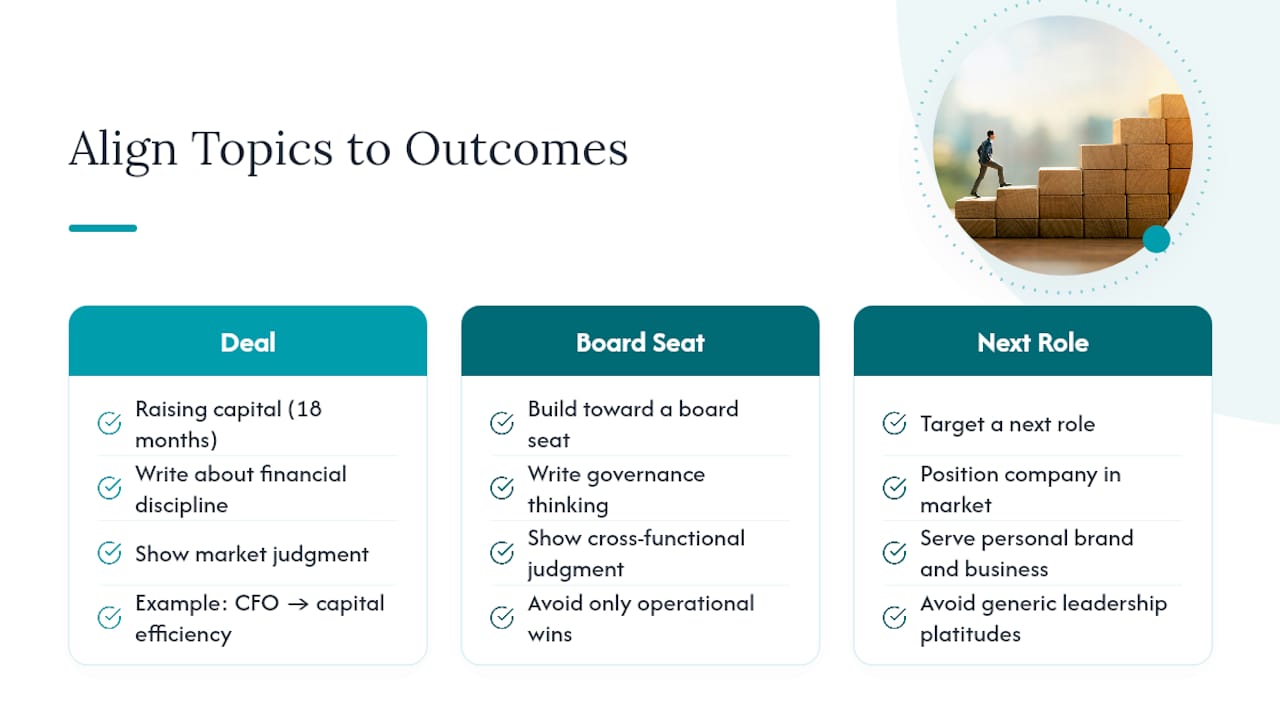
The mistake most executives make is choosing topics based on what feels timely rather than what supports where the business, and their own reputation, needs to go. If you’re raising capital in the next 18 months, your published position should demonstrate financial discipline and market judgment, not general leadership platitudes. If you’re building toward a board seat, your articles should show governance thinking and cross-functional judgment, not just operational wins inside your current company.
Start by listing the three outcomes you want in the next two years: a specific deal, a board seat, a next role, a market position for your company. Then work backward. Each article should serve at least one of those outcomes directly, and ideally serve your personal brand and the business goal at the same time. A CFO writing about capital efficiency during a fundraising push serves both the raise and her own reputation as a disciplined operator.
This alignment also protects you from the trap of publishing generic leadership content that says nothing distinctive. Generic content doesn’t transfer credibility because it doesn’t stake out a position anyone can disagree with, or remember. The sharper the alignment between what you publish and what you’re actually trying to achieve, the more each piece compounds instead of just adding to a pile of forgettable posts.
How Do You Use Published Articles in Stakeholder Communications?
A published article is a communications asset long after its original publish date, and most executives underuse it. Investors doing diligence, board candidates evaluating a seat, and job candidates researching a company all read published material before they ever get on a call. Treat every article as a reusable reference point rather than a one-time media hit.
Practically, that means including relevant articles in board decks as supporting evidence for a strategic direction, referencing them in investor updates when they support a thesis you’re presenting, and sending them directly to prospective hires who ask about company direction or leadership philosophy. A well-placed article can do work that a scripted pitch can’t, because it carries the credibility of an outside editorial process rather than sounding like internal messaging.
Sales and partnership teams benefit too. A tested tactic: attach a relevant published piece to a cold outreach email instead of a generic pitch deck. It gives the recipient third-party proof of expertise before the first conversation even starts, and it travels further internally at the prospect’s organization than a sales one-pager ever will.
What’s the Best Way to Promote a Published Article?
Publishing without promotion wastes most of the credibility value, since a piece that no one sees can’t generate the third-party validation that makes it worth writing in the first place. The distribution work matters as much as the writing itself.
Effective promotion follows a predictable pattern. Share the piece on LinkedIn with a short, specific reflection, not just a repost, since the reflection is what actually gets read and shared further. Send it directly to the ten or so people in your network who would genuinely find it useful, rather than broadcasting to everyone. Loop it into your next newsletter or internal all-hands if it’s relevant to your team’s direction. If a partner agency or PR team supports your communications, tactical promotion advice on original perspective pieces can help extend reach beyond your immediate network.
Timing matters too. Promoting a piece the week it publishes and then again a month later when a related news event breaks doubles its useful life without any new writing.
How Do You Build Publishing Into Long-Term Reputation Management?
Treat publishing as ongoing infrastructure, not a campaign with a start and end date. The executives who sustain credibility over a decade aren’t the ones who published once and moved on. They’re the ones who kept a consistent cadence, even a modest one, tied to a position that evolved naturally with their career.
Build a simple annual rhythm: review your core position every January, decide what’s changed in your industry or role, and adjust your publishing calendar accordingly. Keep a running file of potential evidence, wins, data points, client outcomes, so you’re never starting a draft from a blank page. Revisit older articles periodically and update or reference them when the underlying position still holds, since a well-maintained body of work signals consistency over time.
This is also where career transitions get easier. An executive moving toward a new role, a board seat, or a next company benefits enormously from a searchable, coherent record of thinking that predates the job search itself. That record does the credibility work quietly, in the background, long before a resume or LinkedIn profile becomes the focus.
From Article to Interview: Making Your Executive Brand Work Together
A strong published track record only helps if the rest of your professional presentation matches it. A resume that undersells your P&L outcomes or a LinkedIn profile that doesn’t reflect the same position you’ve been publishing on creates a credibility gap recruiters and boards notice quickly. The same discipline that makes an article convincing (concrete evidence over vague claims) applies directly to writing resume bullet points that quantify real impact.
Resumewiz builds executive resumes, LinkedIn profiles, and interview strategy around the same position you’ve established through your published work, so your candidacy reads as one coherent story instead of three disconnected documents. If you’re heading into a search where your published thought leadership needs to translate into interviews and offers, Resumewiz’s executive services can align your written record with the materials that get you in the room.
Executive Publishing: How This Editorial Playbook Holds Up
The research supports a narrower claim than most executive coaching content admits: publishing helps only when it follows a decision sequence, position first, then evidence, then outlet, then distribution. Skip the sequence and you get content volume without credibility transfer, which is the most common failure mode I see in executive publishing programs.
Conventional advice oversells frequency. Posting weekly on LinkedIn with no underlying position does less for your reputation than three sharp, evidence-backed pieces a year in outlets that actually vet their contributors. The 45% five-year citation rate for top scientific journals should humble anyone chasing volume: even rigorously reviewed work mostly fades. Weak executive content fades faster.
Prioritize the position first. If you can’t state your claim in one sentence you’d defend in a boardroom, no outlet, ghostwriter, or promotion tactic will make the article do real credibility work. Everything downstream, format, venue, distribution, only matters once that sentence exists.
Want a recruiter in your corner for your next senior role? Book a free call with Resume Wiz and we will map out your next move together.
Frequently Asked Questions
Does publishing articles actually improve executive credibility, or is it just visibility? It improves credibility specifically when the article states a clear position backed by evidence and runs in a venue with real editorial standards. Visibility alone, without a defensible claim, doesn’t transfer authority the same way.
How often should an executive publish to build genuine thought leadership? Quality and consistency matter more than frequency. Three well-placed, evidence-backed pieces a year in outlets like Forbes Councils or industry journals typically outperform weekly low-substance posts.
Should executives use a ghostwriter, and does that hurt credibility? Using a ghostwriter is standard practice and doesn’t hurt credibility as long as the position, evidence, and final voice are genuinely yours. Hand over real anecdotes and review every draft closely before it publishes.
How long does it take to see business results from published articles? Expect a lag of several months. Programs that combine tier-one placements with steady owned-channel content, like LinkedIn, tend to compound over 9 to 18 months rather than deliver instant results.
What’s the biggest mistake executives make when publishing for credibility? Publishing generic leadership content with no specific, defensible position, or placing bylines in low-quality or predatory outlets just to generate volume. Both erode trust faster than not publishing at all.
