Skills-Based Resume Format: What Job Seekers Need to Know
If you have ever stared at a blank resume wondering how to make a non-linear career look compelling, understanding what is a skills-based resume format could change your entire approach. This format flips the traditional resume on its head. Instead of leading with where you worked and when, it leads with what you can do. For career changers, recent graduates, and anyone with employment gaps, that distinction is the difference between getting noticed and getting filtered out before a human ever reads your name.
Table of Contents
- Key takeaways
- What is a skills-based resume format?
- Who should use a skills-based resume
- How to structure a skills-based resume
- Common mistakes to avoid
- Skills-based resume examples: what good looks like
- My honest take on skills-based resumes in 2026
- Get expert help building your skills-based resume
- FAQ
Key takeaways
| Point | Details |
|---|---|
| Skills-based format defined | It organizes your resume around skill categories instead of a chronological job history. |
| Hybrid is the modern standard | Pairing a skills summary with a brief work history satisfies both recruiters and ATS. |
| Best for non-linear backgrounds | Career changers, recent grads, and those with gaps benefit most from this structure. |
| Evidence beats keyword lists | Skill claims must be backed by measurable achievement bullets to carry real weight. |
| Tailor each application | Mirroring job posting language in your skill categories significantly improves ATS match rates. |
What is a skills-based resume format?
A skills-based resume format, sometimes called a functional resume, organizes your experience around what you can do rather than a timeline of where you worked. Skills-based resumes prioritize skills and accomplishments over chronological job history, grouping your experience under three to five major skill categories, each supported by bullet points showing concrete achievements.
This differs significantly from a chronological resume, which lists positions in reverse date order and lets your career timeline do the talking. A hybrid resume sits in the middle. It opens with a skills summary and then includes an abbreviated chronological work history section below it. When comparing resume formats, here is how they stack up:
| Format | Lead section | Work history display | Best for |
|---|---|---|---|
| Chronological | Job history | Full, reverse-order | Steady career progression |
| Skills-based (functional) | Skill categories | Minimal or omitted | Career changers, gaps, grads |
| Hybrid | Skills summary + history | Condensed, abbreviated | Most modern job seekers |
The ATS angle matters here. ATS software struggles with resumes that omit job history or use complex layouts. A pure functional resume can get rejected by automated tracking systems before a recruiter ever sees it. That is why the hybrid model has become the practical standard. It gives recruiters the skills narrative they want and gives ATS the job titles, company names, and dates it needs to parse your application correctly.
Pro Tip: Never put your contact information in a header or footer. ATS systems ignore header/footer content, so keep your name, phone, email, and LinkedIn URL in the main document body.
Who should use a skills-based resume
Not everyone benefits from a skills-based approach. But for specific situations, it is genuinely the strongest choice available. Skills-based resumes work best for career changers, recent graduates, and those with employment gaps because the format allows you to showcase transferable skills directly aligned with a target role, bypassing the limitations of a non-linear timeline.
Here are the job seekers who gain the most from this format:
- Career changers moving from one field to another, where direct title-to-title comparisons would hurt rather than help their case
- Recent graduates who have the relevant skills through coursework, internships, and projects but lack years of formal experience
- Freelancers or contractors whose work history looks fragmented on paper but actually reflects a deep, consistent skill set
- Professionals returning from a break, whether for caregiving, health, or personal reasons, who want their abilities front and center rather than a gap
- Professionals pivoting within an industry who want to reframe the same experience for a different function or level
The key insight here is one that gets misunderstood: a skills-based resume does not hide your history. It manages the narrative by leading with your capabilities and backing them with a clear, abbreviated work history. The goal is control over first impressions, not concealment.
“Employers increasingly value candidates who frame their experience around specific, measurable competencies rather than broad job titles.” The Rise of Skills-Based Hiring
That shift in employer thinking is real and documented. 72% of employers prioritize skills over traditional credentials when making hiring decisions in 2026. If your background supports those skills, leading with them is not a workaround. It is smart strategy.
How to structure a skills-based resume
Getting the structure right is where most people stumble. Here is a practical framework that works for both ATS and human readers.
-
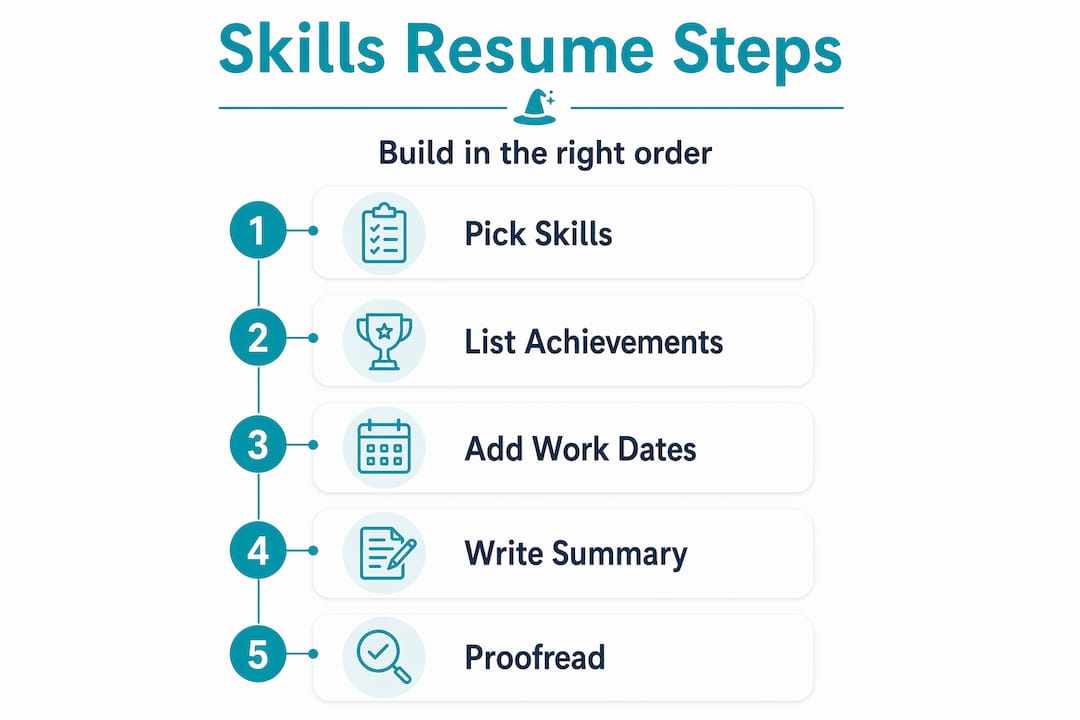
Write a professional summary. Open with two to four sentences that pitch your value directly. Name the role you are targeting, your strongest skill areas, and one or two standout achievements. Keep it tight and specific.
-
Choose three to five skill categories. Select categories that map directly to the job posting. Common examples include Project Management, Data Analysis, Client Relations, Digital Marketing, and Operations. These become your resume’s organizing headers.
-
Write two to three achievement bullets per category. This is where the format either wins or fails. Each bullet should follow the formula: action verb + task + measurable result. “Managed a team” is weak. “Led a cross-functional team of eight to deliver a product launch two weeks ahead of schedule, reducing onboarding costs by 15%” is what gets attention.
-
Add a condensed work history section. List company name, job title, and dates only. No bullet points needed here. This section exists to satisfy ATS requirements and give recruiters the context they need.
-
Include a skills or tools section at the bottom. A short list of technical tools, software, or certifications works well as a footer element. Keep it relevant to the role.
When it comes to formatting, single-column layouts are non-negotiable for ATS compatibility. Two-column layouts confuse ATS parsing, causing key information to get missed or scrambled. Stick to clean, standard fonts and clear section headers.
Pro Tip: Customizing your skill categories to mirror exact phrases from the job description is one of the highest-leverage moves you can make. It improves ATS match scores and signals to recruiters that you understand what the role actually requires.
One more consideration on language: avoid generic soft skill lists. Phrases like “strong communicator” or “team player” sitting alone in a bullet point carry zero weight. Embedding soft skills within achievement bullets with real evidence is what actually moves the needle. “Facilitated weekly stakeholder briefings across three departments, reducing project misalignment incidents by 30%” says “strong communicator” without ever using those two words.
Common mistakes to avoid
Even a well-intentioned skills-based resume can backfire if you fall into these traps.
-
The skill dump. Loading your skills section with a wall of keywords is not the same as demonstrating ability. Integrating specific tools and competencies within achievement bullet points provides evidence of ability. A list does not.
-
Hiding your work history completely. Omitting dates or job titles entirely raises immediate red flags with experienced recruiters. Include a concise chronological section, even if it is just four lines. Transparency builds trust.
-
Complex formatting. Multi-column layouts, tables, text boxes, and graphics look polished in a PDF viewer but often get mangled by ATS. What looks great visually may read as garbled text to the system deciding whether you advance.
-
Generic summaries. Opening with “Results-driven professional with 10 years of experience” communicates nothing specific. Your summary should name your target role and lead with a concrete value statement.
-
Treating every application the same. A skills resume that is not tailored to the specific posting is a generic resume with a different structure. The format only works when the skill categories and keywords reflect what that particular employer actually wants.
Pro Tip: If a recruiter seems skeptical of your format, the hybrid approach is your answer. The hybrid resume leads with a skills summary and pairs it with a condensed chronological history, giving skeptical readers what they need while still centering your capabilities.
Skills-based resume examples: what good looks like
Seeing the structure in action makes the abstract concrete. Here is how a well-built skills-based resume would look for a marketing professional pivoting into project management.
Professional summary: “Operations-minded marketing manager with eight years of experience running multi-channel campaigns and cross-functional teams. Seeking a project management role where strong communication, budget oversight, and workflow design skills can drive execution at scale.”
Skill category example: Project Coordination
- Managed simultaneous execution of six campaign launches across Q3, delivering all on time and 8% under combined budget
- Designed a shared project tracker used by a 12-person team, cutting status meeting time by 40%
Skill category example: Stakeholder Communication
- Presented monthly performance reports to a C-suite audience of five executives, translating campaign data into strategic recommendations
- Resolved three cross-department timeline conflicts by facilitating structured negotiation sessions
The abbreviated work history below these sections lists titles, companies, and dates only. No duties, no bullets. Just context. You can use a tool like SparkCV to help structure and optimize these sections with AI-assisted formatting guidance if you want a head start.
| Resume section | What to include | What to skip |
|---|---|---|
| Professional summary | Target role, top skills, one key achievement | Generic adjectives, vague claims |
| Skill categories | 3-5 categories tied to the job posting | Skills not relevant to the target role |
| Achievement bullets | Action verb + task + measurable result | Duty-based descriptions, passive voice |
| Work history | Title, company, dates | Lengthy job descriptions |
| Skills/tools | Software, certifications, languages | Obvious skills like “Microsoft Word” |
Pro Tip: Write your professional summary last. Once your skill categories and bullets are complete, you will know exactly which two or three strengths to highlight at the top.
My honest take on skills-based resumes in 2026
I have worked with job seekers across dozens of industries over the past decade, and the most common mistake I see with skills-based resumes has nothing to do with formatting. It is the belief that rearranging experience is the same as reframing it.
What I have found actually works is this: the format does not rescue a weak story. It amplifies a clear one. When a career changer comes to me with genuinely transferable skills and specific examples of what they have achieved, a skills-based structure makes those strengths impossible to ignore. When someone uses the format to scatter a dozen vague competencies across the page, it backfires fast.
I also want to push back on the old advice that “recruiters hate functional resumes.” That is outdated. What recruiters dislike is opacity. They get frustrated when they cannot quickly understand what you have done and what you are offering. A well-built hybrid resume, one that leads with a sharp skills narrative and backs it with a clean work history, gives them both. I have seen this format get senior professionals into interviews at companies that had initially passed on their chronological versions. The framing changed. The facts did not.
My recommendation in 2026: default to the hybrid format unless you have a very specific reason to go pure functional. Lead with skills, prove them with bullets, and include your history. That combination works for ATS and for the humans reviewing the shortlist.
Kim
Get expert help building your skills-based resume
Understanding the format is one thing. Executing it well is another, especially when you are in the middle of a career change or re-entering the workforce after time away.
At Resumewiz, we specialize in building ATS-optimized resumes for professionals who need their application to do more than just land in the pile. Kim Taynor and the Resumewiz team work with career changers, managers, and executives to translate complex, non-linear experience into a clear, skills-forward document that speaks directly to hiring managers. From structuring your skill categories to writing achievement bullets that actually quantify your value, the process is built around getting you interviews, not just a polished document. Explore the free resources, templates, and personalized services available at Resumewiz to take your next step with confidence.
Want a recruiter in your corner for your next senior role? Book a free call with Resume Wiz and we will map out your next move together.
FAQ
What is the main difference between a skills-based and chronological resume?
A skills-based resume leads with grouped skill categories and achievement bullets, while a chronological resume lists positions in reverse date order. The skills-based format puts what you can do ahead of where you worked.
Is a skills-based resume format good for ATS?
A pure functional resume can struggle with ATS because it often omits job titles and dates that the software needs. A hybrid version that includes a condensed work history section performs significantly better with applicant tracking systems.
How many skill categories should a skills-based resume include?
Most strong skills-based resumes use three to five major skill categories, each supported by two to three specific achievement bullets. More than five categories tends to dilute focus and overwhelm the reader.
Can a recent graduate use a skills-based resume format?
Yes. Recent graduates with limited formal work experience benefit from this format because it centers on transferable skills built through coursework, internships, projects, and volunteer work rather than a short job list.
How do I choose which skills to feature on a skills-based resume?
Start with the job posting. Pull the core competencies and responsibilities the employer lists, then build your skill categories around those exact themes, using your own experiences as the evidence behind each one.
