Sponsorship vs. Mentorship: What Actually Drives Career Growth
Sponsorship gets you promoted. Mentorship gets you ready for the promotion. If you’re deciding where to spend your limited time and political capital, the data points one direction for advancement and another for capability: employees with sponsors are 19 to 23 percent more likely to move up in their roles, while those with a formal mentor or sponsor are 38 percent more likely to say someone is actively helping them reach their career goals. In the next two weeks, audit who in your network actually advocates for you in rooms you’re not in versus who just gives you feedback. If the answer is “no one advocates for me,” that’s your starting point.
Key Takeaways
Sponsorship drives measurable promotion outcomes through advocacy, while mentorship builds the capability and readiness that make sponsorship possible in the first place.
| Point | Details |
|---|---|
| Sponsorship moves titles | Sponsored employees are 19 to 23 percent more likely to be promoted, per Gallup research. |
| Mentorship builds readiness | Use mentorship early in a role or during a skill gap, before requesting sponsorship. |
| Earn sponsorship, don’t request it cold | Build a documented track record of wins before approaching a potential sponsor. |
| Equity gaps are real | Informal sponsorship favors people who resemble existing leadership; formal programs help close that gap. |
| Run both relationships in parallel | Combine mentorship for skills with sponsorship for visibility during your 8-week readiness plan. |
| Positioning matters for advocacy | Resumewiz builds resumes and LinkedIn profiles that give potential sponsors the proof they need to advocate for you. |
Table of Contents
- Sponsorship vs. Mentorship Career Growth: A Side-by-Side Breakdown
- What the Research Says About Promotions, Visibility, and Development
- Should You Prioritize a Mentor or a Sponsor Right Now?
- How to Find, Win, and Keep a Sponsor
- Building Formal Sponsorship Programs That Actually Close Equity Gaps
- An 8-Week Plan to Move From Mentored to Sponsor-Ready
- What Separates a Mentor From a Sponsor in Practice
- What Good Mentors and Sponsors Actually Do, and What You Owe Them
- Common Pitfalls in Mentorship and Sponsorship, and How to Avoid Them
- Matching the Relationship to Your Career Goals and Industry
- How Resumewiz Helps You Become Sponsor-Ready
- Frequently Asked Questions
- Sources
Sponsorship vs. Mentorship Career Growth: A Side-by-Side Breakdown
A mentor talks to you. A sponsor talks about you when you’re not in the room. That’s the entire distinction, and it explains why the two relationships produce different results.
Mentors typically offer feedback, coaching, and career advice based on their own experience. Sponsors spend their own credibility to get you into stretch assignments, promotion conversations, or the next headcount. Gallup’s research frames it simply: mentorship makes the protégé better, sponsorship makes people notice the protégé.
| Dimension | Mentor | Sponsor |
|---|---|---|
| Who acts | A peer, senior colleague, or manager | Someone with organizational power or influence |
| Primary action | Advice, coaching, feedback | Advocacy, nomination, visibility |
| Best for | Early career, skill gaps, new roles | Mid-to-senior professionals ready to advance |
| How it forms | Often informal, self-selected | Often formal or earned through performance |
| Promotion impact | Indirect, builds readiness | Direct, measurable lift in advancement |
| What to expect | Time, honesty, guidance | Political capital spent on your behalf |
A few concrete examples separate the two roles:
- A mentor reviews your presentation and tells you the opening is weak.
- A sponsor puts your name forward for the presentation slot in front of the executive team.
- A mentor helps you build a negotiation script.
- A sponsor tells the hiring committee you’re the only internal candidate worth considering.
Pro Tip: Don’t treat these as either/or. The strongest career trajectories run both relationships at once, mentorship for the skill work, sponsorship for the visibility, because they solve different problems.
What the Research Says About Promotions, Visibility, and Development
The numbers are more specific than most career advice admits. Sponsored employees see a 19 to 23 percent higher likelihood of promotion, and the gap in perceived career clarity is stark: a strong majority of employees with a formal mentor strongly agree their organization gives them a clear development plan, compared with an even higher rate of those with a formal sponsor.
The mechanism behind that gap is advocacy. A sponsor spends political capital, which means they’re vouching for you with their own reputation on the line, according to Harvard Business Review. That’s a fundamentally different act than giving advice. Mentorship builds the skills; sponsorship converts those skills into opportunity.
There’s an equity problem baked into this system. Because sponsorship is often informal, it tends to flow toward people who already resemble existing leadership, a pattern documented by Harvard Business Review and echoed by the Workplace Gender Equality Agency, which found sponsorship correlates more strongly with objective outcomes like promotions and pay while mentoring tracks closer to job satisfaction. Underrepresented professionals often get plenty of mentors and far fewer sponsors, which is exactly why formal programs matter more than they get credit for.
Should You Prioritize a Mentor or a Sponsor Right Now?
The decision comes down to two questions: what’s your current gap, and how close are you to being promotion-ready?
- If you have a skill gap or you’re new to a role or industry, prioritize mentorship. You need feedback loops, not advocacy you haven’t earned yet.
- If you have a track record of strong performance but keep getting passed over for visibility, prioritize sponsorship. You don’t need more advice; you need someone spending capital on your behalf.
- If you’re unsure which category you’re in, ask your manager directly whether your reputation for reliability is strong enough to support an advocate putting their name behind you.
Signs you’re sponsor-ready:
- You’ve delivered consistent results over multiple quarters, not just one good project.
- Others already ask for your input on decisions above your pay grade.
- You have visible deliverables that a sponsor could point to as proof.
- You’ve built a reputation for following through without close supervision.
A few scenarios make this concrete. An early-career analyst two years into their first job needs a mentor to close skill gaps and learn organizational norms. A mid-career engineer stuck at senior level for three years, doing excellent technical work no one above them has noticed, needs a sponsor far more than another skills workshop. A director pivoting into a general management track needs both: a mentor to translate functional expertise into leadership language, and a sponsor to get them considered for roles outside their current lane.
How to Find, Win, and Keep a Sponsor
Sponsorship isn’t requested the way mentorship is. You rarely walk up to someone and ask them to sponsor you, because sponsorship has to be earned through demonstrated value first, according to ADP’s research on workplace advocacy models. Here’s the sequence that actually works:
- Audit your last 12 months of wins. List projects where you delivered measurable outcomes, not just completed tasks.
- Build a one-page sponsor brief. Summarize your track record, your target role or opportunity, and what you’re specifically asking for, like a nomination for a stretch project or an introduction to a decision-maker.
- Identify who has actual influence over the opportunity you want. This isn’t always your manager. Sometimes it’s a director two levels up who sits in the room where promotions get decided.
- Request visibility, not validation. Ask to present your own results to leadership instead of having your manager summarize them.
- Offer to reduce the sponsor’s risk. Volunteer for the assignment nobody wants, or take work off their plate that frees them up for higher-value priorities.
A short outreach note to a potential sponsor might read: “I’ve led three projects this year that came in ahead of schedule, including [specific result]. I’d like to talk about opportunities where I could take on more visible work. Would you have 20 minutes to discuss what that might look like?”
Pro Tip: Sponsors are not acting out of charity. They benefit when you succeed, since a strong protégé enhances the sponsor’s own credibility and can lighten their workload through delegation. Frame every ask around what you bring to their goals, not just your own.
Building Formal Sponsorship Programs That Actually Close Equity Gaps
Informal sponsorship tends to replicate whoever already holds power, which is why more employers are building structured programs instead of leaving advocacy to chance. Effective programs share a few core elements: senior leaders formally assigned as sponsors, clear expectations for what sponsorship involves, matching criteria that don’t just default to personal comfort, and tracked promotion outcomes for participants.
What tends to work in practice:
- Structured, time-bound matches rather than open-ended informal pairings.
- Training for sponsors on what advocacy looks like beyond a LinkedIn recommendation.
- Transparent selection criteria so sponsorship doesn’t quietly favor people who look like leadership.
- Measured outcomes, tracking promotion and retention rates for sponsored employees against a baseline.
If you want to pitch this internally, a simple proposal works: request a pilot program pairing five senior leaders with five high-performing employees from underrepresented groups, running one quarter, with promotion and retention rates measured against a comparable unsponsored group.
An 8-Week Plan to Move From Mentored to Sponsor-Ready
You don’t need a year to build sponsor readiness. You need eight focused weeks that combine skill visibility with relationship building.
- Week 1: Audit your network. Map who currently mentors you and who has influence over your next promotion.
- Week 2: Document your last four quarters of measurable wins in a single one-page brief.
- Week 3: Identify two to three people with genuine organizational influence who could plausibly sponsor you.
- Week 4: Ask your manager for one stretch assignment with visibility beyond your immediate team.
- Week 5: Volunteer to present results directly to a senior audience instead of routing through someone else.
- Week 6: Have a direct conversation with a potential sponsor about your goals, using the outreach approach above.
- Week 7: Follow up with a specific ask, like an introduction, a nomination, or inclusion in a key meeting.
- Week 8: Review what moved and what didn’t, then set a recurring check-in cadence with your sponsor or mentor.
Track your progress against a few concrete markers rather than gut feeling:
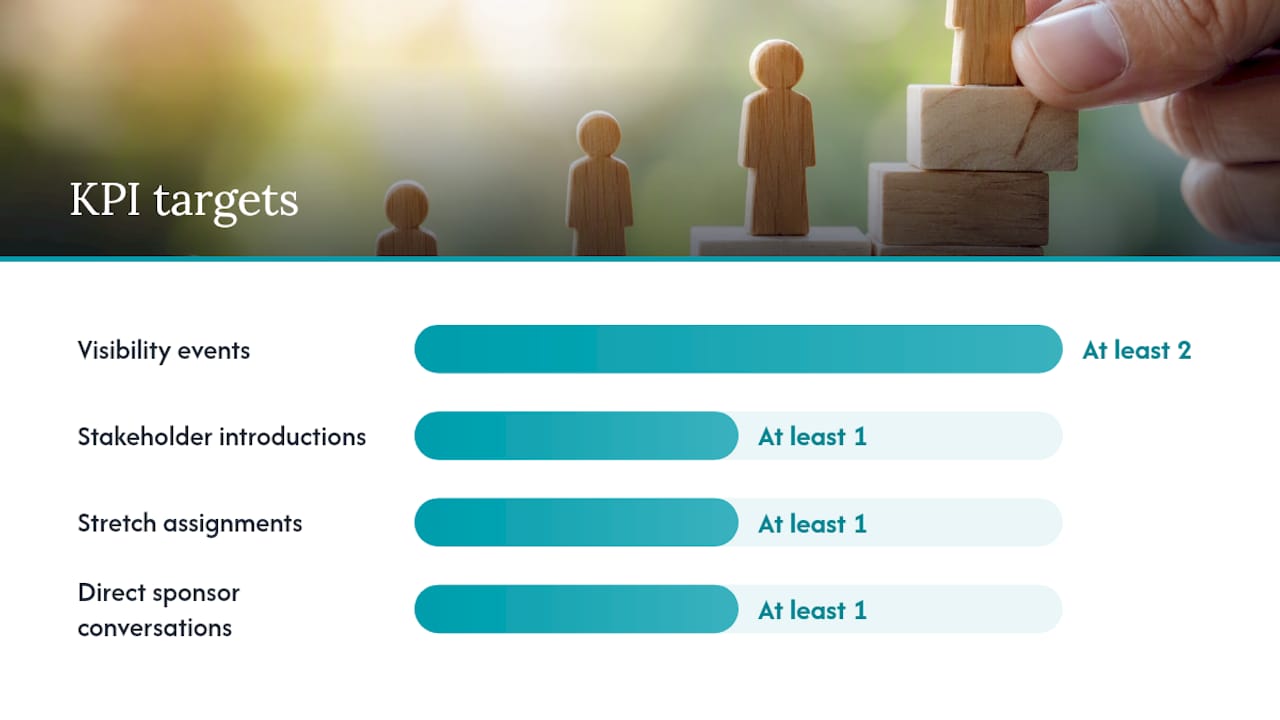
| KPI | Target by Week 8 |
|---|---|
| Visibility events (presentations, leadership updates) | At least 2 completed |
| Stakeholder introductions made by a sponsor or mentor | At least 1 |
| Stretch assignments secured | At least 1 |
| Direct sponsor conversations held | At least 1 |
Weeks 1 through 3 lean on mentorship, closing skill gaps and clarifying your positioning. Weeks 4 through 8 shift toward sponsorship, converting that readiness into visible advocacy. Running both tracks in parallel, rather than treating them as sequential life stages, is what separates people who get sponsored from people who stay perpetually mentored.
What Separates a Mentor From a Sponsor in Practice
A mentor is anyone, inside or outside your organization, who shares knowledge, gives feedback, and helps you develop skills through conversation and coaching. The relationship is usually reciprocal in a low-stakes way: you show up, you’re honest about your gaps, they share what they’ve learned.
A sponsor is someone with actual influence, budget authority, a seat at the promotion table, a say in headcount, who uses that influence on your behalf, often when you’re not present. Parlour’s research on career sponsorship describes it as the active use of influence to open career-defining opportunities: stretch projects, new networks, public visibility you couldn’t access on your own.
The difference in how they act matters as much as who they are. Mentors act through dialogue. Sponsors act through decisions, often decisions you never see happen. A mentor might spend an hour a month talking through your career plan. A sponsor might spend thirty seconds in a closed-door meeting saying “put them on the project,” and that thirty seconds can matter more than a year of mentoring conversations.
This is why sponsorship feels harder to access. You can ask for mentorship and often get it. You can rarely ask for sponsorship directly. It has to be earned through visible performance that gives someone confidence enough to stake their own reputation on you, a distinction that trips up a lot of professionals who mistake a good mentor relationship for sponsorship and wonder why promotions still aren’t coming.
What Good Mentors and Sponsors Actually Do, and What You Owe Them
An effective mentor gives specific, sometimes uncomfortable feedback rather than generic encouragement. They ask questions that surface your own blind spots instead of just telling you what to do, and they follow up on whether you actually applied their advice.
An effective sponsor does something riskier: they publicly stake their credibility on your performance. Signs of a genuine sponsor include being introduced to decision-makers by name, having your work cited in rooms you weren’t in, or being nominated for opportunities you didn’t apply for. If someone only ever gives you private encouragement and never mentions you to anyone with influence, that’s a mentor, not a sponsor, no matter what title they carry.
Your obligations run in both directions. A mentee owes a mentor honesty about struggles and follow-through on feedback. A sponsee owes a sponsor something higher-stakes: consistent performance that doesn’t embarrass the person who vouched for you. Harvard Business Review frames sponsorship as a two-way street precisely because sponsors expend real political capital, and protégés who treat that as automatic entitlement rather than an earned exchange tend to lose sponsors fast.
Practical contribution checklist for the sponsee: deliver on stretch assignments without needing to be chased, credit the sponsor’s role when appropriate, and proactively update them on wins so they have current material to advocate with. A sponsor who has to ask “what have you been working on?” is a sponsor who’s about to stop advocating.
Common Pitfalls in Mentorship and Sponsorship, and How to Avoid Them
The most common mentorship failure is passivity: showing up to meetings without a specific ask, treating the relationship as therapy rather than skill-building. Fix it by bringing a concrete question or problem to every conversation instead of a vague “how’s it going.”
The most common sponsorship failure is asking too early. Requesting sponsorship before you’ve built a track record reads as presumptuous and can burn a relationship before it starts. Build the performance record first; let the ask follow evidence.
Another frequent pitfall on the sponsor side: sponsors who over-promise and under-deliver, mentioning your name once and disappearing. Protect against this by maintaining multiple potential sponsors rather than depending on one, and by checking in periodically rather than assuming silence means things are moving.
Mismatched expectations cause a lot of friction, too. Some mentees expect their mentor to also advocate for them, then feel betrayed when that never materializes, without realizing mentorship and sponsorship were never the same commitment. Be explicit early: ask a mentor directly whether they see themselves in an advisory role or whether they’d be open to advocating for you down the line.
Finally, there’s the risk sponsors themselves face: reputational exposure. HBR’s research on sponsor relationships notes that pairing sponsorship with clear accountability and measurement reduces the chance that a sponsor’s advocacy backfires, which benefits both sides of the relationship.
Matching the Relationship to Your Career Goals and Industry
Not every goal calls for the same relationship, and not every industry rewards sponsorship the same way. If your goal is skill acquisition, like learning a new technical stack, mastering a management discipline, or transitioning into an unfamiliar function, mentorship delivers more value per hour invested. Platforms built specifically around structured skill development, like mentoring platforms designed for clinical training, show how formalized mentorship models work well when the goal is competency, not visibility.
If your goal is a specific promotion, a board seat, or breaking into a role where insider advocacy determines the outcome, sponsorship matters more. In client-facing industries like finance, law, and consulting, where partner-track decisions happen behind closed doors, sponsorship often determines advancement more than performance reviews do. Newsweek’s coverage of workplace advocacy research points out that in periods of economic uncertainty, this dynamic intensifies: decision-makers lean on trusted internal voices rather than resumes alone when deciding who stays through a layoff or who gets the next opening.
In more technical or individual-contributor-heavy fields, like engineering or scientific research, mentorship can carry more day-to-day weight because expertise is easier to demonstrate objectively. But even in those fields, sponsorship still governs the jump from senior individual contributor to leadership. Weigh your specific goal against your industry’s actual promotion mechanics, not generic advice, before deciding where to spend your energy this quarter.
A Recruiter’s View on What Separates the Sponsored From the Merely Mentored
After more than a decade reviewing how professionals actually get promoted, the pattern is consistent: candidates with strong mentors often have polished skills but stalled titles. The ones who advance almost always have someone senior actively vouching for them in rooms they never see. If your resume and LinkedIn presence don’t make that advocacy easy to justify, sponsorship stays out of reach no matter how skilled you are.
How Resumewiz Helps You Become Sponsor-Ready
Sponsorship depends on someone with influence being able to point to concrete proof you’re worth the risk, and that proof starts with how your work is documented and presented. Resumewiz builds executive resumes and LinkedIn profiles specifically positioned around measurable wins, the exact material a potential sponsor needs to make the case for you internally.

Beyond the resume itself, Resumewiz provides outreach templates built for exactly the kind of sponsor conversation outlined above, along with interview and salary negotiation coaching for when that advocacy turns into an offer. Founder Kim Taynor draws on more than ten years of recruiting experience to shape positioning that speaks directly to what decision-makers look for before they stake their reputation on a candidate. If you have the track record but not yet the advocate, visit Resumewiz to start building the materials that make sponsorship an easy yes.
Want a recruiter in your corner for your next senior role? Book a free call with Resume Wiz and we will map out your next move together.
Frequently Asked Questions
How does sponsorship differ from mentorship in practice? A mentor advises you directly; a sponsor advocates for you when you’re not present.
What are the main career sponsorship benefits over mentorship? Sponsorship’s biggest benefit is direct advancement: sponsored employees see a documented promotion lift, and sponsors introduce you to networks and stretch assignments you couldn’t access alone.
How does mentorship impact career growth if it doesn’t guarantee promotion? Mentorship impacts career growth by closing skill gaps, sharpening judgment, and preparing you for the performance record that eventually makes sponsorship possible. It’s foundational, not a substitute for advocacy.
When should I seek a mentor versus a sponsor? Seek a mentor when you’re building skills or navigating a new role. Seek a sponsor once you have a consistent track record of high performance and need someone to advocate for the next step.
Can the same person be both my mentor and my sponsor? Yes, and it happens often. A mentor who sees your performance improve over time may naturally start advocating for you, effectively becoming a sponsor while still offering guidance.
Why is sponsorship harder to access for underrepresented professionals? Informal sponsorship tends to favor people who resemble existing leadership, which limits access for underrepresented groups. Formal, structured sponsorship programs are designed specifically to correct that imbalance.
Sources
- Mentors and sponsors: what’s the difference? | Gallup
- Career sponsorship is a two-way street | Harvard Business Review
- Sponsorship vs. mentorship: which model is best for your organization? | ADP
- The differences between mentorship and sponsorship | Newsweek (excerpt)
