STAR vs CAR Method: When to Use Each in an Interview
Use STAR when the question demands context and a nuanced result; use CAR when time is tight and you need a fast, impact-first answer. STAR usually runs a few minutes and includes enough detail for full context (https://successworks.wisc.edu/the-basics/preparing-for-your-interview-2/the-star-method/); CAR is built for 1 to 2 minutes, around 100 to 150 words. Memorize this rule: if the question asks you to walk through something complex, go STAR. If the interviewer is moving fast or the question is straightforward, go CAR.
- STAR is suited for behavioral deep-dive questions and panel interviews
- CAR works well in phone screens, rapid-fire rounds, and follow-ups where context is known
- Both frameworks share the same backbone: Action and Result. The difference is how much runway you give the setup.
Key Takeaways
The right framework depends on time pressure and question complexity, and the strongest candidates prepare both versions of every story instead of choosing one permanently.
| Point | Details |
|---|---|
| Match format to time | Use STAR for 2 to 3 minute deep-dive answers and CAR for 1 to 2 minute rapid rounds. |
| Prepare layered versions | Build a full STAR story, then compress it into a one-line CAR summary for the same accomplishment. |
| Prioritize the Result | Quantify the outcome and use “I” language so interviewers can judge your individual contribution. |
| Shift for seniority | Swap Task for Obstacles using SOAR when interviewing for roles judged on strategy over execution. |
| Get expert story coaching | Resume Wiz coaches clients to build and switch between STAR, CAR, and SOAR stories under real interview conditions. |
Table of Contents
- STAR vs CAR Method: A Side-by-Side Comparison
- How Do You Decide Between STAR and CAR Mid-Interview?
- STAR and CAR Examples: The Same Story, Two Ways
- How Should You Practice Timing for STAR and CAR?
- When Should You Use SOAR Instead of STAR or CAR?
- What Recruiters Actually Notice About STAR and CAR
- Get Interview Coaching Built Around Your Real Stories
- Where This Guidance Comes From
- Sources
STAR vs CAR Method: A Side-by-Side Comparison
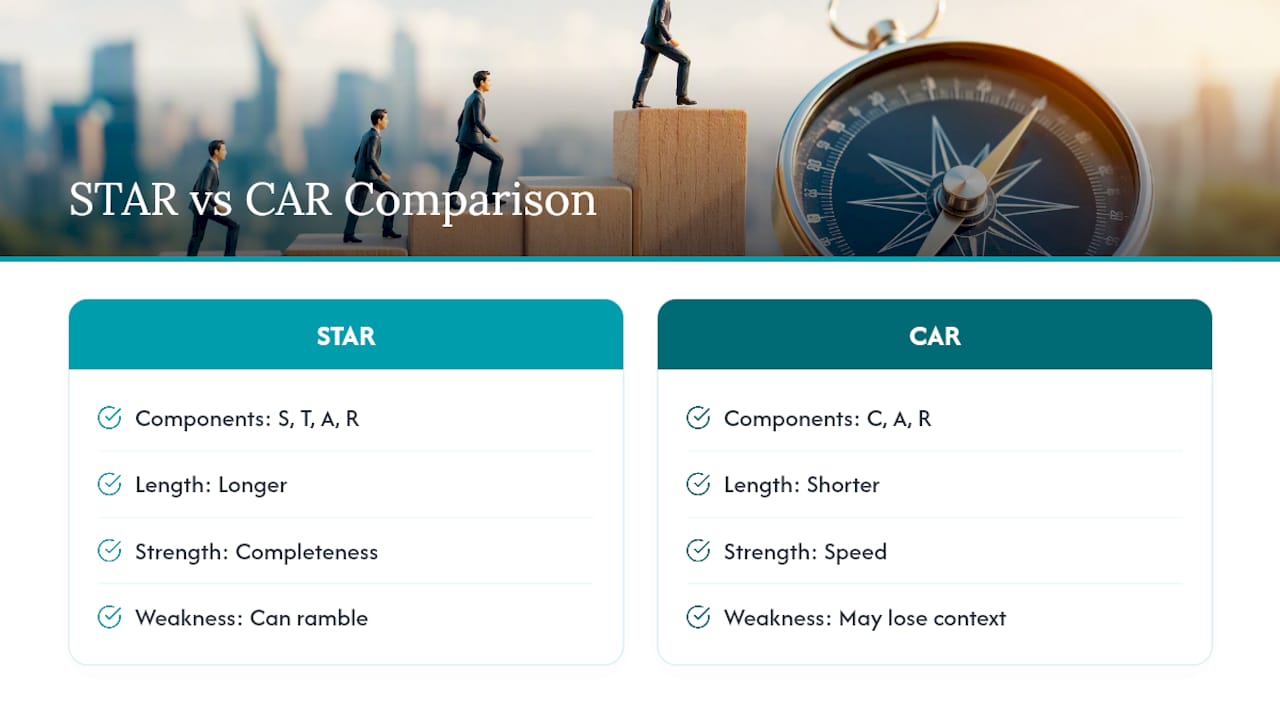
STAR stands for Situation, Task, Action, Result. CAR stands for Context (or Challenge), Action, Result. The only real structural difference is that CAR folds Situation and Task into one beat, which is why it runs shorter and forces you to cut faster.
Here’s what each component sounds like in practice. In STAR, “Situation” sets the scene (“Our support team had a 48 hour response time”), “Task” names your specific responsibility (“I was asked to cut that in half within a quarter”), “Action” details what you did, and “Result” quantifies the outcome. In CAR, Context does the job of Situation and Task at once: “Our support team’s response time was hurting renewal rates, and I owned the fix.” Same information, half the words.
STAR’s strength is completeness. It gives the interviewer enough backstory to judge your reasoning, not just your outcome, which matters most in behavioral deep-dives where the panel wants to see judgment. Its weakness is that candidates tend to ramble through Situation and Task, burning two minutes before they even reach the part that matters.
CAR’s strength is speed. It respects an interviewer’s clock and gets to Result fast, which is why candidates who can compress a full STAR story into a CAR version on demand tend to read as sharper, more prepared. Its weakness is that it can strip away context a technical or panel interviewer actually wants.
Where you land depends on interview stage. A 30-minute phone screen with six questions to get through rewards CAR. A 45-minute onsite behavioral round with one interviewer digging into a single project rewards STAR. Technical interviews that ask “walk me through how you debugged X” usually want STAR’s structure, because the reasoning is the answer.
How Do You Decide Between STAR and CAR Mid-Interview?
You won’t always know which format to use until the interviewer’s tone, pacing, or exact wording tells you. Run this checklist in the first three seconds after a question lands:
- Check the question’s complexity. “Tell me about a challenge you overcame” invites STAR. “Give me a quick example of a time you influenced a stakeholder” invites CAR.
- Read the interviewer’s cues. Glancing at a clock, checking notes, or saying “briefly” is a request for CAR, whether they say so directly or not.
- Know your time budget. In a 20-minute screen with a list of questions, default to CAR and let the interviewer ask for more.
- Listen for the wording. “Walk me through” signals STAR. “Give me an example” signals CAR.
The smartest prep workflow builds both versions of every story before you walk in. Write the full STAR version first, then force yourself to compress it into one CAR sentence. Practicing the toggle between a full STAR story, a two-sentence mid-length version, and a one-line CAR summary means you’re never caught rebuilding a story on the fly.
Signal your format out loud when it helps. Open with a compressed CAR line, then say, “I can go deeper into how I got there if that’s useful.” That single sentence hands control back to the interviewer and shows you’re managing the conversation, not just reciting a script.
Pro Tip: Record yourself answering the same question twice, once in full STAR, once compressed to CAR. Play both back. Most candidates are shocked at how much filler lives in their “Situation” setup once they hear it out loud.
STAR and CAR Examples: The Same Story, Two Ways
Here’s one accomplishment told both ways. Notice how little information actually gets lost when you compress it.
CAR version (about 110 words): “Our customer support team had a 48-hour average response time, and renewal conversations were suffering because of it. (Action) Within six weeks, average response time dropped to 19 hours, and our renewal rate on flagged accounts rose 8 points that quarter. (Result)”
STAR version (about 190 words): “When I joined the support team, our average response time sat at 48 hours, and it was showing up directly in renewal conversations. (Situation) My manager asked me to bring that number down without adding headcount, since the budget for the quarter was already locked. I built an automated tagging system that routed tickets by keyword and account tier, then trained the team on it over two sessions. (Action) Within six weeks, response time dropped to 19 hours, and renewal rate on flagged accounts rose 8 points that quarter, which the VP later cited in the board deck. (Result)”
To compress, cut the manager’s constraint and the training detail. To expand, add the data pull and who eventually used the result. In both versions, the Result carries a number and a follow-on consequence, not just an outcome. Coaches who work through hundreds of these stories consistently flag the Result as the part candidates rush, which is exactly backward: it’s the part that should get the most rehearsal, not the least.
How Should You Practice Timing for STAR and CAR?
Timing can distinguish rehearsed answers. Aim for around one to one and a half minutes for CAR, and one and a half to three minutes for STAR. Anything longer usually means you’re re-explaining instead of adding new information. 2. Prepare 8 to 10 stories, not 20. Map each one to a competency (leadership, conflict, failure, ownership, scale) so you can pull the right story fast instead of searching for one. 3. Run a checklist on every story: clear ownership language (“I,” not “we”), one hard metric, one specific action you personally took, and a short reflection line if the question is about failure or growth. 4. Practice rapid-fire and panel formats separately. A panel interview often lets one person interrupt with a follow-up mid-story, which means your STAR version needs natural pause points where you can stop and answer a clarifying question without losing the thread.
A structured job-search prep workflow built around competency mapping, not just individual questions, makes this rehearsal far less random.
When Should You Use SOAR Instead of STAR or CAR?
Senior and executive candidates often hit a ceiling with STAR because it’s built around Task execution, and executive interviewers care more about judgment than execution. That’s where SOAR, Situation, Obstacles, Actions, Results, earns its place: it swaps Task for Obstacles, which forces you to name the trade-offs and constraints you navigated, not just the job you were assigned.
- Converting a STAR story to SOAR means spending more time on what stood in your way (budget cuts, competing stakeholder priorities, a board deadline) and less on the mechanics of the task itself.
- SOAR also invites you to name who else was affected, since executive decisions rarely touch only your own team.
- One-sentence rule: use SOAR for roles where judgment and strategic trade-offs matter more than task execution, and stick with STAR or CAR for everything below that level.
What Recruiters Actually Notice About STAR and CAR
Ten-plus years of recruiting taught me one thing candidates consistently underestimate: interviewers remember the switch, not the script. A candidate who answers every question in identical five-part STAR cadence starts to sound rehearsed by the third question, and panels notice. The candidates who stand out compress when the room wants speed and expand when it wants depth. That's a skill, not a personality trait, and it's trainable. Resume Wiz builds both frameworks into coaching sessions for exactly that reason.
Kim
Get Interview Coaching Built Around Your Real Stories
Reading about STAR and CAR is one thing. Having someone pressure-test your actual stories, the ones tied to your real numbers and your real career moves, is another. Resume Wiz works directly with executives, managers, and career changers to turn scattered accomplishments into interview-ready stories that switch cleanly between CAR, STAR, and SOAR depending on the room.

That coaching includes building a personal story bank mapped to your target roles, running mock interviews that force you to compress and expand on command, and refining the metrics in your Result lines so they hold up under a follow-up question. If you already know your stories cold and just want a sounding board before a big interview, a single coaching session can sharpen your delivery fast. If you're starting from scratch, or you're mid-search and every answer still feels like it's running too long, the fully managed coaching and job search support at Resume Wiz is built to get you interview-ready. Book a session and bring your three toughest interview questions.
Where This Guidance Comes From
- SuccessWorks, University of Wisconsin sets the timing benchmarks for STAR answers used throughout this guide.
- MIT Career Advising & Professional Development explains why treating frameworks as flexible tools, not rigid scripts, produces stronger answers.
- LinkedIn Business covers the layered prep workflow of building full stories and compressing them on demand.
- Hiration details when CAR outperforms STAR and how to structure the Result for maximum impact.
- The Interview Guys breaks down SOAR as the executive-level alternative built around obstacles and strategic judgment.
Want a recruiter in your corner for your next senior role? Book a free call with Resume Wiz and we will map out your next move together.
Sources
- Preparing for your interview: The STAR method, SuccessWorks, University of Wisconsin
- STAR method guidance, LinkedIn Business
- The STAR method for behavioral interviews, MIT Career Advising & Professional Development
- The STAR Method, Done Right (and When to Use CAR Instead), Hiration
