Stuck in a Job Search Despite Strong Experience?
Being stuck in a job search despite strong experience is not a reflection of your qualifications. It is a structural problem rooted in how modern hiring platforms rank candidates against competitive peer brackets before a human recruiter ever reads a single line of your resume. Applicant Tracking Systems (ATS) and AI-powered screening tools have fundamentally changed the rules. Experienced professionals, including executives, career changers, and long-tenured managers, face a paradox: the more complex your career history, the harder it is for an algorithm to categorize you favorably. Understanding this shift is the first step toward fixing it.
Why experienced professionals get stuck in job searches
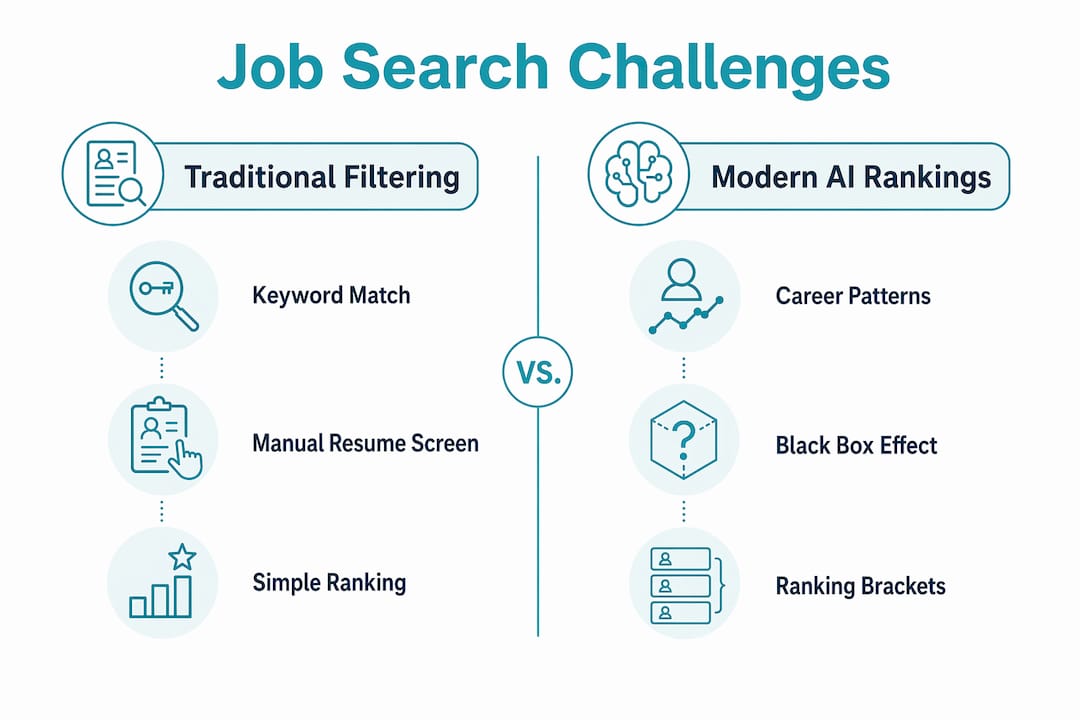
The core issue is that AI hiring platforms rank applicants within competitive career pattern brackets, not simply against a checklist of minimum qualifications. This means your 15 years of experience does not automatically score higher than a candidate with 8 years if their title progression, promotion velocity, and tenure patterns align more cleanly with what the algorithm expects for that role. Being qualified is no longer enough. You are competing against a curated peer group, and the algorithm decides who makes the cut.
This ranking logic creates a “black box” effect that leaves experienced candidates without feedback or clarity. 60% of job seekers report frustration with opaque, automated hiring processes, meaning the silence you receive after applying is not unusual. It is systemic. The frustration is not personal failure. It is a structural feature of modern recruiting technology that disproportionately affects professionals with non-linear or entrepreneurial career paths.
| Traditional hiring filter | Modern AI ranking system |
|---|---|
| Keyword match against job description | Pattern match against competitive peer brackets |
| Human review of all applications | Algorithmic scoring before human review |
| Experience volume valued | Promotion velocity and title consistency weighted |
| Gaps evaluated case by case | Gaps flagged automatically as risk signals |
| Founder/freelancer titles recognized | “Founder” often read as unemployed by ATS |
Pro Tip: If your resume includes titles like “Founder,” “Consultant,” or “Freelancer,” add a brief parenthetical clarifying the scope, such as “(12-person team, $2M revenue)” to give the ATS and human reviewers the context they need to score you accurately.
Common strategic pitfalls in prolonged job searches
Strategy drift is the most underdiagnosed problem in prolonged job searches. It happens when a professional continues applying with the same approach past the 30 to 45 day mark, even after the data clearly shows it is not working. Effort stays high, but targeting quietly deteriorates. The result is persistent silence despite a full calendar of applications.
The most common pitfalls experienced professionals fall into include:
- Applying too broadly. Sending 20 to 30 applications per week across multiple industries or seniority levels dilutes your positioning and signals desperation to recruiters who do review profiles manually.
- Using a generic resume. A single resume version sent to every role fails to mirror the specific language, priorities, and competency signals each employer uses in their job postings.
- Relying on Quick Apply. Bulk submissions through LinkedIn’s Easy Apply or Indeed’s Quick Apply features feed directly into the highest-competition pools with the lowest human review rates.
- Ignoring response rate data. Most professionals track applications sent, not applications that generated any response. Response rate is the only metric that tells you whether your strategy is working.
- Skipping the reset. Continuing the same strategy past six weeks without a deliberate audit is the single most common reason experienced professionals stay stuck.
Pro Tip: Set a calendar reminder every 30 days to audit your job search. Pull your response rate (responses divided by applications sent), review which roles generated any activity, and cut the channels or role types that produced zero results. Treat your search like a campaign with performance data, not a hope-based activity.
How to build proof of work that bypasses ATS limitations
Experienced candidates need to shift from describing their work to demonstrating it. Referrals and sourced applicants bypass many AI screening limitations entirely, improving interview odds compared to cold online applications. This is the most direct path around the algorithmic bottleneck.
Building visible proof of work gives recruiters and hiring managers a reason to reach out to you directly, rather than waiting for your resume to survive the ranking process. Concrete approaches include:
- Live project portfolios. A simple website or Notion page showcasing three to five projects with measurable outcomes (revenue generated, costs reduced, teams led) is more persuasive than a resume bullet point.
- GitHub repositories. For technical professionals, a well-documented GitHub profile with active contributions signals current competency more credibly than a job title from three years ago.
- LinkedIn content. Publishing one substantive post per week about a problem you solved or a trend in your field builds a searchable record of expertise that recruiters can find independently.
- Certifications with outcomes. Google Project Management Certificate, AWS certifications, or PMP credentials add credibility, but only when paired with a project that shows you applied them.
- Direct outreach to hiring managers. A personalized message to a second-degree LinkedIn connection at a target company, referencing a specific business challenge they face, outperforms any cold application. For guidance on structuring this outreach, resume and interview prep resources from recruiting professionals can sharpen your approach.
The shift from passive applicant to visible expert is not a branding exercise. It is a practical workaround to a system that rewards recognizability over raw qualifications.
What application volume actually does to your success rate
The conventional wisdom that more applications equal more chances is wrong for experienced professionals. Limiting applications to three highly targeted roles per week improves response rates because it forces specificity in resume tailoring, cover letter relevance, and company research. Volume without targeting is the numbers game trap.
| Weekly application volume | Targeting level | Likely outcome |
|---|---|---|
| 20 to 30 applications | Generic, broad | Low response rate, high burnout |
| 10 to 15 applications | Moderate targeting | Inconsistent results |
| 3 to 5 applications | High targeting, tailored | Strongest response rate |
| 1 to 2 applications | Hyper-focused | Sustainable, measurable feedback |
The data above reflects a pattern that recruiting professionals consistently observe: quality of fit signals in a tailored application outperforms volume in generating first-round interviews. Each application should include a resume version that mirrors the job posting’s language, a cover letter that references a specific company challenge, and at least one internal or network connection at the target company.
Pro Tip: Before submitting any application, run your tailored resume through a free ATS checker tool to confirm that your keyword alignment matches the specific job description. Small mismatches in terminology, such as “P&L management” versus “budget oversight,” can drop your ranking score significantly.
Managing burnout when the search goes long
Nearly 70% of active job seekers experience severe burnout in 2026 due to constant rejection and automated silence. That statistic matters because burnout does not just feel bad. It actively degrades the quality of your applications, your networking conversations, and your interview performance. A burned-out candidate reads differently to a recruiter than a confident one.
Practical strategies for maintaining effectiveness during a prolonged search include:
- Separate your identity from your search. Your job title is not your worth. Treating every rejection as personal data rather than personal judgment is a skill that takes practice but is the most protective habit you can build.
- Use structured sprints. Dedicate specific days to networking, specific days to applications, and specific days to skill development. Mixing all three daily creates cognitive overload and reduces quality across all three.
- Schedule deliberate pauses. A two-week break focused entirely on portfolio building, certification completion, or informational interviews resets your energy and often produces better leads than two weeks of grinding applications.
- Track wins, not just rejections. Log every response, every conversation, every referral made. Progress is often invisible when you only count offers.
- Set a daily time limit. Two to three focused hours of job search activity per day produces better results than eight unfocused hours. The emotional drain of job hunting compounds with time on task, so protecting your energy is a performance strategy, not an excuse to slow down.
The professionals who break through prolonged searches are rarely the ones who worked hardest. They are the ones who worked most deliberately.
Key takeaways
Experienced professionals get stuck in job searches primarily because AI hiring systems rank candidates against competitive peer brackets, not just job requirements, making strategic positioning more important than raw qualifications.
| Point | Details |
|---|---|
| AI ranking over keyword filtering | Modern ATS platforms score career patterns, not just qualifications, against peer brackets. |
| Strategy drift kills results | Reset your job search targeting every 30 to 45 days based on actual response rate data. |
| Proof of work beats resume bullets | Portfolios, LinkedIn content, and direct outreach bypass algorithmic filters more reliably. |
| Target quality over volume | Three highly targeted applications per week outperform 20 generic submissions. |
| Burnout is a performance issue | Protecting your energy through structured sprints and deliberate pauses directly improves application quality. |
What I’ve learned after 10 years of watching experienced candidates get stuck
The hardest conversation I have with clients is the one where I tell them the problem is not their experience. It is how they are presenting it to a system that was not designed to appreciate nuance. I have worked with directors, VPs, and founders who had genuinely impressive careers and were getting zero responses. In almost every case, the issue was not what they had done. It was that their resume and application strategy were built for a hiring process that no longer exists.
The thing most articles will not tell you is that the competitive bracket problem is real and it is not fair. A candidate with a clean, linear title progression at recognizable companies will often outscore a more capable candidate with a complex, entrepreneurial background, purely because the algorithm finds the first profile easier to categorize. That is not a reason to despair. It is a reason to reframe your resume as a translation document, not a biography. Your job is to make your career legible to a system that thinks in patterns.
I also want to push back on the idea that you need to apply to more roles to break through. In my experience, the professionals who get unstuck fastest are the ones who apply to fewer roles with far more precision, build one or two genuine relationships inside target companies, and treat their LinkedIn profile as a live portfolio rather than a static resume. The misconception around job hopping and non-linear careers is worth understanding too, because how you frame transitions matters as much as the transitions themselves.
The search is hard right now. That is real. But the professionals who adapt their strategy to the current system, rather than working harder at a strategy built for the old one, are the ones who move forward.
Kim
How Resumewiz helps experienced professionals break through
If you have been applying consistently and still not getting interviews, the issue is almost certainly positioning, not qualifications. Resumewiz was built specifically for executives, managers, and career changers who need their experience translated into the pattern signals that 2026 hiring algorithms and recruiters actually respond to.

Resumewiz offers ATS-compliant resume development, LinkedIn profile optimization, and personalized outreach templates designed to get your application in front of human decision-makers, not just past the first filter. The platform's managed job search process includes a fully managed search with tailored applications and outreach, backed by Kim Taynor's decade of recruiting experience. If you are ready to stop guessing and start getting responses, explore Resumewiz to see which service fits your situation.
Want a recruiter in your corner for your next senior role? Book a free call with Resume Wiz and we will map out your next move together.
FAQ
Why am I not getting interviews despite years of experience?
Modern hiring platforms rank candidates competitively within peer brackets based on career pattern signals, not just qualifications. A strong background can still score poorly if your title progression, tenure, or resume language does not match what the algorithm expects for that role.
How many jobs should I apply to per week?
Three highly targeted applications per week is the recommended ceiling for experienced professionals. Tailored applications with role-specific language and internal connections consistently outperform high-volume generic submissions.
Does job search burnout affect application quality?
Yes. Burnout degrades the specificity and energy of your applications, cover letters, and networking conversations. Structured sprints and deliberate pauses protect performance quality during a prolonged search.
Can ATS systems misread my career history?
Titles like “Founder” or “Freelancer” are often misread by ATS as indicators of unemployment rather than leadership experience. Adding scope context directly to your resume title or summary corrects this misclassification.
What is the fastest way to improve job search results?
Shift from cold applications to direct outreach and referrals. Sourced candidates bypass most AI screening layers and reach human reviewers at significantly higher rates than applicants who apply through public job boards.
