8 Job Inquiry Subject Lines Recruiters Prefer for Mid/Senior Candidates
The formula that works for nearly every job inquiry is simple: your name, the exact job title, and a reference number if one exists, separated by clean punctuation, like “Jordan Lee, Senior Product Manager Application, Ref. 48217.” This beats a vague subject because it is searchable and tells the recipient exactly what to do with your email in under two seconds. Below, we break down the formula into templates for cold outreach, referrals, and follow-ups.
Key Takeaways:
- Using a subject line that includes your name, exact job title, and reference number increases the likelihood of your email being found and opened later.
- Different situations require tailored formulas, such as including a reference ID for posted roles or specifying the team for cold inquiries, with clear, searchable details first.
- Avoid vague, generic, or manipulative subjects like “Hello” or “Re:” and keep the subject under eight words to ensure key information is not truncated.
- Senior candidates should lead with their title and scope, and immediately mention a quantifiable achievement in the first email paragraph to match recruiter priorities.
- Treat your subject line as an experiment, track responses, and adapt your tone and format based on industry and recipient preferences.
Table of Contents
- Why your subject line decides whether the email gets opened
- Proven subject-line formulas and when to use them
- Copyable subject-line templates by situation
- What to avoid in a job inquiry subject line
- What recruiters actually notice in a subject line
- Test small, track replies, and adjust
- FAQ
- Sources
Why your subject line decides whether the email gets opened
Hiring managers and recruiters often triage dozens of emails a day, scanning subject lines before anything else. A subject that names the role and includes a job reference is far easier to find later in a crowded inbox or applicant tracking workflow than one that just says “Resume” or “Following up.”
Career guidance from Indeed recommends including your name, the exact job title, and a job ID or reference number when applying to a posted role, specifically because it gives the recipient a searchable identifier. Purdue OWL’s email etiquette guidance adds a useful test: a recipient should be able to identify the role, your name or referral, and your reason for writing from the subject line alone, without opening the message.
Proven subject-line formulas and when to use them
Different situations call for different formulas, but each one follows the same logic: lead with the most searchable, most specific information first.
- Posted role: “[Your name], [Exact job title], Ref. [Job ID]” works because it mirrors how the role is listed internally, per Indeed’s application guidance.
- Unadvertised or cold inquiry: lead with the function or value you bring, not a generic “job inquiry.” A line like “Exploring product leadership roles, [Name]” signals intent without pretending a job exists.
- Referral or networking: name the mutual contact only when the referral is real, following Indeed’s cold-email guidance, such as “Referral from [Mutual Contact], VP Operations.”
- Follow-up: restate the original subject and add context rather than faking urgency, for example “Follow-up, Senior Finance Director Application, Ref. 48217,” which Purdue OWL treats as a brief employment letter rather than a nudge.
Pro Tip: Never use “Re:” unless you are genuinely replying to an existing thread; it reads as manipulative the moment a recruiter notices there was no prior email.
Cold outreach benefits from the same structure used in consulting networking templates, where the subject states the specific team or practice area instead of a generic request for a conversation.
Copyable subject-line templates by situation
Pick the group that matches your situation, then swap in your details.
- For a posted role with a job ID: “Jordan Lee, Senior Product Manager Application, Ref. 48217”
- For a posted role without an ID: “Jordan Lee, Application for Marketing Director”
- For a cold inquiry about future openings: “Exploring finance leadership opportunities, Jordan Lee”
- For a cold inquiry naming a team: “Experienced operations leader interested in your supply-chain team”
- For a genuine referral: “Referral from Maria Chen, Senior Data Analyst”
- For networking, more conversational tone: “Quick question about your data-team hiring plans”
- For a first follow-up: “Follow-up, Senior Finance Director Application, Ref. 48217”
- For a second, lighter follow-up: “Additional information for Marketing Director application, Jordan Lee”
Formal organizations, such as banks or government contractors, tend to respond better to the strict “Role, Name” format, while startups and agencies often tolerate the warmer, more conversational versions. Include a job ID whenever one exists, name a referral only when it is real, and add a single metric (a percentage, a dollar figure, a team size) only in the body, never crammed into the subject itself.
What to avoid in a job inquiry subject line
A handful of habits quietly tank open rates and credibility before the email is even read.
- Skip vague subjects like “Job Inquiry,” “Hello,” or “Following Up,” none of which tell the recipient anything searchable.
- Never fake a “Re:” prefix or use “URGENT” to manufacture priority, a tactic Purdue OWL specifically flags as misleading.
- Avoid all caps and emoji in professional outreach; they read as unprofessional regardless of industry.
- Put the most important searchable term (your name or the job title) first, since some email clients truncate long subject lines on mobile screens.
- Keep the subject under about eight words so nothing critical gets cut off.
What recruiters actually notice in a subject line
Kim Taynor, founder of Resume Wiz, spent more than 10 years recruiting before building out executive career services, and the pattern that stands out across that experience is how often senior candidates bury their strongest signal. A subject line that leads with title and a quantified scope, rather than just a name, tends to get opened faster by hiring teams screening dozens of similar inquiries.
A subject line for an executive audience should answer “why you, why now” in under ten words, then let the first line of the email carry the one number that proves it.
Two formulas that work well at the senior level: “Jordan Lee, VP Operations, $40M P&L oversight” for a posted role, or “Former VP Engineering exploring CTO opportunities” for a cold inquiry. In the body’s first paragraph, frame one quantified achievement, a revenue figure, a team size, a percentage improvement, immediately after the greeting, so the subject’s promise gets delivered on instantly.
Test small, track replies, and adjust
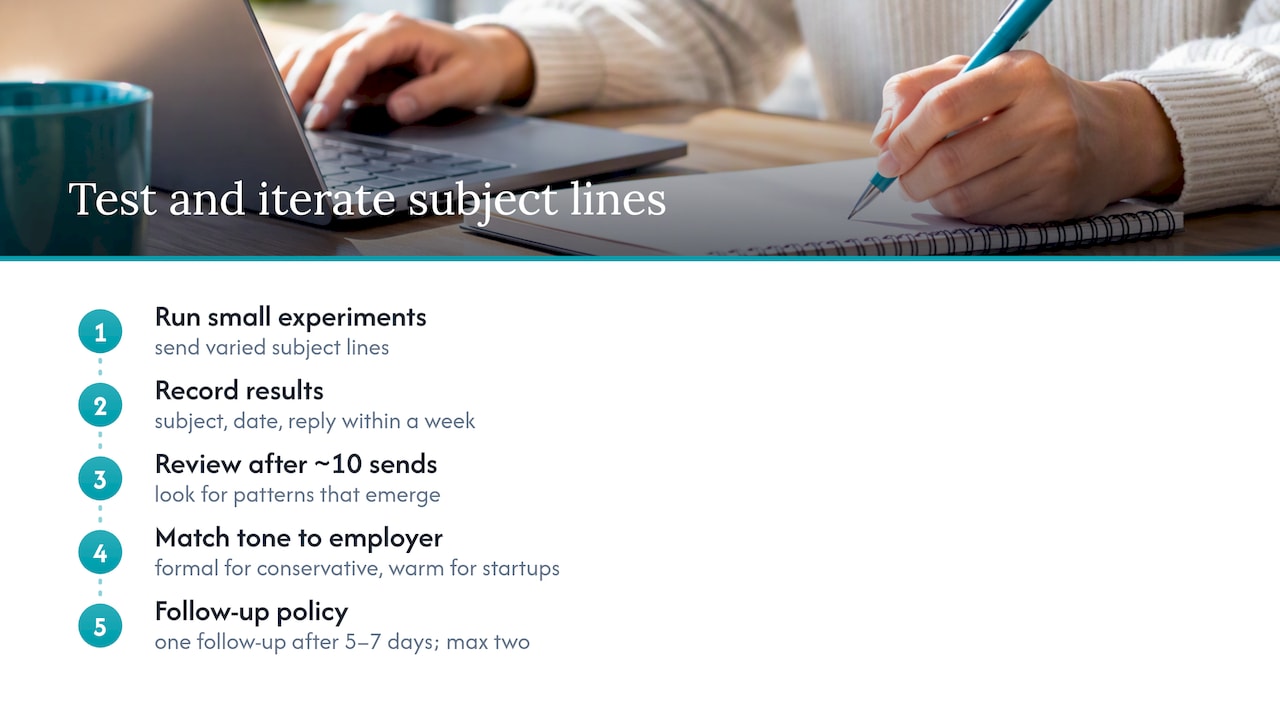
Treat your subject line like a small experiment rather than a guess. Keep a simple spreadsheet with three columns: the exact subject line sent, the date, and whether you got a reply within a week. After ten or so emails, patterns usually surface, formal phrasing might outperform in finance or legal outreach, while a conversational line might work better at a startup.
Match tone to the organization’s own communication style; a strict “Role, Name” format fits conservative industries, while a warmer phrase fits a casual one, per Indeed’s job inquiry guidance. Follow up once after about five to seven days, and cap it at two follow-ups total before moving on.
Kim
Want a recruiter in your corner for your next senior role? Book a free call with Resume Wiz and we will map out your next move together.
FAQ
What is a good subject line for an inquiry email?
A good inquiry subject names the function or team you are interested in along with your name, such as “Exploring finance leadership opportunities, Jordan Lee.” It should give the recipient enough information to understand your intent without opening the email, per Indeed’s cold-email guidance.
What is a good example of a subject line?
For a posted role, a strong example is “Jordan Lee, Senior Product Manager Application, Ref. 48217,” which combines your name, the exact title, and a searchable reference number. This format mirrors how the role is tracked internally, making it easy for a recruiter to find later.
What are some good subject lines for job emails?
Effective examples include “Referral from Maria Chen, Senior Data Analyst” for a warm introduction and “Follow-up, Senior Finance Director Application, Ref. 48217” for a status check. Each leads with the most specific, searchable detail rather than a generic greeting.
How do I politely inquire about a job?
Lead the subject with your name and the function or team you are curious about, then use the email body to connect your background to the employer’s apparent needs, following the approach outlined by CareerOneStop’s inquiry-letter framework. Close with a clear, low-pressure call to action, such as asking for a brief call rather than demanding an interview.
Where can I find outreach templates if I want extra support?
Free templates and guides are available through resources like Resume Wiz, and for readers who want a fully managed outreach process, including tailored subject lines and executive positioning, the Elevate packages build that support into a multi-week engagement.
