The C-suite resume format that wins executive roles
Most executives assume their resume just needs a polish, not a rethinking. They pile on titles, responsibilities, and decades of experience, then wonder why calls from executive search firms dry up. The truth is that C-suite resumes operate by a completely different set of rules. A format built for a director-level candidate will actively work against you at the VP, SVP, or C-level. This guide breaks down exactly what separates a high-performing executive resume from the rest, and how to structure yours for maximum impact in 2026.
Table of Contents
- Why C-suite resumes differ from traditional formats
- Core structure of a winning C-suite resume
- Addressing gaps, transitions, and unconventional paths
- What recruiters and boards want to see in 2026
- What most executives get wrong about C-suite resumes
- Ready to elevate your C-suite resume?
- Frequently asked questions
Key Takeaways
| Point | Details |
|---|---|
| Strategic structure | Executive resumes need a framework that showcases leadership narrative and results over chronology. |
| Frame career gaps | Contextualizing breaks or transitions can strengthen your resume rather than weaken it. |
| Board and recruiter expectations | Boards value clarity, strategic impact, and a story, not just a gap-free record. |
| Common mistakes | Over-detailing or underselling transitions can cost opportunities, frame your story for influence. |
Why C-suite resumes differ from traditional formats
To understand how to craft an effective C-suite resume, let’s first clarify why the usual format doesn’t suffice for executive roles.
Traditional resumes are built around roles and responsibilities. They answer the question: “What did you do?” C-suite resumes must answer a fundamentally different question: “What did you change, build, or lead, and what was the outcome?” That shift from task-listing to impact-storytelling is the single biggest structural difference, and most executives underestimate how significant it is.
At the senior leadership level, every reader of your resume already assumes you can do the job. What they’re evaluating is how you think, what kind of leader you are, and whether your track record maps to their specific organizational challenges. A hiring committee for a Chief Operating Officer isn’t scanning to confirm you’ve managed P&L. They want to know by how much you improved it, in what environment, under what constraints.
Common myths vs. executive reality:
| Myth | Executive reality |
|---|---|
| Longer resumes signal more experience | Two focused pages beat five cluttered ones every time |
| Gaps are disqualifying red flags | Context and framing matter far more than a clean record |
| List every role for completeness | Only strategic, relevant experience earns page space |
| Use jargon to demonstrate expertise | Clear, plain language with metrics reads better to boards |
| Functional format hides weaknesses | Chronological with strategic framing is almost always stronger |
The narrative framing point cannot be overstated. HBR research shows executives should treat resume gaps as context, not red flags, fundamentally changing the approach seen in traditional resume writing. That insight alone should shift how you think about every section of your document.
Strategic storytelling also means connecting the dots between roles, especially if your path wasn’t linear. Did you move from a publicly traded company to a startup? That isn’t inconsistency. It’s range. Did you take a year off to manage a family health crisis? That’s a leadership story about priorities and resilience. The framing is everything, and tailoring C-suite resumes to match your target organization’s strategic priorities is where that work lives.
Here’s what a strong C-suite resume emphasizes, and what it leaves behind:
- Emphasize: Quantified outcomes, strategic decisions, team size and scope, revenue or cost impact, transformation stories
- Remove: Administrative tasks, obvious responsibilities, outdated software skills, roles from more than 20 years ago unless uniquely relevant
- Reframe: Career pivots as strategic choices, consulting stints as applied leadership, board service as governance expertise
“The best executive resumes don’t read like job descriptions. They read like strategy documents with a human story attached.”
Core structure of a winning C-suite resume
Having established why a distinct approach is mandatory for the C-suite, let’s outline the specific structure that sets top executive resumes apart.
The order of sections in your resume is not arbitrary. It reflects what you’re prioritizing for the reader, and executive readers form impressions fast. Many are senior-level professionals themselves who can spot a well-constructed narrative versus a data dump within seconds. Structure your document to guide their attention deliberately.
Recommended section order for C-suite resumes:
| Section | Content focus | Approximate length |
|---|---|---|
| Executive summary | Strategic identity, top-line impact, career theme | 4 to 6 lines |
| Core competencies | 12 to 18 keywords for ATS and human scanners | 2 to 3 rows |
| Leadership achievements | 3 to 5 cross-role wins tied to metrics | 1 short section |
| Career timeline | Reverse-chronological with outcomes, not duties | 1 to 1.5 pages |
| Education and credentials | Degrees, executive programs, certifications | 3 to 5 lines |
| Board, advisory, or civic roles | Governance, thought leadership, community impact | Optional, 4 to 6 lines |
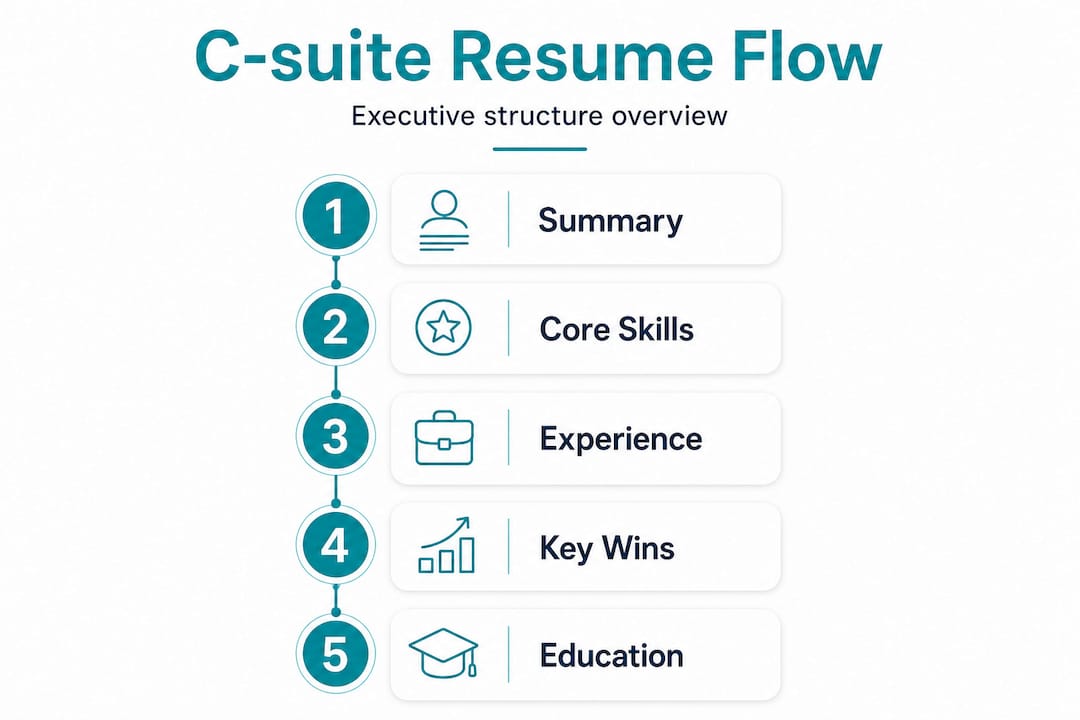
A strong structure does more than organize information. It tells a story. Your executive summary sets the theme. Your core competencies create the ATS bridge between your experience and the role’s language. Your leadership achievements section, often underused or omitted entirely, gives readers a high-level proof point before they dive into the detail of your career timeline.
Here’s the numbered flow for building each section effectively:
- Write the executive summary last. After you’ve assembled all your accomplishments, you’ll have a much clearer sense of what your defining leadership narrative actually is.
- Pull core competencies directly from the job posting. Mirror the language used by the target organization to pass ATS filters and resonate with human reviewers.
- Lead the career timeline with impact. Open each role with a one-sentence context statement, then bullet your outcomes. Avoid leading with “Responsible for.”
- Include board or advisory roles even if unpaid. These signal governance readiness and community leadership, both of which matter at the C-suite level.
- Keep education concise. Your MBA was critical at 35. At 55, it’s a credential, not a differentiator. List it without elaboration unless you attended a highly relevant executive program recently.
Pro Tip: Your executive summary is prime real estate. Open with a bold statement of your leadership identity, such as “Operations executive with a track record of scaling teams through high-growth transitions,” rather than a passive description of your career history. That single shift positions you as a candidate with a point of view.
HBR also confirms that framing your story, including handling gaps, impresses more than mere chronology. Structure your resume format essentials around narrative, not just sequence.
Addressing gaps, transitions, and unconventional paths
With the framework in place, the next challenge is dealing with nontraditional paths or gaps. Here’s how to turn them into assets.
If you’re an experienced executive, there’s a near certainty your career path has at least one moment that doesn’t fit neatly into a traditional resume format. A sabbatical. A consulting period. An entrepreneurial venture that didn’t scale. A role at a company that failed. These moments feel like vulnerabilities, but handled correctly, they become the most compelling parts of your story.
The first thing to recognize is that executive recruiters and board members are not expecting a flawless, linear record. They’ve seen enough careers to know that the most capable leaders often have the most complex paths. What they’re watching for is self-awareness, growth, and how you contextualize your own experience.
Common executive-level gaps and how to frame them:
- Sabbatical or personal leave: “Executive sabbatical focused on strategic reflection, board advisory work, and executive education.” Even if you mostly traveled or recovered, the framing should reflect intentional use of time.
- Consulting period: “Independent consulting for private equity-backed firms, advising on operational restructuring.” List a client or two if NDAs allow. Outcomes, not client names, are the real currency here.
- Board or nonprofit service: “Served as board director for a regional healthcare network, contributing to strategic planning and CEO succession.” This signals governance experience and community leadership.
- Entrepreneurial venture: “Founded and scaled an early-stage SaaS company to $2M ARR before strategic pivot.” Even if the company didn’t survive, the experience demonstrates risk tolerance, execution, and leadership range.
- Family caregiving or health: You are not required to disclose this, but a brief line such as “Executive career break for family obligations, 2022 to 2023” is better than an unexplained white space.
Pro Tip: For any gap or transition, use bullet points directly beneath the role entry to show outcomes, learnings, or skills applied during that period. A hiring committee reading three crisp bullets about what you accomplished during a consulting phase will see capability, not absence.
Career breaks are only perceived negatively when they’re left unexplained, without context. The solution isn’t to hide the break. It’s to narrate it. Think of addressing career gaps as writing a brief chapter in your leadership story rather than filling in a blank on a form.
“Your career path doesn’t need to look like everyone else’s. It needs to look intentional.”
What recruiters and boards want to see in 2026
To solidify your approach, let’s highlight what recruiters and leadership teams are prioritizing right now.
Executive search has shifted significantly in the last few years. The rise of AI-assisted screening tools means your resume now has to perform for two audiences simultaneously: algorithms looking for keyword and structure patterns, and senior humans who will spend 60 to 90 seconds scanning before deciding to read more carefully. Serving both audiences well requires intentional design.
Boards in particular are evaluating C-suite candidates through a governance lens that goes beyond functional expertise. They want leaders who understand risk, stakeholder communication, organizational culture, and sustainable performance. Your resume should surface evidence of all of those qualities, not just operational accomplishments.
What boards and executive recruiters prioritize in 2026:
- Quantified results at every level. Revenue grown, costs reduced, teams scaled, markets entered. Numbers tell a story faster than paragraphs.
- Evidence of leading through change. Restructuring, mergers, digital transformation, crisis response. These demonstrate the kind of leadership that matters most in uncertain environments.
- Cultural and people leadership. Retention rates, talent development stories, DEI outcomes where applicable. Senior leaders are increasingly judged on how they lead, not just what they deliver.
- External visibility. Speaking engagements, published thought leadership, board memberships, and advisory roles signal credibility beyond one organization.
- ATS compliance. Clean formatting, standard section headers, and no tables or graphics in the base document. Executive resumes that fail ATS parsing never reach human eyes.
- Brevity with depth. Two well-crafted pages are almost always stronger than three or four dense ones. Every sentence should earn its place.
Highlighting strategic outcomes and context resonates with executive recruiters far more than a gap-free record. The candidate who shows a purposeful 18-month pivot into consulting and emerges with a tighter strategic narrative will almost always outperform the candidate who stayed in an irrelevant role just to avoid a gap. Understanding executive resume trends means seeing your document as a living strategy tool, not a static record.
What most executives get wrong about C-suite resumes
Here’s a candid take informed by years of executive resume coaching and review.
The most common mistake isn’t poor formatting or typos. It’s self-diminishment through over-documentation. When an executive tries to prove their worth by listing everything they’ve ever done, they actually dilute the signal. A 47-bullet resume covering 25 years of work doesn’t read as experienced. It reads as unfocused.
The second biggest mistake is treating the resume as a historical record rather than a strategic document. Your resume isn’t a CV. It doesn’t exist to archive your career. It exists to get you a specific conversation with a specific type of organization. Every decision about what to include, what to cut, and how to frame transitions should be made with that goal in mind.
We’ve reviewed hundreds of executive resumes through the work at Resume Wiz, and one pattern stands out clearly: executives who’ve had unconventional paths are often the most hesitant to lean into those stories. A former COO who took two years to launch a venture capital-backed startup sometimes buries that experience in a footnote, when it’s actually the most interesting and relevant thing on the page for the right opportunity.
The instinct to protect yourself by hiding complexity almost always backfires. Board members and senior recruiters have seen thousands of careers. What reads as strength to them is not a clean record. It’s self-awareness, adaptability, and a clear sense of what you bring to a specific challenge. Frame the senior executive resume mistakes you might be making as opportunities to sharpen your narrative, not as deficiencies to hide.
The executives who land the right C-suite roles aren’t the ones with the cleanest records. They’re the ones who’ve told the most coherent, compelling, and honest story about who they are as leaders.
Ready to elevate your C-suite resume?
If you’re putting these strategies into practice and want expert support to accelerate your results, that’s exactly what Resume Wiz was built for.
Resume Wiz offers executive-focused resume consulting and career strategy services led by Kim Taynor, with over 10 years of recruiting experience working directly with C-suite candidates. Whether you’re navigating a career transition, addressing gaps in your timeline, or trying to position yourself for your next board-level opportunity, the platform provides personalized guidance built around your specific story. Explore C-suite resume services and get a strategy that matches the seniority and ambition of your next move. Your career story is ready to be told the right way.
Want a recruiter in your corner for your next senior role? Book a free call with Resume Wiz and we will map out your next move together.
Frequently asked questions
What is the best format for a C-suite resume?
A C-suite resume should lead with an executive summary and use results-focused sections that highlight strategic impact and narrative context rather than just job duties. Research confirms that C-suite resumes must highlight achievements and strategic narrative above all else.
How should executives address career gaps on their resume?
Frame gaps with brief, confident context that describes what you accomplished or learned during that period rather than leaving white space unexplained. Career gaps are not automatically disqualifying when they’re explained with clarity and intention.
Should C-suite resumes include every position held?
Focus on senior and strategically relevant roles, generally covering the last 15 to 20 years, and omit early-career or unrelated positions that don’t support your executive narrative.
How long should a C-suite resume be?
Two pages is the widely accepted standard for C-suite resumes, prioritizing a clear, results-driven narrative over exhaustive detail or length.
