The real power of cover letters in your executive job search
Cover letters have a reputation problem. Too many senior professionals either skip them entirely or dash off a recycled summary of their resume, assuming the hiring team won’t bother reading anyway. That assumption is costing real opportunities. For executives and mid-to-senior leaders, the cover letter isn’t a bureaucratic formality; it’s the one place in your application where you can speak directly, explain your intent, and show how you think. Used well, it can be the single document that separates your application from a stack of equally qualified candidates.
Table of Contents
- What is the true role of the cover letter in a modern executive job search?
- Executive presence: How top candidates use cover letters for strategic impact
- Common mistakes: Why most executive cover letters miss the mark
- Framework: Building a high-impact executive cover letter
- Why cover letters still give senior candidates an edge, if used right
- Take action: Create a memorable executive cover letter today
- Frequently asked questions
Key Takeaways
| Point | Details |
|---|---|
| Strategic positioning | For executives, cover letters explain your intent and unique fit, not just your history. |
| Showcase leadership | Highlight your executive presence and strategic thinking to stand out as a senior candidate. |
| Avoid pitfalls | Don’t repeat your resume; add new context, address career changes, and reference company challenges. |
| Use a proven framework | Structure your letter with a clear opening, leadership narrative, company alignment, and confident close. |
What is the true role of the cover letter in a modern executive job search?
With the myth addressed, let’s look at how cover letters actually function at the leadership level.
Here’s the first thing to get clear: your cover letter is not a second resume. Hiring managers at the executive level are not looking for a bulleted recap of your career history. They already have your resume. What they want from a cover letter is something your resume cannot provide on its own: context, intent, and positioning.
“For mid-to-senior and executive job searches, cover letters primarily function as a context-and-positioning tool (the ‘why’ and ‘why you’), rather than an ATS-parsed second resume.”
That distinction matters enormously. ATS systems (applicant tracking software, which scans resumes for keywords before a human ever sees them) are primarily designed to filter resumes, not cover letters. That means your cover letter reaches a human reader with far less algorithmic interference. It’s one of the few parts of your application that lands in front of a decision-maker in your own voice.
So what should that voice be saying? At the senior level, a strong cover letter does three things:
- It explains why you’re applying to this specific company at this specific moment in your career.
- It clarifies why you’re the right fit, not just in terms of skills, but in terms of leadership approach and values.
- It frames your career story in a way that makes your trajectory feel intentional and forward-looking.
Reviewing executive cover letter best practices before you write is a smart first step, but the core principle is simple: your cover letter should add something your resume cannot.
Executive presence: How top candidates use cover letters for strategic impact
Understanding positioning leads naturally to leveraging cover letters for maximum strategic value.
At the C-suite and VP level, hiring teams are not just evaluating credentials. They’re assessing whether you can lead through complexity, navigate ambiguity, and drive results in their specific organizational context. Your cover letter is where you demonstrate that capacity before you ever walk into an interview room.
A key executive nuance is that the cover letter is expected to demonstrate executive presence and strategic thinking, including your leadership philosophy and how you address complex business challenges, not just restate past roles.
Here’s what that looks like in practice. Compare two approaches:
| Weak approach | Strong approach |
|---|---|
| “I have 15 years of experience in operations management.” | “I’ve led three operational turnarounds in high-growth environments, and I’m drawn to your company’s current scale-up challenge.” |
| “I am a results-driven leader with strong communication skills.” | “My leadership style centers on building cross-functional alignment early, which cut our product launch cycle by 30% at [Company].” |
| “I believe I would be a great fit for this role.” | “Your recent expansion into Southeast Asia mirrors a transition I led at [Company], and I’d bring that playbook to your team.” |
The difference is specificity and strategic framing. Strong executive cover letters reference real business context, name actual challenges, and connect your experience to where the company is going, not just where it has been.
Pro Tip: Research the company’s recent earnings calls, press releases, or leadership interviews before writing. Referencing a current market challenge or strategic initiative signals that you’ve done your homework and that you think at the business level, not just the job-description level.
Here’s a numbered framework for building strategic impact into your letter:
- Name the company’s current challenge or opportunity in your opening paragraph.
- State your leadership philosophy in one clear, memorable sentence.
- Connect a specific past achievement to the challenge you just named.
- Articulate your cultural fit by referencing the company’s stated values or mission.
- Close with a forward-looking statement about what you’d prioritize in the first 90 days.
Demonstrating executive presence in applications is not about sounding impressive. It’s about showing that you already think like someone who belongs in that role.
Common mistakes: Why most executive cover letters miss the mark
Knowing what works is just half the battle; understanding what to avoid is equally crucial.
Even highly accomplished professionals make predictable errors with cover letters. The frustrating part is that these mistakes are entirely avoidable once you know what to look for.
Here are the most damaging patterns:
- Rehashing the resume. If your cover letter reads like a prose version of your resume, you’ve wasted the reader’s time and missed your best opportunity to differentiate yourself. The cover letter’s job is to add new information, not repackage old information.
- Generic language that could apply to any company. Phrases like “I am passionate about driving results” or “I am excited about this opportunity” tell the reader nothing. Every candidate says the same thing. Specificity is what creates impact.
- Ignoring career transitions or gaps. If you’re changing industries, pivoting to a new function, or returning after a sabbatical, your cover letter is the ideal place to address that directly. Leaving it unexplained forces the reader to make assumptions, and those assumptions are rarely flattering.
- Failing to demonstrate strategic thinking. The cover letter is where you show how you think, not just what you’ve done. Listing accomplishments without connecting them to a broader strategic narrative is a missed opportunity.
- Submitting the same letter to every company. As hiring experts confirm, the cover letter’s primary function is context and positioning, which means it must be tailored to each specific role and organization. A generic letter signals low effort and low interest.
Pro Tip: Before submitting, ask yourself: “Could this letter have been written by any senior candidate applying to any company?” If the answer is yes, rewrite it. Every sentence should be specific enough that it could only have been written by you, for this company, at this moment.
Avoiding executive job application mistakes like these doesn’t require a complete overhaul of your writing. It requires a shift in mindset: from “covering” your resume to strategically positioning yourself for a specific leadership role.
Framework: Building a high-impact executive cover letter
Having examined common errors, let’s outline how to build a cover letter that genuinely stands out.
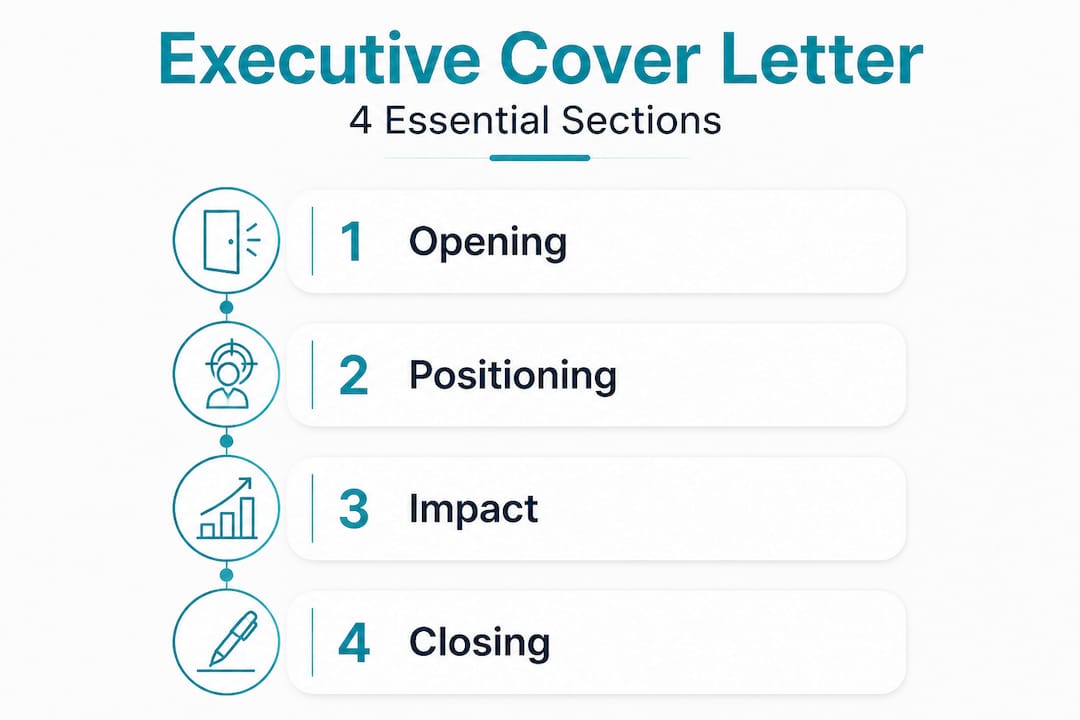
Structure matters. A disorganized letter, even one with strong content, signals poor communication skills. At the executive level, that’s a serious red flag. Here’s a proven four-part structure:
-
Opening paragraph: Intent and hook. State clearly why you’re writing and lead with a specific insight about the company or role. Avoid “I am writing to apply for…” and instead open with something that demonstrates you’ve thought about their business.
-
Leadership narrative: Philosophy and approach. In one to two paragraphs, describe your leadership style, how you build teams, how you navigate complex challenges, and what you believe drives sustainable organizational performance. This is the section most candidates skip, and it’s the one that creates the strongest impression.
-
Strategic alignment: Connect your experience to their needs. Reference one or two specific achievements that directly relate to the company’s current situation. Use metrics where possible, but prioritize relevance over raw numbers.
-
Motivated close: Forward-looking and confident. End by expressing genuine enthusiasm for the specific opportunity and indicating your readiness to discuss how you’d approach the role. Avoid passive closes like “I hope to hear from you.”
Here’s a quick comparison of what each section should and should not include:
| Section | Include | Avoid |
|---|---|---|
| Opening | Company-specific insight, clear intent | “I am writing to apply for…” |
| Leadership narrative | Philosophy, style, real examples | Generic buzzwords, vague claims |
| Strategic alignment | Specific achievements, relevant metrics | Resume-style bullet points |
| Close | Enthusiasm, forward-looking statement | “Please find my resume attached” |
The cover letter frameworks that work best at the executive level are not rigid templates. They’re flexible structures that give your narrative a clear shape while leaving room for your voice and your specific story.
One more thing worth noting: length. One page is the standard, and it’s the right call. If you can’t make your case in 350 to 450 words, the letter needs editing, not expanding. Brevity at the executive level is itself a signal of strong communication skills.
A key executive nuance is that the cover letter is expected to demonstrate executive presence and strategic thinking, so every word should earn its place on the page.
Why cover letters still give senior candidates an edge, if used right
Let’s step back and look at when and why cover letters really move the needle for executive job seekers.
Here’s an honest take that most career advice skips over: a cover letter is not always better than no cover letter. A generic, poorly written, or resume-repeating letter can actually hurt your candidacy. It signals low effort, weak communication skills, or a lack of genuine interest in the role. In those cases, submitting nothing would have been a better choice.
But that’s exactly why the cover letter is such a powerful differentiator for executives who use it well. Because so many candidates either skip it or phone it in, a genuinely strong, tailored, strategically framed letter stands out dramatically. You’re not competing against perfection. You’re competing against a sea of mediocrity.
The cover letter’s primary function as a context-and-positioning tool means it’s the one document in your application that lets you speak as a whole person, not just a list of credentials. Your resume shows what you’ve done. Your cover letter explains why it matters, where you’re headed, and why this specific company and role fits into that trajectory.
For career changers and executives returning after a break, this is especially important. A well-crafted cover letter can reframe a non-linear career path as a strategic asset rather than a liability. It lets you get ahead of the narrative before the reader forms their own conclusions.
The professionals who treat cover letters as a strategic communication tool, rather than a box to check, consistently report better response rates and more meaningful conversations with hiring teams. That’s not a coincidence. It’s the result of giving decision-makers exactly what they need to say yes.
Investing in effective applications for executives means treating every element of your job search materials with the same strategic rigor you’d bring to a board presentation.
Take action: Create a memorable executive cover letter today
If you’ve read this far, you already understand that a well-crafted cover letter is not optional at the executive level. It’s a strategic asset. The next step is putting that knowledge into practice, and that’s where having the right support makes all the difference.
At Resume Wiz, we specialize in helping mid-to-senior professionals and executives build application materials that actually open doors. Our team brings over a decade of recruiting experience to every cover letter, resume, and LinkedIn profile we craft. We know what hiring managers and executive recruiters look for because we’ve sat on that side of the table. When you work with us, your cover letter won’t just check a box. It will position you as a strong choice. Explore professional executive cover letter help and take the first step toward a job search that works as hard as you do.
Want a recruiter in your corner for your next senior role? Book a free call with Resume Wiz and we will map out your next move together.
Frequently asked questions
Are cover letters really read by executive recruiters?
Yes, executive recruiters often read cover letters to assess context, motives, and culture fit beyond the resume. As hiring experts confirm, at the senior level they function primarily as a positioning tool, not an ATS filter.
What should an executive cover letter focus on?
Highlight your leadership philosophy, strategic thinking, and direct alignment with the company’s challenges, not just past achievements. Executive-specific cover letters are expected to demonstrate how you think and lead, not simply restate your roles.
Do I need to submit a cover letter if the job posting says optional?
Submitting a tailored cover letter is still strongly recommended for executives because it sets you apart and shows genuine interest. Given that cover letters serve as positioning tools at the senior level, skipping one means leaving a key differentiator on the table.
How long should an executive cover letter be?
One page is ideal, typically 350 to 450 words, focusing on impact, context, and your motivation for the specific role.
Should I address gaps or a career change in my cover letter?
Absolutely. Executive cover letters are ideal for explaining career shifts and framing them as intentional, strategic decisions. Leaving a transition unexplained forces the reader to fill in the blanks, and context-setting is exactly what the executive cover letter is designed to do.
