The Role of LinkedIn During an Industry Switch
Switching industries is one of the most ambitious career moves you can make, and LinkedIn is the single most powerful tool you have to pull it off. The role of LinkedIn during an industry switch goes far beyond uploading a resume and waiting for recruiters to call. LinkedIn is a living ecosystem where visibility, narrative, and relationships converge. When you approach it strategically, it becomes your primary channel for repositioning your professional identity, connecting with insiders who have already made the move you are planning, and landing interviews that would never have come through a cold application. This guide breaks down exactly how to use it.
Table of Contents
Key takeaways
PointDetailsProfile is your pitchRewrite your headline, About section, and skills specifically for the industry you are targeting, not the one you are leaving.Algorithm rewards qualitySubstantive comments and complete profiles get far more recruiter visibility than passive browsing ever will.Bridge connections are goldProfessionals who have already crossed your exact career gap are your most valuable LinkedIn contacts.Consistency beats intensityFive to ten meaningful weekly interactions outperform one-time mass outreach campaigns every time.LinkedIn complements, not replacesPair LinkedIn activity with offline networking to avoid mistaking online engagement for real progress.
The role of LinkedIn during an industry switch
Most professionals treat LinkedIn as a static document. They set it up once, keep the job titles accurate, and hope for the best. When you are switching industries, that approach will quietly kill your chances before a single recruiter even sees your name.
The platform’s 2026 algorithm is built around relevance and engagement, not tenure or job titles. It rewards profiles that speak clearly to a target industry and users who participate actively in relevant conversations. If your profile still reads like a summary of your old career, the algorithm will keep surfacing you to the wrong people.
Here is what actually matters to the algorithm right now:
Profile completeness. LinkedIn weights complete profiles dramatically higher in search results. Every section you skip is visibility you are giving away.
Skills alignment. LinkedIn’s Semantic Skill Graph infers candidate relevance to roles beyond simple keyword matching, which means the way you describe your experience contextually matters as much as the specific words you use.
Engagement signals. The algorithm treats comments over 15 words as 2.5 to 15 times more valuable than a simple like. Thoughtful comments on posts in your target industry get you seen by the right people fast.
Open to Work settings. With over 220 million users on the Open to Work feature in early 2026, the public badge increases recruiter inbound messages by 40%. If you are concerned about your current employer seeing the badge, the Recruiters Only setting offers more discretion, though it is not completely airtight.
Pro Tip: Before updating anything, search for five to ten job postings in your target industry and note the exact skill language they use. Build those precise terms into your profile before you start any outreach.
Rewriting your profile for a new industry
Your LinkedIn headline is not a job title. It is advertising copy. During an industry switch, most people write headlines that either describe where they have been or vague aspirational phrases like “Seeking opportunities in tech.” Neither one works.
The stronger approach is to lead with the transferable value you bring. A healthcare operations manager moving into management consulting might write: “Operations Leader | Systems Thinking & Process Improvement for Complex Organizations.” That framing speaks directly to what consulting firms actually buy.
The same logic applies to your About section. Here is how to structure it for maximum impact during a transition:
Open with the problem you solve, not your career history. Speak to the target industry’s pain points first.
Acknowledge your background briefly and frame it as the source of your unique perspective, not as a disclaimer.
Close with a clear statement of what you are pursuing and why. Ambiguity costs you.
When it comes to experience descriptions, restructuring your profile around transferable skills rather than past job titles gets you surfaced significantly more in recruiter searches. Instead of describing what your old role was, describe what you accomplished in terms that resonate in your new space. “Led cross-functional teams to reduce operational costs by 22%” reads well in almost any industry. “Managed department operations per company protocol” reads well in none.
Avoid language that signals uncertainty or desperation. Phrases like “open to anything” or “passionate about making a change” undermine you. Confidence in your narrative creates confidence in the reader.
Pro Tip: Have someone currently working in your target industry read your profile and tell you what role they think you are going for. If they cannot tell clearly, rewrite until they can.
Building connections that actually open doors
85% of jobs are filled through networking, and most of that activity happens on LinkedIn. The problem is that most people network transactionally. They connect, then immediately ask for a favor. That approach burns goodwill faster than it builds it.
The most effective LinkedIn networking strategy for an industry switch is built on three moves.
Find bridge connections first. Use LinkedIn’s search filters to identify people who have held roles in both your current and target industries. These professionals have a 73% willingness to help someone who approaches them thoughtfully. They are not just contacts. They are living maps of the exact path you are trying to take.
Personalize every single connection request. Generic requests get accepted less than 20% of the time. Personalized requests referencing shared context achieve acceptance rates over 70%. Reference a specific article they wrote, a comment they made, or a shared professional interest. One sentence of genuine context does more than three sentences of flattery.
Engage before you ask. Leave substantive comments on posts from people in your target industry for two to three weeks before you ever send a connection request. This is not manipulation. It is relationship-building in the order relationships actually work. By the time you reach out, your name is already familiar.
When requesting informational interviews, be specific and respectful of time. Avoid vague phrases like “pick your brain” and instead offer a clear, time-bounded ask: “Would you have 20 minutes to share your perspective on breaking into product management from a finance background? I am happy to work around your schedule and will keep it brief.” That kind of message converts.
Creating daily momentum on LinkedIn
Strategy without execution is just theory. Career switchers who gain traction on LinkedIn do so through consistency, not occasional bursts of activity.
Here is a weekly activity framework that works:
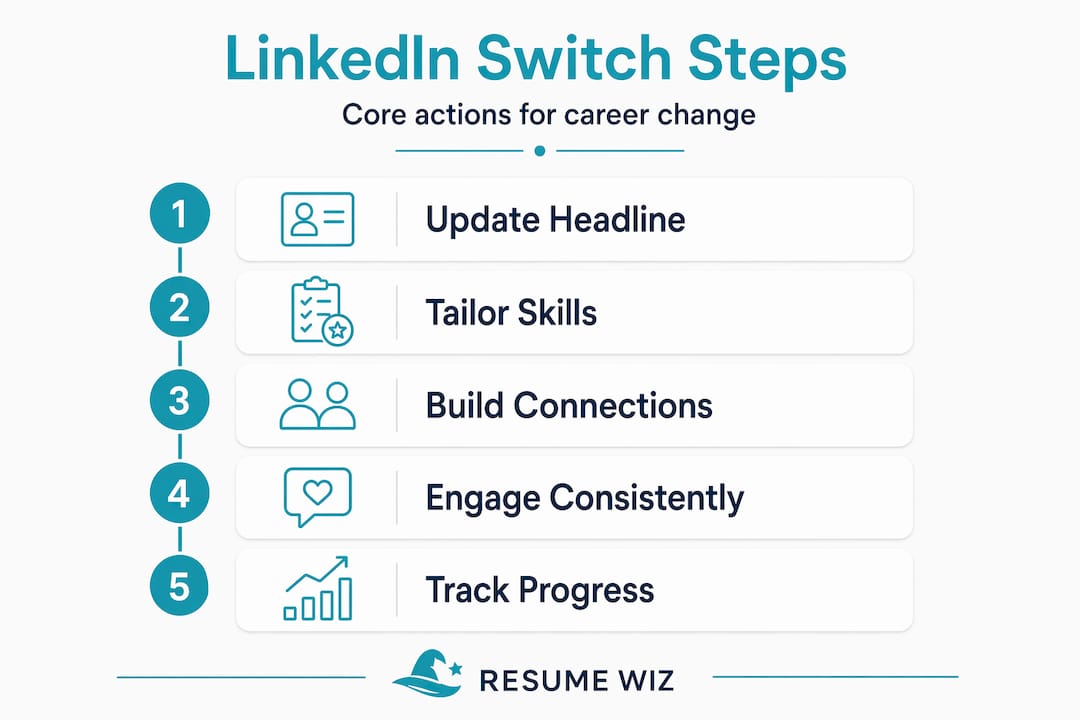
ActivityFrequencyGoalSubstantive comments on industry posts3 to 5 per weekBuild visibility with target-industry professionalsPersonalized connection requests5 to 10 per weekGrow relevant network incrementallyProfile views check and analytics reviewWeeklyIdentify what is working and adjustInformational interview outreach1 to 2 per weekBuild relationships with insidersOriginal post or article share1 per weekEstablish thought presence in new industry
Consistent engagement routines outperform sporadic mass outreach in every measurable way. The professionals who try to compress all their LinkedIn activity into one weekend followed by two weeks of silence get almost no results. Five meaningful interactions each week for three months will open far more doors.
Timing also matters more than most people realize. Posting during the first 60 to 90 minutes after you publish, when your target audience is active, increases content reach by up to 40%. Tuesday through Thursday between 8 and 10 AM or noon and 2 PM consistently outperform other windows.
Use LinkedIn’s built-in analytics to track profile views, search appearances, and connection acceptance rates weekly. A drop in profile views after you update your headline tells you something. A spike after a comment goes viral in a niche community tells you something else. Let the data guide your adjustments rather than guessing.
The one critical warning here: do not let LinkedIn activity become a substitute for real-world networking. The platform works best when it opens doors that you then walk through in person, by phone, or on video. Scrolling and commenting for three hours a day while declining to attend any industry events is a version of very productive procrastination.
My honest take on LinkedIn and industry switches
I have spent over 10 years watching professionals navigate career transitions, and the pattern I see repeatedly is this: people spend too much time polishing and not enough time connecting. They rewrite their headline five times but send two connection requests a month.
In my experience, the LinkedIn profiles that generate real traction during an industry switch are not the most elaborate ones. They are the clearest ones. When I look at a profile and can immediately understand who this person is targeting and why their background makes them a credible candidate, that profile works. When I have to guess, it does not.
What I have also found is that the professionals who treat LinkedIn as a long game win it. They are not the ones who send 50 connection requests the first week and give up when the response rate is low. They are the ones who comment thoughtfully on five posts, follow up on two conversations, and stay visible for months. That kind of consistency builds a small network of genuinely engaged connections that is worth far more than a list of 500 cold contacts.
The harder truth is that LinkedIn cannot do the whole job. It surfaces you, frames your story, and gets you into conversations. But at some point, a human being has to decide you are worth a conversation, and that decision is made based on relationships and reputation, not algorithms. Build both.
Kim
Take your LinkedIn profile to the next level
If you have read this far and are thinking, “I know what needs to change but I am not sure how to say it,” that is exactly where professional support pays off.

At Resumewiz, we specialize in helping career professionals reframe their experience for new industries, from rewriting headlines and About sections to building keyword-optimized skills profiles that get noticed by recruiters. Our LinkedIn optimization services are designed specifically for career changers who need their profile to do real work, not just look good. When your profile, your outreach, and your narrative all point in the same direction, the results come faster.
Want a recruiter in your corner for your next senior role? Book a free call with Resume Wiz and we will map out your next move together.
FAQ
What is the most important LinkedIn section to update during an industry switch?
Your headline and About section are your highest-priority updates because they are the first things a recruiter reads. Restructure both to speak directly to your target industry, not your current one.
How does the Open to Work feature help when changing industries?
The public Open to Work badge increases recruiter inbound messages by 40%. If you want discretion from your current employer, the Recruiters Only setting limits visibility while still signaling availability.
How many LinkedIn connections do I need for an industry switch?
Quality matters far more than quantity. A focused network of 50 to 100 genuine connections in your target industry will generate more real opportunities than thousands of cold, unengaged contacts.
What are bridge connections and why do they matter?
Bridge connections are professionals who have already transitioned between your current and target industries. They understand both worlds and are highly willing to help career switchers who approach them with clear, specific asks.
How long does it take to see results from LinkedIn networking during a career switch?
Most professionals see meaningful traction within two to three months of consistent activity. Sporadic effort rarely produces results. Commit to a weekly routine and give it at least 60 days before evaluating what is working.
