Transform your job search: Build and optimize your funnel
Most experienced professionals treat job applications as a numbers game, firing off dozens of resumes each week and wondering why interviews stay scarce. The real leverage, however, comes from a completely different place: identifying and fixing the specific “leaks” in your job search process, using the same funnel logic that top recruiters apply to their own hiring pipelines every day. When you start viewing your search through this structured lens, you stop guessing and start making precise improvements that actually move the needle. This guide shows you exactly how to do that.
Table of Contents
- Understanding the job search funnel: The recruiter’s playbook
- Stages of the job search funnel and where candidates leak out
- Diagnosing and fixing leaks: Applying funnel metrics to your job hunt
- Beyond volume: Why more applications don’t always result in better outcomes
- The uncomfortable truth most professionals ignore about job search funnels
- Optimize your job search funnel with expert support
- Frequently asked questions
Key Takeaways
| Point | Details |
|---|---|
| Funnel stages matter | Mapping your job hunt as a funnel lets you identify exactly where you lose momentum. |
| Track your conversion rates | Using funnel metrics reveals weak spots so you can make targeted improvements. |
| Quality beats quantity | More applications are less effective if you aren’t fixing leaks at ATS or interview stages. |
| Segment your job sources | Comparing referrals, cold applications, and recruiter outreach optimizes your effort. |
| Small tweaks, big impact | Addressing stage-specific issues in your funnel often results in more interviews with less wasted effort. |
Understanding the job search funnel: The recruiter’s playbook
Recruiters have used funnel thinking for decades. They track candidates from the moment a job posting goes live all the way through to a signed offer letter, measuring conversion at every step. What most professionals never realize is that you can and should apply the exact same model to your own search.
A job search funnel mirrors this recruiting logic almost perfectly. Funnel strategy for always-on hiring uses three broad stages: top (awareness and attraction), mid (interest and application), and bottom (evaluate, interview, and hire). As a job seeker, your funnel follows the same structure. You discover opportunities, you apply, you get screened, and ideally you receive an offer.
The power of this model is that it transforms a vague, stressful experience into a measurable process. Rather than feeling like your search is a black box, you have a visible structure to analyze. Each stage can be tracked, tested, and improved independently.
Here is how the two funnels compare side by side:
| Recruiter’s funnel stage | Your equivalent stage | What it measures |
|---|---|---|
| Sourcing and attraction | Opportunity discovery | Jobs found per week |
| Application review | Submitting applications | Applications per jobs found |
| Phone screen | Recruiter or HR screen | Screens per application |
| Interview rounds | Hiring manager interviews | Interviews per screen |
| Offer and close | Offer received | Offers per interview |
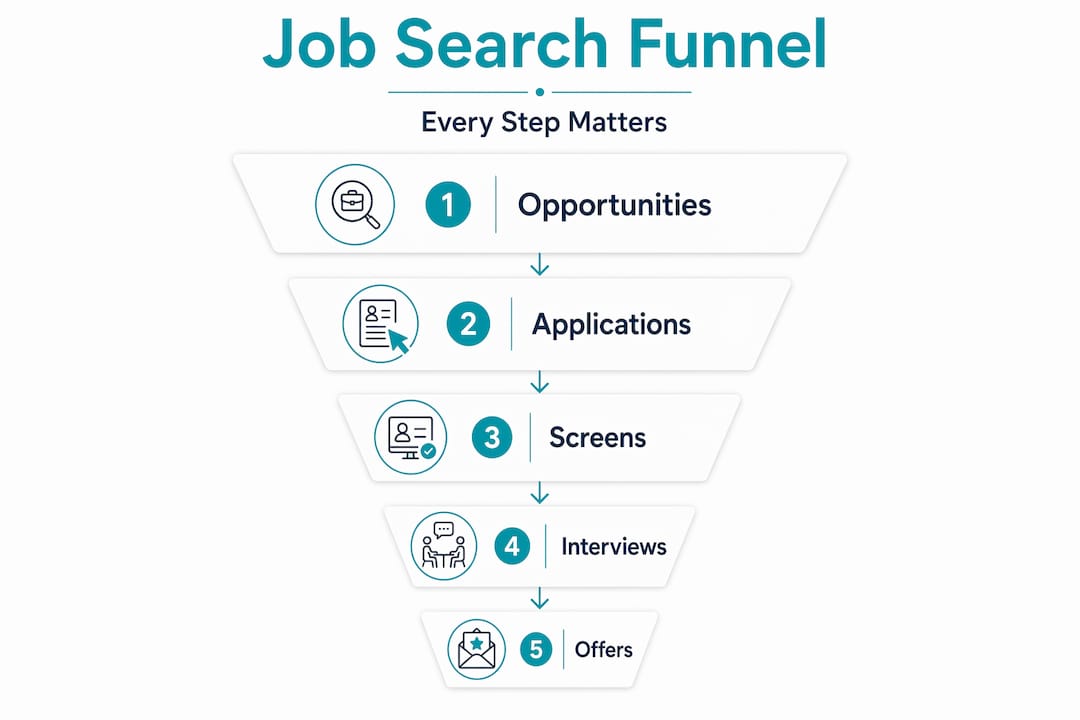
The professionals who consistently land senior roles treat this pipeline the way businesses treat sales performance data. They track their numbers, identify weak stages, and adjust their approach with precision. This is not obsessive spreadsheet management. It is simply using the right mental model to make smarter decisions.
Key behaviors of high-performing job seekers:
- They track the number of opportunities discovered versus applied weekly
- They note which sources (LinkedIn, referrals, recruiters) produce the most screens
- They review interview feedback to identify recurring objections
- They set stage-specific goals rather than just aiming for “more applications”
“The difference between a struggling job search and a successful one is rarely effort. It’s almost always measurement. When you know where candidates drop off, you know where to invest.”
Stages of the job search funnel and where candidates leak out
Now that you understand the big picture, let’s zoom in on where most job searches break down, often unnoticed.
Every stage of your funnel has its own conversion rate, and there are predictable drop-off points that catch even senior professionals off guard. Researchers in recruiting conversion metrics define these as the percentage of people who move from one stage to the next, and understanding those percentages is how you find your specific problem.
Here is a realistic data snapshot for mid-career and executive candidates using cold applications through job boards:
| Funnel stage | Typical conversion rate | Common problem |
|---|---|---|
| Jobs found to applied | 30 to 50% | Too selective or not selective enough |
| Applied to ATS screen passed | 10 to 30% | Resume not optimized for ATS parsing |
| Screen to recruiter call | 20 to 40% | Weak headline or outdated LinkedIn |
| Recruiter call to interview | 40 to 60% | Poor positioning or salary mismatch |
| Interview to offer | 15 to 30% | Interview preparation gaps |
These numbers reveal something critical: the leakiest stage for most professionals is the ATS screen. Your resume may never reach a human if it is not formatted for automated tracking systems. For executive candidates especially, a resume that reads beautifully in PDF can fail completely when parsed by software.
The five stages most candidates encounter, and where they commonly lose traction:
- Discovery: Not finding enough relevant roles because search terms are too narrow or too broad, or because they rely only on job boards rather than referrals and recruiter relationships.
- Application: Applying with a generic resume rather than a tailored document that mirrors the language of the specific job description.
- ATS screening: Getting filtered out automatically because of formatting issues, missing keywords, or incorrect file types.
- Recruiter or HR screen: Failing to communicate value quickly and clearly in the first 30 seconds of a phone screen.
- Hiring manager interview: Struggling to tell a compelling story about career trajectory, achievements, or leadership impact at the level the role demands.
Pro Tip: Track your funnel using a simple spreadsheet with columns for each stage. After three to four weeks, you will have enough data to see exactly where your search is stalling. Tools for managing job search conversion can help you systematize this process and spot patterns faster.
The channel tracking piece is equally revealing. Referrals almost always convert at two to three times the rate of cold applications. If you are spending 80% of your effort on job boards and 20% on networking, you may be investing heavily in your least effective channel.
Diagnosing and fixing leaks: Applying funnel metrics to your job hunt
To move from awareness to action, let’s get tactical about analyzing your own funnel and making measurable changes.
The first step is collecting your own data. Start tracking every job you find, every application you submit, every screen, every interview, and every offer. Within a month, you will have a personal conversion table that tells you far more than any generic job search advice can. Think of it like a health checkup for your search: without the numbers, you are guessing at a diagnosis.
The practical methodology here is to treat your search like a measurable pipeline, segment by channel (referrals versus cold apply versus recruiter inbound), and then run targeted improvements on the stage that is leaking rather than assuming the whole process needs an overhaul.
Here is how to act on what you find:
- If discovery is low: Expand your sourcing. Set up job alerts using more varied keyword combinations, reach out directly to executive recruiters in your niche, and activate your network by letting trusted colleagues know you are open to opportunities.
- If ATS conversion is low: Rebuild your resume with clean formatting. Use standard section headings like “Work Experience” and “Education.” Avoid tables, text boxes, and images inside the document. Mirror the exact language from job postings you target.
- If screen-to-interview conversion is low: Rewrite your LinkedIn headline and summary. The recruiter almost always checks LinkedIn before or after the first call. A profile that reinforces your resume dramatically increases your chances of moving forward.
- If interview-to-offer conversion is low: Invest in structured interview preparation. Practice telling achievement stories using a clear situation, action, result format. Record yourself and review the footage honestly. This is the stage where most senior professionals underinvest, assuming that experience speaks for itself.
Pro Tip: Segment your tracking by source from day one. When you look back at your job search funnel steps after 30 days, you want to know whether your interviews came from referrals, LinkedIn outreach, recruiter calls, or cold job board applications. That data will tell you exactly where to double down.
Statistic callout: Studies on executive job searches consistently show that referral-sourced candidates are hired at rates up to three times higher than candidates who apply cold through job boards. If referrals are generating better interviews for you, that is your signal to shift your effort toward networking rather than mass applying.
The goal of this diagnostic process is not to make your search feel like a corporate metrics review. It is to give you clarity so you can make intentional decisions rather than reactive ones. Every hour you spend improving a leaky stage is worth more than hours spent adding volume to a broken process.
Beyond volume: Why more applications don’t always result in better outcomes
With a method for tracking and fixing leaks, it is vital to avoid a common pitfall: mistaking volume for progress.
It is tempting to believe that sending out more applications will eventually produce results. And at some point it might. But if your main leak is in the ATS screen or the recruiter call stage, you are essentially adding more water to a bucket with a hole in the bottom. The bucket never fills, and you exhaust yourself in the process.
Low conversion is often a stage-specific problem: ATS parsing, recruiter screens, and interview calibration are all distinct failure points. Volume alone will not fix outcomes if the leak is upstream of applications or embedded in the screening process. This reframing is especially important for senior professionals, where the stakes of each opportunity are high and the number of truly right-fit roles is naturally smaller.
Why quality improvements outperform volume at the executive level:
- A tailored resume with the right keywords has a dramatically higher chance of passing ATS than a generic one, regardless of how many you send
- A well-crafted LinkedIn profile generates inbound recruiter interest, which converts at far higher rates than outbound cold applications
- Thorough interview preparation turns marginal interview performance into compelling conversations that generate offers
- Focused targeting of roles that genuinely fit your experience and goals means you walk into every interaction with conviction and energy
“Spraying and praying with job applications is a junior-level strategy applied to a senior-level search. The math does not work, and the results show it.”
The mental shift required here is significant. Most professionals were trained to equate effort with volume, but senior job searching rewards precision over persistence. When you know your funnel, you know exactly where your next hour of effort will produce the most return.
The uncomfortable truth most professionals ignore about job search funnels
With all the practical tactics covered, let’s reflect on what separates successful executive job-seekers from the rest.
Here is something most career advice will not tell you directly: the majority of professionals, including very accomplished ones, never measure their job search at all. They apply, wait, feel uncertain, apply more, and repeat. They attribute slow progress to a tough market or bad luck, when the real issue is a fixable process problem they have never bothered to quantify.
This avoidance is understandable. Looking at your own conversion data honestly can feel uncomfortable. What if the numbers reveal that you have sent 80 applications and received two screens? That is hard to sit with. But it is also incredibly actionable information. Without that data, you might keep doing the same thing for another three months and wonder why nothing changes.
The professionals who move fastest through their searches, particularly at the director, VP, and C-suite levels, are the ones who treat their search like a project with metrics, milestones, and review cycles. They are not necessarily more talented or better connected than you. They are simply more disciplined about examining what is working and what is not.
Real executive searches are won through focused process improvements: a resume rewritten to clear ATS filters, a LinkedIn profile rebuilt to attract recruiter inbound, an interview narrative sharpened to communicate leadership impact with precision. These are targeted, strategic improvements to specific funnel stages, not random increases in volume.
The uncomfortable truth is that most job seekers outsource accountability to the market. They think, “I applied, now it is up to them.” The funnel mindset flips that entirely. Your conversion rates are within your control. The stage where you are leaking is almost always fixable with the right diagnosis and the right support.
Optimize your job search funnel with expert support
Ready to put this funnel approach into practice? Here is how Resume Wiz can help you close the gap and land the interviews you want.

At Resume Wiz, every service is designed to address a specific stage of your job search funnel. Whether your resume is getting filtered out before a human sees it, your LinkedIn profile is not generating inbound interest, or your interview performance needs sharpening, the platform has a targeted solution. Kim Taynor’s decade-plus of recruiting experience means you get guidance built on how hiring decisions are actually made, not generic advice. Resume Wiz solutions include ATS-optimized resume development, LinkedIn profile rebuilds, personalized outreach templates, and interview coaching, all structured to improve your funnel conversion at exactly the right stage.
Want a recruiter in your corner for your next senior role? Book a free call with Resume Wiz and we will map out your next move together.
Frequently asked questions
What are the main stages of a job search funnel?
The main stages are opportunity awareness, application, screening, interview, and offer acceptance. Recruiting funnel strategy maps these to the top (awareness), mid (interest and application), and bottom (evaluate and hire) stages that organizations use internally.
Why is tracking job search funnel metrics important?
Tracking funnel metrics shows you the exact stage where your process breaks down, so you can target your improvements rather than overhauling everything at once. Conversion metrics reveal what percentage of candidates advance from each stage, giving you a clear diagnostic tool.
How can I tell if my job search funnel is leaking?
Review how many of your submitted applications convert to recruiter screens and interviews. If that rate is low, that drop-off marks your primary leak. A measurable pipeline approach helps you pinpoint whether the problem is in ATS screening, recruiter calls, or interviews.
Does applying to more jobs always improve results?
No. If your leak is in ATS screening or interview performance, adding more applications will not fix the core issue. Low conversion is typically a stage-specific problem that requires a stage-specific solution, not higher volume.
