Senior Leadership Competency Types Every Executive Must Know
The core types of senior leadership competencies fall into eight families: strategic thinking, organizational influence and stakeholder management, financial and business acumen, change and innovation leadership, talent and people development, ethical leadership and governance, cross-functional and global leadership, and digital and technology fluency. At the senior level, these families matter because the stakes shift from team outcomes to enterprise-wide consequences, and the problems you face rarely come with a clear playbook. Before reading further, run a quick self-check: for each family, ask whether you can name a recent example where you applied it at an enterprise scale. That gap between “yes” and “I’m not sure” is exactly where your development plan should start.
Key takeaways
Senior leadership competency development requires mapping the right families, assessing your current proficiency level honestly, and sequencing development around your highest-impact gap rather than spreading effort across every area at once.
| Point | Details |
|---|---|
| Eight core competency families | Strategic, influence/stakeholder, financial acumen, change leadership, talent development, ethics/governance, cross-functional, and digital fluency. |
| Senior vs. mid-level distinction | Senior competencies operate at enterprise scope, longer time horizons, and higher stakeholder complexity than mid-level management skills. |
| Assessment before development | Use a structured self-check, 360 behavioral questions, and a proficiency-level matrix before designing a development plan. |
| Sequencing over breadth | Fix your top derailer first; then build coalition and influence skills as the highest-leverage entry point for most new C-suite leaders. |
| Resumewiz for career translation | Resumewiz converts your competency evidence into executive resumes, LinkedIn profiles, and interview narratives that reach the right decision-makers. |
Table of Contents
- What are the main types of senior leadership competencies?
- How do senior competencies differ from mid-level management skills?
- Which frameworks help you benchmark senior leadership competencies?
- How do you assess which senior leadership competencies you need?
- How do senior leaders actually build these competencies?
- What gaps and derailers most often trip up senior leaders?
- What actually matters most when you are building your senior leadership plan
- How Resumewiz helps you turn competencies into a career-defining narrative
- Sources
What are the main types of senior leadership competencies?
Senior leadership competencies organize into eight families, each containing specific skills that look different at the executive level than they do in mid-level management. The catalog below maps each family to concrete behaviors so you can locate yourself within it.
Strategic competencies
- Strategic thinking: Scanning the external environment, synthesizing trends, and making resource bets across a 3 to 5 year horizon. At the executive level, this means presenting a coherent market thesis to the board, not just a departmental roadmap.
- Scenario planning: Building and stress-testing multiple futures so the organization can pivot without panic. A senior leader runs war-game exercises with the executive team; a manager updates a project risk log.
- Portfolio prioritization: Deciding which initiatives get funded and which get cut based on enterprise return, not departmental loyalty.
- Vision setting: Translating a long-range strategy into a narrative that employees at every level can act on.
Wharton frames executive management skills around enterprise outcomes rather than functional depth. This is why strategic thinking sits at the top of every serious C-suite skills list.
Organizational influence and stakeholder management
- Executive presence: Commanding credibility in the boardroom, with regulators, and in public forums, not just in team meetings.
- Building coalitions: Aligning peers, external partners, and board members around a shared agenda. The OPM ECQ framework treats this as a distinct competency separate from general stakeholder management.
- Political savvy: Reading organizational dynamics and timing influence moves accordingly.
- Negotiation at scale: Structuring deals, partnerships, and budget decisions where the counterpart has equal or greater authority.
Financial and business acumen
- P&L ownership: Understanding how revenue, cost, and capital decisions interact across the full income statement, not just a departmental budget line.
- Capital allocation: Evaluating investment cases and making trade-offs between growth, efficiency, and risk.
- Financial storytelling: Translating financial data into a narrative that non-finance board members and investors can act on.
- Risk and compliance literacy: Knowing enough about regulatory exposure to ask the right questions of your legal and finance teams.
Change and innovation leadership
- Change architecture: Designing the structure of a transformation, including governance, communication cadence, and resistance management.
- Leading through uncertainty: Maintaining organizational confidence and direction when the outcome is genuinely unknown. Leadership IQ research identifies this as one of the hardest-to-hire-for senior capabilities.
- Innovation sponsorship: Creating conditions for experimentation without exposing the core business to unacceptable risk.
- Organizational resilience: Building systems and culture that absorb shocks and recover faster than competitors.
Talent and people development
- Succession planning: Identifying and deliberately developing two or three potential successors for every critical role, including your own.
- Coaching at scale: Moving from coaching individuals to building a coaching culture across the leadership pipeline.
- Talent pipeline management: Assessing bench strength across the organization and making targeted investments to close gaps.
- Inclusive talent practices: Designing hiring, promotion, and development processes that surface capability regardless of background.
Leaders who systematically develop successors reduce operational risk and increase board confidence. Talent development is not a soft skill at the senior level; it is a governance responsibility.
Ethical leadership and corporate governance
- Principled decision-making: Holding ethical lines under commercial pressure, including when the financially attractive option conflicts with stated values.
- Governance fluency: Understanding board structures, fiduciary duties, audit committee expectations, and disclosure obligations.
- Transparency and accountability: Modeling the reporting and escalation behaviors you expect from the organization.
- Stakeholder ethics: Balancing shareholder returns against employee, community, and environmental obligations.
IESE’s C-suite leadership skills research places principled behavior and emotional intelligence at the top of the list for executive effectiveness, ahead of functional expertise.
Cross-functional and global leadership
- Working across boundaries: Driving outcomes through functions, geographies, and business units you do not control.
- Cultural intelligence: Adapting leadership style and communication to different national and organizational cultures.
- Systems thinking: Seeing how decisions in one part of the enterprise ripple through others.
- Enterprise perspective: Consistently prioritizing company-wide outcomes over divisional wins.
Digital and technology fluency
- Data literacy: Interpreting dashboards, understanding statistical confidence, and asking the right questions of your analytics team.
- AI and automation strategy: Framing where AI creates value in your business model and where it introduces risk.
- Cybersecurity governance: Understanding threat exposure well enough to set policy and allocate resources.
- Digital transformation sponsorship: Championing technology investments and modeling adoption behaviors for the organization.
Digital fluency at the senior level is less about hands-on engineering and more about framing strategy around data and AI opportunities while governing the associated risks.
Pro Tip: Emotional intelligence (EQ) cuts across every family above. Technical skill gets you to the senior level; EQ determines whether you stay there. Executives with low EQ tend to derail on stakeholder conflict, talent retention, and change resistance, not on strategic or financial decisions.
How do senior competencies differ from mid-level management skills?
The difference is not just scope. It is the nature of the problems, the time horizon of the decisions, and the consequences of being wrong.
A mid-level manager applies communication skills by coaching a direct report through a performance conversation. A senior executive applies the same competency by crafting a town-hall narrative that holds organizational confidence during a restructuring, then adapting that message for the board, the press, and a skeptical regulator, all in the same week. The skill label is identical; the application is a different job.
Three dimensions separate senior from mid-level competency application:
Scope and accountability. Mid-level managers are accountable for team or departmental outcomes. Senior leaders are accountable for enterprise outcomes, which means their decisions affect people and functions they may never meet. A budget cut that looks rational at the divisional level can hollow out a capability the company needs in the future.
Ambiguity and novelty. Most mid-level problems have precedent. Senior leaders routinely face situations where no one in the organization has been here before. The competency that matters most in those moments is not expertise; it is the ability to make a high-quality decision with incomplete information and then hold the organization steady while the outcome plays out.
Stakeholder complexity. Mid-level managers manage up, down, and across within the organization. Senior leaders manage a much wider field: boards, investors, regulators, union representatives, community stakeholders, and external partners who have their own agendas and their own power.
CCL’s research on senior-level trade-offs makes this concrete: the Fundamental 4 skills (self-awareness, communication, influence, and learning agility) do not disappear at the senior level. They get applied at a different altitude, across boundaries and with higher stakes, while new capabilities like working across organizational silos and acting strategically under pressure become non-negotiable additions.
What to stop doing when you move up. Stop solving problems your direct reports should own. Stop optimizing for your function’s metrics at the expense of enterprise metrics. Stop communicating in the detail-heavy style that worked when you were a subject-matter expert. Start asking better questions instead of providing better answers.
Which frameworks help you benchmark senior leadership competencies?
Several authoritative frameworks organize these competency families differently. Knowing which framework fits which purpose saves you from building a development plan on the wrong map.
OPM Executive Core Qualifications (ECQs). The U.S. Office of Personnel Management groups senior executive competencies into five ECQs: Leading Change, Leading People, Results Driven, Business Acumen, and Building Coalitions. Each ECQ contains specific competencies with proficiency-level behavior indicators ranging from basic to expert. This framework is the standard for U.S. federal Senior Executive Service hiring and is the most detailed publicly available proficiency-level guide for U.S. executives. Use it when you need to write ECQ narratives, benchmark against federal standards, or build a proficiency matrix for your organization.
CCL Fundamental 4 and Senior Capabilities. The Center for Creative Leadership grounds its framework in four foundational skills (self-awareness, communication, influence, learning agility) and layers senior-specific capabilities on top, including building an effective executive team, expanding influence across boundaries, and encouraging feedback. CCL’s research base makes this framework particularly strong for development planning and coaching conversations. Use it when you want a research-backed development curriculum or are designing a senior leadership program.
IESE C-Suite Skills. IESE’s framework covers ten traits: emotional intelligence, strategic vision, adaptability, principled behavior, resilience, innovation, decisiveness, results orientation, collaboration, and listening. It is organized around character and disposition as much as behavior, which makes it useful for executive selection and culture-fit assessment at the CEO-to-CFO level.
Wharton Executive Skills. Wharton frames C-suite competencies around enterprise outcomes: strategic thinking, change management, communication, and subject-matter expertise. The framing is deliberately outcome-linked rather than trait-based, which makes it useful for aligning executive development with business strategy.
DDI Leadership Competency Framework. DDI recommends defining observable behaviors and aligning competencies with the knowledge and experiences that build them, differentiating by level only when it changes how the competency is applied. DDI’s approach is the most practical for organizations building or auditing their own competency frameworks, because it pairs each competency with the stretch experiences and success profiles that develop it.
| Framework | Best used for | Competency families covered |
|---|---|---|
| OPM ECQs | Federal hiring, proficiency matrices | Leading Change, Leading People, Results Driven, Business Acumen, Building Coalitions |
| CCL Fundamental 4 | Development planning, coaching programs | Self-awareness, communication, influence, learning agility, plus senior-specific capabilities |
| IESE C-Suite Skills | Executive selection, culture-fit assessment | EQ, strategic vision, adaptability, resilience, decisiveness, collaboration |
| Wharton Executive Skills | Strategy-linked development | Strategic thinking, change management, communication, subject-matter expertise |
| DDI Framework | Competency framework design, succession | Observable behaviors paired with experiences and success profiles |
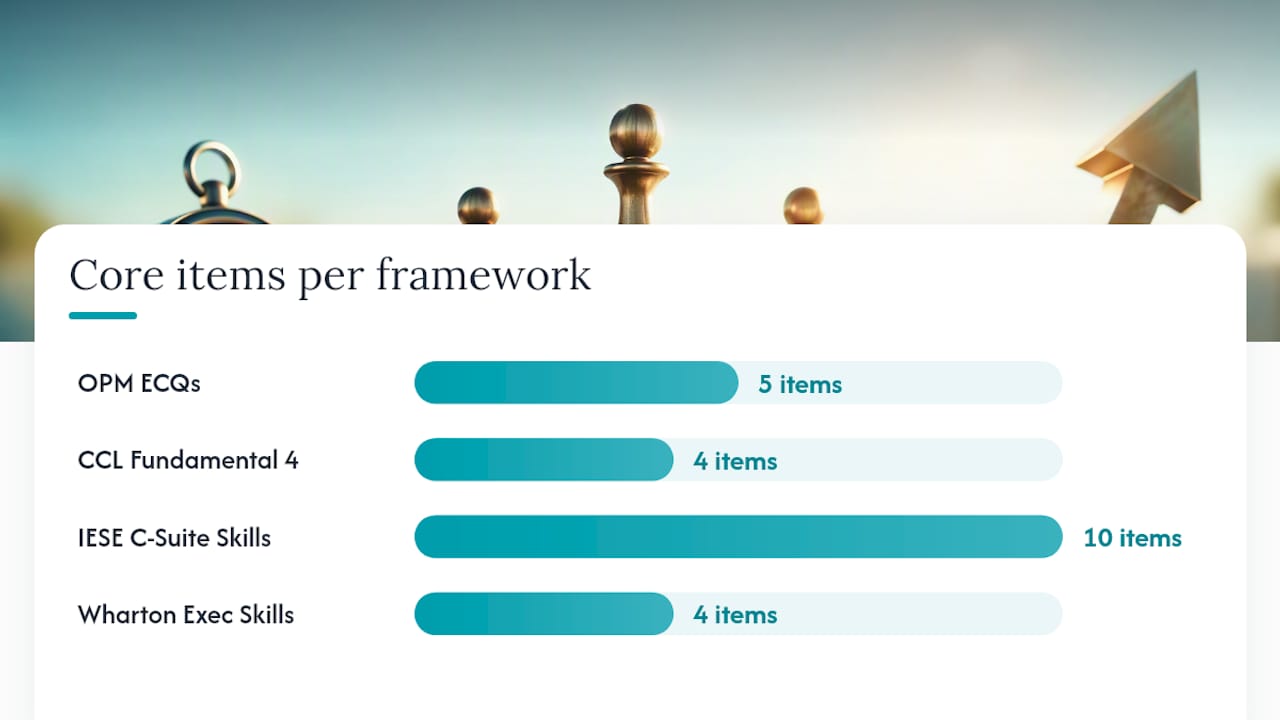
No single framework covers every family in the catalog above. In practice, most U.S. organizations use OPM ECQs as the structural backbone and pull from CCL or DDI for development design.
How do you assess which senior leadership competencies you need?
Assessment at the senior level requires more than a self-rating survey. The most useful toolkit combines a structured self-check, a 360-degree behavioral assessment, and a proficiency-level map.
A practical self-check
Work through these prompts for each competency family. Be specific: a vague “yes” is not evidence.
- Name the last time you made a decision that affected the enterprise, not just your function. What was the outcome?
- Who are your two or three potential successors? What are you actively doing to develop each one?
- When did you last change your position based on feedback from a peer or direct report?
- Describe how you influenced a decision you did not control. What was the mechanism?
- What is your organization’s biggest digital or data risk, and what have you done about it in the last six months?
Sample 360-degree behavioral questions
Use these with peers, direct reports, and board members to get calibrated external data.
- “When [leader] communicates strategy, does the message connect to enterprise priorities or does it feel functional and siloed?”
- “How does [leader] respond when a direct report brings a problem they could solve themselves?”
- “Can you describe a moment when [leader] held an ethical line under commercial pressure?”
- “How does [leader] handle a situation where the data is incomplete and a decision cannot wait?”
- “Does [leader] actively develop talent, or does development happen only when someone asks for it?”
Pro Tip: Ask your board chair or a trusted non-executive director to answer two or three of these questions. Board-level feedback is the rarest and most calibrating data a senior leader can get, and most executives never ask for it.
Proficiency levels for senior leadership competencies
The OPM proficiency structure translates well to any organization’s senior leadership assessment.
| Proficiency level | What it looks like in practice |
|---|---|
| Foundational | Applies the competency within own function; needs guidance on enterprise-wide application |
| Proficient | Applies consistently across functions; coaches others; adapts to moderate ambiguity |
| Advanced | Leads enterprise-wide application; shapes organizational capability; performs under high ambiguity |
| Strategic expert | Defines standards for the organization; builds systems that outlast their tenure; influences the field |
Most senior leaders entering a C-suite role for the first time are proficient in their functional competencies and foundational or proficient in enterprise-wide competencies. The development goal is to reach advanced across the full catalog within 18 to 24 months.
The University of Minnesota’s leadership competency framework offers a publicly available example of how level-differentiated descriptors work in practice, with role-specific indicators from individual contributor through senior leader.
How to interpret mixed feedback
Mixed 360 feedback, where peers rate you high and direct reports rate you low, is usually a signal about delegation and psychological safety, not about competence. When board members rate you lower than peers, the gap is usually about executive presence and strategic clarity. Treat the lowest-rated source as the most important signal, because that is the relationship where your blind spot is most likely to derail you.
How do senior leaders actually build these competencies?
Development at the senior level is not a course catalog problem. The activities that move the needle are almost always experiential, relational, or structural, not classroom-based.
A practical development roadmap
-
Months 1 to 3 (diagnosis and quick wins). Complete your self-check and 360 assessment. Identify your top two gap competencies. For each, design one small experiment: a new behavior you will practice in a specific recurring context (a weekly leadership team meeting, a monthly board update, a quarterly business review). Measure the response.
-
Months 4 to 12 (stretch and structured learning). Take on one cross-functional stretch assignment that puts you in a situation where you cannot rely on functional expertise. If financial acumen is a gap, volunteer to co-lead a capital allocation process. If coalition-building is the gap, lead an enterprise initiative that requires buy-in from three or more peer functions. Pair this with an executive coach who has board-level experience. Add a peer learning group (a CEO roundtable, a YPO forum, or a curated peer cohort) for external calibration. For strategic planning development, work directly with your strategy team on the next planning cycle rather than receiving the output.
-
Months 12 to 36 (enterprise impact and succession readiness). Redesign your delegation model so that your direct reports are making decisions you used to make. Build a formal succession plan for your top three critical roles. Sponsor a digital or AI initiative that requires you to learn alongside your team. Consider an executive education program at a business school (Wharton, Harvard, or Kellogg offer senior-specific programs) for structured exposure to frameworks you have not used before.
Measuring progress
Behavioral metrics matter more than course completions. Track:
- Stakeholder feedback cadence: are you soliciting and acting on board and peer feedback at least quarterly?
- Succession bench strength: do you have a named, development-active successor for every critical role?
- Decision quality: are the decisions you made 12 months ago holding up, or are they being reversed?
- Talent outcomes: are the leaders you developed getting promoted or recruited for larger roles?
Activity-to-competency mapping
- Stretch cross-functional assignment: coalition-building, enterprise perspective, systems thinking.
- P&L ownership rotation: financial acumen, capital allocation, results orientation.
- Executive coaching: self-awareness, emotional intelligence, communication at altitude.
- Peer learning group: learning agility, external calibration, resilience.
- Reverse mentoring (a junior digital native mentors you): digital fluency, adaptability, listening.
Pro Tip: Reverse mentoring is the highest-leverage, lowest-cost activity for digital fluency. Pair it with a concrete delegation redesign: identify two decisions you currently make that a direct report should own, and hand them over during the same quarter. The combination forces you to learn the new domain while practicing the letting-go that enterprise leadership requires.
For organizations looking at embedded leadership approaches, integrating development directly into day-to-day operational roles rather than separating it into off-site programs tends to produce faster behavioral change at the senior level.
What gaps and derailers most often trip up senior leaders?
The most common senior leadership failures are not about strategy or finance. They are about behaviors that worked at lower levels and become liabilities at the top.
-
Failure to develop talent. Leadership IQ’s analysis identifies talent development as a consistent underperformance area for senior leaders. The countermeasure: build a formal development conversation into every one-on-one with direct reports and track succession readiness as a quarterly metric.
-
Inability to lead through change. Leading through uncertainty is one of the hardest-to-hire-for senior capabilities. Leaders who rely on certainty before acting stall organizations during exactly the moments when speed matters most. The countermeasure: practice making provisional decisions with explicit review triggers rather than waiting for complete information.
-
Weak stakeholder influence. Many senior leaders are strong within their function and weak across it. They win arguments in their own domain and lose the ones that matter most, which happen in rooms where they have no formal authority. The countermeasure: map your influence network explicitly and identify two or three relationships where you have low trust and high dependency.
-
Lack of enterprise perspective. Continuing to optimize for divisional metrics after moving to an enterprise role is one of the most common and most damaging derailers. Boards notice it quickly. The countermeasure: before every significant decision, ask what the enterprise-level consequence is, not just the functional one.
-
Overreliance on subject-matter expertise. Technical credibility that built your career can become a crutch that prevents you from developing the people around you. When you are the smartest person in the room on every topic, you have a talent development problem. The countermeasure: deliberately hire and promote people who are stronger than you in specific domains.
-
Poor resilience under sustained pressure. CCL’s senior executive leadership guide identifies resilience as one of five high-leverage capabilities for sustained organizational impact. Leaders who absorb pressure without visible recovery behaviors model fragility for the organization. Building resilience through structured practices, whether resilience workshops or deliberate recovery routines, is a professional development investment, not a personal one.
-
Avoiding feedback. Senior leaders receive less honest feedback than anyone else in the organization. Leaders who do not actively create feedback channels end up with a distorted picture of their own effectiveness. The countermeasure: ask for specific behavioral feedback after every major presentation or decision, not general impressions.
What actually matters most when you are building your senior leadership plan
Most leadership development advice tells you to work on everything at once. That is a reliable way to improve nothing.
The sequencing question matters more than the competency list. If you are moving into a C-suite role for the first time, the single highest-leverage investment is almost always stakeholder influence, specifically the ability to build coalitions across functions and with board members. You can be strategically brilliant and financially sharp, but if you cannot move a room of peers who do not report to you, none of it translates into organizational outcomes.
The second sequencing principle: fix your biggest derailer before you develop your next strength. A leader who is excellent at strategy but consistently fails to develop talent will eventually be replaced by someone less strategically gifted who builds a stronger bench. Derailers are asymmetric. They can erase years of strength-building in a single high-visibility failure.
The starter experiment I recommend for most senior leaders is a structured feedback sprint: spend 30 days asking one specific behavioral question after every significant interaction. Not “how did I do?” but something like “what would have made that conversation more useful for you?” The specificity of the question changes the quality of the answer, and 30 days of that data will tell you more about your actual gaps than any 360 survey.
The leaders who develop fastest are not the ones who attend the most programs. They are the ones who treat every high-stakes interaction as a development opportunity and build a feedback loop tight enough to learn from it in real time.
How Resumewiz helps you turn competencies into a career-defining narrative
Knowing your competencies is only half the equation. The other half is communicating them in a way that lands with a board, a search committee, or a hiring executive who has 90 seconds to decide whether to read further.

Resumewiz specializes in exactly that translation for senior professionals. The team builds ATS-compliant executive resumes that frame your competency evidence in the language hiring decision-makers actually use, optimizes your LinkedIn profile to reflect your enterprise-level impact rather than your job history, and prepares you for board-level and C-suite interviews where the questions are designed to surface the competency gaps described in this article. For leaders targeting roles that require ECQ narratives or board-facing bios, Resumewiz’s fully managed job search service handles positioning, outreach, and interview preparation. If you are ready to translate your leadership competencies into a document that opens doors, visit Resumewiz to get started.
Want a recruiter in your corner for your next senior role? Book a free call with Resume Wiz and we will map out your next move together.
Sources
The sources below are vetted for authority and practical utility. Each serves a different purpose in your development work.
- Proficiency levels for leadership competencies
- The 10 top C-suite leadership skills
- Top Executive Management Skills Needed in the C-Suite
