What Does an Adjacent Career Move Mean for Career Changers?
An adjacent career move means shifting into a role that shares a meaningful portion of your current skills, context, or domain knowledge without requiring you to start from scratch. Think of it as a pivot rather than a leap: you change the type of work, the industry, or the function, but you carry enough proven experience that a hiring manager can see the connection immediately. For most professionals weighing a career shift, adjacency is the faster, lower-risk path. The main exception is when the work itself is the problem, or when the new field requires mandatory credentials you simply do not have yet.
Before reading further, run this quick screen:
- Do you want to keep at least some of what you currently do well? If yes, adjacency likely fits.
- Is your frustration with the environment, industry, or title rather than the daily tasks? Adjacency is probably the answer.
- Does the target role require a license, degree, or certification you cannot get on the job? If so, you may be looking at a restart, not a pivot.
Table of Contents
- What does an adjacent career move mean, exactly?
- What do real adjacent career moves look like?
- How do you decide between an adjacent move and starting over?
- How do hiring managers actually evaluate an adjacent move?
- How to make your adjacent pivot credible fast
- A step-by-step plan to test and execute your adjacent move
- Key Takeaways
- The part most career-change advice gets wrong
- Resumewiz makes your adjacent pivot land faster
- Useful sources and further reading
What does an adjacent career move mean, exactly?
An adjacent career move is a deliberate shift into a role where a meaningful portion of your existing skills transfer directly, according to career-change analysis across many job listings. You are not starting over, and you are not simply getting promoted. You are moving sideways and slightly forward into territory that is new enough to be meaningful but familiar enough that you are not a beginner.
Adjacent skills are the competencies, behaviors, and domain knowledge that carry across roles even when the job title changes. A project manager who moves into product management brings stakeholder communication, scope management, and deadline accountability. Those are adjacent skills. The new skills required, such as product roadmapping or user research, are learnable on the job precisely because the foundation is already there.
How adjacency differs from other types of moves
A lateral move is often confused with an adjacent one, but they are not the same. A lateral move typically means the same function at a similar level, often in a different company or industry. An adjacent move changes the function itself while preserving skill overlap. A promotion moves you up within the same function. A full restart means entering a field where your current experience carries little weight and the hiring bar is set for people with credentials or background you do not have.
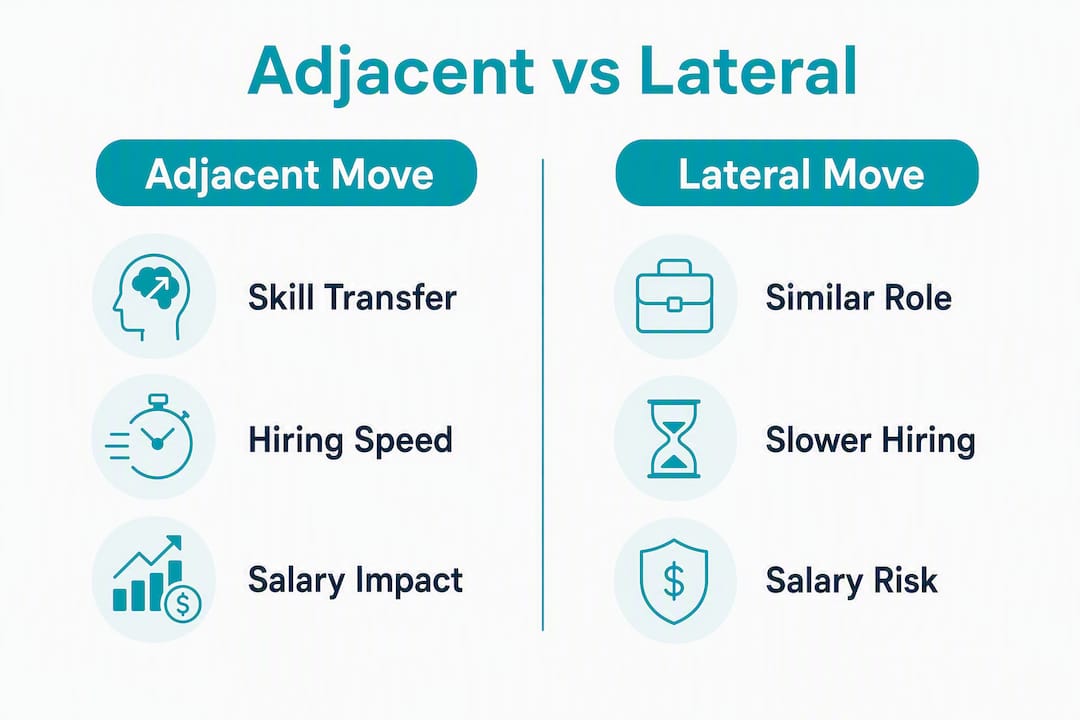
The practical difference shows up in hiring speed and salary preservation. An adjacent move usually makes more sense when it changes the part of work you want to leave while keeping experience an employer will recognize; a restart is better when the work itself is the problem or when the new field requires mandatory credentials. Adjacency lets you stay competitive on compensation while building toward something new.
What do real adjacent career moves look like?
The clearest way to understand adjacency is through concrete examples. Each one below works because the daily tasks and outcomes overlap enough that a hiring manager can picture the candidate succeeding without a long ramp-up.
- Project Manager → Product Manager. Both roles require managing timelines, aligning stakeholders, and translating ambiguous requirements into deliverables. The product manager adds user research and roadmap ownership, but the core operating rhythm is familiar.
- Teacher → Corporate Trainer or Instructional Designer. Curriculum design, adult learning principles, and facilitation skills transfer almost directly. The audience changes; the craft does not.
- Nurse → Medical Device Sales Representative. Clinical credibility, patient communication, and deep product knowledge are exactly what medical device companies pay for. The shift is from care delivery to consultative selling.
- Journalist → Content Strategist or UX Writer. Research, audience awareness, and clear writing under deadline are the same skills. The output format and the stakeholder map change.
- Financial Analyst → Business Intelligence Analyst. Data modeling, variance analysis, and presenting findings to non-technical audiences are shared. The toolset expands to include SQL or Tableau, but the analytical thinking is already there.
- Marketing Manager → Customer Success Manager. Campaign storytelling, customer segmentation, and understanding buyer psychology translate well into managing post-sale relationships and driving retention.
One caveat: the same title does not guarantee adjacency. A software engineer moving from a small startup to a large enterprise may face more friction than a project manager moving into product, even though the title stays the same. Organizational complexity, tooling, and stakeholder expectations can create hidden barriers that make a nominally similar role feel like a restart.
How do you decide between an adjacent move and starting over?
The decision comes down to one honest question: is the work itself the problem, or is it the context around the work? Changing employer or setting, such as moving from agency to in-house, can address setting-related friction while preserving skills. If you like what you do but hate where you do it, adjacency or even a straight lateral move may be enough.
Push toward adjacency when:
- You want to keep your current compensation or get close to it.
- Your skills are recognized in the target field, even if your title is not.
- The new role requires skills you can build on the job within 6 to 12 months.
- You have transferable outcomes you can quantify (managed $2M budgets, led teams of 10, reduced churn by 18%).
Push toward a restart when:
- The daily tasks in the new field are fundamentally different from anything you have done.
- The field requires a license, board certification, or degree that takes years to obtain.
- The skill overlap is below 20%, meaning most of what you know is irrelevant to the new role.
- You are willing to accept a significant pay cut and a longer timeline to get there.
| Dimension | Adjacent move | Full restart |
|---|---|---|
| Best fit | Want to change function or industry, keep experience recognized | Work itself is the problem; mandatory credentials required |
| Difficulty | Moderate; requires reframing and bridge work | High; often requires formal training or degree |
| How hiring managers view it | Transferable proof reduces perceived risk | You are evaluated as a junior candidate regardless of prior experience |
| Typical timeline to become hireable | 3 to 9 months with targeted preparation | 1 to 4 years depending on credential requirements |
| Training and certification costs | Often low to moderate; courses and certifications vary in price. | High; degree programs, licensing exams, unpaid internships |
| Risk vs. reward | Lower risk, salary preservation likely; reward depends on role quality | Higher risk, lower initial pay; higher reward if the field is a strong fit |
Timelines and costs vary significantly: a full restart typically demands longer training and lower initial pay, while adjacency is often faster and preserves salary. The risk with adjacency is choosing a move that changes your title but not the parts of the job that were making you miserable.
How do hiring managers actually evaluate an adjacent move?
Recruiters are not opposed to adjacent candidates. What they are opposed to is risk they cannot quantify. When your background does not match the job description line for line, the hiring manager’s first question is: “Can this person actually do the work?” Your job is to answer that question before it is asked.
Hiring managers prioritize demonstrated ability; the fastest way to validate an adjacent pivot is a concrete work sample or bridge portfolio that mirrors the target role’s demands. That means your resume, LinkedIn profile, and interview answers all need to speak the language of the new role, not just your old one.
What recruiters want to see:
- Outcome-focused bullets that use the vocabulary of the target role (“managed cross-functional product roadmap” rather than “coordinated project timelines”).
- Transferable metrics that show scale and impact, not just activity.
- Direct evidence of adjacent work: a side project, a stretch assignment, a freelance engagement, or a relevant certification.
- A coherent narrative that explains the move in one or two sentences without sounding defensive.
One common employer misconception is that an adjacent candidate will need a long ramp-up. The counter to that is specificity. Instead of saying “I’m a fast learner,” say: “I’ve managed product launches for three years; the roadmapping tools are new to me, but the stakeholder alignment and prioritization work is identical.” That reframe shifts the conversation from potential to evidence.
Adjacent applicants see on average a 27% higher interview invitation rate compared to strict-title matches when their applications are framed correctly. The framing is the variable, not the background.
How to make your adjacent pivot credible fast
The single most effective thing you can do is build a bridge portfolio: a small collection of work samples that demonstrate you can perform the target role’s core tasks, not just that you have adjacent experience.
Successful pivots happen most often between adjacent domains where roughly 40 to 60% of skills transfer directly, making bridge roles the most efficient path to change. The remaining 40 to 60% is what the portfolio addresses.
What to include in a bridge portfolio:
- A mini project that mirrors a real deliverable in the target role (a product requirements document, a training module, a data dashboard, a content strategy brief).
- Measurable results from cross-functional work in your current role that map to the new function.
- A case study written in the language of the target role, not your current one.
Sample resume bullet templates for adjacent pivots:
- “Led cross-functional team of 8 to deliver [outcome], applying [skill directly relevant to target role].”
- “Reduced [metric] by [X%] through [process that mirrors target role’s core task].”
- “Designed and facilitated [program/initiative] for [audience], resulting in [measurable outcome].”
The goal is not to hide your background. It is to translate it. Repackaging through strategic branding and ATS-aware formatting is more effective than presenting yourself as a novice; outcome-focused bullets demonstrate fit far better than a list of responsibilities.
Pro Tip: Before applying externally, look for an internal stretch assignment that sits on the border of your current role and the target function. Volunteering for cross-functional projects is the lowest-risk way to build bridge evidence, and it often converts faster than external applications because the hiring manager already knows your work quality.
A step-by-step plan to test and execute your adjacent move
Use this sequence to move from curiosity to offer without burning months on unfocused activity.
-
Self-audit (Week 1 to 2). List every skill, outcome, and domain knowledge area from your current and past roles. Map each one to job descriptions in your target function. Identify the 3 to 5 skills you already have and the 2 to 3 gaps you need to close. Use O*NET’s transferable skills database to cross-reference skill categories.
-
Validate the target (Week 2 to 4). Run five to ten informational interviews with people currently in the target role. Ask what a typical week looks like, what the hardest part of the job is, and what they wish they had known before entering the field. This is your market research, and it will sharpen your narrative.
-
Close the skill gaps (Month 1 to 3). Identify one or two certifications or short courses that address your gaps. For many adjacent moves, a recognized certificate or relevant industry credential costing a few hundred dollars is enough to signal seriousness without a multi-year commitment.
-
Build one bridge project (Month 2 to 4). Create a single, polished work sample that mirrors the target role’s primary deliverable. This is the centerpiece of your bridge portfolio. It does not need to be paid work; a self-initiated project or a volunteer engagement works.
-
Rewrite your resume and LinkedIn (Month 3 to 4). Translate your experience into the language of the target role. Lead every bullet with an outcome, not a task. Update your LinkedIn headline and summary to reflect where you are going, not just where you have been. A phased transition timeline typically runs 3 to 9 months from self-audit to first offer for an adjacent move.
-
Run targeted outreach (Month 4 to 6). Apply to roles where you meet 70 to 80% of the stated requirements. Send personalized connection requests to hiring managers and team members at target companies. Aim for two to three warm conversations per week.
-
Prepare your pivot narrative (Ongoing). Practice a 60-second answer to “Why are you making this change?” that leads with the value you bring, not the reason you are leaving. Test it in informational interviews before you use it in formal ones.
Phase cues: Move from validate to demonstrate when you have confirmed the role is genuinely what you want. Move from demonstrate to apply when you have at least one strong work sample and your resume passes a 30-second scan test in the target role’s language.
Key Takeaways
An adjacent career move can be a fast, lower-risk path to meaningful change when your skills transfer significantly and the target role’s gaps are closeable on the job.
| Point | Details |
|---|---|
| Adjacency defined | A pivot where roughly 40 to 60% of your skills transfer directly, letting you stay competitive on pay and hiring speed. |
| When to choose it | Choose adjacency when the context or function is the problem rather than the work itself; restart when mandatory credentials are required. |
| Employer proof matters | A bridge portfolio with one concrete work sample reduces perceived hiring risk faster than any cover letter. |
| Timeline expectation | Most adjacent moves typically take several months from self-audit to first offer with focused preparation. |
| Resumewiz can help | Resumewiz builds ATS-compliant resumes, LinkedIn profiles, and managed job search strategies tailored for adjacent pivots. |
The part most career-change advice gets wrong
Most articles on adjacent moves treat the concept as a positioning problem: reframe your resume, update your LinkedIn, and the right employer will find you. That framing is incomplete.
The harder truth is that adjacency only works if the move actually changes the friction that made you want to leave. An adjacent label only helps if the move changes the specific friction that made you want to leave; otherwise it is a lateral detour, not a strategic pivot. A marketing manager who is burned out from constant client demands who moves into content strategy at an agency is still in an agency. The title changed. The pressure did not.
The professionals who make adjacency work well treat their career as a series of strategic projects, evaluating each opportunity by whether it adds a genuinely new dimension to their toolkit rather than merely changing their title. That framing, borrowed from career strategists who study the “adjacent possible” in career development, is what separates a smart pivot from a sideways shuffle.
From a recruiter’s standpoint, the candidates who land adjacent roles fastest are not the ones with the most transferable skills. They are the ones who can articulate exactly which of their skills are relevant and show one concrete piece of work that proves it. The bridge portfolio is not a nice extra. It is the argument.
Resumewiz makes your adjacent pivot land faster
Knowing what an adjacent career move is and executing one are two different challenges. The resume, LinkedIn profile, and interview narrative that got you your current role will not automatically work for the new one. They need to be rebuilt in the language of the target function, optimized for ATS screening, and positioned to reduce the hiring risk a recruiter feels when they see a non-traditional background.
Resumewiz specializes in exactly this work. Kim Taynor and the Resumewiz team translate your existing experience into ATS-compliant, outcome-focused resumes that speak the target role’s language from line one. LinkedIn optimization ensures your profile surfaces in recruiter searches for the new function. For professionals pursuing a fully managed search, Resumewiz handles targeted outreach and tailored applications as part of its done for you job search support. If you are serious about making an adjacent pivot stick, the place to start is Resumewiz’s career services, where the process is built for career changers who want to move fast without starting over.
Useful sources and further reading
The sources below back the claims in this article and are worth reading directly if you want to go deeper on any specific aspect of an adjacent career move.
| Source | What it is useful for |
|---|---|
| Career Change: What Listings Say About Switching, Seeker | Data on skills-transfer rates across career pivots; supports the 40 to 60% adjacency range and bridge-role strategy. |
| Adjacent Career Move Or Start Over Completely? GradSimple | Decision framework for choosing adjacency vs. restart; covers timelines, cost, and setting-change considerations. |
| How to Change Careers Without Starting Over, CourseCareers | Practical bridge-portfolio and resume-repackaging tactics for career changers. |
| Career Transition Timeline Explained, ResumeMatch | Phased timeline guidance for professionals planning a structured adjacent move. |
| The Adjacent Possible Career Pivot, Comarvisa | Strategic framing for evaluating adjacent opportunities as career projects. |
| ONET Transferable Skills Dictionary, ONET Center | Authoritative U.S. database for mapping transferable skills across occupations. |
Want a recruiter in your corner for your next senior role? Book a free call with Resume Wiz and we will map out your next move together.
