What Does At-Will Employment Mean for Employees?
At-will employment means your employer can fire you at any time, for almost any reason, or no reason at all, and you can quit the same way, without notice. That freedom runs in both directions, but it isn’t absolute. A firing that violates a federal or state anti-discrimination or anti-retaliation law is illegal even when your job is at-will.
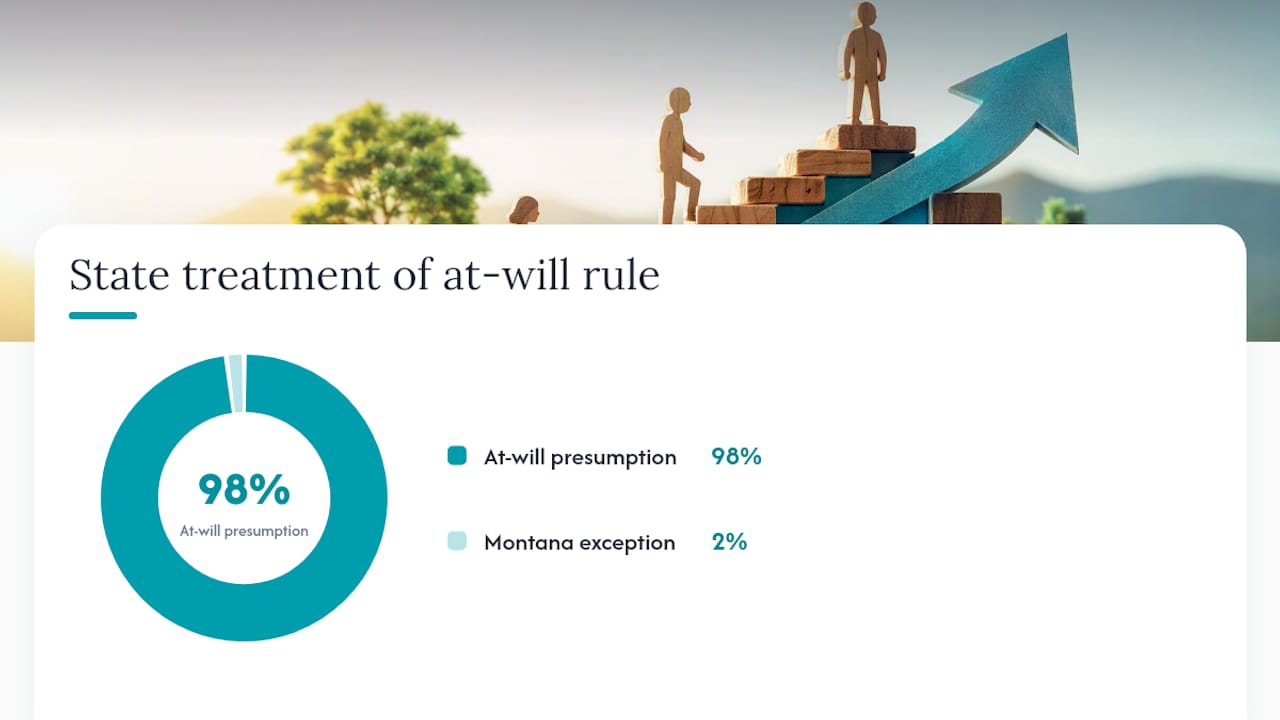
This presumption governs the workplace for most of the country. As of March 2025, 49 states presume employment is at-will by default, meaning that unless a contract says otherwise, either side can end the relationship without cause. The one holdout is Montana, where the rules shift once you clear an initial probationary period.
- The default rule: No contract, no cause required, on either side.
- The legal limit: Firing someone because of their race, sex, age, disability, or for reporting illegal conduct is against the law regardless of at-will status.
- The outlier: Montana requires “good cause” for termination after probation, the only state with a general exception to the rule.
Quick stat: 49 out of 50 states follow the at-will presumption. Montana stands alone in requiring good cause for most terminations after an initial employment period.
Key Takeaways
At-will employment lets either side end the relationship without cause, but federal and state law still bars firings motivated by discrimination or retaliation.
| Point | Details |
|---|---|
| Default rule applies almost everywhere | 49 states presume employment is at-will absent a contract or statute saying otherwise. |
| Montana is the outlier | Montana requires “good cause” for termination once an employee clears probation. |
| Check your paperwork first | Offer letters, handbooks, and signed acknowledgments can quietly modify your at-will status. |
| Document everything if something feels wrong | Save emails, dated reviews, and written explanations before you lose system access. |
| Rebuild your job search fast | Resumewiz helps you refresh your resume and LinkedIn profile so a termination doesn’t stall your next role. |
Table of Contents
- How the at-will presumption plays out at work
- When at-will status gets overridden by contracts and handbooks
- The common-law exceptions courts recognize
- The statutory protections that override at-will status
- Why the rules differ by state, and why Montana stands apart
- What at-will status actually means for your day-to-day choices
- What to do if you think your firing was illegal
- Why most people misjudge what “at-will” actually protects
- Get back in the market faster with the right resume and strategy
- Where to find official guidance and file a claim
- Sources
How the at-will presumption plays out at work
Most jobs in the United States run on at-will terms, even if nobody ever says the words out loud. If you were hired without signing an employment contract, and your offer letter doesn’t promise a fixed term or list specific grounds for termination, you’re almost certainly at-will. The employment-at-will doctrine is the default legal position: no contract means no cause required.
In practice, this plays out in ordinary, sometimes frustrating ways. Your manager can let you go because your performance slipped, because the department is cutting costs, or because you two just never clicked. None of that requires an explanation, and none of it is illegal on its own.
Here’s where it gets interesting: the same set of facts can be perfectly lawful or completely illegal depending on the real motive behind it.
- Lawful: You’re laid off during a budget cut that affects your entire team.
- Lawful: You’re fired after missing quarterly sales targets three periods in a row.
- Unlawful: You’re fired two weeks after filing a workers’ compensation claim, with no documented performance issues beforehand.
- Unlawful: You’re let go shortly after telling HR you’re pregnant, even if your manager cites “restructuring” as the official reason.
Pro Tip: If a termination happens right after you did something legally protected, like reporting harassment or requesting medical leave, timing itself becomes evidence. Write down the date of the protected activity and the date of termination side by side. That gap is often the first thing an employment lawyer will ask about.
When at-will status gets overridden by contracts and handbooks
Not everyone who thinks they’re at-will actually is. Certain documents and employer practices can quietly convert an at-will job into something closer to a for-cause arrangement, and most employees never check for these before a dispute starts.
Pull out these documents before you assume anything about your job status:
- Employment contracts that specify a term of employment or list the only grounds for termination.
- Offer letters with language promising continued employment “as long as performance is satisfactory” or similar.
- Collective bargaining agreements, which almost always require just cause for discipline or discharge.
- Employee handbooks with disciplinary procedures framed as mandatory steps rather than guidelines.
- Written policies referencing progressive discipline, probationary periods, or termination “for cause only.”
Courts sometimes find an implied contract even without a signed agreement. If a handbook lays out a strict disciplinary process, or a manager repeatedly assured you that “as long as you hit your numbers, you’re safe here,” a court may treat that as a promise the employer has to honor. This is exactly why at-will employment doctrine leaves room for exceptions when employer statements create a reasonable expectation of continued work.
| Weakens at-will status | Protects at-will status |
|---|---|
| “Employees will only be terminated for just cause” | “Employment may be terminated by either party at any time, for any reason” |
| Repeated verbal promises of job security | A signed at-will acknowledgment in the offer letter |
| Mandatory, step-by-step disciplinary policy | Disciplinary steps framed as discretionary guidelines |
Pro Tip: Many employers now require new hires to sign an at-will acknowledgment specifically to prevent handbook language from being read as a contract. If you signed one, courts generally enforce it unless other strong evidence points the other way. Keep a copy for your own records, not just HR’s file.
The common-law exceptions courts recognize
Beyond contract language, several judge-made doctrines can limit an employer’s right to fire at will. These vary by state, but most states recognize at least one.
- Public policy exception. An employer can’t fire you for refusing to do something illegal, or for exercising a legal right like filing a workers’ comp claim. Example: getting fired for refusing to falsify safety records.
- Implied contract exception. Handbook language or repeated assurances can create an unwritten promise of continued employment. Courts look at how consistently the employer followed its own stated procedures.
- Covenant of good faith and fair dealing. A smaller number of states read an obligation of basic fairness into every employment relationship, barring firings meant to cheat an employee out of earned benefits, like firing a salesperson right before a big commission is due.
- Promissory estoppel. If you relied on a clear promise (say, “the job is yours, quit your current position”) and suffered real harm when the promise was broken, some courts will enforce it even without a formal contract.
- Tort-based claims. Wrongful termination can sometimes overlap with defamation, intentional infliction of emotional distress, or other tort claims if the manner of firing was especially egregious.
Evidence matters enormously here. Courts weighing implied-contract or promissory-estoppel claims look for specifics: dated emails, handbook excerpts, and named witnesses who heard the same promises you did. Vague memories of “they told me I had a job for life” rarely hold up alone.
A few red flags tend to make an otherwise routine firing look suspicious to a court or agency:
- Termination immediately after a complaint, injury report, or leave request.
- A sudden negative performance review after years of positive ones, with no documented incidents in between.
- Inconsistent reasons given for the firing at different points in time.
The statutory protections that override at-will status
Common-law exceptions come from judges. Statutory protections come from Congress and state legislatures, and they hit harder because they’re written into law, not inferred from behavior.
At the federal level, a handful of statutes do most of the heavy lifting:
- Title VII of the Civil Rights Act bars firing based on race, color, religion, sex, or national origin.
- The Age Discrimination in Employment Act (ADEA) protects workers 40 and older.
- The Americans with Disabilities Act (ADA) protects qualified employees with disabilities and requires reasonable accommodation.
- The Family and Medical Leave Act (FMLA) protects eligible employees who take approved leave for medical or family reasons.
- Retaliation and whistleblower protections under various federal statutes bar firing someone for reporting illegal conduct, unsafe conditions, or wage violations.
The Equal Employment Opportunity Commission enforces most of the federal discrimination statutes, and at-will employees keep every one of these protections regardless of what their offer letter says. Many states layer additional protections on top, covering things like sexual orientation, marital status, or off-duty conduct that federal law doesn’t touch.
If you suspect your firing crossed one of these lines, documentation is what turns a suspicion into a case:
- Save emails and messages referencing your performance, complaints, or accommodation requests.
- Keep dated copies of every performance review, not just the final one.
- Note exact dates: when you engaged in protected activity, when treatment changed, and when you were terminated.
Pro Tip: Forward important work emails to a personal account the moment something feels off, not after you’re already locked out of your work account. Once you’re terminated, you typically lose access to company systems within hours.
Why the rules differ by state, and why Montana stands apart
The at-will rule isn’t a single federal law. It’s a common-law default that each state applies and modifies on its own, which is why the exceptions above don’t look identical from state to state.
NCSL confirms that every state except Montana presumes employment is at-will, and that absent a contract or statute, employers can change wages, benefits, and schedules unilaterally, without notice. Montana breaks from that pattern entirely: under the Montana Wrongful Discharge From Employment Act, employers must have “good cause” to fire an employee once they’ve cleared an initial probationary period, typically defined in company policy or defaulting to six months.
That single-state exception matters more than its size suggests. It’s proof that at-will isn’t some unchangeable constitutional principle. It’s a legal default that a state legislature can simply reject, and Montana did.
- State courts differ on how easily they’ll find an implied contract from handbook language.
- Public-sector employees often have separate civil-service protections that private-sector at-will employees don’t get.
- Some states (California among them) have built out unusually detailed employer-facing guidance on how to preserve at-will status through careful policy drafting, which tells you how seriously employers there take the risk of accidentally creating a contract.
If you want to know exactly how your state handles this, your state’s bar association or attorney general’s office usually publishes plain-language guidance, and it’s worth five minutes of reading before you assume the national default applies to your exact situation.
What at-will status actually means for your day-to-day choices
Legal doctrine is one thing. What you actually do with that knowledge is another.
You are legally free to quit without giving two weeks’ notice, and no law requires otherwise. But skipping notice can still hurt you professionally: it can affect references, burn bridges with a manager who might otherwise vouch for you, and in some industries, follow you through word of mouth. The legal risk is zero. The professional risk is real, and it’s yours to weigh.
The downsides of at-will status run in the other direction too, and they’re worth naming plainly:
- Your employer can change your pay, benefits, or schedule without warning, as long as no contract locks those terms in place.
- You can be let go with no notice and no severance unless your state or a company policy requires otherwise.
- Scheduling and job security can feel precarious in industries with high turnover, since neither side owes the other continuity.
None of this means you’re powerless. A few habits go a long way toward protecting yourself if things go sideways:
- Save copies of every performance review the moment you receive them, not months later.
- Keep a personal log of significant workplace events, dated, in your own words.
- Request any promised raise, promotion, or policy change in writing, even a confirming email works.
Pro Tip: If HR ever tells you something important verbally, like a policy exception or a promised timeline, follow up with “Just to confirm what we discussed…” in an email. That single sentence turns a conversation into a paper trail.
What to do if you think your firing was illegal
If something about your termination feels wrong, the sequence of steps you take in the first weeks matters more than almost anything else you’ll do in the process.
- Preserve everything now. Download or forward emails, screenshot messages, and save performance reviews before you lose system access. Guides consistently stress preserving evidence like dates, reviews, and written communications early, before memory fades or access disappears.
- Request the reason in writing. Ask HR directly, by email, why you were terminated. A written response, or a notable refusal to give one, both become useful evidence later.
- Review your paperwork. Reread your offer letter, handbook, and any signed acknowledgments for language that either supports or undercuts an at-will defense.
- File with the right agency. The EEOC handles federal discrimination and retaliation claims, and most states have a parallel civil rights or labor agency that accepts complaints, often on a tighter or overlapping deadline. Federal EEOC charges generally must be filed within 180 days of the incident, sometimes 300 days in states with their own fair-employment agency, so don’t sit on this.
- Consult an employment lawyer if the facts suggest discrimination, retaliation, or breach of an implied contract. Most offer a free or low-cost initial consultation, and they’ll want the timeline and documents you gathered in steps one through three.
Quick stat: Federal discrimination charges typically must reach the EEOC within 180 days of the alleged violation, though that window can extend to 300 days depending on your state’s own fair-employment agency.
For employers navigating the disciplinary side of this, from documenting performance issues to running a fair process before termination, structured guidance on managing performance and discipline helps limit wrongful-termination exposure on both sides of the table. Employers looking for ongoing compliance support around payroll and termination risk sometimes work with a PEO broker rather than handling it all in-house.
Why most people misjudge what “at-will” actually protects
Here’s the thing that surprises people most about at-will employment: it’s not the lawless free-for-all it sounds like. Plenty of workers assume at-will means they have no rights at all, and that misunderstanding costs them. They see a termination, shrug, and move on, when the timing or the stated reason might have been worth a serious second look.
The opposite mistake happens just as often. Some people convince themselves every firing that felt unfair must be illegal, and that’s not true either. Losing a job because your department got restructured, or because a new manager wanted a different personality on the team, is legal and common. The line isn’t about fairness. It’s about whether the real motive crossed into protected territory: your race, your age, a complaint you filed, a leave you took.
What actually protects you isn’t a general sense that something felt off. It’s paper. Employers often state a reason at termination precisely to avoid looking like they’re hiding something, and a vague or shifting explanation is frequently the first thing a lawyer flags. If you take one thing from years of watching résumés and career transitions cross a desk, it’s that people who kept records, dated emails, saved reviews, wrote down what was said and when, had options that people without those records simply didn’t.
This is educational information, not legal advice, and every state applies these doctrines a little differently. If your situation involves a real dispute, talk to an employment lawyer licensed in your state. What Resumewiz can help with is the part that comes next: rebuilding your resume, your LinkedIn presence, and your outreach strategy so a termination becomes a pause, not a derailment.
Get back in the market faster with the right resume and strategy
A termination, at-will or otherwise, doesn’t have to define your next move; what you do in the following few weeks does. Resumewiz built its entire model around that window: turning a layoff or firing into a fast, well-positioned job search instead of months of scattered applications.
This is not legal help, and it won’t tell you whether your termination was lawful. What it will do is get your resume past applicant tracking systems, sharpen your LinkedIn profile so recruiters actually find you, and build outreach templates that get replies instead of silence. If you’re staring at a blank resume the week after being let go, that’s exactly the moment Resumewiz is built for. Start with a resume refresh and a targeted outreach plan, and let the job search move faster than the shock of the termination did.
Where to find official guidance and file a claim
Government agencies and legal reference sites remain the most reliable starting points when you need answers specific to your situation rather than general commentary.
- The EEOC is the right stop for federal discrimination and retaliation complaints, including filing deadlines and required documentation.
- USAGov’s termination guidance covers the baseline at-will rule and the Montana exception in plain language.
- Cornell’s Legal Information Institute offers a legally precise breakdown of the doctrine and its common-law exceptions for readers who want the underlying legal reasoning.
- Your state bar association or attorney general’s office will have state-specific guidance, since the exceptions and filing deadlines vary by jurisdiction.
- The NCSL overview is the fastest way to compare how states differ, particularly if you’re weighing a move or a remote job based in another state.
Use agency and government sources when you’re building an actual legal claim. Save the practical guides, like Nolo’s plain-language explanations, for understanding your paperwork and figuring out what questions to bring to a lawyer in the first place.
FAQ
Can you sue for at-will employment termination? You can’t sue simply because you were fired at will, that’s legal by design. You can sue if the firing violated an anti-discrimination law, breached an implied contract, or violated a state’s public-policy exception.
Can you be fired without being told why? Yes. At-will employers generally don’t have to give a reason. If you suspect the real reason was illegal, request the explanation in writing anyway; a refusal or shifting answer can become evidence.
Can you quit an at-will job without notice? Legally, yes, there’s no requirement to give two weeks’ notice. It can affect references and rehire eligibility, so weigh the professional cost even though the legal risk is nonexistent.
How does at-will employment differ from a contract job? A contract job specifies terms, often a fixed duration or “for cause only” termination language, that override the at-will default. At-will jobs have no such guarantee on either side.
Is at-will employment the same in every state? No. Forty-nine states follow the general presumption, but common-law exceptions, statutory protections, and filing deadlines all vary by state. Montana requires good cause after probation, unlike anywhere else in the country.
This article is general information, not a substitute for advice from a qualified lawyer. Consult a qualified legal professional about your own circumstances before acting on anything here.
Want a recruiter in your corner for your next senior role? Book a free call with Resume Wiz and we will map out your next move together.
Sources
- Termination guidance for employers | USAGov
- at-will employment | Wex | US Law | LII / Legal Information Institute
- At-Will Employment - Overview
