What Change Management Means for Executives Who Sponsor It
Change management is the structured, people-focused discipline that gets employees to actually adopt new systems, processes, or strategies, so the business results you approved on paper show up in real performance. Prosci research finds projects using structured change management are 7X more likely to meet objectives, and Evanta/Gartner data shows 80% of C-level executives are already running active change initiatives, with another 8% planning them. If your peers are doing this, the question isn’t whether to engage. It’s how fast you can start.
Three moves in the next 72 hours set the tone:
- Make your sponsorship visible. Send a signed message to the organization naming the change and your personal commitment to it.
- Declare the strategic outcome. State plainly what business result this change is supposed to produce, in numbers if possible.
- Convene a sequencing check. Pull department heads together to surface what else is competing for employee attention right now.
Key Takeaways
Executive-led change management succeeds when leaders sponsor visibly, sequence initiatives deliberately, and measure adoption rather than deployment alone.
| Point | Details |
|---|---|
| Definition in one line | Change management is the people-focused discipline that turns deployed projects into adopted outcomes. |
| Sponsorship quality drives results | Visible, active sponsors see 79% project success versus 27% under weak sponsorship. |
| Prevalence is high | 80% of C-level executives report active change initiatives, with 8% more planning them. |
| Use a five-step sequence | Align, assess, design, launch, and reinforce, with adoption metrics tracked at every stage. |
| Model the behavior | Transformations succeed more often when senior leaders visibly demonstrate the change themselves. |
Table of Contents
- What Does Change Management Mean for Executives in Practice?
- Why Should Executives Invest in Structured Change Management?
- What Models Do Executives Need to Recognize?
- What Is the Executive’s Role in Change Management?
- How Should Executives Structure a Change Program?
- Executive Checklist for Change Kickoff and Milestones
- The Research Executives Can Cite to Build Their Case
- Leading Change Feels Different Than It Sounds in a Meeting
- Ready to Show Leadership That Sponsors Change?
- Where Executives Can Go Deeper on Change Management
- Frequently Asked Questions
- Sources
What Does Change Management Mean for Executives in Practice?
For an individual employee, change management means being prepared for what’s coming, equipped with the skills to do the new thing, and supported when it gets messy. For the organization, it means the difference between a system going live and a system actually being used. That distinction is the whole discipline in a sentence.
Project management builds the thing. Change management gets people to use it. Confuse the two and you get a finished product nobody wants to touch.
Take an ERP rollout. The technical deployment might finish on schedule and under budget. Six months later, though, half your finance team is still running shadow spreadsheets because nobody retrained them on the new approval workflow. The software launched. The change didn’t.
Typical impacts worth tracking before you approve any initiative:
- Shifts in daily workflows and decision rights
- New skills or certifications required for existing roles
- Changes to how performance gets measured
- Temporary productivity dips during the transition window
Why Should Executives Invest in Structured Change Management?
The business case is straightforward: adoption is the part of ROI that technology alone can’t deliver. You can buy the best platform on the market, but if nobody changes how they work, you’ve bought an expensive paperweight.
The numbers: Prosci’s research shows structured change management makes teams 7X more likely to hit project objectives, and projects with highly effective, visible sponsors succeed 79% of the time versus 27% when sponsorship is weak or absent.
That sponsorship gap is often the single biggest predictor of whether an initiative pays off. When you invest in structured change management, you’re buying:
- Faster time-to-value on technology and process investments
- Less rework from employees reverting to old habits
- Lower risk of the initiative quietly dying six months post-launch
What Models Do Executives Need to Recognize?
You don’t need to become a change practitioner, but you do need to recognize the vocabulary your team brings you. A handful of principles show up across every credible approach: align the change to strategy, keep sponsorship visible, engage stakeholders early, measure adoption rather than just deployment, and manage the sequencing of competing initiatives so people aren’t drowning.
The ADKAR Model breaks the individual journey into five stages: Awareness, Desire, Knowledge, Ability, and Reinforcement. It’s useful because it maps directly to where an employee gets stuck, whether that’s not understanding why the change matters or lacking the skill to execute it. Kotter’s eight-step model and Lewin’s “unfreeze, change, refreeze” framework cover similar ground with more emphasis on organizational momentum and culture. Prosci’s own three-phase approach (Prepare, Manage, Sustain Change) is built to run in parallel with a standard project plan, which is why it shows up so often in enterprise environments.
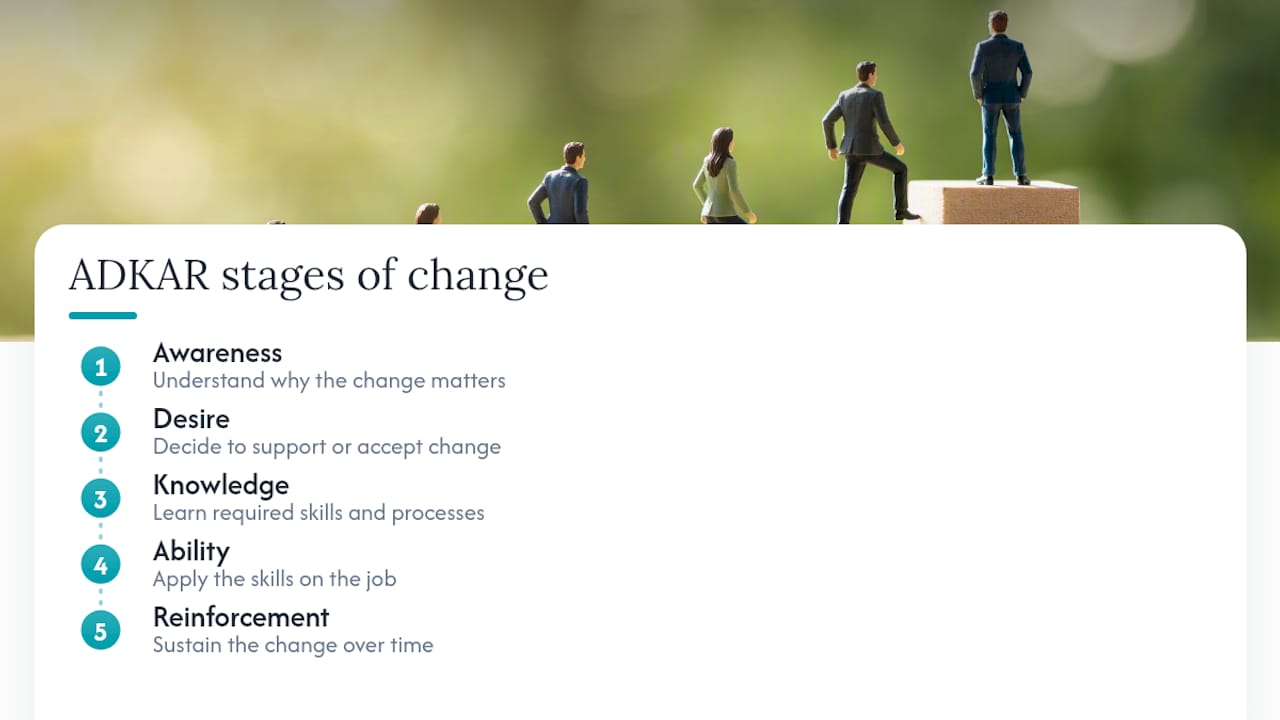
Pro Tip: Ask your project lead one question before approving any initiative: “Where’s the ADKAR plan for the people affected by this?” If they can’t answer, the plan is technically sound and people-blind.
What Is the Executive’s Role in Change Management?
Active sponsorship is not the same as sending one supportive email and moving on. Prosci’s research distinguishes active, visible sponsors, those who show up at milestones, coach hesitant managers, and hold people accountable, from passive endorsers who approve budgets and disappear.
Your other core job is managing total change capacity. Hallett Leadership’s guidance for C-suite executives is blunt about this: sequence initiatives deliberately, or you’ll burn out your workforce with simultaneous, uncoordinated demands. Change fatigue isn’t a soft complaint. It’s a measurable drag on adoption rates.
Practical governance looks like this:
- A written sponsor plan naming who does what, and when
- A recurring cadence, biweekly or monthly, to check sponsorship activity against milestones
- Clear escalation rules for when adoption metrics slip
- Coaching conversations with direct reports who manage the teams absorbing the change
Role-specific checklist: CEOs set the strategic “why” and model the behavior publicly. Business-unit leaders own local sequencing and resource protection. People managers run the daily coaching conversations that actually move ADKAR stages forward.
How Should Executives Structure a Change Program?
A five-step sequence, drawn from frameworks Harvard Business School Online outlines, gives you a repeatable structure to sponsor without micromanaging the details.
- Align and prioritize. Ask: does this initiative map to a named strategic outcome, and does it beat other competing priorities?
- Assess impact and readiness. Ask: which roles and processes change, and how ready is the workforce to absorb it?
- Design sponsor and manager plans. Ask: who is visibly accountable, and do frontline managers know their coaching role?
- Launch and measure adoption. Ask: what adoption metric are we tracking weekly, not just deployment completion?
- Reinforce and sustain. Ask: what happens at month three when attention naturally drifts elsewhere?
Watch adoption metrics, not just go-live dates. A stalled adoption curve or rising help-desk tickets three weeks post-launch is an early resistance signal, not noise to ignore.
Executive Checklist for Change Kickoff and Milestones
Paste this into your next kickoff agenda or milestone review:
- Sponsor commitment publicly declared and dated
- Strategic outcome named with a measurable target
- Cross-functional sequencing reviewed against other active initiatives
- Manager coaching plan in place before launch
- Adoption metrics defined and owned by name
- Reinforcement checkpoint scheduled after launch
Red flags requiring immediate attention: adoption metrics declining two periods in a row, conflicting priorities surfacing across business units, or frontline managers reporting they haven’t been briefed. Any one of these means stop and course-correct before launch, not after.
The Research Executives Can Cite to Build Their Case
Three numbers do most of the work in a business-case slide. Structured change management makes projects 7X more likely to meet objectives. And 80% of C-level executives already report active change initiatives underway, with 8% more planning them.
Use the first number to justify budget. Use the second to justify your own time commitment as sponsor, since it’s the variable you personally control. Use the third to tell your board this isn’t optional, it’s standard practice among peer companies.
Practitioners at Prosci also note that this case lands better framed as risk mitigation and governance than as tools or theory. Boards respond to risk language, not methodology.
Leading Change Feels Different Than It Sounds in a Meeting
Successful sponsorship rarely looks dramatic. It looks like showing up at a milestone review nobody expected you to attend, or asking a direct report why adoption dipped instead of waiting for the quarterly report to explain it away. McKinsey’s research on transformation success backs this: leaders who visibly model the behavior they’re asking for see far better outcomes than those who just announce it. That’s the gap between a memo and real sponsorship. At Resume Wiz, founder Kim Taynor has spent over a decade watching how executives get evaluated on exactly this kind of visible leadership, and it shows up in how hiring committees read a resume, too.
Ready to Show Leadership That Sponsors Change?
Executives who sponsor change well don’t just talk about transformation in interviews, they demonstrate it with specifics: the initiative they led, the adoption metric they moved, the team they coached through resistance. If you’re preparing for your next executive role or board seat, that story needs to be on your resume and LinkedIn profile in language hiring committees actually recognize. Resumewiz builds executive resumes and LinkedIn profiles around exactly this kind of leadership evidence, backed by founder Kim Taynor’s recruiting background, alongside interview coaching and a fully managed job search for professionals who need to move fast.
Where Executives Can Go Deeper on Change Management
- Prosci: adoption research and the ADKAR model for individual change
- Evanta/Gartner: C-suite pulse data on change management prevalence
- Harvard Business School Online: practical five-step process framing
- McKinsey: research on leadership role modeling in transformations
- Resumewiz: executive resume support grounded in real hiring insight
Want a recruiter in your corner for your next senior role? Book a free call with Resume Wiz and we will map out your next move together.
Frequently Asked Questions
What does change management mean for executives specifically? It means owning visible sponsorship of a transition, not just approving its budget. Executives who show up at milestones and coach their direct reports see dramatically higher success rates than those who sign off and disappear.
How is change management different from project management? Project management delivers the technical output, the new system, the reorganized process. Change management gets the people who touch that output to actually use it as intended.
What is the biggest mistake executives make in sponsoring change? Treating sponsorship as communication rather than active coaching. Sending an announcement email is not the same as intervening at a milestone when adoption metrics start slipping.
How do executives know if change management is working? Track adoption metrics, not just deployment completion. A stalled adoption curve, rising help-desk tickets, or manager complaints about confusion are early signals worth acting on immediately.
Should executives learn a specific model like ADKAR or Kotter? You don’t need to master the mechanics, but recognizing the vocabulary helps you ask sharper questions. Ask your team where the ADKAR plan is, or how they’re sequencing this change against everything else competing for attention.
Sources
- Change Management | What is Change Management | Prosci
- C-Suite Community Pulse on change management: Evanta/Gartner
- Change Management Considerations for C-Suite Executives: Hallett Leadership
- Successfully transitioning to new leadership roles: McKinsey
