Hybrid Resume Format: What Job Seekers Need to Know
A hybrid resume, also called a combination resume, leads with a skills section and follows it with a reverse-chronological work history. It is the best format for career changers, candidates with employment gaps, recent graduates with strong project experience, and anyone whose skills matter more than their job titles. This guide covers the exact structure, ATS-safe formatting rules, annotated templates for four experience levels, and a pre-submission checklist you can use before your next application.
Table of Contents
What is a hybrid resume format, exactly?
The hybrid (combination) resume merges two older formats: the functional resume’s skills-first approach and the chronological resume’s timeline structure. The result is a document that tells a recruiter what you can do before it tells them where you worked. According to Indeed, the standard structure includes a professional summary, a core competencies block of skills, reverse-chronological work experience, and education.
Here is the typical section flow, from top to bottom:
Contact information (name, phone, email, LinkedIn URL, city/state)
Professional summary (3 lines, tailored to the target role)
Core competencies / skills (10 to 14 items in a two- or three-column list)
Work experience (reverse-chronological, 4 to 7 bullets per role)
Education and certifications
Optional extras (projects, volunteer work, tools, publications)
The skills block is the defining feature. It sits above the work history so a recruiter scanning the top third of the page sees your strongest qualifications immediately, before they reach your job titles or dates. That placement is deliberate: it shifts the first impression from “where did this person work?” to “what can this person do?”
Who should use a hybrid resume?
The format fits a specific set of situations well. Resume.io identifies career changers, recent graduates, and candidates with employment gaps as the primary users, because the hybrid lets them lead with transferable skills rather than a timeline that might raise questions.
Use a hybrid resume when:
You are changing industries and your skills transfer but your job titles do not
You have a gap of six months or more in your work history
You are a recent graduate with strong coursework, internships, or projects but limited formal experience
You hold expertise across multiple disciplines and want a recruiter to see the full picture quickly
Stick with a chronological resume when:
You are applying to federal government positions, which typically require the USAJobs format
You are pursuing academic or research roles that expect a CV or strict timeline
Your career progression is linear and your most recent title is your strongest selling point
A quick decision test: if your best qualifications live in your skills rather than your most recent job title, the hybrid format is likely the right call. If your job titles and employer names are the most impressive things on the page, a straight chronological layout lets those details lead.
What are the real benefits and drawbacks?
FlexJobs puts it plainly: a hybrid resume lets you draw attention to what you want recruiters to notice and draw attention away from what you do not, without hiding anything. That is the core appeal.
Key benefits:
Relevant skills appear at the top, so a six-second scan lands on your strengths
Employment gaps are less visually prominent because the skills block comes first
Career pivots read more clearly when transferable skills are grouped and labeled
The chronological work history still satisfies recruiters who need to verify your timeline
Main drawbacks:
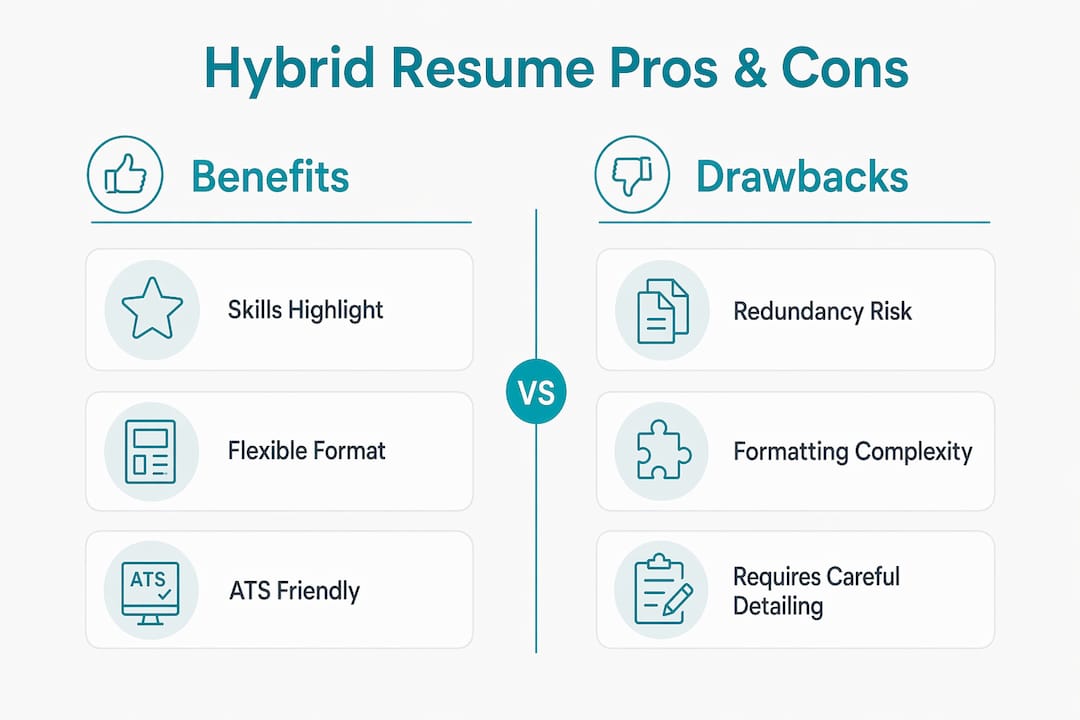
Traditional industries (law, finance, government) may expect a strict chronological format and view the hybrid as unconventional
If your skills block repeats the same phrases as your experience bullets, the resume reads as padded
A poorly formatted hybrid can confuse ATS software if headings are nonstandard or tables are used
Pro Tip: To avoid redundancy, take your top two skills from the competencies block and prove each one with a single outcome-based bullet in your work experience. The skills block names the capability; the experience section demonstrates it with a result. Never copy the same phrase verbatim into both places.
How to write a hybrid resume step by step
Follow these steps in order. Each one builds on the last, and skipping ahead tends to produce a skills block that does not match the experience section.
Write your contact header. Name (slightly larger font), phone, professional email, LinkedIn URL, and city/state. No full street address, no photo.
Draft your professional summary. Three lines, written in first person without the pronoun “I.” Tailor it to the specific job posting. Include your years of experience, your core area of expertise, and one measurable outcome.
Build your core competencies block. List 10 to 14 skills in a two- or three-column format. Pull keywords directly from the job description. Prioritize hard skills (tools, methodologies, technical knowledge) before soft skills.
Write your work experience section. List roles in reverse-chronological order. Include company name, your title, city/state, and dates (month and year). Write 4 to 7 bullets per role using the formula: strong verb + action + measurable impact.
Add education and certifications. Degree, institution, graduation year. Certifications go here or in a separate block if they are central to the role.
Include optional sections. Relevant projects, volunteer work, publications, or tools lists add depth for candidates whose formal experience is thin.
Turning duties into impact bullets
Weak bullets describe what you were supposed to do. Strong bullets describe what happened because you did it. Three examples:
✗ “Responsible for managing social media accounts”
✓ “Grew LinkedIn following by 40% in six months by shifting to a weekly video series”
✗ “Helped with onboarding new employees”
✓ “Redesigned onboarding materials, cutting new-hire ramp time from eight weeks to five”
✗ “Assisted in budget planning”
✓ “Identified $120K in vendor redundancies during annual budget review, reducing department spend”
Formatting checklist
Font: Calibri, Garamond, or Georgia at 10 to 12pt for body text; name at 14 to 16pt
Margins: 0.75 to 1 inch on all sides
Length: one page for under ten years of experience; two pages for senior or executive candidates
Consistent date format throughout (e.g., “Jan 2021 to Mar 2024” everywhere)
No tables, text boxes, or images in the main body
Standard section headings only (see ATS section below)
Pro Tip: Save your resume as a PDF for most applications. If the job posting or ATS portal specifically requests a Word document (.docx), send that instead. Some older ATS platforms parse DOCX more reliably than PDF.
Hybrid resume templates and examples by experience level
The structure stays consistent across levels. What changes is the depth of the skills block, the number of bullets per role, and the page length.
Template levelSkills blockBullets per rolePage lengthWhat to emphasizeEntry-level10 to 14 skills4 to 7 bullets1 pageProjects, coursework, internshipsMid-career10 to 14 skills4 to 7 bullets1 to 2 pagesOutcomes, promotions, scope growthSenior/executive10 to 14 skills4 to 7 bullets2 pagesRevenue impact, team size, strategic winsCareer change10 to 14 skills4 to 7 bullets1 to 2 pagesTransferable skills, relevant projects
Entry-level template
[Name] | [Phone] | [Email] | [LinkedIn] | [City, State]
Marketing graduate with hands-on experience in content creation, SEO research, and social media analytics. Delivered a 25% engagement increase on a university brand campaign. Seeking a digital marketing coordinator role.
Core Competencies: Content Writing | SEO Research | Google Analytics | Canva | Social Media Management | Email Marketing | Copyediting | Data Reporting
Work Experience Marketing Intern, [Company], City, ST | Jun 2024 to Aug 2024
Wrote 12 blog posts that averaged 800 organic monthly visits within 90 days of publication
Built weekly analytics reports in Google Analytics 4 for a team of five
Annotation: Two focused bullets beat five vague ones. The skills block carries the weight; experience proves it.
Mid-career template
The summary names a specialty and a scope (“led cross-functional teams of up to 12”). The skills block reaches 10 to 12 items. Each role carries 3 to 4 bullets with dollar amounts or percentages where possible. If you have been promoted within one company, stack the titles under a single employer header to show progression clearly.
Senior/executive template
At this level, the summary is almost a positioning statement: industry, scope, and a signature result. The skills block can include leadership competencies (“P&L Management,” “Board Reporting,” “M&A Integration”) alongside technical ones. Bullets lead with scale: team size, budget owned, revenue generated. Two pages are expected and appropriate.
Career-change template
Lead the skills block with transferable skills labeled clearly for the target industry. Add a short “Relevant Projects” subsection directly below the skills block when your formal work history is in another field. Resume.io recommends this approach specifically for career-change candidates, because it gives recruiters a bridge between your past and your target role before they reach the experience section.
How does ATS read a hybrid resume?
Applicant Tracking Systems parse resumes by scanning for section headings, then extracting text beneath them. A hybrid resume passes through ATS cleanly when the headings match what the system expects and the formatting is plain. Coursera confirms that standard headings, simple bullets, and no images or tables are the baseline requirements.
ATS formatting rules:
Use standard headings: “Professional Summary,” “Skills,” “Work Experience,” “Education.” Avoid creative labels like “What I Bring” or “My Story.”
Skip tables and text boxes. ATS software often reads table content out of order or skips it entirely.
Keep key contact details in the body of the document, not in a header or footer field, because many parsers ignore those areas.
Use a clean bullet character (•) rather than custom symbols or icons.
Submit as PDF unless the posting specifies DOCX. When in doubt, check the portal’s upload instructions.
Parsing test: Paste your resume into a plain-text editor like Notepad. If the section order looks scrambled, the keywords are buried, or the formatting collapses, an ATS will likely read it the same way. Fix the layout before submitting. This quick copy-paste check, recommended by Coursera, takes two minutes and catches most hidden formatting problems.
One more detail worth knowing: the University of Kansas Graduate Studies notes that you do not need to label your file “hybrid resume.” Recruiters care about content and clarity, not the format name. Name your file something like “FirstName-LastName-Resume.pdf” and move on.
Common mistakes and a pre-submission checklist
Most hybrid resume problems fall into four categories: redundancy, nonstandard headings, keyword stuffing, and unclear chronology. All four are fixable in under an hour.
Top mistakes to fix:
Copying the same phrase from the skills block into an experience bullet verbatim (signals padding)
Using creative section headings that ATS cannot recognize
Loading the skills block with 20+ items, which dilutes the signal and reads as a keyword dump
Omitting dates from roles or listing only years when months are needed to clarify gap length
Burying the most relevant experience at the bottom because it is older
Pre-submission checklist:
[ ] Skills block contains 10 to 14 items, prioritized by relevance to this specific job
[ ] Professional summary is 3 to 5 lines and mentions the target role or industry
[ ] Every role has a date range with month and year
[ ] Each role has 4 to 7 bullets, each starting with a strong action verb
[ ] No phrase appears identically in both the skills block and an experience bullet
[ ] Section headings are standard and ATS-readable
[ ] Plain-text paste test completed and order is logical
[ ] File saved as PDF (or DOCX if the posting requires it) and named “FirstName-LastName-Resume”
[ ] Keywords from the job description appear naturally in the summary, skills block, and at least two bullets
Fix anything that hurts scannability first: headings, bullet structure, and spacing. A recruiter who cannot find your most recent role in three seconds will move on.
What do recruiters actually notice first?
Recruiters spend an average of a few seconds on an initial resume scan. The first thing they check on a hybrid resume is whether the skills block matches the job description. If the top five skills listed do not align with what the posting asks for, the resume goes to the “no” pile before the work history is ever read.
After the skills block, they look for recent impact. A bullet that says “Managed a team” tells them nothing. A bullet that says “Managed a team of eight engineers and delivered a product launch two weeks ahead of schedule” tells them you can lead and execute. That specificity is what moves a resume from the “maybe” pile to the “call” pile.
FlexJobs notes that the stigma around non-chronological formats is fading, and many private-sector hiring teams now view a clean hybrid resume as a results-focused standard rather than a red flag. The key word is “clean.” A hybrid that is cluttered, redundant, or formatted with tables and icons signals inexperience with professional document standards, which undercuts the very impression you are trying to make.
Pro Tip: Take one skill from your competencies block and write a one-sentence translation: “[Skill] → [Specific outcome it produced].” That sentence is your interview answer when a recruiter asks, “Tell me about your experience with [skill].” Preparing it before you apply means you are ready the moment the phone rings.
Kim Taynor, founder of Resumewiz, brings over 10 years of recruiting experience to this guidance, with a focus on executive and career-change resume strategy. The recruiter-side perspective throughout this article reflects what actually moves candidates forward in hiring pipelines, not just what looks good on paper.
Key Takeaways
The hybrid resume format is the most effective choice for career changers, candidates with gaps, and multi-skilled professionals because it leads with relevant skills before the work history.
PointDetailsCore definitionA hybrid resume leads with a skills block (10 to 14 items), then a reverse-chronological work history.Best use casesCareer changers, candidates with gaps, recent graduates, and multi-disciplinary professionals benefit most.ATS complianceUse standard headings, plain bullets, no tables or images, and run a plain-text paste test before submitting.Avoid redundancyNever copy a phrase verbatim from the skills block into an experience bullet; prove each skill with an outcome instead.Resumewiz supportResumewiz offers ATS-compliant templates and professional resume services for job seekers at every level.
Why the hybrid format matters more than most people realize
The conventional wisdom says “pick the format that fits your experience level.” What that advice misses is that format choice is really a framing decision. A chronological resume frames you as the sum of your job titles. A hybrid resume frames you as the sum of your capabilities. For anyone whose capabilities outrun their titles (a project manager who has been doing director-level work without the director title, a teacher pivoting to instructional design, a freelancer with a spotty timeline but deep expertise), the chronological format actively works against them.
What I see consistently is that candidates undersell themselves not because their experience is weak, but because they let the format bury the lead. The hybrid format forces you to answer the question “what can you actually do?” before you answer “where have you worked?” That reordering changes how a recruiter reads you. It is not a trick. It is a more honest representation of what most professionals actually bring to a role.
If you are sitting on a resume that lists your jobs in order and hoping the right person reads between the lines, the hybrid format is worth trying. Build the skills block first. You will often find that the act of listing your capabilities in one place clarifies what you are actually selling, which makes every other section easier to write.
Resumewiz can help you build a resume that gets interviews
Knowing the structure is one thing. Executing it in a way that passes ATS and convinces a hiring manager to call you is another. Resumewiz specializes in exactly that gap: ATS-compliant resume formatting, executive branding, and career-change positioning built by a recruiter who has sat on both sides of the hiring table.

Free templates are available at Resumewiz for candidates who want a ready-made hybrid structure they can fill in themselves. For professionals who want a fully tailored resume, LinkedIn profile, and job search strategy, the paid service packages include a personalized review, keyword optimization, and a clear, written process with verifiable results. Whether you are a first-time hybrid resume user or a senior executive repositioning for a new industry, the resume services at Resumewiz are built to move you from application to interview faster.
Useful sources and tools
Indeed: How to Write a Hybrid Resume: Detailed structure guide with template and example; covers section order, skills counts, and bullet writing.
FlexJobs: Combination and Hybrid Resume Guide: Covers recruiter perspective, benefits, and the fading stigma around non-chronological formats.
Coursera: Combination Resume Guide: ATS formatting rules, file type guidance, and the plain-text parsing test.
Resume.io: Hybrid Resume Format: Use-case breakdown for career changers and gap candidates, with template guidance.
University of Kansas Graduate Studies: Resumes and CV/Resume Hybrids: Academic perspective on hybrid format labeling and content priorities.
Resumewiz: Free hybrid resume templates, ATS-compliant formatting services, and paid career coaching for executives and career changers.
Want a recruiter in your corner for your next senior role? Book a free call with Resume Wiz and we will map out your next move together.
