What is a keyword-optimized resume? The executive's guide
What is a keyword-optimized resume? The executive’s guide
Most senior professionals assume that a compelling career history sells itself. It doesn’t, not anymore. A keyword-optimized resume is one deliberately built with the specific words, phrases, and credentials that applicant tracking systems (ATS) and recruiters use to filter candidates. Get this wrong, and your resume never reaches a human eye. Approximately 98.4% of Fortune 500 companies use an ATS or recruiting management system to screen applications, meaning keyword strategy is now as important as the substance on the page.
Table of Contents
- What is a keyword-optimized resume and why does it matter?
- Common misconceptions and best practices for keyword usage
- How to identify the right keywords for your resume
- Where and how to incorporate keywords in your resume effectively
- Comparing keyword types and examples for executives
- Key tips for maintaining keyword relevance and ATS compatibility
- The overlooked balance: integrating keywords without sacrificing authenticity
- Boost your executive resume with expert keyword optimization support
- Frequently asked questions
Key Takeaways
| Point | Details |
|---|---|
| Keyword optimization defined | A keyword-optimized resume uses specific job-relevant terms to improve visibility to ATS and recruiters. |
| Avoid keyword stuffing | Including about 25 to 30 relevant keywords naturally is best; too many keywords can cause filtering. |
| Source keywords from job postings | The best resume keywords come directly from the original job description and related company materials. |
| Integrate keywords strategically | Place keywords thoughtfully in job titles, summaries, skills, and experience with evidence of achievement. |
| Match exact language | Mirroring titles and key terms exactly as in the job posting boosts ATS compatibility and recruiter recognition. |
What is a keyword-optimized resume and why does it matter?
Think of a keyword-optimized resume as a translation document. Your career is written in one language; employers and their software speak another. The goal is to close that gap.
A keyword-optimized resume is a resume tailored with specific words and phrases, skills, responsibilities, credentials, and job and industry terms, that map directly to what employers and ATS are scanning for when they screen applicants. When your language matches theirs, your experience gets recognized as a relevant match rather than filtered out before anyone reads a word.
“Keywords in resumes help pass ATS screening because many recruiters use ATS to filter applicants based on specific keywords, if you’re not optimized, the software can screen you out even when you’re qualified.”
The screening process actually happens in two waves. The ATS scans for keyword matches first, typically ranking or rejecting candidates based on how closely the resume mirrors the job description. Then, the surviving resumes land on a recruiter’s desk for a second pass, where the same keywords signal relevance and fluency in the role. You have to clear both gates. That’s why resume keyword resources built specifically for executives focus on language alignment, not just experience documentation.
Common misconceptions and best practices for keyword usage
Understanding the definition is vital, but it’s equally important to avoid common pitfalls when applying keywords on your resume.
The biggest myth in keyword targeting in resumes is that volume wins. It doesn’t. Flooding your resume with every keyword from a job description is called keyword stuffing, and it actively works against you. ATS tools detect excessive or unnatural use and may filter your resume out entirely. The practical guideline sits at around 25 to 30 relevant keywords per resume, chosen for precision, not quantity.
Here’s what effective keyword integration actually looks like:
- Use keywords inside accomplishment statements. Instead of listing “P&L management” in a skills section and nowhere else, write: “Directed P&L management across a $200M business unit, cutting overhead by 18%.”
- Match terminology exactly. If the posting says “cross-functional leadership,” don’t substitute “team collaboration.” ATS matches strings, not concepts.
- Prioritize keywords that appear repeatedly. If a term shows up three times in a job description, it’s non-negotiable on your resume.
- Distribute keywords across sections. Don’t dump everything into a skills list. Weave them through your summary, experience, and skills sections.
- Read it as a human would. If a sentence sounds like it was written for a machine, rewrite it. Recruiters still read what survives ATS.
Pro Tip: After drafting your resume, read it aloud. Anywhere it sounds robotic or unnatural is exactly where keyword stuffing has crept in. Fix those sections first.
For deeper guidance, explore keyword best practices tailored to senior-level job searches.
How to identify the right keywords for your resume
Now that you know what keywords are and how to avoid mistakes, let’s explore how to find the best keywords for your resume.
The job description is your primary source. The best place to find resume keywords is the job posting itself, because recruiters typically use their own job description wording to program ATS filters. Start there, and you’re working with the exact vocabulary the system is scanning for.
Here’s a repeatable process for extracting keywords from any posting:
- Copy the full job description into a document. Highlight every skill, tool, credential, responsibility, and qualification listed. Pay attention to both required and preferred qualifications.
- Identify repeating terms. Terms that appear more than once carry more weight. These are almost certainly ATS trigger words.
- Note exact phrasing. “Revenue forecasting” and “sales forecasting” are not the same in an ATS. Match the exact language used.
- Check spelling and abbreviations. If the posting uses “CPA” not “Certified Public Accountant,” include both forms on your resume to cover all parsing scenarios.
- Research 3 to 5 similar job postings. Cross-referencing multiple postings for the same role reveals the industry-standard terms versus the company-specific ones. Both matter.
- Visit the company’s website and LinkedIn page. The language a company uses to describe itself often mirrors the internal vocabulary hiring managers favor during review.
You should select the most relevant skills, tools, and responsibilities that match the job description, not every keyword you find, but the ones that genuinely reflect your experience and appear in the posting.
Pro Tip: Paste the job description into a free word frequency tool. The most repeated nouns and phrases are almost always the keywords the ATS is weighted to catch.
You can also use finding resume keywords frameworks developed specifically for executive roles, where terminology is more nuanced than entry-level positions.
Where and how to incorporate keywords in your resume effectively
Having identified keywords, the next step is placing them in your resume where they carry the most weight.
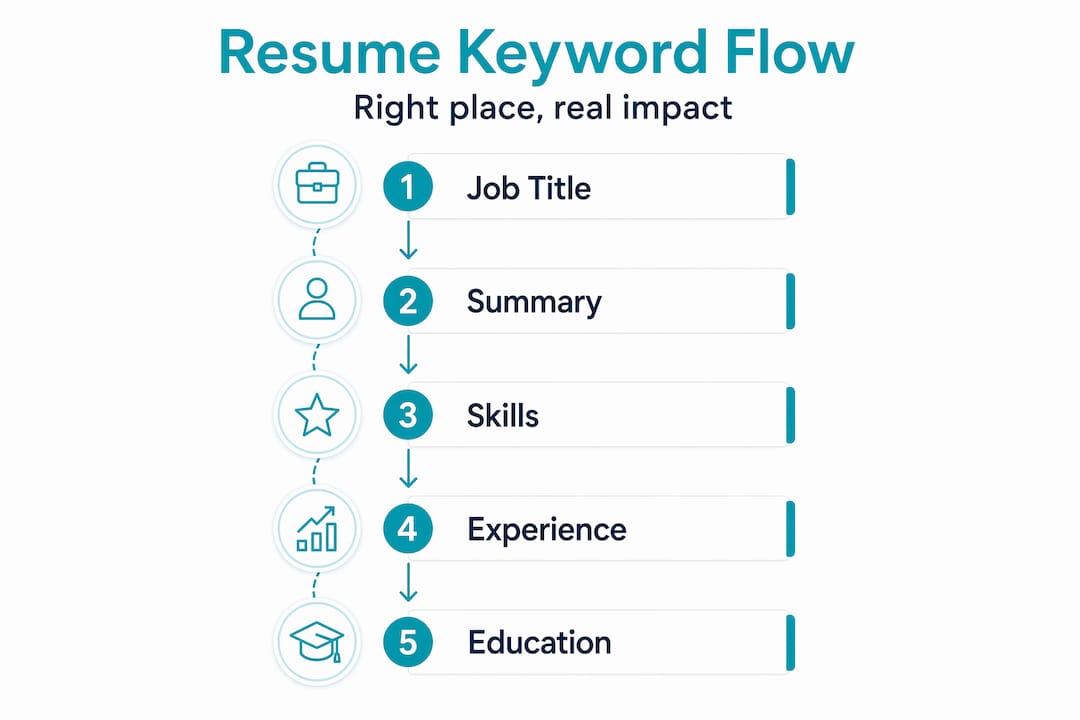
Not all resume real estate is equal. ATS systems and recruiters both prioritize the top third of the page. That means your title and summary are the highest-value locations for keyword placement.
The job title used in the resume should closely mirror the job posting, and your resume summary is a high-signal location because ATS and recruiters parse early sections first. If the posting says “VP of Operations” and your current title is “Director of Operations,” consider adding a resume headline that reads: VP of Operations | Supply Chain | P&L Leadership. You’re not misrepresenting yourself, you’re speaking the system’s language.
Here’s how each section should handle keywords:
- Resume headline/title: Mirror the target job title exactly. This is the first thing ATS reads.
- Summary (3 to 4 sentences): Load this with your top 4 to 5 keywords. Write it as a human would, but make every sentence earn its keywords.
- Core competencies/skills section: List 8 to 12 hard and soft skill keywords. Use the exact phrasing from the job description.
- Work experience bullet points: This is where keywords become evidence. Combine action verbs with skill keywords and quantify results.
- Certifications and credentials: Spell these out in full and add the abbreviation in parentheses so ATS catches both versions.
| Resume section | Primary keyword type | Example |
|---|---|---|
| Headline/title | Job title keywords | Chief Financial Officer, Fortune 500 |
| Summary | Role and industry terms | Enterprise financial strategy, M&A leadership |
| Core competencies | Hard and soft skills | P&L management, stakeholder communication |
| Work experience | Action verbs plus skill keywords | Led $500M budget restructuring |
| Certifications | Credentials and abbreviations | Certified Public Accountant (CPA) |
Pro Tip: Never use text boxes, headers, or footers to place keywords in your resume. Many ATS systems cannot parse those elements, and your carefully chosen keywords will simply vanish from the scan.
For section-by-section placement strategy, review resume section keyword tips built around ATS-compliant formatting.
Comparing keyword types and examples for executives
To further clarify keyword selection, let’s compare different types and look at executive-specific examples.
Resume keywords encompass all the specific words and phrases that describe your qualifications, while action verbs are a subset that specifically describe what you accomplished or contributed. Understanding the difference helps you build a resume that checks every box.
| Keyword type | Definition | Executive examples |
|---|---|---|
| Hard skills | Technical, measurable abilities | Financial modeling, SAP S/4HANA, M&A due diligence |
| Soft skills | Behavioral and interpersonal capabilities | Executive leadership, board communication, crisis management |
| Action verbs | Dynamic descriptors of achievement | Directed, spearheaded, restructured, negotiated |
| Credentials | Degrees, certifications, licenses | MBA, CPA, PMP, Six Sigma Black Belt |
| Industry terms | Sector-specific vocabulary | EBITDA, go-to-market strategy, SaaS metrics |
A few principles worth noting for senior professionals:
- Hard skills anchor credibility. “SAP expertise” means something specific. “Technology skills” means nothing.
- Soft skills need context. “Leadership” alone won’t pass an ATS or impress a recruiter. “Cross-functional leadership across five global business units” does both.
- Action verbs shift your resume from static to dynamic. “Responsible for budgeting” reads like a job description. “Directed $80M annual budgeting cycle, reducing variance by 12%” reads like a result.
- Credentials must be keyword-complete. List the full name and the acronym so both versions are searchable.
Browse executive keyword examples to see how these types combine in real senior-level resumes.
Key tips for maintaining keyword relevance and ATS compatibility
Now that you know keyword types, here are expert tips to keep your resume both relevant and ATS-compatible.
The resume you wrote last year for a different role is not the resume you should submit today. Every application requires a fresh keyword pass. That’s not optional for executives competing in tight talent markets, it’s table stakes.
- Tailor your resume for every application. Swap out or add keywords based on each specific job description. A CFO role at a private equity-backed company uses different language than one at a Fortune 100 corporation.
- Match spelling exactly. If the posting uses “programme” or an industry-specific abbreviation, check whether the role is U.S.-based. For U.S. roles, use American spelling conventions consistently.
- Limit yourself to 25 to 30 keywords. ATS tools can detect excessive or unnatural use and may filter your resume out. Restraint is a feature, not a limitation.
- Use synonyms only when they appear in the posting. If the job description says “client acquisition” and you’re tempted to also add “business development,” check first whether the posting uses that term too.
- Run a readability test. Ask yourself: would a smart colleague find this resume clear, credible, and compelling? If not, the keyword balance is off.
Pro Tip: Keep a master resume with your complete career history and the full range of your keywords. Customize a targeted version for each application by pulling from the master. You’ll save time and avoid starting from scratch every time.
For a full checklist, visit ATS keyword compatibility resources designed for executive job seekers.
The overlooked balance: integrating keywords without sacrificing authenticity
Here’s a perspective that most resume advice misses entirely: keyword optimization is not a formatting exercise. It’s a translation exercise. And translation requires you to understand both languages, the employer’s language and your own authentic professional story.
Experienced professionals often make one of two errors. They either ignore keyword strategy entirely, trusting that their career speaks for itself, or they overcorrect and build a resume that reads like an SEO article rather than a career narrative. Both approaches fail.
The most effective resumes aren’t keyword lists, they’re keywords integrated with real evidence, especially in work experience. “Revenue growth” as a standalone bullet point is noise. “Drove 34% revenue growth in 18 months by renegotiating vendor contracts and launching two new product lines” is a keyword-rich achievement that a human actually wants to read.
What separates executives who land interviews from those who don’t isn’t the number of keywords on the page. It’s the quality of the evidence attached to those keywords. A recruiter who sees “P&L management” in a skills list feels nothing. A recruiter who reads “Managed $150M P&L across three divisions, turning a $4M deficit into an $11M profit in two fiscal years” stops scrolling.
The other thing most advice glosses over: keyword optimization is cumulative. It’s not about one perfect resume. It’s about building a vocabulary of terms that consistently represent your executive brand across your resume, LinkedIn profile, and even interview language. When every touchpoint speaks the same language, you don’t just pass ATS screens, you become memorable to the humans on the other side.
Explore authentic keyword integration approaches that align your voice with employer expectations at the executive level.
Boost your executive resume with expert keyword optimization support
Keyword strategy is clear in theory. In practice, when you’re managing a full-time role and running a confidential job search, finding the time to research, analyze, and tailor every resume is a different challenge entirely.

Resume Wiz was built specifically for professionals in this position. With over a decade of recruiting experience behind every engagement, the team at Resume Wiz identifies the exact keywords that move the needle for your target roles, integrates them with your authentic career story, and ensures your resume is calibrated for ATS filters and recruiter review. From your executive summary to your credentials section, every element is calibrated for visibility and impact. If you’re ready to turn your experience into interviews, professional resume services from Resume Wiz are your next step. Explore executive resume help today.
Want a recruiter in your corner for your next senior role? Book a free call with Resume Wiz and we will map out your next move together.
Frequently asked questions
What is a keyword-optimized resume?
A keyword-optimized resume is a document tailored with specific words and phrases that match what employers and ATS seek, increasing your chances of passing automated screenings and reaching a recruiter. Keywords that map to employer requirements are the difference between being filtered out and being shortlisted.
How many keywords should I include in my resume?
Aim for 25 to 30 relevant keywords per resume. Going beyond that risks triggering ATS filters, since excessive or unnatural keyword use is detectable by most modern screening tools.
Where do I find the right keywords for my resume?
Start with the job posting itself, since recruiters use job description wording to set ATS filters. Cross-reference 3 to 5 similar postings and the company’s own website to identify the most consistent and high-priority terms.
Can I just list keywords to get through ATS?
No. Keyword stuffing looks unnatural, may cause ATS rejection, and fails completely with human reviewers. Effective resumes integrate keywords with concrete evidence of your achievements, particularly in work experience sections.
How important is matching the job title exactly on my resume?
Very important. The job title should closely mirror the posting’s language, particularly in your headline and summary, because many ATS systems are configured to match exact job title strings before ranking candidates.
