Informational Interview: What It Is and How to Do It
An informational interview is a short, informal conversation, typically 20 to 30 minutes, where you ask a working professional for insight into their career, industry, or organization. You are not applying for a job. You are gathering real-world intelligence that no job posting can give you. According to Berkeley’s Career Engagement office, strong connections can occasionally stretch these conversations to an hour, but 20 to 30 minutes is the standard to request and respect. Most professionals genuinely enjoy reflecting on their careers when approached respectfully, so cold outreach is far less awkward than it feels. Your next step is simple: identify one person in a role or field you want to learn about, then send a short message proposing a 20 to 30 minute chat this week or next.
Table of Contents
- Why informational interviews are worth your time
- How to run an informational interview from start to finish
- Questions to ask during an informational interview
- How to reach out: templates that actually get responses
- Etiquette: what to do, what to avoid, and how to close well
- Can an informational interview actually lead to a job?
- Key Takeaways
- The part most guides get wrong about informational interviews
- Resumewiz can sharpen your outreach before you send it
- Further reading and authoritative sources
Why informational interviews are worth your time
The benefits of informational interviews go well beyond “learning about a field.” Here is what you actually gain:
- Insider knowledge you cannot Google. Princeton’s Career Development office notes that firsthand information about what it is really like to work in a role or organization is rarely available online.
- Career paths you did not know existed. Professionals routinely mention adjacent roles, niche specializations, or lateral moves that never appear in job listings.
- Network expansion without the pressure of applying. Every conversation is a potential referral source, a future reference, or a door to a hiring manager.
- Career validation before you commit. For career changers especially, a single honest conversation can confirm or redirect a months-long transition plan.
- Resume and interview prep. The language professionals use to describe their work is exactly the language that resonates in applications and interviews.
- Broader business perspective. CNBC’s career reporting highlights that informational interviews help professionals understand how different business functions connect, which sharpens problem-solving across roles.
The use cases are wider than most people assume. Early-career professionals use them for exploration. Mid-career managers use them before pivoting industries. Executives use them to map a new sector before making a lateral move. Even those considering internal transfers benefit from talking to someone already in the target department.
Networking drives a significant share of hiring in the U.S. market, and informational interviews are one of the most direct ways to build those connections before a specific role opens up.
How to run an informational interview from start to finish
University career centers from Virginia Tech to Berkeley teach the same six-step workflow. Here it is, with the practical details most guides skip.
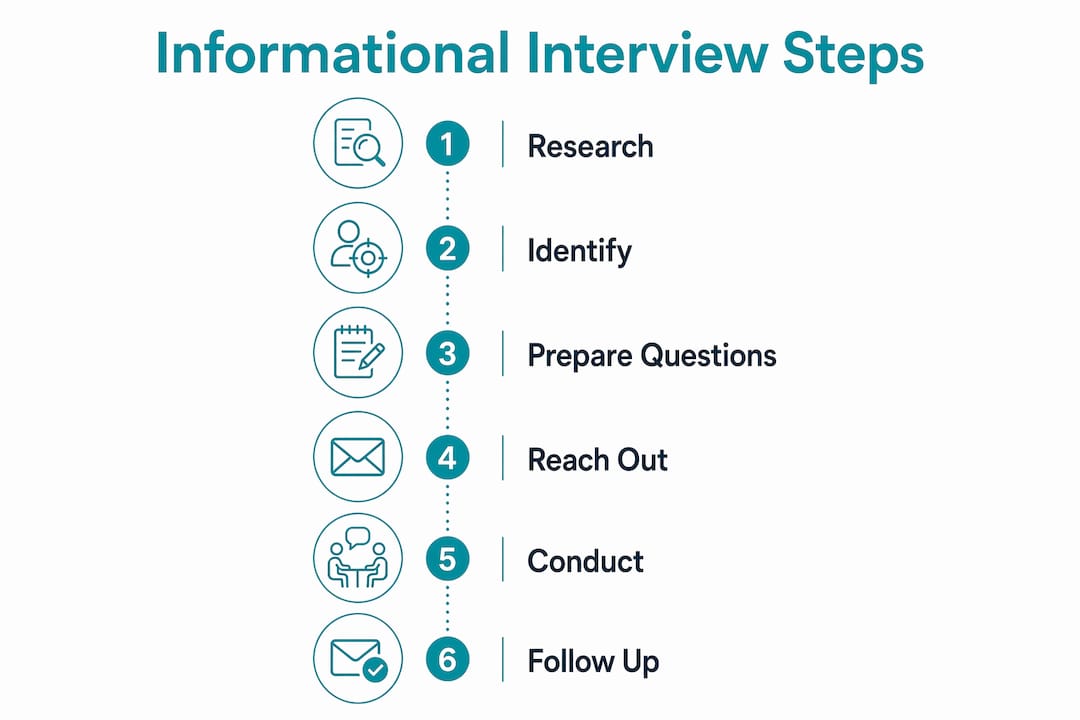
1. Research first. Before you identify anyone to contact, get clear on what you want to learn. Are you exploring an industry, a specific role, or a particular company? Knowing your goal shapes every question you will ask and every person you will approach.
2. Identify the right people. LinkedIn is the obvious starting point. Search by job title, company, or industry. Alumni networks, professional associations, and your existing contacts are equally productive. Aim for people two or three levels above where you are now, not just peers.
3. Prepare your questions. Come with six to eight prepared questions, ranked by priority. You will not get through all of them in 20 to 30 minutes, so know which three matter most. Research the person’s background on LinkedIn before the meeting so you are not asking questions their profile already answers.
4. Reach out with a specific ask. Keep your initial message short: who you are, why you chose them specifically, and a concrete request for 20 to 30 minutes. Berkeley’s Career Engagement guidance is explicit that suggesting specific availability and explaining why you chose that person significantly improves response rates. Vague requests get ignored.
5. Conduct the meeting. Arrive on time, whether it is a video call or an in-person coffee. Open with a brief overview of yourself, then let your questions drive the conversation. Keep it conversational, not interrogative. You manage the clock.
6. Follow up within 24 hours. Send a thank-you note that references something specific from the conversation. A generic “thanks for your time” is forgettable. A note that says “your point about the shift toward product-led growth in SaaS changed how I’m thinking about my next role” is not.
Pro Tip: Ask permission before recording the meeting. A simple “Would you mind if I recorded this so I can focus on the conversation rather than my notes?” works well. If they decline, take brief notes by hand and write up a full summary immediately after the call while it is fresh.
Questions to ask during an informational interview
The best informational interview questions invite stories, not yes/no answers. Avoid rapid-fire lists that feel like a quiz. Pick five or six and let the conversation breathe.
Opening questions to get the conversation going:
- How did you get into this field, and was it a straight path or did you take some detours?
- What does a typical week look like for you right now?
- What drew you to this particular company or organization?
- What has surprised you most about working in this industry?
Role-focused questions:
- What skills do you use most in your day-to-day work that you did not expect to need?
- What does strong performance look like in this type of role?
- If you were hiring for a position like yours, what would you prioritize in a candidate?
Industry and trend questions:
- Where do you see this industry heading over the next few years?
- What are the biggest challenges people in this field are navigating right now?
- Are there certifications, communities, or publications you would recommend for someone trying to break in?
Closing and referral questions:
- Is there anyone else you would suggest I speak with?
- Would it be okay if I stayed in touch as I continue my research?
- Is there anything you wish someone had told you before you entered this field?
The closing questions are where most people leave value on the table. Asking for a referral to one more person is how a single conversation becomes a network.
How to reach out: templates that actually get responses
The outreach message is where most informational interview attempts fail. Too long, too vague, or too obviously copy-pasted. Here is what works.
Cold LinkedIn message:
Hi [Name], I came across your profile while researching [industry/role]. Your path from [X] to [Y] caught my attention. I’m currently exploring a transition into [field] and would love to hear your perspective. Would you be open to a 20 to 30 minute conversation at your convenience? Happy to work around your schedule.
Cold email (subject line: “Quick question from a [shared connection/alumni/field] professional”):
Hi [Name],
I’m [your name], a [brief current role or context]. I’ve been following your work in [specific area] and would value 20 to 30 minutes of your time to learn about your experience in [field/role]. I’m not looking for a job referral, just genuine insight from someone who has done what I’m hoping to do. Would [specific date/time] or [alternate date/time] work for you?
Warm introduction via mutual contact:
Hi [Name], [Mutual contact] suggested I reach out. I’m exploring [field/role] and would love to hear about your experience. Could we find 20 to 30 minutes to connect? I’m flexible on timing and happy to do a call or coffee.
Follow-up timing: Wait five to seven business days before following up once. Keep the follow-up to two sentences. If there is still no response after a second attempt, move on without frustration.
Best-practice checklist for outreach:
- Keep the message under 100 words
- Name one specific reason you chose this person
- Propose 20 to 30 minutes, not “a quick call” (vague)
- Offer two specific time options or say you will work around their schedule
- Never attach your resume to the initial outreach
Etiquette: what to do, what to avoid, and how to close well
The BLS Career Outlook describes informational interviews as a way to expose yourself to career paths and hiring leads without the pressure of a formal hiring process. That low-pressure dynamic is the whole point, and it is easy to destroy with one misstep.
Do:
- Confirm the meeting 24 hours in advance
- Arrive or log on two minutes early
- Open by restating that you are there to learn, not to ask for a job
- Signal the time at the five-minute mark (“I want to be respectful of your time, I have a couple more questions if you have a few minutes”)
- End on schedule even if the conversation is going well
- Send a specific, personalized thank-you within 24 hours
Don’t:
- Ask for a job, a referral to HR, or a formal introduction to a hiring manager during the meeting
- Overshare personal frustrations about your current job search
- Let the meeting run long without the other person’s explicit invitation
- Send a follow-up resume without being asked or without asking permission first
- Treat the conversation as a pitch
Informational interview vs. job interview at a glance:
| Dimension | Informational interview | Job interview |
|---|---|---|
| Purpose | Gather career insight and build connections | Evaluate fit for a specific open role |
| Who asks questions | Primarily you, the requester | Primarily the interviewer/employer |
| Tone | Informal, conversational, low-stakes | Formal, evaluative, higher-stakes |
| Duration | Typically 20 to 30 minutes | Usually 20 to 30 minutes |
| Outcome | Relationship, insight, possible referral | Hiring decision |
| Job request appropriate? | No | Yes |
The Wikipedia entry on informational interviews frames this well: it is a “non-threatening forum” where both sides can learn about each other without the weight of a hiring decision hanging over the room.
Can an informational interview actually lead to a job?
Yes, but not by asking for one during the meeting. That distinction matters more than people realize.
Asking directly for a job or a referral to an open role during an informational interview typically shuts the conversation down. The professional feels misled about the purpose of the meeting, and the goodwill you built evaporates. The path from conversation to opportunity is indirect and usually slower, but it is real.
Conversion tactics that work:
- At the end of the meeting, ask if they know anyone else you should speak with. This is a referral request for more conversations, not for a job, and most people are happy to make it.
- After the meeting, send your thank-you note and mention that you would be glad to share your resume if they ever think it might be useful. This plants the seed without pressure.
- Stay in touch every few months with a brief, low-ask message: a relevant article, a quick update on your progress, or a note referencing something they mentioned.
- When a role opens at their company, you now have a warm contact who already knows your background.
Behaviors that hurt your chances:
- Following up more than twice before getting a response
- Sending a resume without being asked
- Asking the professional to advocate for you to their hiring team after a single conversation
- Treating every follow-up as an opportunity to ask for something
Bill Driscoll, New England District President of Accountemps, put it plainly in UConn’s career guidance: “An informational interview is a great way to meet someone who can make hiring decisions, but don’t get discouraged if it doesn’t lead to a job interview. The point is to learn and establish an important business relationship.”
Career changers get particular value here. CNBC’s reporting on informational interviews notes that these conversations can reveal niche entry points and training paths that never appear in public job postings, which is often the most direct route into a new field.
Key Takeaways
An informational interview is a 20 to 30 minute, low-pressure conversation that builds your network and career knowledge without the stakes of a formal job interview.
| Point | Details |
|---|---|
| Not a job interview | The purpose is learning and connection, not applying: never ask for a job during the meeting. |
| 20 to 30 minute standard | Request this duration in your outreach and manage the clock yourself as the requester. |
| Outreach specificity wins | Name why you chose this person and offer two specific time slots to improve response rates. |
| Referrals come at the close | Ask who else you should speak with at the end of every meeting to grow your network organically. |
| Resumewiz accelerates the process | Resumewiz provides outreach templates, LinkedIn optimization, and coaching to help you move faster and present stronger. |
The part most guides get wrong about informational interviews
Most advice on informational interviews focuses on what to say during the meeting. The real leverage is in what happens before and after.
Before the meeting, most people under-research. They scan a LinkedIn profile for two minutes and show up with generic questions. The professionals who remember a conversation are the ones who referenced a specific article the contact published, mentioned a career transition they made three years ago, or asked about a challenge specific to that company’s market position. That level of preparation signals that you are serious, and it makes the conversation genuinely interesting for both sides.
After the meeting, most people send a thank-you and disappear. The professionals who convert informational interviews into real opportunities treat them as the first touchpoint in a long-term relationship. A brief check-in two months later, a relevant industry article, a note saying “I took your advice and enrolled in that certification”, these are the moves that keep you top of mind when something opens up.
From a recruiter’s perspective, the candidates who stand out in these conversations share two traits. They have a clear, concise answer to “tell me about yourself” that takes under 90 seconds and ends with a specific question. And they follow up with something memorable: a link, a resource, a reference to a specific moment in the conversation. Generic follow-ups are forgotten within a week.
The mistake that costs the most goodwill is the pivot. You have a great 25-minute conversation, the professional seems genuinely engaged, and then in the last five minutes you ask if they can pass your resume to their hiring manager. The entire dynamic shifts. What felt like a peer conversation suddenly feels like a sales call. That professional will think twice before agreeing to another informational interview, and they will not be referring you anywhere.
One concrete action that works: after the meeting, send your thank-you and include one specific resource, article, or idea that connects to something they mentioned. It takes five minutes and it is the single most effective way to stay memorable without asking for anything.
Resumewiz can sharpen your outreach before you send it
Knowing how to do an informational interview is one thing. Showing up with a polished LinkedIn profile, a tight professional summary, and outreach messages that actually reflect your value is another.
Resumewiz works with executives, managers, and career changers who want to move faster and present stronger throughout their job search. That includes outreach templates and LinkedIn optimization built around your specific background, interview coaching that prepares you for both informational and formal interviews, and a fully managed job search process for professionals who want tailored applications and outreach. This article gives you everything you need to run informational interviews on your own. If you want a recruiter-reviewed profile and ready-to-send outreach assets behind you, visit Resumewiz to see which service fits your situation.
Further reading and authoritative sources
These are the primary sources behind this article, each worth bookmarking for your own research:
- Princeton Career Development, Informational Interviews: Clear overview of purpose, benefits, and what to expect from the process.
- Berkeley Career Engagement, Informational Interviews: Detailed guidance on outreach, etiquette, and the requester’s responsibilities.
- Virginia Tech Career Services, Informational Interviews: The six-step framework and timekeeping guidance used by career coaches nationwide.
- BLS Career Outlook, Informational Interviewing: A government labor publication explaining how these conversations expose you to career paths and hiring leads.
- UConn Center for Career Readiness, How to Conduct a Successful Informational Interview: Practical tips including expert quotes from hiring professionals.
- CNBC, Why You Should Do Informational Interviews: Career expert perspectives on the value for career changers and industry researchers.
- Resumewiz: Outreach templates, LinkedIn optimization, and coaching for mid- to senior-level professionals navigating a job search or career transition.
Want a recruiter in your corner for your next senior role? Book a free call with Resume Wiz and we will map out your next move together.
