Why Applying Without a Network Rarely Works for Pros
Applying without a network usually fails because it strips away the trust and access signals that both automated hiring systems and human gatekeepers rely on to decide whose resume is worth a second look. Without a referral or warm introduction, your application enters a queue with hundreds of others, and the hiring funnel is not designed to surface anonymous candidates fairly.
Two facts frame the problem immediately. First, a large share of jobs are filled through personal contacts before they ever reach a public job board, according to U.S. Department of Labor career development guidance. Second, research tracking applications per hire shows that number tripled between the early 2020s and 2025, meaning each individual application is statistically less likely to be noticed than it was just a few years ago. Referral-sourced candidates, by contrast, convert to interviews at materially higher rates than portal applicants.
Stop doing this week:
- Submitting more than 5 applications per day through generic portals without a tailored resume or any connection at the company
- Treating application volume as a proxy for progress
Start doing this week:
- Identify 10 target companies and find one person at each on LinkedIn who holds a role one level above the one you want.
- Send three short, specific outreach messages this week, not to ask for a job, but to ask one genuine question about their work.
Table of Contents
- Why applying without a network rarely works: the hiring funnel explained
- What the research actually shows about referrals and hidden roles
- The networking activities that actually convert to hires
- Common mistakes professionals make when they keep mass-applying
- A 30/60/90-day plan for professionals with few connections
- Can you still land a job without networking?
- When paid career services make sense and what they actually deliver
- Key Takeaways
- The real cost of waiting to network
- Resumewiz can manage the outreach you do not have time for
- Useful sources
Why applying without a network rarely works: the hiring funnel explained
Most professionals picture the hiring process as a meritocratic ladder: post a resume, a recruiter reads it, the best candidate wins. The actual funnel looks nothing like that.
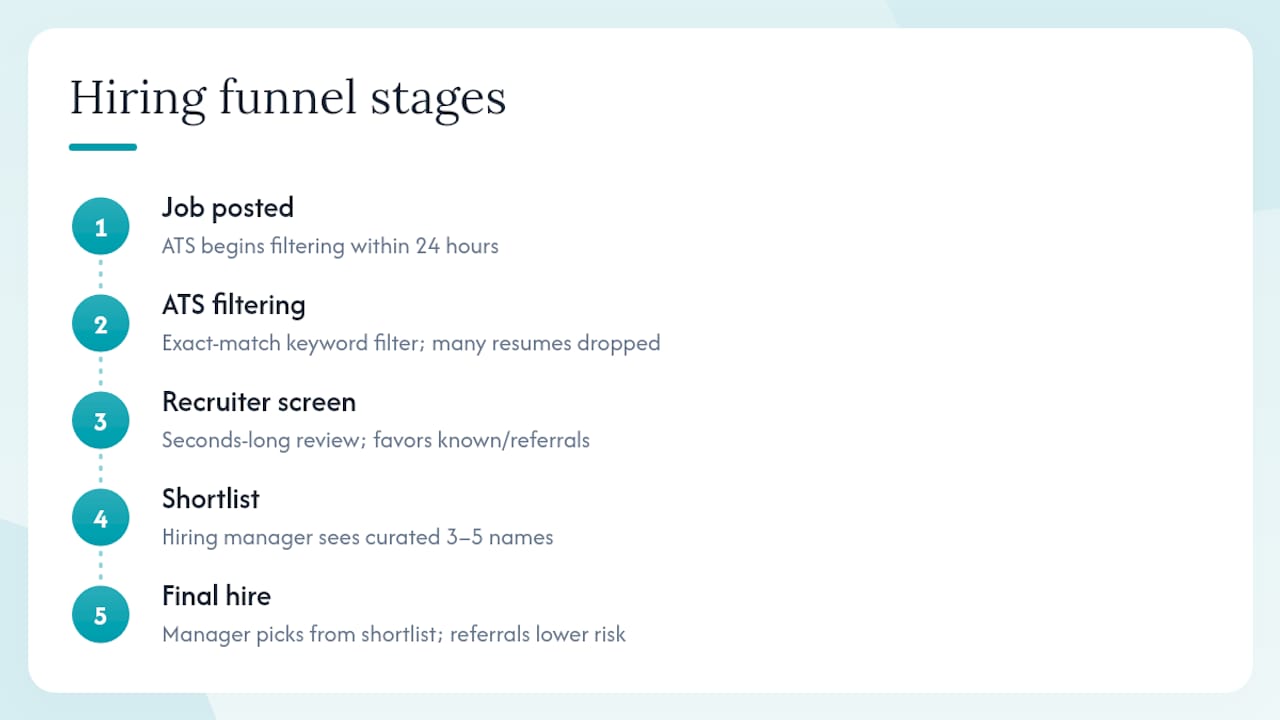
A job posting goes live. Within 24 hours, an applicant tracking system (ATS) like Workday, Greenhouse, or Lever begins filtering submissions against keyword criteria. Many resumes never reach a human eye. Of those that do, a recruiter typically spends seconds on an initial screen before deciding whether to advance a candidate. The hiring manager sees only a curated shortlist, often three to five names, and makes a final call from there.
At every stage, anonymous applicants face a structural disadvantage. The ATS filters on exact-match keywords, not on judgment. The recruiter, managing dozens of open roles simultaneously, defaults to the candidates with a recognizable name, a mutual connection, or an internal referral attached. The hiring manager trusts the recruiter’s shortlist, which already skews toward known quantities.
“When a hiring manager receives a referral, the perceived risk of a bad hire drops immediately. The referrer has already done a credibility check. That’s a signal no resume keyword can replicate.” Business Insider, on trust signals in the AI-era job market
The AI application wave has made this worse. As AI tools make it trivially easy to generate polished applications at scale, the signal-to-noise ratio for recruiters has collapsed. Industry analysis from 2026 documents that direct outreach and referrals now produce response rates that dwarf those of portal applications, precisely because they stand out in a sea of AI-generated submissions.
Pro Tip: Run a quick diagnostic on your last 20 applications. Count how many had a named contact at the company, a tailored resume, and a follow-up message. If the answer is fewer than five, you have found your failure mode, and it is not your resume.
What the research actually shows about referrals and hidden roles
The evidence here is not anecdotal. It is experimental.
A landmark study published in Science used LinkedIn’s recommendation algorithm as a randomized experiment across millions of users. The finding: adding weak ties causally increases job mobility. Crucially, the effect is nonlinear. Moderately weak ties, people you know but do not interact with daily, produced the strongest job-transmission results. Your closest contacts share your information bubble. Your distant acquaintances open doors to new networks, new companies, and roles you would never have found on a job board.
Scientific American’s coverage of the same study translates the finding plainly: the people most likely to help you get a job are not your best friends. They are the former colleague you worked with three years ago, the conference acquaintance you connected with on LinkedIn but rarely speak to, the alumni contact two years ahead of you.
A separate field experiment with 491 job seekers found that a training program designed to raise networking self-efficacy, the BRIO program, increased networking activity and produced measurably higher-quality reemployment outcomes. Networking is not a personality trait. It is a skill, and it responds to deliberate practice.
| Signal | What the research shows | Implication for your search |
|---|---|---|
| Weak ties | Causally increase job mobility; moderately weak ties most effective | Prioritize reconnecting with dormant contacts over cold outreach |
| Referral conversion | Referral candidates convert to interviews at materially higher rates than portal applicants | One referral is worth dozens of blind applications |
| Applications per hire | Increased significantly since the early 2020s | Volume strategy is becoming less effective |
| Networking self-efficacy | Teachable; training raises activity and reemployment quality | Confidence barriers are real but fixable with structured practice |
| Hidden job market | Large share of roles filled through contacts before public posting | Networking uncovers roles that never appear on job boards |
The practical read: if your search has produced few responses despite high application volume, the problem is almost certainly access, not qualifications.
The networking activities that actually convert to hires
Not all networking is equal. “Go to more events” is advice that sounds useful and rarely produces a job offer. Here is what the research and practitioner evidence actually support, ranked by conversion potential.
1. Reconnect with moderately weak ties
Former colleagues, classmates, and past clients sit in the sweet spot the LinkedIn experiments identified. They know you well enough to vouch for you, but they move in different professional circles. A short, specific message referencing shared history and asking one genuine question about their current work has a far higher response rate than a cold outreach to a stranger.
2. Request informational interviews
An informational interview is a 20-minute conversation with someone in a role or company you are targeting. You are not asking for a job. You are asking for perspective. The Department of Labor’s career development guidance identifies informational interviewing as one of the most effective tools for uncovering hidden roles and building the relationships that lead to referrals. The conversion path is indirect but reliable: conversation leads to referral leads to interview.
3. Target hiring managers directly with a specific value proposition
Recruiters manage process. Hiring managers feel the pain of the open role. A short LinkedIn message or email to a hiring manager that names a specific problem they face and connects it to your experience cuts through in a way that a portal application cannot. LinkedIn’s career content consistently shows that targeted outreach to decision-makers produces response rates that generic applications cannot match.
4. Ask for employee referrals explicitly
Most professionals are reluctant to ask directly. Most employees are happy to refer someone they respect because many companies offer referral bonuses and because referring a strong candidate reflects well on them. If you have a contact at a target company, ask plainly: “Would you be comfortable referring me for this role?” A direct ask works better than hinting.
5. Use project-based proof as a networking entry point
A short public project, a published analysis, a GitHub repository, a LinkedIn article on a specific industry problem, gives you a reason to reach out to people in your field and a reason for them to remember you. Sharing your work with a relevant contact is not self-promotion. It is a conversation starter that demonstrates competence before the interview.
Common mistakes professionals make when they keep mass-applying
The errors are predictable, and they compound each other.
Mistake 1: Treating Easy Apply as a strategy. LinkedIn’s one-click application is a convenience feature, not a job-search strategy. When everyone can apply in 10 seconds, the signal value of applying drops to near zero. Recruiters know which roles attract 500 Easy Apply submissions in 48 hours. Those roles get screened harder, not easier.
Mistake 2: Sending templated outreach. A message that could have been sent to anyone will be treated as if it was sent to no one. Hiring managers and potential contacts can identify a template in two sentences. Personalization is not flattery. It is proof that you did the work.
Mistake 3: Chasing “soft” listings. Roles posted with vague requirements and no salary range are often either already filled internally or posted for compliance reasons. Spending time on these listings produces false hope and no feedback.
“Volume is not a strategy. It is a way of feeling busy while avoiding the harder, more effective work of building one real relationship at a time.” Career development principle supported by Path Ascent’s research summary on what gets job seekers hired
Mistake 4: Using application volume as feedback. If you send 100 applications and get two responses, the natural interpretation is that 98 companies rejected you. The more accurate interpretation is that 98 applications were never meaningfully reviewed. Volume produces noise, not signal. A better feedback loop is outreach response rate, not application count.
Pro Tip: Pick one company you genuinely want to work for and spend the time you would have used on 10 generic applications on one targeted campaign: a tailored resume, a LinkedIn message to the hiring manager, and a note to any contact at the company. Compare the response rate. The experiment usually settles the debate.
A 30/60/90-day plan for professionals with few connections
This plan assumes you are starting with a thin network and limited time. It is built around small, repeatable weekly tasks with measurable outputs.
Days 1 to 30: Research and first contact
- Build a target list of 15 to 20 companies where your skills are a clear fit. Use LinkedIn, industry publications, and job boards to identify them, but do not apply yet.
- For each company, identify one or two people: a hiring manager or department head, and one employee at your level or one above.
- Reconnect with five dormant contacts this week. Keep the message under 75 words, reference something specific you shared, and ask one question.
- Send three informational interview requests. Use this structure: one sentence on who you are, one sentence on why you are reaching out to them specifically, one clear ask for 20 minutes.
- Track every outreach in a simple spreadsheet: date sent, name, company, response (yes/no/pending), next step.
Days 31 to 60: Build proof and deepen relationships
- Follow up once on any unanswered outreach from week two (one follow-up only, seven days later).
- Complete one informational interview per week. Prepare three specific questions. Send a thank-you note within 24 hours that references something they said.
- Create or update one piece of public proof: a LinkedIn article, a portfolio piece, or a case study that demonstrates a specific skill relevant to your target roles.
- Begin applying to roles at your target companies, but only after you have made contact with someone there.
Days 61 to 90: Convert relationships to referrals
- Ask explicitly for referrals from contacts who have responded positively. Be specific: name the role and the company.
- Run a small experiment: compare your response rate from applications with a contact versus applications without one. The data will clarify where to focus.
- Expand your target list by 5 to 10 companies based on what you have learned from informational interviews.
Outreach template (informational interview request):
“Hi [Name], I came across your work at [Company] and found your background in [specific area] genuinely interesting. I am currently exploring opportunities in [field] and would value 20 minutes of your perspective on [specific question]. Happy to work around your schedule.”
Keep it under 100 words. No attachments. No resume. No “I am looking for a job” in the first message.
Tracking table:
| Metric | Week 1 target | Week 4 target | |
|---|---|---|---|
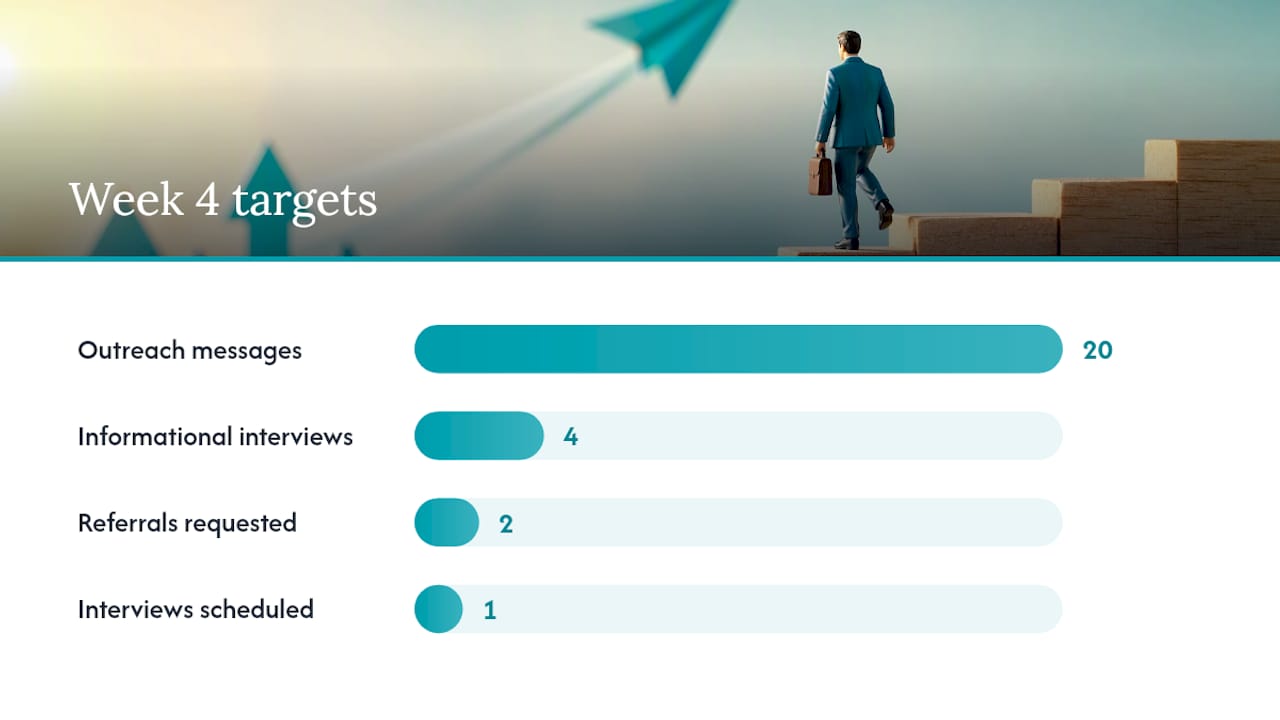
| Outreach messages sent | 5 | 20 | |
| Response rate | Baseline | 20%+ | |
| Informational interviews | 1 | 4 | |
| Referrals requested | 2 | 5 | |
| Interviews scheduled | 1 | 3 |
Can you still land a job without networking?
Yes, in specific circumstances. No, not reliably at the mid-to-senior level.
Blind applications work best in three scenarios. First, high-volume contract and staffing roles where companies hire in bulk and the process is genuinely transactional. Second, entry-level positions where the applicant pool is large but relatively undifferentiated and a strong resume can surface. Third, niche technical roles where the candidate pool is small enough that a qualified applicant stands out regardless of connections.
For mid-level managers, senior individual contributors, directors, and executives, the calculus shifts sharply. At these levels, roles are more likely to be filled through referrals or executive search before they reach a public board. The competition among applicants who do apply is higher. And hiring managers at this level rely more heavily on social proof, because the cost of a bad hire is larger.
Career changers face the steepest climb without a network. When your resume does not tell a linear story, a referral from someone who can vouch for your transferable skills becomes close to mandatory. Without one, the ATS and the recruiter both have a reason to pass.
Pro Tip: If your timeline is under 60 days, networking is not optional. The average job search through blind applications alone takes considerably longer than one that includes targeted outreach. If you are time-constrained, every week spent on mass applications is a week not spent building the access that actually shortens the search.
A 2025 Business Insider analysis noted that as AI-generated applications flood hiring systems, the relative value of a trust signal, a referral, a warm introduction, a visible professional reputation, has grown. The floor for what it takes to get noticed without a connection has risen.
When paid career services make sense and what they actually deliver
There is a category of professional who genuinely cannot afford to spend six months on a trial-and-error job search: the executive managing a full-time role while searching, the career changer whose resume tells the wrong story, the manager who has not searched in a decade and does not know what the current market expects.
For these professionals, paid career services fix specific, high-cost problems. A professionally written, ATS-optimized resume removes one of the most common early-funnel failure points. LinkedIn profile optimization changes who finds you, not just how you look when someone does. Managed outreach, where a service handles the targeting, messaging, and follow-up cadence on your behalf, compresses the timeline of the 30/60/90 plan above into something a busy professional can sustain.
“The professionals who benefit most from managed career services are not the ones who lack skills. They are the ones who lack time, positioning, or access, and who recognize that the cost of a slow search exceeds the cost of getting professional help.” Career services principle supported by Wiley’s research on networking interventions and reemployment outcomes
What to look for in a provider: sample deliverables you can evaluate before buying, a clear timeline with defined milestones, and a clear, written process and verifiable results. Vague promises about “improving your chances” are not a guarantee. A specific, documented process with examples of real outcomes is.
Who benefits most: executives and senior managers whose time is the binding constraint, career changers who need their story repositioned, and professionals re-entering the market after a gap. Entry-level job seekers with flexible timelines and the bandwidth to run their own outreach campaign will often get sufficient value from free resources and templates.
Key Takeaways
Applying without a network rarely works because it removes the trust and access signals that move candidates past automated filters and human gatekeepers at every stage of the hiring funnel.
| Point | Details |
|---|---|
| Hidden job market is real | A large share of roles are filled through personal contacts before public posting, per Department of Labor guidance. |
| Weak ties are your best asset | LinkedIn’s randomized experiments show moderately weak ties causally increase job mobility more than close contacts do. |
| Volume strategy is failing | Applications per hire tripled between the early 2020s and 2025, making each blind application statistically less effective. |
| Networking is a learnable skill | The BRIO field experiment with 491 job seekers showed that training raises networking confidence and produces better reemployment outcomes. |
| Resumewiz accelerates access | For time-constrained executives and career changers, Resumewiz’s managed search, LinkedIn optimization, and outreach services compress the timeline from months to weeks. |
The real cost of waiting to network
Most professionals who rely on mass applications are not lazy. They are uncomfortable. Sending 50 applications feels productive in a way that sending five personal messages does not, because applications are easy to count and easy to send. The discomfort of reaching out to a near-stranger, of asking for 20 minutes of someone’s time, of making yourself visible before you have a job offer to show for it, is real. It is also the exact barrier that separates the professionals who find roles in eight weeks from those who are still searching at month six.
The research is unambiguous on this point. The LinkedIn weak-ties study was not a survey or a self-report. It was a randomized experiment at scale. Adding the right connections causally changed outcomes. That is a rare standard of evidence in social science, and it points in one direction: the discomfort of networking is the price of access, and access is what the job market actually runs on.
What I have seen repeatedly is that professionals underestimate how willing people are to help when asked specifically and respectfully. A 20-minute informational interview request, sent to someone whose work you have genuinely engaged with, gets a yes more often than most people expect. The barrier is not the other person. It is the story we tell ourselves about what they will say.
Networking is not a personality trait. It is a skill, and like any skill, it gets easier with repetition. The first outreach message is the hardest. By the tenth, you have a framework. By the thirtieth, you have a pipeline.
Resumewiz can manage the outreach you do not have time for
If the 30/60/90 plan above is the right approach and your calendar does not have room for it, that is exactly the gap Resumewiz was built to close.
Resumewiz works with executives, managers, and career changers who need more than a polished resume. The service covers ATS-optimized resume development, LinkedIn profile positioning that changes who finds you in recruiter searches, personalized outreach templates built around your specific targets, and a fully managed job search process with tailored applications and outreach.
The professionals who get the most from this service are the ones who know exactly what they want next but cannot afford to spend four months figuring out why their applications are not converting. Kim Taynor brings over 10 years of recruiting experience to every engagement, which means the outreach strategy is built on how hiring managers actually make decisions, not on how job seekers assume they do.
If you are a mid-to-senior professional ready to stop sending applications into the void and start building the access that produces real interviews, visit Resumewiz to see what a managed search engagement looks like and whether it fits your situation.
Useful sources
- Science, LinkedIn experiments on weak ties and job mobility
- Wiley Online Library, Networking interventions and reemployment outcomes
- U.S. Department of Labor, Networking materials for career development
- Path Ascent, What actually gets job seekers hired (research summary)
- angld.ai, Why most job applications never get a response (2026 analysis)
- Business Insider, Networking is key in the AI-era job market
- LinkedIn Top Content, Why networking outperforms online job applications
- Scientific American, Coverage of LinkedIn weak-ties study
Want a recruiter in your corner for your next senior role? Book a free call with Resume Wiz and we will map out your next move together.
