Why Career Changers Need a Different Resume Strategy
Career changers need a different resume strategy because hiring managers evaluate cross-industry candidates by transferable value, not job titles. A standard chronological resume built around your old industry’s roles will trigger skepticism before a recruiter reads past the first third of the page. The single most important action you can take right now: write a Bridge Narrative summary at the top of your resume that acknowledges your pivot, states your transferable value, and names the specific outcome you deliver in the new field.
Three forces make this non-negotiable. First, recruiters apply a mental checklist calibrated to their industry’s norms, and your old titles don’t map cleanly onto it. Second, ATS systems score keyword relevance against the job description, and your previous industry’s vocabulary won’t match. Third, the hybrid (skills-first) format, recommended by Wharton Online and widely adopted by career coaches, controls what a recruiter sees first, putting your strongest transferable evidence front and center before they reach your job history.
Your resume is not a history ledger. As Harvard Business School Online puts it, it is a strategic document designed to secure a conversation, one that narrates a coherent story linking where you have been to where you are going.
Table of Contents
- Why a standard chronological resume fails career changers
- What resume architecture actually works for career changers?
- How do you translate your transferable skills into the new field’s language?
- Section-by-section guide: what to write and how to reframe it
- ATS and keyword strategy: how to get past filters honestly
- Common mistakes career changers make on resumes
- How long does it take to rewrite a career-change resume?
- Why the hybrid approach and Bridge Narrative actually work
- Key Takeaways
- The part most career changers get wrong
- Resumewiz helps career changers get interviews faster
- Useful sources and templates
Why a standard chronological resume fails career changers
A chronological resume is built for someone whose career follows a straight line. When you are pivoting industries, that format works against you in two distinct ways: it buries your most relevant evidence, and it amplifies every doubt a hiring manager already has.
Here is what happens inside a recruiter’s head when they see a cross-industry resume. They scan the most recent job title, recognize it as belonging to a different field, and immediately ask: Does this person understand our industry? Are they committed, or just testing the water? That skepticism is not irrational. Hiring managers are accountable for their hires, and a candidate from outside the field carries perceived risk. A chronological layout does nothing to preempt those doubts. It leads with the evidence that confirms them.
The ATS problem compounds this. Most enterprise applicant tracking systems score your resume against the job description by matching terminology. Your previous industry’s vocabulary, even when the underlying skills are identical, often fails to match the target field’s keywords. A project manager in construction who applies for an operations role in healthcare may have managed budgets, timelines, and cross-functional teams, but if the resume says “subcontractor coordination” instead of “vendor management” and “punch list” instead of “quality assurance,” the ATS scores it low before any human sees it.
The concrete consequences stack up fast:
- ATS mismatch: Your resume scores below the threshold and never reaches a human reviewer.
- Six-second scan failure: Recruiters spend an average of six seconds on an initial resume scan; a mismatched title in the top third ends the review.
- Mistaken fit assumptions: A hiring manager who does see it assumes your skills are industry-specific and non-transferable, even when they are not.
- Commitment doubt: Without a clear narrative, the recruiter wonders whether you are serious about the transition or hedging your bets.
The fix is not cosmetic. Rearranging bullet points or swapping a few keywords won’t solve a structural problem. The architecture of the resume itself has to change.
What resume architecture actually works for career changers?
The hybrid format, sometimes called the combination resume, is the right structure for a career pivot. It is not purely chronological (jobs listed in reverse order) and not purely functional (skills listed with no timeline). It does both: it leads with a skills-first section that surfaces your transferable value, then preserves a transparent employment history so recruiters can verify your background.
Monster and Wharton Online both recommend this format specifically for career changers because it controls the reader’s journey. The recruiter sees your value proposition before they see your old job titles.
How the three main formats compare
| Format | Recruiter scan ease | ATS friendliness | Signals commitment to new field |
|---|---|---|---|
| Chronological | High, but favors same-field candidates | Strong when titles match | Low, buries transferable skills |
| Functional | Low, recruiters distrust it | Weak, lacks timeline context | Moderate, but raises red flags |
| Hybrid (combination) | High, leads with relevant skills | Strong when keywords are placed correctly | High, pairs skills with proof |
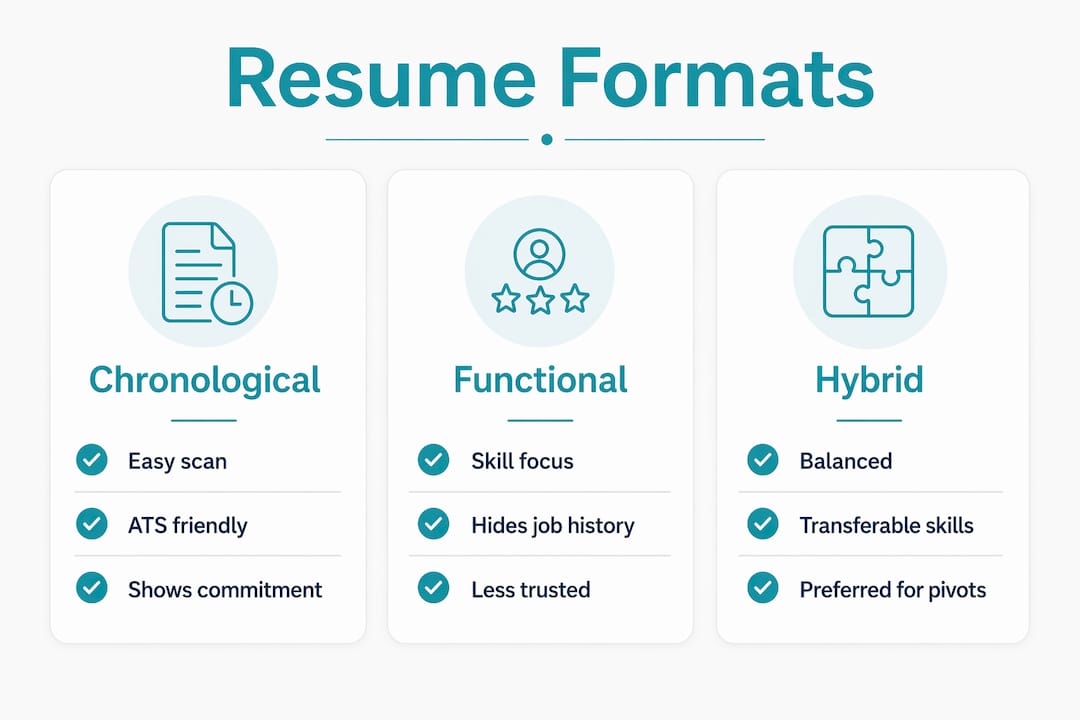
The functional format deserves a specific warning: recruiters often treat it as a signal that the candidate is hiding something, whether gaps, short tenures, or irrelevant experience. The hybrid avoids that problem by keeping the employment timeline intact while front-loading the skills evidence.
The section order that works
A career-change resume built on the hybrid model should follow this sequence:
- Headline and value proposition (your Bridge Narrative, two to three lines)
- Core competencies / skills summary (keyword-rich, grouped by competency cluster)
- Selected projects or relevant work (freelance, volunteer, coursework, side projects)
- Professional experience (reverse chronological, reframed with transferable language)
- Education and certifications (include new-field credentials prominently)
Each section has a specific job. The headline preempts skepticism by naming your pivot and your value in the same breath. The skills summary gives ATS parsers the keywords they need and gives human reviewers a shortcut to your relevance. The projects section is where you prove commitment to the new field, especially if you have taken courses, completed freelance work, or built something on your own time. The experience section then provides the credibility timeline, rewritten in the target industry’s language.
Pro Tip: If you have completed a certification, bootcamp, or relevant project in the past 12 months, put it above your work experience. Recency signals commitment more powerfully than a long history in a different field.
How do you translate your transferable skills into the new field’s language?
Translating skills is not about finding synonyms. It is a systematic process of connecting what you did, the problem you solved, and the outcome you produced to what the target role actually requires. Forbes recommends starting with a skills inventory before you write a single word of the resume.
Step 1: Conduct a skills inventory
Divide your experience into two categories:
- Hard skills: Technical abilities, tools, systems, methodologies (e.g., financial modeling, Python, supply chain management, Salesforce)
- Soft skills: Leadership, communication, negotiation, problem-solving, stakeholder management
For each skill, tag it with an outcome. Not “managed a team” but “managed a team of eight that reduced client onboarding time by 30%.” The outcome is the currency. Skills without outcomes are assertions; outcomes are evidence.
Step 2: Map each skill to a target-role requirement
Pull the job description for three to five roles in your target field. Highlight every requirement. Then match your inventory items to those requirements, one by one. Where the language differs, translate it.
| Your old-field skill | Translated phrase for target field | Evidence to cite on the resume |
|---|---|---|
| “Managed subcontractor bids” | “Vendor selection and contract negotiation” | Negotiated 12 vendor contracts totaling $2.4M, on time and under budget |
| “Ran weekly project standups” | “Cross-functional team coordination” | Led weekly syncs for cross-functional teams across multiple departments |
| “Wrote grant proposals” | “Stakeholder communications and funding strategy” | Secured funding through written proposals to multiple foundations |
| “Trained new hires on compliance” | “Learning and development program delivery” | Designed onboarding curriculum adopted across multiple offices |
This mapping table becomes the raw material for your resume bullets. You are not inventing new skills. You are expressing real skills in the vocabulary the target industry uses.
Step 3: Prioritize project-based proof
Skills-based job matching research consistently shows that project-based evidence outperforms job-title evidence for career changers. A project you completed in the target field, even a small freelance engagement or a capstone course project, carries more weight than five years of adjacent experience described in the wrong language.
Pro Tip: Use the Bridge Narrative framework (Origin → Catalyst → Bridge) to structure your summary. Origin establishes credibility, Catalyst explains the pivot, and Bridge connects your transferable skills to the target role’s specific needs. This three-part structure, developed by career transition specialists, preempts the three questions every recruiter asks about a career changer.
Section-by-section guide: what to write and how to reframe it
Writing the headline and Bridge Narrative summary
Your headline is not a job title. It is a positioning statement. For a career changer, it should name the target role, acknowledge the pivot implicitly, and state the value you bring.
Before (old-field framing): After (Bridge Narrative framing): The summary below the headline expands this into two to three sentences using the Origin → Catalyst → Bridge structure:
“Operations professional with 12 years managing large-scale construction projects, including budget oversight, regulatory compliance, and multi-vendor coordination. Transitioning to healthcare operations to apply proven process improvement and stakeholder management skills in a mission-driven environment. Certified in Lean Six Sigma; completed a healthcare operations practicum with [Organization].”
Skill summary: keywords and grouping
Group competencies into two to three clusters: new-field skills first, then transferable skills. This ordering serves both ATS scoring and human scanning.
- Healthcare operations (target field): Regulatory compliance, vendor management, process improvement, Lean Six Sigma, HIPAA awareness
- Transferable leadership skills: Cross-functional team coordination, budget oversight, stakeholder communications, risk management
Before → after sample bullets
Before (construction framing): After (operations framing): Before: After: Notice what changed: the vocabulary shifted from construction-specific terms to operations-neutral language, and the outcomes became the headline of each bullet rather than the task. WriteCV recommends placing new-field projects, freelance work, or certifications above older career experience to signal commitment, which is exactly what the hybrid format’s section order accomplishes.
ATS and keyword strategy: how to get past filters honestly
ATS systems do not read resumes the way humans do. They parse text, match terms against the job description, and score relevance. For a career changer, the risk is not that your experience is irrelevant. It is that your experience is described in the wrong vocabulary.
What ATS matching actually looks for
The system compares your resume text against the job description’s keywords, including job titles, required skills, tools, certifications, and industry-specific terminology. If your resume uses “punch list” and the job description says “quality assurance checklist,” those are not a match, even though the underlying process is identical.
The fix is straightforward: mirror the job description’s exact phrasing wherever it is truthful. If you managed quality control processes, and the job description calls for “quality assurance,” use “quality assurance.” You are not misrepresenting your experience. You are translating it.
What not to do
Specific traps to avoid:
- Title inflation: Do not change “Project Coordinator” to “Project Manager” if that was not your actual role. Recruiters verify.
- Tool name-dropping: Do not list software you have only read about. A single interview question exposes it.
- Keyword dumping in white text: Some candidates paste invisible keywords into the document. ATS systems increasingly flag this, and it destroys credibility if discovered.
Where to place keywords for maximum effect
- Skills summary: The highest-weight section for ATS parsing. Place target-field keywords here first.
- Project descriptions: Use the target field’s terminology to describe what you built or accomplished.
- Resume headline: Include the target job title or a close variant. ATS systems weight the top of the document heavily.
- Education and certifications: Name certifications using their official titles, exactly as they appear in job descriptions.
ATS readiness checklist:
- [ ] Resume saved as a .docx or clean PDF (not a scanned image or heavily formatted template)
- [ ] Target job title appears in the headline or summary
- [ ] Skills section uses exact terminology from the job description
- [ ] No tables, text boxes, or graphics in the ATS-submitted version (use a separate design version for human readers)
- [ ] Certifications listed with full official names
- [ ] Employment dates included for every role
Common mistakes career changers make on resumes
Most career-change resumes fail for the same handful of reasons. Here are the most common, with a one-line fix for each.
-
Burying transferable skills in the experience section. Fix: Move a skills summary to the top of the resume, above work history, and lead with competencies that match the target role.
-
Apologetic or hedging language. Phrases like “although my background is in X” or “while I don’t have direct experience” signal doubt before the recruiter forms their own opinion. Fix: State your value directly. “Operations leader with a track record of…” not “Former construction manager hoping to transition into…”
-
Keeping irrelevant technical detail. A software engineer pivoting to product management does not need to list every programming language they used in 2015. Fix: Cut any technical detail that does not translate to the target role, even if it represents years of work.
-
No proof of new-field work. A resume that claims interest in a new field but shows zero activity in it, no courses, no projects, no certifications, is unconvincing. Fix: Complete one tangible project in the target field before you apply, then put it on the resume.
-
Generic objective statements. “Seeking a challenging role where I can grow” tells a recruiter nothing. Fix: Replace with a two-sentence Bridge Narrative that names the target role and your top transferable value.
-
Treating employment gaps as something to hide. Gaps are visible in a chronological format and suspicious when unexplained. Fix: Address them in one line. “2023 to 2024: Career transition; completed [Certification] and freelance [relevant work].” Transparency beats silence every time.
For nonlinear timelines, the one-sentence rule: name the period, name the activity, and name the relevant output. Recruiters can accept a gap they understand; they cannot accept one they have to guess at.
How long does it take to rewrite a career-change resume?
The honest answer depends on how much translation work your experience requires and whether you need to build new proof of work before you apply.
Weekend refresh (2 to 3 days): You are pivoting within a related field, your transferable skills are obvious, and you mainly need to reframe language and reorder sections. This is the minimum viable rewrite: new headline, Bridge Narrative summary, skills section added, bullets retranslated.
Mid-level rewrite (1 to 2 weeks): You are crossing into a genuinely different industry, you need to audit your full skills inventory, and you have a few new-field activities (a course, a project, a certification) to incorporate. This timeline allows for proper keyword research against real job descriptions and at least two rounds of revision.
Deep rewrite with new proof of work (3 to 6 weeks): You are making a significant pivot with little obvious overlap, and you need to complete a project, earn a certification, or do freelance work before the resume will be credible. The resume writing itself takes one to two weeks; the proof-building takes the rest.
Step-by-step rewrite checklist
- Pull five job descriptions from your target role and highlight every repeated keyword and requirement.
- Conduct your skills inventory: list hard skills, soft skills, and tag each with an outcome.
- Build your translation table: old-field skill → target-field phrase → evidence.
- Write your Bridge Narrative summary using the Origin → Catalyst → Bridge structure.
- Reorder resume sections into the hybrid format: headline, skills, projects, experience, education.
- Rewrite every bullet using the target field’s vocabulary and outcome-first structure.
- Run an ATS check: compare your resume’s keyword density against the job description manually or with a tool like Jobscan.
- Create a clean, ATS-safe version (.docx, no graphics) and a design version for human readers.
- Write a targeted cover letter that reinforces the Bridge Narrative (see the next section).
- Build at least two resume versions targeted to different role types within your target field.
Recruiters recommend maintaining multiple targeted resume versions rather than a single generic document. If you are applying to both “Operations Manager” and “Program Manager” roles, those two versions should have different headlines, different keyword priorities, and slightly different skills groupings. The underlying experience is the same; the framing shifts to match each role’s specific requirements.
Why the hybrid approach and Bridge Narrative actually work
The case for this architecture is not theoretical. It is grounded in how hiring managers actually process cross-industry applications and what makes them willing to take a chance on a non-traditional candidate.
Hiring managers are not looking for a reason to reject you. They are looking for a reason to say yes. The problem is that a chronological resume from a different industry gives them no easy path to “yes.” They have to do the translation work themselves, mapping your old titles to their open role’s requirements. Most won’t. They will move to the next candidate.
The hybrid format and Bridge Narrative shift that burden back to you, where it belongs. You do the translation. You make the connection explicit. You answer the skepticism before it forms.
“A career change resume is not a history ledger but a strategic narrative connecting where you’ve been to where you want to go.” Kim
The Bridge Narrative framework, which structures your summary around Origin (your credibility), Catalyst (your reason for the pivot), and Bridge (your transferable skills and evidence), works because it answers the three questions every recruiter asks about a career changer in the first 30 seconds:
- Can this person do the job? (Bridge: transferable skills and proof)
- Do they understand our field? (Bridge: target-field vocabulary and certifications)
- Are they serious about this? (Catalyst: a clear, confident reason for the transition)
Two patterns that consistently produce interview callbacks for career changers:
- Placing new-field certifications and projects above older experience. A data analyst who completed a UX research bootcamp and lists it before five years of analytics work signals commitment. The recruiter sees the pivot as intentional, not accidental.
- Quantifying outcomes in the target field’s units. A teacher pivoting to instructional design who writes “Designed curriculum for 200 students, improving assessment scores by 22%” is speaking the L&D field’s language. The numbers matter less than the fact that the candidate is measuring in the right dimension.
The TailorForge career change guide frames this well: reframing is deeper than simple tailoring. It requires systematic language and evidence mapping, not a find-and-replace pass on your existing resume.
Key Takeaways
Career changers who lead with transferable value in a hybrid format, rather than a chronological job history, often get further in the hiring process because they answer recruiter skepticism before it forms.
| Point | Details |
|---|---|
| Use the hybrid format | Place skills and projects before work history to control what recruiters see first. |
| Write a Bridge Narrative | Structure your summary as Origin → Catalyst → Bridge to preempt the three questions every recruiter asks. |
| Translate, don’t just tailor | Map each skill to the target field’s exact vocabulary using a skills-to-evidence table. |
| Pass the ATS check | Mirror job description keywords in your skills section, headline, and project lines using truthful phrasing. |
| Resumewiz builds it for you | Resumewiz offers hybrid resume builds, ATS compliance review, and LinkedIn optimization for career changers at the mid-to-senior level. |
The part most career changers get wrong
Most career-change advice focuses on what to put on the resume. The harder problem, and the one that actually determines whether you get interviews, is how you frame what is already there.
Career changers often approach the resume as a confession: “Here is my history, and here is why it doesn’t quite fit.” That framing is fatal. A hiring manager reading a defensive resume will find reasons to agree with the doubt the candidate is already expressing.
The Bridge Narrative flips this. It is not an apology for your background. It is a claim about your future. You are not asking the recruiter to overlook your history. You are showing them how your history is exactly the preparation that makes you effective in this new role.
There is a subtler point worth making: the career changers who get interviews fastest are rarely the ones with the most relevant experience. They are the ones who did the translation work most thoroughly. A candidate who spent two weekends building a mapping table, rewriting every bullet in the target field’s language, and completing one visible project in the new field will outperform a candidate with more adjacent experience who submitted a lightly edited version of their old resume.
The resume is the argument. Make it a strong one.
Resumewiz helps career changers get interviews faster
Career changers who try to rewrite their own resumes often underestimate how much translation work is involved. You know your experience. What is harder to see from the inside is how a hiring manager in a different field will read it, which keywords will register, and which framing will preempt skepticism rather than confirm it.

Resumewiz was built specifically for mid-to-senior professionals making significant career moves. Kim Taynor brings over 10 years of recruiting experience to every engagement, which means the resume she builds for you is written from the hiring manager’s side of the table, not the job seeker’s. The service covers hybrid resume development, ATS compliance, LinkedIn profile optimization, and a fully managed job search process with tailored applications and outreach. You get a document that speaks the target field’s language from the first line, without spending weeks figuring out the translation yourself. If you are ready to stop submitting and start interviewing, get started with Resumewiz today.
Useful sources and templates
The following resources back the guidance in this article and give you practical next steps for applying it:
- How to Write a Career Change Resume, Wharton Online Insights: Wharton’s practitioner-level breakdown of the hybrid format and section ordering for career changers.
- How to Make Your Resume Stand Out, Harvard Business School Online: HBS framing of the resume as a strategic narrative, not a history document.
- The Ultimate Guide to Writing a Career Change Resume, Forbes: Skills inventory methodology and value proposition building.
- Career Change Resume, Monster: Format comparison and practical section-order guidance.
- Career Changers: Guide to Resume Writing, University of Northwestern: Downloadable PDF guide with sample career-change resume structure.
- Skills-Based Job Matching: A 2026 Guide for Job Seekers, ResumeMatch: Practical methods for reframing past experience into transferable value and matching to target roles.
- Resumewiz: Professional resume writing, ATS compliance, LinkedIn optimization, and managed job search for career changers at the mid-to-senior level.
Want a recruiter in your corner for your next senior role? Book a free call with Resume Wiz and we will map out your next move together.
