Why First Impressions Matter in Resume Formatting
Recruiters decide whether your resume earns a deeper read in 6 to 8 seconds. During that window, their eyes sweep your name and headline, drop down the left margin to scan section headings, then catch the first line or two of your most recent role. If those anchor points tell a clear, relevant story, you survive the first pass. If they look cluttered, vague, or misaligned with the job, the rest of your carefully written bullets may never get read at all.
That is why the importance of resume formatting goes far beyond aesthetics. Format is the delivery mechanism for your qualifications. A clean, well-structured layout signals professionalism before a recruiter reads a single word. A messy one triggers doubt before they get the chance.
Here is what shapes that first impression:
- Visual clarity: Clean layouts reduce cognitive load and make key data easy to grab fast.
- Relevance at a glance: Your headline and top section must immediately answer “Is this person the right fit?”
- ATS compatibility: Poor formatting can prevent your resume from being parsed correctly, killing your chances before any human sees it.
- Consistency: Uniform fonts, spacing, and section headers signal attention to detail.
- Error-free presentation: Typos and formatting inconsistencies suggest carelessness, not competence.
- Achievement visibility: Numbers and results placed near the top confirm impact quickly.
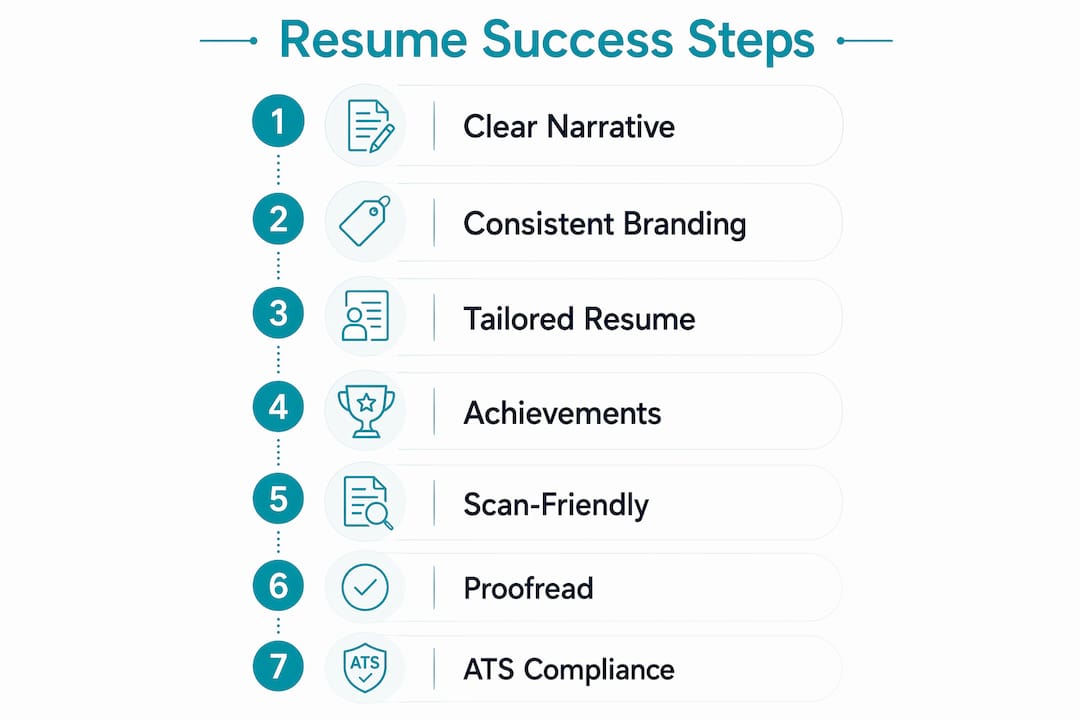
1. How to craft a clear professional narrative
Your resume’s narrative should answer one question within the first few lines: “Why is this person applying for this role, and do they have the background to do it?” A vague or generic opening forces recruiters to dig for that answer. Most won’t.
Start with a focused headline that mirrors the target job title. Follow it with a two-to-three line summary that names your specialty, the type of organizations you’ve served, and a concrete outcome you’ve delivered. Skip phrases like “results-driven professional” or “passionate team player.” Those words appear on thousands of resumes and communicate nothing specific.
Tips for building a clear narrative:
- Lead with your target title, not your current internal title if it doesn’t match the role.
- Write a summary that names who you help and how, not just a list of traits.
- Use each job description to show progression, not just a list of duties.
- Include measurable outcomes within the first bullet of each role.
- Cut roles older than 15 years unless they are directly relevant to the position.
2. Why consistency in resume branding matters
Visual cues trigger fast impressions that affect whether a resume gets a deeper review, independent of content quality. A layout that looks clean and intentional signals that the candidate communicates clearly. A chaotic one creates doubt before the recruiter has read a word.
Consistency is the foundation of a polished layout. That means one font family, two sizes at most, uniform bullet styles, and aligned section headers throughout. Switching between bold and italic headers, or using different spacing between sections, creates visual friction that slows the reader down.
Practical steps to maintain formatting coherence:
- Use one font family such as Calibri, Arial, or Georgia throughout the entire document.
- Set body text at 10.5 to 11 pt and headers at 14 to 16 pt for clear visual hierarchy.
- Keep all section headers identical in style, size, and capitalization.
- Align all text to the left for both human readability and ATS parsing.
- Use consistent date formatting across every role, such as “January 2022 to March 2024.”
- Apply the same bullet style in every section, no mixing of dashes and dots.
3. How tailoring your resume to the job increases your chances
A generic resume is one of the most common reasons qualified candidates get overlooked. Recruiters can tell immediately when a resume hasn’t been customized. The headline doesn’t match the role, the summary reads like a template, and the skills listed don’t reflect the job posting’s language.
Tailoring works because it does two things at once: it increases your ATS keyword match, and it makes your relevance obvious to the human reviewer. One case study found that changing a resume headline to match the exact target job title produced a sixfold increase in callbacks for a candidate who had received zero responses across 22 applications with the same content underneath.
Tailoring techniques that pay off:
- Read the job posting carefully and pull out the exact keywords used for skills and responsibilities.
- Rewrite your headline to match the job title as closely as your experience supports.
- Adjust your summary to reflect the specific industry, company size, or function.
- Reorder bullet points so the most relevant experience appears first within each role.
- Mirror the language of the posting rather than using synonyms the ATS may not recognize.
- Remove or de-emphasize experience that is unrelated to the target role.
Pro Tip: Keep a master resume with all your experience, then create a tailored version for each application. It takes 20 minutes and dramatically improves your response rate.
4. How to showcase achievements so they actually get noticed
Resumes featuring quantifiable results in top positions receive higher recruiter engagement. Numbers do two things: they break the visual monotony of text, and they confirm impact without requiring interpretation. A recruiter scanning your resume will register “increased revenue by 34%” faster than “responsible for growing the sales pipeline.”
Place your strongest achievement in the first bullet of your most recent role. That is the spot recruiters look at after they check your title and employer. If that bullet is vague, the rest of the role may not get read.
Best practices for presenting achievements:
- Lead with a number whenever possible: percentages, dollar amounts, team sizes, or timeframes.
- Use the format: action verb + result + context, such as “Reduced onboarding time by 40% across a 200-person team.”
- Prioritize recent outcomes over older ones, even if the older ones feel more impressive.
- Limit each role to 3 to 4 bullets so every line carries weight.
- Avoid vague statements like “contributed to company growth” with no supporting figure.
5. Design choices that make your resume easier to scan
ATS software parses simple, text-based resumes most reliably. Excessive graphics, two-column layouts, and decorative fonts cause keyword scanning failures that can eliminate your resume before any human sees it. The same design choices that confuse ATS also slow down human readers.
A clean, single-column layout with generous white space is not boring. It is the format that wins the 8-second scan. When a recruiter is reviewing 60 to 80 resumes in a sitting, they will not squint at tiny text or decode a cluttered sidebar. They move on.
Design elements that improve immediate comprehension:
- Use a single-column layout for both ATS reliability and human readability.
- Set body text at 10.5 to 11 pt and never go below 10 pt to fit more content.
- Keep margins at 0.5 to 1 inch on all sides to create breathing room.
- Use white space deliberately between sections so the eye can navigate quickly.
- Avoid graphics, icons, and photos unless you are in a creative field where they are expected.
- Save as a PDF to preserve formatting unless the job posting specifies a Word document.
For a deeper look at what recruiters want in 2026, the shift toward clean, text-based layouts has only accelerated as ATS technology has become more widespread.
6. Proofreading and the resume red flags that cost you interviews
Typos and formatting mistakes are among the top reasons resumes get eliminated early. A single spelling error signals poor attention to detail, which is exactly the opposite of what most job descriptions require. Formatting inconsistencies carry the same message: if you can’t maintain consistency in a two-page document, why would a hiring manager trust you with complex work?
Beyond typos, certain content patterns raise immediate flags. Unexplained gaps, a pattern of very short tenures, vague job titles with no context, and walls of unbroken paragraph text all slow the recruiter down or trigger doubt. The goal is a resume that reads without friction.
Practical proofreading tips and red flags to avoid:
- Read your resume aloud to catch awkward phrasing and missing words.
- Use spell-check as a starting point only, then review manually for context errors.
- Ask a trusted colleague to read it cold and tell you what role they think you’re targeting.
- Check every date for accuracy and consistency in format.
- Avoid paragraph-style job descriptions; use bullets of no more than two lines each.
- Address employment gaps briefly in your cover letter rather than leaving them unexplained.
- Remove outdated skills like software that hasn’t been relevant for a decade.
7. Expert insights on ATS compliance and recruiter psychology
Passing ATS and earning a recruiter’s attention are distinct but overlapping requirements. A resume can match every keyword in the job description and still fail the human scan because the layout is unreadable. Both hurdles require deliberate attention.
The top 50mm of your resume, what recruiting professionals call Zone 1, is the most undervalued real estate on the page. It should contain your name, target title, current employer, location, and contact details. That section answers the recruiter’s first question: “Is this person plausibly the right shape for this role?” If your Zone 1 is dominated by a generic summary full of buzzwords, your resume may be filtered out before anyone reads what you’ve actually accomplished.
The key formatting mistakes that get resumes discarded fastest include using two-column layouts, decorative fonts and graphics, very small text, and wall-of-text paragraphs instead of bullets. Any one of these forces the reader to work harder than they want to in a fast-scan environment. For guidance on tailoring each application to pass both filters, the combination of keyword alignment and clean layout is the most reliable path to the shortlist.
Pro Tip: Hand your resume to someone unfamiliar with your field and ask them to tell you in 8 seconds: who you are, what role you want, and what you’ve achieved. If they can’t answer all three, your Zone 1 or your bullet points need work.
Key Takeaways
Resume formatting directly determines whether your qualifications get read, because recruiters form a judgment in 6 to 8 seconds based on layout, clarity, and relevance before reading a single bullet point.
| Point | Details |
|---|---|
| First scan is 6 to 8 seconds | Recruiters check your title, employer, and section headers before reading any bullet points. |
| Zone 1 is critical real estate | The top 50mm must show your name, target title, employer, and contact details clearly. |
| Tailoring multiplies callbacks | Matching your headline to the exact job title can produce a sixfold increase in responses. |
| ATS requires text-based layouts | Single-column, graphics-free resumes parse most reliably across applicant tracking systems. |
| Resumewiz builds ATS-ready resumes | Resumewiz combines recruiting expertise with tailored formatting to help you pass both the ATS and the human scan. |
Resumewiz helps you get past the 8-second scan
Most job seekers spend hours refining bullet points that never get read because the top of their resume already lost the recruiter. Resumewiz fixes that from the top down.

Founded by Kim Taynor, a recruiter with over 10 years of hiring experience, Resumewiz builds ATS-compliant, professionally formatted resumes tailored to your target role and industry. The service goes beyond formatting: you get a resume where Zone 1 is engineered to pass the first scan, achievements are quantified and placed where recruiters actually look, and every section is aligned to the job description you’re pursuing. Whether you’re an executive making a career pivot or a manager targeting a step up, Resumewiz delivers a document that earns the deeper read. Visit Resumewiz to get started with a resume built around how hiring actually works.
Want a recruiter in your corner for your next senior role? Book a free call with Resume Wiz and we will map out your next move together.
