Why LinkedIn Applications Rarely Work (And What to Do)
LinkedIn applications rarely work because the platform routes your submission into a priority queue that most recruiters never fully read. The fix is not a better resume alone: stop mass-applying through Easy Apply, identify one hiring manager per target role, and submit a tailored application through the company’s careers page. Do those three things in the next 48 hours and your odds improve materially.
Before you hit Apply, run this quick check:
- Is your LinkedIn headline specific to the role you’re targeting (not a generic title)?
- Is your resume file named with your name and the role (e.g.,
JaneDoe_ProductManager.pdf)? - Do you have a one-line, company-specific message ready to send alongside the application?
- Have you identified a mutual connection or a referral target at the company?
If any of those are “no,” fix them first. The application itself is the last step, not the first.
Three actions to take in the next 48 hours:
- Stop submitting through Easy Apply for any role you genuinely want.
- Find the hiring manager’s name on LinkedIn, then send a two-to-three sentence message referencing something specific about the company or role.
- Submit the actual application through the employer’s careers page with a tailored resume attached.
Table of Contents
- Why LinkedIn applications rarely work: the system-level reasons
- How recruiters actually triage and shortlist candidates
- How ATS filters and resume parsing knock out qualified applicants
- Why personalization is the single most powerful predictor of getting read
- Action plan: exact steps and a weekly cadence to turn LinkedIn into interviews
- When does Easy Apply actually help?
- Recruiter-led help that moves applications into interviews
- Key Takeaways
- The habit that actually wins
- What Resumewiz offers and how to get started
- Sources and further reading
Why LinkedIn applications rarely work: the system-level reasons
The core problem is volume. Easy Apply generates a very high number of applications per post, and recruiters typically filter by Premium users first, then stop reading after a small number of applications. Your application is not competing against 800 humans. It is competing against a filter pipeline most applicants never see.
Here are the structural reasons LinkedIn job application problems persist, regardless of how strong your background is:
- Volume mechanics. Easy Apply queues routinely hold hundreds to over a thousand applications per post. Recruiters scan the first handful to a few dozen and ignore the rest. If you apply on day three, you are almost certainly in the ignored tail.
- Priority queues with hidden sort criteria. LinkedIn’s recruiter tooling is not first-in, first-out. It is a priority queue with undisclosed ranking factors. Referrals and direct outreach route to a different, faster channel. Easy Apply routes to the slow path.
- Ghost listings. A meaningful share of posted jobs are already filled or were never truly open. HR compliance policies often require a public posting even when an internal candidate is already identified. You apply; the role closes on day two.
- ATS auto-rejects. “Application Submitted” is a write-to-queue receipt, not confirmation a human read your file. Screening questions about location, certifications, or salary can trigger an automatic rejection before any recruiter sees your name.
- The activity trap. After roughly 50 to 100 applications, applicant behavior degrades and response rates fall measurably. Mass-applying feels productive but actively reduces quality and steals time from higher-return actions.
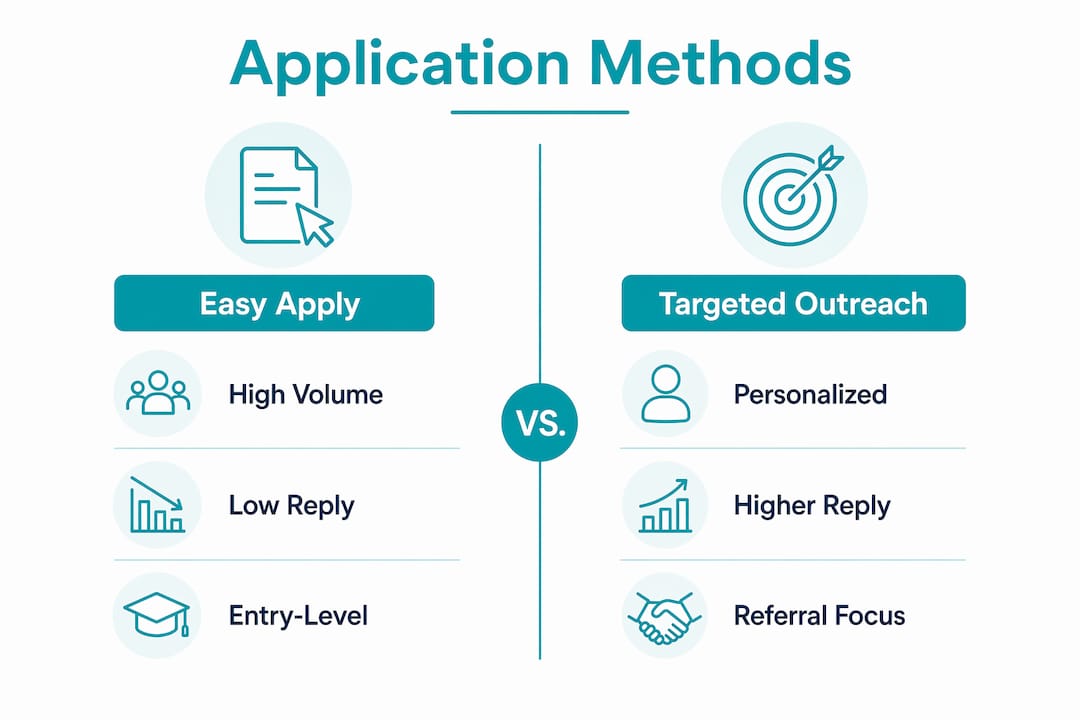
The reply-rate gap is stark. Easy Apply produces low single-digit reply rates. Direct outreach and referrals produce much higher reply rates. That is not a marginal difference; it is a different game entirely.
The information asymmetry is the product, not a bug. LinkedIn does not show applicants the queue depth. If the Apply button displayed “this post has 800 applications and the recruiter reads 20,” behavior would change immediately. It does not display that because engagement and Premium upgrades depend on applicants believing the button works.
How recruiters actually triage and shortlist candidates
Recruiters do not sit down and read every application. The typical workflow looks like this:
- Sourcing first. Before a job even posts publicly, most recruiters have already messaged two or three candidates they found through LinkedIn Recruiter or referrals.
- First-pass triage. Once the post goes live, a recruiter opens the applicant queue and scans the first 20 to 60 resumes. Once a posting hits a high-volume threshold, the probability of a human read drops sharply into the low single digits for anyone beyond that first batch.
- Shortlist for interviews. From that first pass, six to twelve candidates move forward. The rest receive a form rejection or nothing.
- Final selection. Two to four candidates reach the hiring manager.
Where you land in that funnel depends heavily on channel. Referrals and direct messages arrive outside the Easy Apply queue entirely. They reach the recruiter or hiring manager as a human-flagged contact, not a database row.
What the first 24 to 72 hours after a post goes live actually look like:
- Hour 0 to 6: Sourced candidates and referrals are already in conversation.
- Hour 6 to 24: The first wave of Easy Apply submissions arrives. Recruiters scan the top of the queue.
- Hour 24 to 72: Volume spikes. The queue fills. Recruiters stop reading new submissions unless something stands out.
- Day 4+: Most new Easy Apply submissions will not be read.
Channel reply rates in practice: Direct applications through company career pages combined with a LinkedIn message to a hiring contact produce materially higher read rates than portal-only Easy Apply submissions. The combination of a direct application and a personal message is one of the more reliable ways to get a human read in this process.
Timing matters more than most applicants realize. Applying within the first six hours of a post going live puts you near the top of the queue. Applying three days later, after the recruiter has already shortlisted, is close to futile for competitive roles.
How ATS filters and resume parsing knock out qualified applicants
Submitting through LinkedIn does not mean your resume arrives cleanly on the recruiter’s screen. Some ATS integrations mis-map LinkedIn-submitted resumes, producing blank fields and parsing errors that cause automatic disqualifications. The recruiter sees an incomplete record, not your actual background.
Common parsing failure modes:
- Tables, text boxes, and columns in resume files break most ATS parsers. Use a single-column, plain-text-friendly format.
- PDF files are safer than
.docxfor most systems, but some older ATS platforms prefer.docx. Check the job posting for guidance. - Date or title mismatches between your LinkedIn profile and your submitted resume are immediate red flags. Recruiters perform six-second pattern-recognition scans and dismiss profiles with inconsistencies between LinkedIn and resume dates or titles.
- Screening questions about location, certifications, or right-to-work status can trigger an auto-reject before a human ever opens your file.
LinkedIn-specific limitations compound the problem. Your LinkedIn headline is fixed across every application you submit. If it reads “Open to new opportunities” instead of a specific role title, it signals generic intent to every recruiter who sees it. The profile-driven data LinkedIn pulls into Easy Apply forms also tends to be less tailored than a purpose-built resume.
ATS-friendly resume checklist:
- Single-column layout, no tables or text boxes
- Standard section headers (Experience, Education, Skills)
- Dates formatted consistently (Month Year) on both resume and LinkedIn profile
- Keywords from the job description used naturally in context, not stuffed in a list
- File named:
FirstLast_RoleTitle.pdf
Pro Tip: Name your resume file with your full name and the specific role title before every application. Recruiters download dozens of files named “Resume_Final_v3.pdf.” Yours should be the one that reads “JaneDoe_VPMarketing.pdf” and takes zero effort to identify.
Why personalization is the single most powerful predictor of getting read
The personalization signal is the difference between a message a recruiter reads and one they delete. An automated Easy Apply submission carries no personalization signal at all. It is a row in a database. A short, specific outreach message referencing a real company decision, a recent product launch, or a post the hiring manager wrote is the opposite of that.
Short, company-specific outreach messages can produce reply rates an order of magnitude higher than Easy Apply. The evidence from a widely documented case of 170 Easy Apply submissions with no offers confirms what recruiters already know: volume applying without personalization produces 1% to 3% reply rates at best.
“I applied to an online job the usual way and included a mini business plan and it went into a black hole, but I also found the hiring manager’s email and sent him a mini business plan, and two days later I got an email inviting me to an interview. I never heard back from my formal application even a year later.”
That is the personalization signal in action. The formal application disappeared. The direct, specific message produced an interview.
How to build a personalized outreach message without spending an hour per company:
- Research anchor (30 seconds): Find one specific thing: a recent hire, a product launch, a LinkedIn post by the hiring manager, or a company news item.
- Two-to-three sentence structure: Open with the specific anchor, state your relevant experience in one sentence, and close with a clear, low-friction ask.
- Cadence: Send five to eight targeted messages per week. That is a realistic volume that maintains quality.
Example outreach snippet:
Batching personalization work into a repeatable research-plus-message template produces far higher reply rates per hour invested than mass-applying. Spend 90 minutes on five targeted messages rather than 90 minutes clicking Easy Apply on 30 listings.
Action plan: exact steps and a weekly cadence to turn LinkedIn into interviews
The goal is to replace volume with precision. Here is a weekly structure that produces measurable results.
Weekly cadence:
- Monday: Identify five target roles. For each, find the hiring manager’s name and one research anchor. Do not apply yet.
- Tuesday: Write and send five personalized outreach messages. Submit tailored applications through company careers pages for the same five roles.
- Wednesday: Follow up on any messages sent the previous week with no reply (one short follow-up per contact, maximum).
- Thursday: Research and queue the next batch of five roles for the following week.
- Friday: Review your metrics: messages sent, replies received, conversations scheduled. Adjust targeting if reply rates are below 8%.
Three outreach templates:
Hiring manager cold message: Recruiter intro with mutual connection: Follow-up (sent 5 to 7 days after no reply): Per-application checklist:
- LinkedIn headline updated to match the target role
- Resume tailored with keywords from the job description
- Application submitted through the employer’s careers page, not Easy Apply
- Personalized outreach message sent to the hiring manager or recruiter
- Screening questions reviewed and answered specifically (not with saved generic answers)
Pro Tip: Batch your research on Sunday evening. Spend 30 minutes finding five companies, five hiring manager names, and five research anchors. Write all five messages in one sitting. The quality stays high because you are in research mode, not application mode.
Track three numbers weekly: messages sent, replies received, and conversations scheduled. If you send 20 messages and get zero replies, the problem is the message, not the volume. If you get replies but no conversations, the problem is the ask.
When does Easy Apply actually help?
Easy Apply is not useless. It is just misapplied by most people who use it.
Use Easy Apply when:
- The role is high-volume and operational (customer support, entry-level sales, logistics) where employers genuinely hire at scale and expect portal applications.
- You are applying within the first six hours of a post going live and the role has fewer than 50 applicants showing.
- The company is small and unlikely to have a sophisticated ATS, making the queue shorter and more likely to be read fully.
- You have already sent a direct outreach message and want to also have a formal application on file.
Avoid Easy Apply when:
- The role is mid-level, specialist, or competitive (director, VP, niche technical roles).
- The post is more than 72 hours old.
- The application count already shows 200+ applicants.
- The job description is vague or the posting has been reposted multiple times (a strong signal of a ghost listing or a role that keeps failing to fill for internal reasons).
Signs a posting is likely a ghost listing:
- Posted more than 30 days ago with no updates
- Vague responsibilities with no specific team or reporting structure mentioned
- The same role reposted every few weeks
- No named recruiter or hiring manager visible on the post
Easy Apply vs. direct application vs. referral:
| Route | Typical reply rate | Best for |
|---|---|---|
| Easy Apply only | 1% to 3% | High-volume, entry-level roles |
| Direct company site application | 8% to 25% | Mid-level and specialist roles |
| Direct application + outreach message | 8% to 25% | Any competitive role |
| Referral | Highest | Any level, any role type |
The “Open to Work” banner deserves a separate note. Some hiring managers perceive it negatively, reading it as a signal of recent layoff or extended unemployment rather than simple availability. Whether to use it depends on your situation, but it is worth knowing that the signal you intend to send is not always the signal received.
Recruiter-led help that moves applications into interviews
Resumewiz was built specifically for mid-level and senior professionals who are stuck in the Easy Apply loop and need a different approach. The founder, Kim Taynor, brings more than 10 years of recruiting experience to every engagement, which means the service is designed around how hiring actually works, not how applicants assume it works.
What Resumewiz delivers:
- ATS-compliant resume formatting that passes parsing filters and reads cleanly in recruiter tooling
- LinkedIn profile optimization that improves how you appear in recruiter searches and removes signals that trigger negative first impressions
- Tailored outreach templates written for your specific target roles and industries
- Interview coaching and salary negotiation preparation
- A fully managed job search option for executives and career changers who want a recruiter handling targeting, outreach, and application strategy on their behalf
The typical engagement runs in phases. Early on, the focus is on building the foundation: resume, LinkedIn profile, and a target company list. From there, the focus shifts to outreach and application activity, with Resumewiz reviewing and refining messages based on what is generating replies. For executives pursuing a fully managed search, the service includes tailored applications and outreach, with details available on the Elevate and Land page.
For professionals who have been applying for months without traction, the most common issue is not the resume. It is the channel and the message. Resumewiz addresses both.
Key Takeaways
LinkedIn applications fail primarily because Easy Apply routes submissions into a high-volume queue where most are never read, while personalized direct outreach and referrals consistently produce reply rates that are five to ten times higher.
| Point | Details |
|---|---|
| Stop spray-applying | Easy Apply reply rates run 1% to 3%; direct outreach and referrals produce 8% to 25%. |
| Apply within 6 hours | Recruiters scan the first 20 to 60 applications; late submissions rarely get read. |
| Personalize every message | A two-to-three sentence message anchored in a specific company detail drives materially higher replies than any portal submission. |
| Submit via company careers page | Direct applications combined with a LinkedIn message to the hiring manager produce the highest read rates. |
| Resumewiz for hands-on help | Resumewiz offers ATS-compliant resumes, LinkedIn optimization, outreach templates, and a fully managed job search for mid-level to executive professionals. |
The habit that actually wins
There is a pattern I see consistently in job searches that work: the candidate stopped measuring activity by applications submitted and started measuring it by conversations started. Those are completely different metrics, and they produce completely different outcomes.
The professionals who get traction fastest are not the ones who applied to the most jobs. They are the ones who sent five specific messages this week, got two replies, and turned one of those into a conversation with a hiring manager. That is a better week than 40 Easy Apply submissions with zero replies, even though it looks like less activity on paper.
The managed engagements at Resumewiz tend to confirm this. When a client shifts from volume applying to targeted outreach with a recruiter-reviewed message, the reply rate changes quickly. Not because the job market suddenly got easier, but because the channel changed. You can explore executive coaching communities and professional networking events as additional ways to build the referral network that makes outreach land faster.
The advice at the end of every honest post-mortem on LinkedIn job searching is the same: stop applying, start talking. That is not a motivational line. It is a routing instruction. Get your message to a human before it hits the queue.
What Resumewiz offers and how to get started

Resumewiz is the alternative to spending another three months in the Easy Apply loop with nothing to show for it. The service is built for mid-level managers, senior professionals, executives, and career changers who need more than a polished document. They need a strategy that actually reaches hiring managers.
The service options cover every layer of the problem: an ATS-compliant resume that passes parsing filters, a LinkedIn profile optimized for recruiter searches, outreach templates tailored to your target roles, interview and salary negotiation coaching, and a fully managed job search for professionals who want a recruiter handling the targeting and outreach on their behalf. The managed option includes tailored applications and outreach, with specifics on the Elevate and Land page.
In the first two weeks, clients typically complete the resume and LinkedIn profile work. Outreach begins in week three, with Resumewiz refining messages based on real reply data. Most clients see their first meaningful conversations within the first month.
If you are ready to stop guessing which application might get read and start getting into actual conversations with hiring managers, visit Resumewiz to review the service options and take the next step.
Want a recruiter in your corner for your next senior role? Book a free call with Resume Wiz and we will map out your next move together.
Sources and further reading
The claims in this article draw on recruiter commentary, platform analysis, and documented applicant case studies. The sources below are worth reading directly if you want to go deeper on any specific point.
- Why LinkedIn Easy Apply Fails in 2026 (Recruiter Fix, 5x Replies) The most detailed breakdown of Easy Apply queue mechanics, channel reply-rate comparisons (1% to 3% vs. 8% to 25%), and recruiter workflow. Use this to understand why the portal route is structurally disadvantaged.
- LinkedIn Jobs Easy Apply: Worth It After 100+ Applications? (Honest Data) Covers the activity trap, the “Open to Work” banner perception issue, and ATS mis-mapping errors. Useful for understanding how volume applying degrades outcomes over time.
- LinkedIn Easy Apply Not Working? 9 Months and 170 Applications Later, Reddit Has the Receipts A documented case study of mass-applying failure and the evidence for personalized outreach as the higher-return alternative.
- LinkedIn Is Broken, and You Probably Already Know It (Medium) A systems-design analysis of why the Apply button is a write-to-queue, not a direct message to a recruiter. Explains ghost listings and priority queue mechanics clearly.
- Ask The Headhunter: LinkedIn, “This Dog Don’t Hunt” Recruiter-perspective commentary on ATS firewalls and the documented case of a direct outreach message producing an interview while the formal application disappeared permanently.
- Why Your LinkedIn Applications Get Ignored Practitioner observations on six-second scans, date and title inconsistencies as red flags, and the specific profile signals that cause immediate dismissal.
