Why Recruiters Aren't Responding to Your Senior Role Applications
Why Recruiters Aren’t Responding to Your Senior Role Applications
Recruiters don’t reply to senior candidates primarily because those candidates fail to position themselves as the lowest-risk, highest-fit choice within seconds of contact. This is the core problem behind why recruiters aren’t responding to you for a senior role, and it goes far deeper than qualifications. Hiring managers choose the safest candidate, not necessarily the most accomplished one. At the same time, 70% of job seekers now use generative AI to craft applications, flooding recruiters with volume and skepticism in equal measure. Add the fact that 60 to 80% of senior roles are never publicly posted, and the picture becomes clear: the standard application process is built for junior roles, not executive ones.
Why recruiters aren’t responding to senior role candidates: the ATS problem
Applicant tracking systems, commonly called ATS, act as the first filter between your resume and a recruiter’s eyes. ATS parsing errors and keyword mismatches cause qualified candidates to become invisible in recruiter search results, regardless of their actual experience. A resume formatted with tables, graphics, or non-standard fonts often fails to parse correctly. The system stores a broken version of your profile, and no recruiter ever sees it.
The AI application surge makes this worse. Over 33% of HR professionals identify AI-generated resumes in under 20 seconds. That instant recognition triggers skepticism, not interest. Recruiters handling hundreds of applications per week have become pattern-recognition machines, and AI-polished resumes now read as noise rather than signal.
For senior professionals, the stakes are higher because the keyword bar is more specific. A VP of Operations resume that uses “managed teams” instead of “P&L ownership” or “cross-functional leadership” will fail ATS keyword searches for director-level roles. The vocabulary mismatch is invisible to you but fatal to your visibility.
Here is what causes ATS invisibility for senior candidates:
- Tables, text boxes, and graphics that ATS cannot parse correctly
- Job titles that don’t match the exact phrasing used in the target role
- Missing keywords from the specific role’s requirements section
- Functional resume formats that hide chronology and confuse parsing logic
- Overuse of soft-skill language where quantified outcomes are expected
Pro Tip: Copy the job description into a plain text document and highlight every noun and verb that describes the role’s core function. Then check your resume against that list. Every missing term is a gap in your ATS visibility.
Why most senior roles are never posted publicly
Most senior jobs are filled through relationships, internal promotions, or confidential retained searches before they ever appear on a job board. This is not a rumor. It is the standard operating model for executive hiring. When a company posts a C-suite or VP-level opening publicly, it often signals that internal succession planning failed or that the search has already stalled.
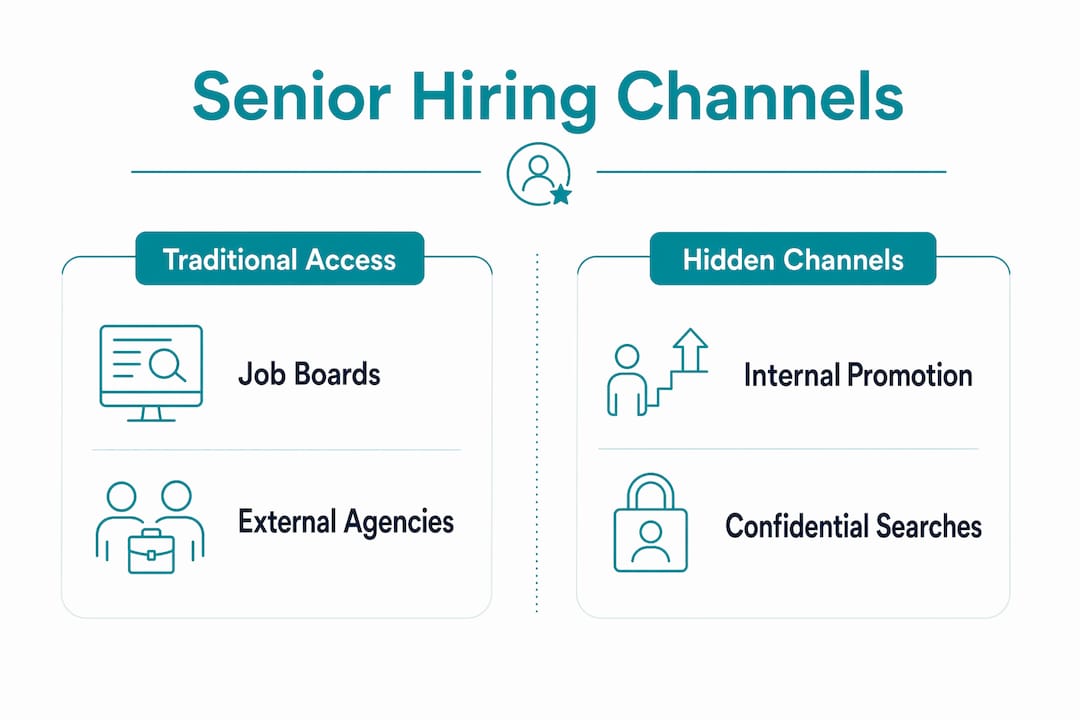
Retained executive recruiters manage the majority of confidential senior searches. These recruiters are paid by the company, not the candidate, and they work from curated shortlists built through referrals and prior relationships. If you are not in their network before the search begins, you are not on the list.
The reasons companies keep senior openings confidential are straightforward:
- A public posting signals leadership instability to competitors, clients, and investors
- Internal candidates need time to be evaluated before external candidates are considered
- Retained search firms require exclusivity and confidentiality as part of their engagement terms
- The outgoing executive may still be in the role during the search
| Hiring channel | How senior roles are filled | What you need to access it |
|---|---|---|
| Internal promotion | Current employee moves up | Internal visibility and sponsorship |
| Retained executive search | Recruiter builds a confidential shortlist | Prior relationship with the recruiter |
| Referral from leadership | Trusted contact recommends a candidate | Active network at the right level |
| Public job board posting | Open application process | ATS-optimized resume and early timing |
The table above shows that only one of the four main channels for senior hiring is accessible through a standard application. The other three require relationships built before the role exists.
How to craft outreach that gets recruiter responses for senior positions
Effective recruiter outreach follows a specific formula. Outreach messages of 101 to 150 words combined with four or more follow-up emails achieve a 22.6% reply rate. That is a meaningful number in a market where most cold messages get no response at all. Brevity and persistence together outperform a single polished message every time.
The subject line matters as much as the message body. Subject lines with 3 to 9 words produce the highest open rates, and adding a single personalization token, such as the recruiter’s name or their firm’s recent placement, lifts open rates by 5%. That small detail signals that you did your homework, which separates you from the AI-generated mass.
Follow this sequence for outreach that gets results:
- Research the recruiter. Find their recent placements on LinkedIn. Reference a specific role they filled in your message. This proves you are not sending a bulk email.
- Write a 100 to 150 word message. State your current title, your target role type, your clearest quantified achievement, and one sentence on why you are reaching out to this recruiter specifically.
- Send a follow-up on day 5. Keep it to two sentences. Reference your first message and add one new piece of context, such as a recent industry development relevant to your specialty.
- Follow up again on day 12 and day 21. Each follow-up should be shorter than the last. The goal is to stay visible without becoming a burden.
- Use the Send-on-Behalf-Of approach. This tactic, where a hiring manager or senior contact sends a brief note on your behalf, boosts reply rates by 55.5%. Only 21.9% of candidates use it, which makes it a genuine differentiator.
Pro Tip: Ask a former manager or board member to forward your profile to a recruiter with a single sentence: “I worked with [your name] for X years and think they’d be worth a conversation.” That warm introduction changes the entire dynamic of the outreach.
Common mistakes that cause recruiters to ignore senior candidates
Generic messaging is the most common reason recruiters don’t reply. A one-line message that says “I’m interested in opportunities in your space” tells a recruiter nothing about fit, level, or value. Recruiters skim outreach quickly, seeking clarity and confidence that a candidate matches current openings and will be easy to work with. A vague message signals neither.
Timing is the second major mistake. Recruiters prioritize early applicants and work through applications from the top of the queue downward. Applying to a posting that has been live for two weeks means the recruiter may already have a shortlist. You are competing against candidates who applied on day one.
The third mistake is misaligned positioning. Senior candidates often list responsibilities instead of outcomes. A recruiter hiring a CFO does not need to know you “managed the finance team.” They need to know you reduced close cycle time from 12 days to 5, or that you led a $200 million capital raise. Outcomes reduce risk perception. Responsibilities do not.
Watch for these patterns in your own applications:
- Opening your outreach with your job title instead of your value proposition
- Sending the same resume to every role without adjusting keywords to match the posting
- Applying to roles outside your seniority band, which signals unclear self-awareness to recruiters
- Skipping the follow-up entirely after submitting an application or sending an initial message
- Ignoring LinkedIn as a channel while focusing only on email or job boards
Practical strategies to improve your visibility to recruiters
Tailoring your resume for each role is the single highest-return activity for senior candidates. Pull the exact language from the job description and mirror it in your resume bullets. This is not about copying text. It is about matching the vocabulary that the ATS and the recruiter both use to evaluate fit.
Apply within the first 24 to 48 hours of a posting going live. Early applications receive more attention, and the recruiter’s mental energy is highest at the start of a search. A strong application submitted on day one carries more weight than the same application submitted on day ten.
Build internal contacts before you apply. Identify two or three people inside the target company on LinkedIn. Reach out with a specific question about the team or the company’s direction. A brief, genuine conversation before you apply gives you a name to reference in your cover letter and a potential internal advocate who can flag your application.
Connect with executive search professionals in your sector now, not when you are actively searching. Retained recruiters build their shortlists from people they already know. A relationship started six months before a search begins is worth far more than a cold message sent the day a role is posted.
Key takeaways
Recruiters ignore senior candidates most often because of unclear positioning, ATS invisibility, and over-reliance on public job boards that rarely list the roles worth having.
| Point | Details |
|---|---|
| ATS visibility is non-negotiable | Match your resume vocabulary exactly to the job description to pass keyword filters. |
| Most senior roles are never posted | Build recruiter and referral relationships before a search begins, not during it. |
| Outreach length and follow-up cadence matter | Messages of 101 to 150 words with four or more follow-ups achieve a 22.6% reply rate. |
| Timing affects application outcomes | Apply within 24 to 48 hours of a posting going live to maximize recruiter attention. |
| Risk reduction beats credential listing | Lead with quantified outcomes, not responsibilities, to lower recruiter risk perception. |
What I’ve learned after 10 years of watching senior candidates get ignored
The candidates I see get ignored most often are not underqualified. They are unclear. They have impressive careers, but their materials and messages force the recruiter to do interpretive work. Recruiters will not do that work. They move to the next profile.
The hardest thing to accept at the senior level is that your track record is not enough on its own. A recruiter reviewing 200 applications does not have time to connect the dots between your past roles and the value you would bring to this one. You have to connect those dots for them, in the first three sentences of your message and the first third of your resume.
The other pattern I see constantly is candidates treating recruiter silence as rejection. It rarely is. It is usually a timing mismatch, a keyword gap, or a network gap. The fix is almost always structural, not personal. When you address the structure, the responses follow.
Patience matters, but passive patience does not work. Multi-channel engagement, meaning LinkedIn, email, referrals, and industry events used together, produces results that any single channel cannot. The senior professionals I have seen land the best roles are the ones who treated their search as a relationship-building campaign, not an application submission exercise.
Kim
How Resumewiz helps senior professionals get recruiter attention
Senior candidates who work with Resumewiz stop guessing what recruiters want and start presenting exactly what they need to see. Resumewiz builds ATS-compliant, role-specific resumes that pass keyword filters and position you as the clearest, lowest-risk choice for the role. The platform also provides personalized outreach templates designed for executive-level messaging, so your first contact with a recruiter lands with authority rather than getting lost in the pile.

Kim Taynor brings over 10 years of recruiting experience to every client engagement. That means the resume and messaging you receive reflect how recruiters actually evaluate candidates, not how career advice blogs say they do. For senior professionals who need results on a defined timeline, Resumewiz offers a fully managed search with tailored applications and outreach.
Want a recruiter in your corner for your next senior role? Book a free call with Resume Wiz and we will map out your next move together.
FAQ
Why are recruiters not responding to my senior role applications?
The most common reason is unclear positioning. Recruiters choose the lowest-risk candidate, and if your materials don’t immediately signal fit, they move on.
How many follow-ups should I send after reaching out to a recruiter?
Send at least four follow-ups. Outreach sequences with four or more emails achieve a 22.6% reply rate, compared to far lower rates for single-message attempts.
Do most senior roles appear on job boards?
No. Between 60% and 80% of senior roles are filled through confidential searches, internal promotions, or referrals before they are ever posted publicly.
What is the best length for a cold outreach message to a recruiter?
Keep it between 101 and 150 words. Messages in that range, combined with a 3 to 9 word subject line, produce the highest open and reply rates.
How do I improve my ATS visibility as a senior candidate?
Mirror the exact keywords from the job description in your resume bullets. Avoid tables, graphics, and non-standard formatting that ATS systems cannot parse correctly.
