Why Resumes Get Rejected Immediately: Fix It Fast
Immediate resume rejection is defined as the elimination of a job application before a human recruiter ever reads it, triggered by qualification mismatches, formatting failures, or automated screening filters. Most job seekers assume rejection means they are unqualified. The reality is more specific: your resume may be perfectly suited for the role but still fail because of a misplaced table, a missing cover letter, or an application submitted three days too late. Understanding the actual mechanics behind rejection, backed by data from Indeed, NIST, and recruiter surveys, gives you a precise target to fix rather than a vague sense of inadequacy.
Why resumes get rejected immediately: the core reasons
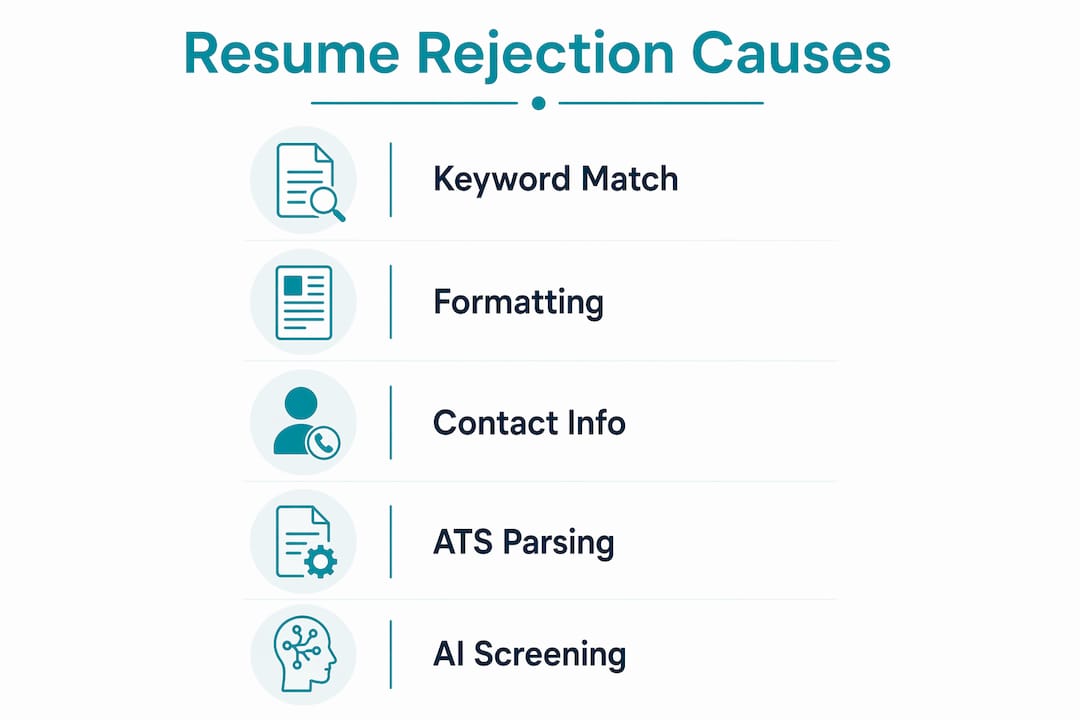
Instant resume disqualification happens most often because the application fails one of several hard filters before a recruiter invests any time. Indeed identifies eight distinct causes, and the most common ones share a pattern: they are preventable with preparation.
The leading causes of immediate rejection include:
- Qualifications mismatch. The job requires five years of experience in a specific domain and your resume lists two. Recruiters screen for minimum thresholds, not potential.
- Poor formatting. A resume built with columns, text boxes, or graphics looks polished to a human eye but reads as garbled text to an Applicant Tracking System (ATS). The content becomes invisible.
- Missing application materials. If the posting requests a cover letter or portfolio and you skip it, many employers disqualify the application automatically, regardless of your credentials.
- Overqualification. Overqualified applicants are screened out when employers anticipate retention problems or budget constraints. Your seniority can work against you for mid-level roles.
- Employment gaps without context. Unexplained gaps trigger skepticism during initial screening, particularly when the gap is recent and the resume offers no framing.
- Vague or generic content. Phrases like “responsible for managing projects” tell a recruiter nothing measurable. Resumes that substitute job titles for documented accomplishments fail to prove qualification.
Pro Tip: Read the job posting as a checklist. Every requirement listed is a filter. If your resume does not address each one explicitly, assume it will be screened out.
The common thread across these rejection reasons is specificity. Employers are not looking for impressive resumes in the abstract. They are matching documented evidence against a defined set of criteria, and any gap in that evidence triggers removal.
How do ATS and AI actually cause resume rejection?
The most persistent myth in job searching is that ATS systems automatically reject resumes for using the wrong font or missing a keyword. A recruiter survey found that 92% said ATS do not auto-reject resumes for formatting or keywords alone. Rejections happen primarily because of recruiter workflows, volume management, and relevance filtering, not because a machine flagged your bullet points.
What ATS systems actually do is parse and store applications, then surface the most relevant ones to recruiters based on search criteria. Many applications are stored without the candidate ever being notified. Rejection timing can be misleading: an instant rejection notice often reflects a compliance automation trigger, not a deliberate human decision about your qualifications.
That said, formatting errors create real problems at the parsing stage. Here is what ATS handles well versus what causes failures:
| Resume element | ATS-friendly format | Format to avoid |
|---|---|---|
| Contact information | Plain text in the body | Headers, footers, or tables |
| Work history | Chronological text blocks | Columns or text boxes |
| Skills section | Simple bulleted list | Graphics or icons |
| Section headings | Standard labels (Experience, Education) | Creative or stylized fonts |
| File format | .docx or plain PDF | Image-based PDFs |
Placing contact info in headers or footers causes ATS systems to omit those fields entirely, which means the recruiter cannot identify or contact you even if your qualifications are strong. NIST specifically advises keeping all contact details in the body text for this reason.
AI-powered screening tools, which are increasingly layered on top of traditional ATS platforms, scan for keyword alignment between your resume and the job description. Career expert Christina O’Connell notes that instant rejections are often AI screening results that do not reflect true qualifications. Her recommendation: follow up directly with the recruiter after receiving an automated rejection. That one step alone can move your application past the filter.
Pro Tip: Mirror the exact language from the job posting in your resume. If the posting says “cross-functional collaboration,” use that phrase, not “working across teams.” AI tools match strings, not synonyms.
What subtle factors cause rejection that most applicants miss?
Beyond formatting and qualifications, several less obvious factors determine whether your application advances or disappears. These are the resume rejection reasons that frustrate even experienced professionals.
- Timing of submission. Applications submitted within 48 to 72 hours of a job posting have the highest chance of recruiter attention before volume overwhelms the screening workflow. Apply on day four and you may be competing against hundreds of already-reviewed candidates.
- Internal candidate preference. Many job postings go live after an internal candidate has already been identified. The posting exists for compliance reasons. Your application is reviewed, but the decision was made before you applied. This is not a reflection of your resume quality.
- Knockout questions. Many employers embed pass/fail questions into the application form. Answering “No” to “Do you have a valid driver’s license?” or “Are you authorized to work in the US?” triggers automatic disqualification regardless of what your resume contains.
- Federal resume standards. Federal hiring through USAJOBS operates under a separate set of rules. Federal resumes must explicitly document hours per week, start and end dates by month and year, and specific accomplishments for each role. Human Resources specialists and Subject Matter Experts cannot infer experience from general statements or job titles. Vague summaries cause immediate elimination.
- AI-generated content in federal applications. NIST warns that AI-generated or plagiarized content in federal resume submissions can result in removal from consideration. Federal reviewers are trained to identify recycled or templated language.
- Incomplete application packages. The USAJOBS evaluation process uses multi-component screening that includes resumes, questionnaires, work samples, and assessments. Missing any one component eliminates the application regardless of resume strength.
The pattern here is that rejection often has nothing to do with your qualifications. It reflects process gaps, timing, or structural requirements you were not aware of. Knowing these factors lets you address them before submitting.
How to improve your resume and avoid instant disqualification
Fixing the top reasons for resume rejection requires a specific set of changes, not a general polish. Work through this list before submitting your next application.
- Strip out complex formatting. Remove tables, columns, text boxes, and graphics. Use a single-column layout with standard section headings. Save the designed version for in-person meetings.
- Customize for every role. Pull the exact keywords and required qualifications from the job description and map them directly onto your resume. Generic resumes fail because they do not speak to the specific role.
- Include every requested material. If the posting asks for a cover letter, references, or a portfolio, include all of them. Missing one item is an automatic disqualification at many companies.
- Apply within the first 48 to 72 hours. Early applications receive disproportionate recruiter attention before volume builds. Set job alerts on LinkedIn, Indeed, and company career pages to catch postings immediately.
- Quantify every accomplishment. Replace “managed a team” with “managed a team of eight across three product lines, reducing delivery time by 20%.” Numbers give reviewers evidence they can verify and compare.
- Move contact information into the body. Never place your name, email, or phone number in a header or footer. ATS systems frequently drop this data, making your application uncontactable.
- Follow up after automated rejections. As Christina O’Connell advises, an AI screening result is not a final decision. Find the recruiter on LinkedIn and send a brief, direct message making your case. This works more often than most applicants expect.
- Use AI tools as drafting aids, not replacements. Platforms like Easy CV can help you automate resume drafts and align language with job descriptions, but the final document must reflect your authentic voice and specific experience.
Pro Tip: Run your resume through a free ATS checker before submitting. Tools that parse your document the way an ATS would reveal formatting errors you cannot see in a standard word processor.
Key takeaways
Resumes get rejected immediately because they fail specific, identifiable filters, and every one of those filters can be addressed before you submit.
| Point | Details |
|---|---|
| Qualifications must be explicit | Document every requirement from the posting with specific evidence, dates, and measurable results. |
| ATS does not auto-reject on formatting alone | Rejections reflect recruiter workflows and volume; focus on timing and keyword alignment over font choices. |
| Timing matters more than most applicants realize | Submitting within 48 to 72 hours of posting significantly increases recruiter visibility. |
| Contact info belongs in the body | Headers and footers cause ATS to drop your contact data, making you unreachable even if qualified. |
| Follow up after automated rejections | An instant rejection is often an AI filter result, not a final human decision. Direct outreach can reverse it. |
What I’ve learned after a decade of watching resumes fail
I have reviewed thousands of resumes across industries ranging from federal contracting to Fortune 500 executive searches. The single most consistent pattern I see is this: job seekers treat their resume as a biography when employers need it to function as a proof document.
The psychological weight of repeated rejection is real. I have worked with senior managers who had 20 years of genuine accomplishment and still could not get past the first screen because their resume read like a job description rather than a record of impact. The frustration is legitimate. But it is also fixable, and fixing it requires a shift in how you think about the document.
The ATS myth has done real damage. Candidates spend hours tweaking fonts and obsessing over keyword density while ignoring the actual problem: their resume does not explicitly prove they meet the stated requirements. A recruiter cannot infer that you managed a $10 million budget from the phrase “oversaw financial operations.” Write the number. Write the outcome.
My other strong conviction is that online applications alone are not a job search strategy. They are one channel. The candidates I see land interviews fastest are the ones who combine a well-structured, ATS-friendly resume with direct outreach to hiring managers and recruiters. The resume gets you past the filter. The relationship gets you the interview. Both matter, and neither works without the other.
If you are applying to federal roles, treat the process as an entirely separate discipline. The NIST and USAJOBS standards are non-negotiable, and most private-sector resume advice does not apply. Get specific about hours, dates, and accomplishments, or expect to be screened out before a human ever reads your name.
Kim
How Resumewiz helps you get past the first screen
Resumewiz was built specifically for professionals who are done guessing why their applications disappear. Kim Taynor’s team brings over 10 years of recruiting experience to every engagement, translating that insider knowledge into resumes that pass ATS filters and compel hiring managers to act. The platform covers ATS-compliant formatting, keyword optimization aligned to your target roles, LinkedIn profile positioning, and direct outreach templates that put your application in front of decision-makers rather than waiting in a queue. Whether you are a senior manager, an executive in transition, or a career changer targeting a new industry, Resumewiz delivers a tailored document built to perform. Stop submitting and hoping. Start with a resume that is engineered to advance.
Want a recruiter in your corner for your next senior role? Book a free call with Resume Wiz and we will map out your next move together.
FAQ
Why do I get rejected immediately after applying online?
Immediate rejection after an online application typically means an automated filter, not a human reviewer, screened you out. Common triggers include missing required qualifications, incomplete application materials, or knockout question responses that disqualify automatically.
Does ATS automatically reject resumes for formatting issues?
A recruiter survey found 92% said ATS platforms do not auto-reject for formatting or keywords alone. Formatting errors cause parsing failures that make your content unreadable, but outright rejection is usually a downstream effect of recruiter filtering, not the system itself.
How can I tell if my resume is ATS-friendly?
Use a single-column layout, standard section headings, and plain text throughout. Keep contact information in the body, not in headers or footers. Avoid tables, graphics, and columns, which cause ATS systems to misread or drop your content entirely.
Should I follow up after an instant rejection?
Yes. As career expert Christina O’Connell recommends, instant rejections are often AI screening results that do not reflect true qualifications. A direct message to the recruiter on LinkedIn explaining your fit can move your application past the automated filter.
What makes federal resumes different from private-sector resumes?
Federal resumes must document hours per week, start and end dates by month and year, and specific accomplishments for every role listed. NIST states that reviewers cannot infer qualifications from general titles or vague summaries, and incomplete documentation causes immediate elimination from consideration.
