Why Top Candidates Don't Get Offers: 2026 Guide
Why Top Candidates Don’t Get Offers: 2026 Guide
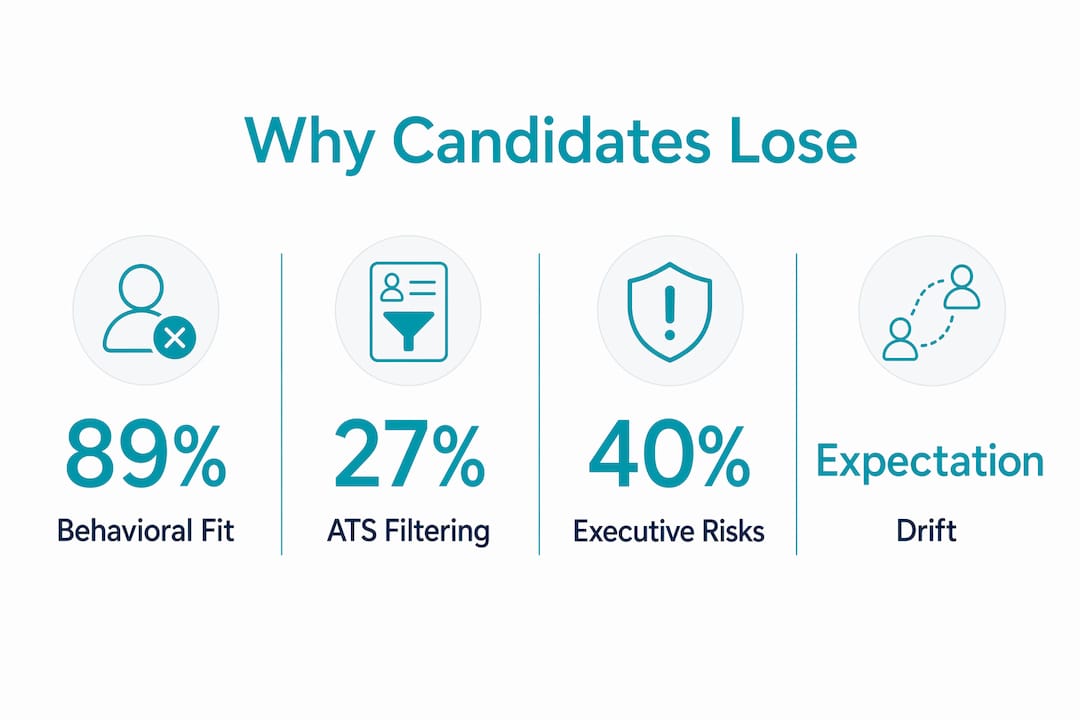
Qualified candidates lose job offers every day not because of missing skills, but because of how they are perceived during the hiring process. The real reasons top candidates don’t get offers center on behavioral fit, risk assessment, and communication clarity. A study of 5,247 hiring managers found that 89% of new-hire failures stem from poor attitude, low motivation, and lack of coachability rather than technical deficiencies. Hiring managers are not just evaluating your resume. They are deciding whether they can predict your behavior on a difficult Tuesday afternoon when things go wrong.
Why top candidates don’t get offers: the behavioral truth
The most common reason strong candidates are rejected has nothing to do with their credentials. Hiring managers consistently report that behavioral fit and predictability outweigh technical skill when making final offer decisions. When a manager says “not a fit,” they usually mean they could not picture that person as a reliable teammate for two years.
The problem is that most candidates prepare for interviews by polishing their answers until every response sounds rehearsed. That polish creates distance. Interviewers read it as armor, and armor signals that the real person is hidden. What managers actually want is to see the “Tuesday-afternoon version” of you, not the version that has memorized STAR-format responses.
Four behavioral signals kill strong candidacies before the offer stage:
- Inability to handle pushback. When an interviewer challenges your answer and you immediately back down or over-explain, it signals low confidence and poor judgment under pressure.
- No demonstrated vulnerability. Candidates who never admit a mistake or a learning moment appear either dishonest or unaware of their own blind spots.
- Lack of coachability. Interviewers test this by asking how you have changed your mind based on feedback. Candidates who cannot give a real example raise red flags.
- Over-rehearsed persona. A perfectly polished answer with no hesitation, no nuance, and no genuine emotion reads as performance, not authenticity.
Pro Tip: Before your next interview, practice answering one question badly on purpose. Pause, reconsider, and correct yourself out loud. That moment of visible thinking is exactly what hiring managers are looking for.
Interviewers assess risk by looking for controlled vulnerability and coachability rather than perfect answers. A candidate who shows they can receive feedback, adjust, and still hold their position when warranted is far less risky than one who performs flawlessly but reveals nothing real.
How does AI screening filter out qualified candidates?
Automated resume screening is now a primary filter in most hiring pipelines, and it creates a specific type of rejection that candidates rarely see coming. 27% of strong applications are filtered out before a human ever reads them. That means your qualifications never reach the person who could actually recognize your value.
ATS and AI tools are built to reward exact keyword matches and linear career paths. They are not built to interpret leadership nuance, recognize the value of a lateral move, or understand that a two-year entrepreneurial gap reflects initiative rather than instability. Profiles with non-linear histories get downranked despite quality because the algorithm sees deviation, not depth.
Here is what this means practically for your application:
- Mirror the job description language. If the posting says “cross-functional collaboration,” your resume needs that exact phrase, not “working across teams.” ATS tools match strings, not concepts.
- Avoid graphics, tables, and text boxes. Most ATS systems cannot parse these elements. Your carefully formatted resume may arrive as a blank document.
- Address gaps directly in your summary. A brief, confident framing of a career transition or entrepreneurial period prevents the algorithm from flagging it as unexplained absence.
- Tailor every application. A single resume sent to 50 roles will score poorly on most of them. Targeted resumes with role-specific language consistently outperform generic ones.
The hiring market in 2026 favors exact-match, low-risk candidates who require minimal ramp time. That bias disadvantages experienced, transformative leaders who bring broader value but do not fit a narrow keyword profile. Knowing this, you can fight back by treating every resume as a targeted document, not a biography.
Why does expectation drift cause late-stage offer failures?
Expectation drift is the gap that forms when different interviewers describe the same role differently across multiple conversations. It is one of the most underreported reasons great candidates are rejected or decline offers at the final stage. Misalignment in role clarity leads candidates to decline offers even when compensation is adequate, because they no longer trust what they are walking into.
The drift happens because hiring teams rarely align internally before interviews begin. One interviewer emphasizes growth opportunity. Another focuses on crisis management. A third describes a collaborative culture while a fourth signals a top-down structure. By the time the offer arrives, the candidate has assembled four different versions of the job and none of them match.
| What candidates hear | What creates confusion |
|---|---|
| “This role has a lot of growth potential” | No timeline, no defined path, no budget attached |
| “We have a collaborative culture” | No clarity on decision-making authority |
| “The team is high-performing” | No context on current gaps or challenges |
| “Compensation is competitive” | No range shared until the final offer stage |
Clarity and consistency in messaging about role expectations reduce late-stage offer rejections significantly. As a candidate, you can protect yourself by asking the same clarifying questions to every interviewer and noting where answers diverge. That divergence tells you something important about the organization’s internal alignment.
Pro Tip: Ask each interviewer, “What does success look like in this role after 90 days?” If the answers vary widely, you are seeing expectation drift in real time. Use that information to ask a direct alignment question before accepting any offer.
Salary is rarely the deciding factor when strong candidates walk away from offers. The real issue is that they cannot picture a clear, stable reality on the other side of the signature. Candidates who negotiate for clarity, not just compensation, make better decisions and accept offers with more confidence.
What unique challenges do senior executives face at the interview stage?
Executive-level rejections follow a different pattern than those at individual contributor or management levels. Up to 40% of senior leaders fail or underdeliver in new roles within 18 months, and boards know this. That awareness turns executive interviews into risk assessments, not credential validations.
The specific pitfalls that derail senior candidates are predictable once you know what boards are actually evaluating:
- Overusing jargon. Executives who speak in frameworks and acronyms signal that they prioritize sounding sophisticated over being understood. Boards want clarity, not complexity.
- Underselling personal impact. Many senior candidates describe what their teams achieved without clearly stating what they personally decided, changed, or drove. That ambiguity reads as a lack of ownership.
- Avoiding setbacks. Executives who cannot discuss a failure with specificity and composure raise serious concerns. Boards expect leaders to have faced adversity and learned from it.
- Failing to demonstrate room awareness. Executive presence is partly about reading the energy in a room and adjusting. Candidates who deliver a monologue regardless of audience signals miss this entirely.
- Downleveling their answers. When a C-suite candidate answers questions with manager-level examples, they signal they are not ready for the scope of the role.
“Boards want specific examples, emotional intelligence, and authentic leadership presence. A candidate who can articulate the scope of their decisions, the resistance they faced, and the outcome they drove is far less risky than one who speaks in generalities.”
Senior executives risk getting downleveled when their answers do not demonstrate readiness for the targeted leadership scope. The fix is not to memorize better answers. The fix is to practice narrating your thinking out loud, leading the conversation, and aiming your stories above the level assessed by focusing on impact and scope before technical detail.
Key Takeaways
Top candidates are rejected not for lack of skill, but because hiring managers cannot predict their behavior, trust their authenticity, or align on a clear role definition before the offer stage.
| Point | Details |
|---|---|
| Behavioral fit drives decisions | 89% of new-hire failures trace back to attitude and coachability, not technical gaps. |
| ATS filters remove strong profiles | 27% of qualified applications never reach a human reviewer due to keyword mismatches. |
| Expectation drift kills late-stage offers | Inconsistent role descriptions across interviewers cause candidates to decline or distrust offers. |
| Executive interviews are risk assessments | Boards evaluate scope, judgment, and presence, not just credentials or career history. |
| Authenticity outperforms polish | Showing controlled vulnerability and real thinking builds more trust than rehearsed perfection. |
What I’ve learned after 10 years of watching great candidates lose
After a decade in recruiting, the pattern I see most often is this: the candidate who loses the offer is almost never the least qualified person in the room. They are usually the most prepared. And that preparation is exactly what costs them.
Over-preparation creates a kind of interview armor that reads as inaccessibility. Hiring managers do not want to hire a performance. They want to hire a person they can work with when a project falls apart or a client escalates. When every answer is polished to a shine, the interviewer cannot see that person at all.
The candidates I have watched win the most competitive offers share one habit: they narrate their thinking in real time. They say things like, “My first instinct was X, but when I saw the data, I shifted to Y.” That kind of visible reasoning is what builds trust faster than any credential.
The other thing I tell every executive I work with is to stop treating the interview as a performance review. It is a negotiation. You are evaluating them as much as they are evaluating you. Candidates who ask sharp questions, push back thoughtfully, and request clarity on ambiguous points come across as leaders. Candidates who only answer questions come across as employees.
Run parallel applications. Never let one opportunity consume all your attention and emotional investment. The candidates who lose the most are the ones who stopped applying after round two of a process that ultimately went sideways.
Kim
How Resumewiz helps qualified candidates secure the offers they deserve

Knowing why rejections happen is only half the equation. Fixing the specific gaps in your resume, interview approach, and personal positioning is where the real work begins. Resumewiz was built for exactly this situation. The platform specializes in ATS-compliant resume development and executive branding that gets qualified professionals past automated filters and in front of the decision-makers who can actually evaluate their value. Resumewiz founder Kim Taynor brings over 10 years of recruiting experience to every engagement, translating behavioral strengths and leadership impact into language that resonates with both algorithms and hiring managers. If your qualifications are strong but your offers are not coming, the gap is almost always in how your story is being told.
Want a recruiter in your corner for your next senior role? Book a free call with Resume Wiz and we will map out your next move together.
FAQ
Why do qualified candidates get rejected so often?
89% of new-hire failures trace back to behavioral issues like poor attitude and low coachability rather than technical skill gaps. Hiring managers prioritize predicting how a candidate will behave under pressure over validating their credentials.
How does ATS screening eliminate strong applicants?
ATS tools match exact keywords and penalize non-linear career paths, causing 27% of strong applications to be filtered out before a human reviews them. Tailoring your resume language to mirror each job description is the most direct fix.
What is expectation drift and why does it matter?
Expectation drift occurs when different interviewers describe the same role inconsistently, leaving candidates confused about what they are actually accepting. This misalignment is a leading cause of late-stage offer declines even when compensation is competitive.
Why do senior executives fail interviews despite strong track records?
Up to 40% of senior leaders underdeliver in new roles within 18 months, so boards treat executive interviews as risk assessments. Candidates who rely on jargon, avoid discussing setbacks, or undersell their personal impact signal high risk regardless of their resume.
What is the single most effective change a candidate can make?
Narrating your thinking out loud during interviews, rather than delivering polished final answers, builds more trust with hiring managers than any other single adjustment. It shows judgment, self-awareness, and the kind of real-time reasoning that predicts on-the-job performance.
