Why You Can't Land Interviews at Your Level
Why You Can’t Land Interviews at Your Level
Channel mismatch is the leading cause of interview failure for mid to senior-level professionals. Not resume quality. Not experience gaps. The core problem is that your applications aren’t reaching decision-makers because you’re using the wrong channels and getting filtered out by AI ranking systems before a human ever sees your name. If you’re asking why I can’t land interviews at my level, the answer almost never lives in your resume. It lives in how and where you’re applying.
Why I can’t land interviews at my level: the channel problem
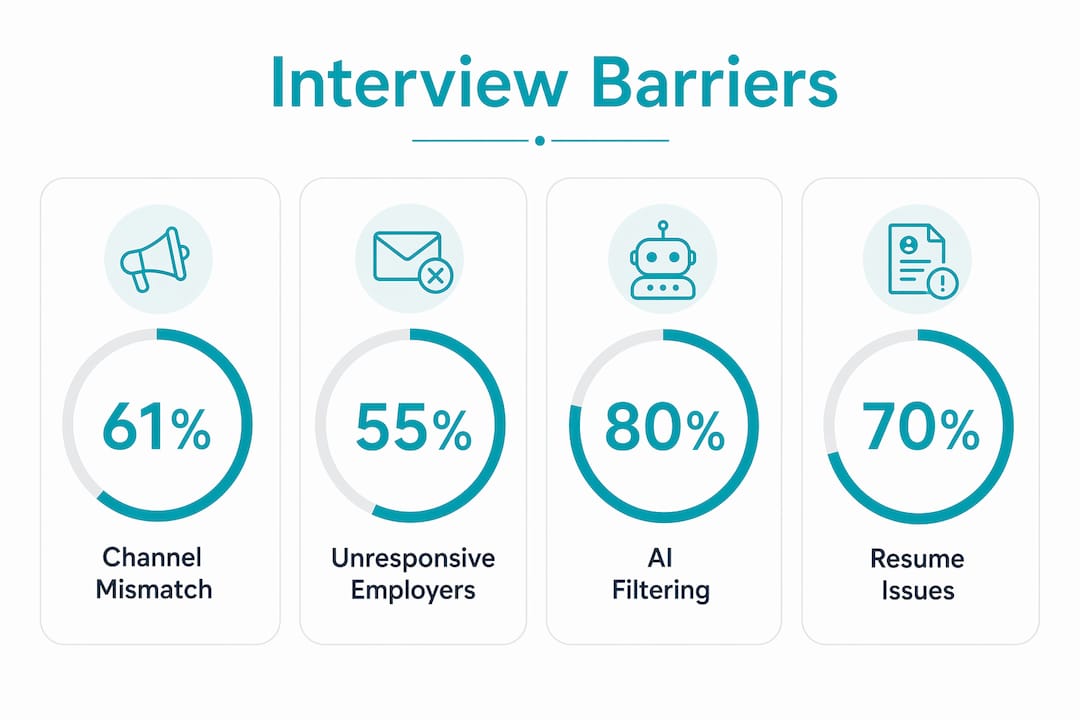
The single biggest barrier for professionals earning $75,000 to $150,000 is channel mismatch. 61% of professionals at this compensation level fail to get interviews because they rely on cold job board submissions without networking or referrals. That number is striking. It means the majority of qualified candidates are using the least effective method available.
Cold applications put you at the back of a very long line. Most hiring managers tap internal networks and referrals before a role ever gets posted publicly. By the time you find a listing on LinkedIn or Indeed, the internal shortlist may already exist. You’re not competing for an open seat. You’re competing against candidates who were already known quantities to the hiring team.
The referral pipeline is especially dominant at the mid to senior level. A VP of Operations or a Director of Finance isn’t hired the same way an entry-level analyst is. Hiring managers at that level rely on trusted contacts, executive recruiters, and warm introductions. Cold applications to these roles often land in an ATS queue that nobody actively monitors.
- Cold job board applications: Low conversion rate at senior levels due to late entry into the hiring process
- Recruiter outreach without a warm connection: Gets filtered as generic noise
- Applying to every relevant posting: Signals volume thinking, not targeted strategy
- Ignoring LinkedIn as an inbound channel: Misses recruiter searches that bypass job boards entirely
Pro Tip: Run an Interview Funnel Diagnostic on your last 20 applications. Track how many came from cold boards versus warm referrals, and compare your callback rates. The data will show your bottleneck within minutes.
How AI ranking systems filter out qualified candidates
AI recruitment software doesn’t just check whether you meet the minimum criteria. It ranks candidates by career trajectory and promotion patterns relative to a peer group. That distinction changes everything about how you need to think about your application.
Here’s what that means in practice. If you’re applying for a Senior Director role and the AI system places you in a peer group with candidates who have faster promotion timelines or more consistent title progression, your application gets ranked lower. You may be fully qualified on paper. But within the competitive bracket the system creates, you appear weaker than your actual experience warrants.
This is the category mismatch problem. Your resume may signal “strong manager” when the role needs “emerging executive.” The AI reads career trajectory signals, not just keywords. A candidate who moved from Manager to Senior Manager to Director in six years will rank above a candidate with equivalent skills but a less linear path, even if the second candidate has broader experience.
- Trajectory signals: Consistent upward movement in title and scope matters more than lateral breadth
- Promotion velocity: Faster promotions within a company read as high-performer signals to AI systems
- Scope indicators: Managing larger teams, budgets, and P&L responsibility strengthens your peer ranking
- Keyword matching alone: No longer sufficient. AI systems now weigh contextual career signals alongside keywords
AI hiring platforms have shifted recruitment to rank candidates among peer groups, making competitive context more important than raw qualifications. The implication is direct: you need to make your career trajectory legible to both humans and machines.
Why your resume language is working against you
Executive-level resume framing is a distinct skill. Most professionals write resumes that describe what they did rather than what they changed. Resumes must communicate leadership impact and business results to pass senior-level screening. A list of responsibilities reads as an execution-level document. Hiring managers at the VP and Director level need to see a strategist.
The difference is concrete. “Managed a team of 12 and oversaw quarterly reporting” is a task description. “Led a 12-person analytics team that reduced reporting cycle time by 40%, freeing $1.2M in operational capacity annually” is an executive signal. Both describe the same job. Only one gets a callback.
Common resume pitfalls at the senior level include:
- Listing duties instead of outcomes: Tells the reader what you were responsible for, not what you delivered
- Omitting dollar and percentage figures: Leaves hiring managers guessing about the scale of your impact
- Generic leadership language: Phrases like “collaborated cross-functionally” or “drove alignment” say nothing specific
- Underselling scope: Failing to mention budget ownership, headcount, or revenue responsibility
Pro Tip: Audit every bullet point on your resume with this test: “So what?” If you can’t answer that question with a number or a business outcome, rewrite the bullet before you send another application.
Resume language that emphasizes leadership impact and strategic outcomes is far more effective than listing executional duties for mid to senior roles. This isn’t a minor polish issue. It’s the difference between being screened in or screened out before a human reads past the first section.
How to improve your interview chances in 2026
Improving your interview rate requires a shift from applicant thinking to strategist thinking. Job seekers need to design targeted narratives and interview stories that specifically match desired roles. That process starts before you apply, not after you get a call.
-
Build warm connections at target companies. Identify 10 to 15 companies where you want to work. Find second-degree connections on LinkedIn who work there. Request brief informational conversations, not job leads. This positions you as a known quantity before a role opens.
-
Optimize your LinkedIn profile for recruiter searches. Your headline, About section, and job titles need to reflect the role you want, not just the role you have. Recruiters search by title, skill, and location. If your profile doesn’t surface in those searches, you don’t exist to them.
-
Apply selectively, not at volume. Sending 50 cold applications produces worse results than sending 10 targeted applications backed by a warm introduction or a recruiter relationship. Quality of channel beats quantity of submissions at this level.
-
Prepare STAR stories with concrete numbers. Successful interview preparation involves mastering structured STAR (Situation, Task, Action, Result) stories reinforced with specific figures. Prepare six to eight stories that cover leadership, conflict, failure, and scale. Memorizing generic answers is not the same as owning a specific, quantified narrative.
-
Treat your job search as a campaign. Set weekly targets for outreach, applications, and follow-ups. Track your funnel metrics. Adjust based on where you’re losing traction.
| Strategy | Primary benefit | Best for |
|---|---|---|
| Warm networking outreach | Bypasses ATS queue entirely | Roles at $100K+ |
| LinkedIn profile optimization | Increases inbound recruiter contact | All senior levels |
| Selective targeted applications | Higher callback rate per application | Director and above |
| STAR story preparation | Converts interviews into offers | All interview stages |
| Recruiter relationship building | Access to unlisted roles | VP and C-suite |
The job search struggles that feel most personal, such as ghosting and silence after applications, are systemic. 55% of job seekers report employer ghosting as their top frustration, and 67% suspect fake or misleading postings. These aren’t reflections of your value. They’re features of a broken application ecosystem that rewards channel strategy over volume.
Key Takeaways
The primary reason qualified professionals don’t land interviews is channel mismatch, not resume quality, and fixing that requires targeted networking, AI-aware positioning, and executive-level resume framing.
| Point | Details |
|---|---|
| Channel mismatch is the core problem | 61% of mid to senior-level professionals fail to get interviews due to cold applications without referrals. |
| AI ranks you against peers, not criteria | Career trajectory and promotion velocity determine your ranking, not just keyword matches. |
| Resume language must signal leadership | Replace task descriptions with quantified business outcomes to pass executive-level screening. |
| Warm networking beats volume applications | Building connections at target companies before roles open dramatically increases callback rates. |
| STAR stories convert interviews to offers | Prepare six to eight quantified stories covering leadership, conflict, and scale before any interview. |
What I’ve learned after 10 years of watching this play out
The professionals who come to me most frustrated are almost always the most qualified. They’ve spent months tweaking their resume, swapping keywords, and refreshing their inbox. They’re doing everything they were told to do. The problem is that the advice they received was written for a different job market.
Many senior professionals focus excessively on resume keyword optimization while ignoring the critical importance of warm referrals and networking connections. I’ve watched this pattern repeat itself across hundreds of clients. The resume is rarely the bottleneck. The channel is.
What actually works is uncomfortable for most people: reaching out to strangers on LinkedIn, asking for introductions, building relationships before you need them. That feels presumptuous. It isn’t. It’s how senior roles get filled. The professionals who understand this stop asking why am I not getting interviews and start asking who do I need to know.
Mental resilience matters here too. 1 in 4 job seekers have been searching for over a year, and 45% search for three months or more. A prolonged search doesn’t mean you’re unqualified. It often means you’re using the wrong strategy. Adjust the strategy, not your confidence.
The shift I recommend to every client is this: stop thinking like an applicant and start thinking like a hiring manager. Ask yourself who that manager already knows and trusts, then figure out how to become one of those people before the role is posted.
Kim
How Resumewiz helps mid to senior-level professionals land interviews
Mid to senior-level professionals working with Resumewiz get more than a polished resume. The platform addresses the full picture: ATS-compliant formatting, executive-level resume framing, LinkedIn profile optimization, and personalized outreach templates that open doors through warm channels rather than cold queues.
Founder Kim Taynor brings over 10 years of recruiting experience to every engagement. That background means Resumewiz understands what hiring managers actually look for at the Director, VP, and executive level, and builds client materials to match. The platform also offers a fully managed job search with tailored applications and outreach. If your current approach isn’t producing callbacks, explore the services built specifically for professionals at your level.
Want a recruiter in your corner for your next senior role? Book a free call with Resume Wiz and we will map out your next move together.
FAQ
Why am I not getting interviews despite being qualified?
The most common cause is channel mismatch. Qualified professionals at the mid to senior level often apply cold through job boards, entering the process after internal referrals have already shaped the shortlist.
How does AI affect my chances of landing an interview?
AI recruitment systems rank candidates within peer groups based on career trajectory signals, not just qualifications. A less linear promotion path can lower your ranking even when you meet all stated criteria.
What resume changes improve interview chances at the senior level?
Replace task descriptions with quantified business outcomes. Hiring managers at the Director level and above screen for leadership impact, budget ownership, and measurable results, not lists of responsibilities.
How important is networking for landing senior-level interviews?
Networking is the primary channel for roles above $100,000. Most hiring managers fill senior positions through referrals and internal networks before posting publicly, making warm connections far more effective than cold applications.
How long do most senior-level job searches take?
Job searches at this level routinely extend beyond three months. Data from the Monster Research Institute shows 45% of job seekers search for three months or more, with 1 in 4 searching for over a year.
