Why Your Director Resume Isn't Getting Interviews
Why Your Director Resume Isn’t Getting Interviews
A director-level resume fails to generate interviews when it signals operational competence instead of strategic leadership. This is the core problem Resumewiz sees repeatedly among qualified mid to senior professionals who ask why my resume isn’t getting interviews director level. The issue is rarely spelling, formatting, or length. The real failure is a resume that reads like a job description rather than a record of organizational impact. Tools like Grammarly can fix grammar, but no grammar checker fixes a resume that buries your executive value under a list of daily tasks. Understanding this distinction is the first step toward a real fix.
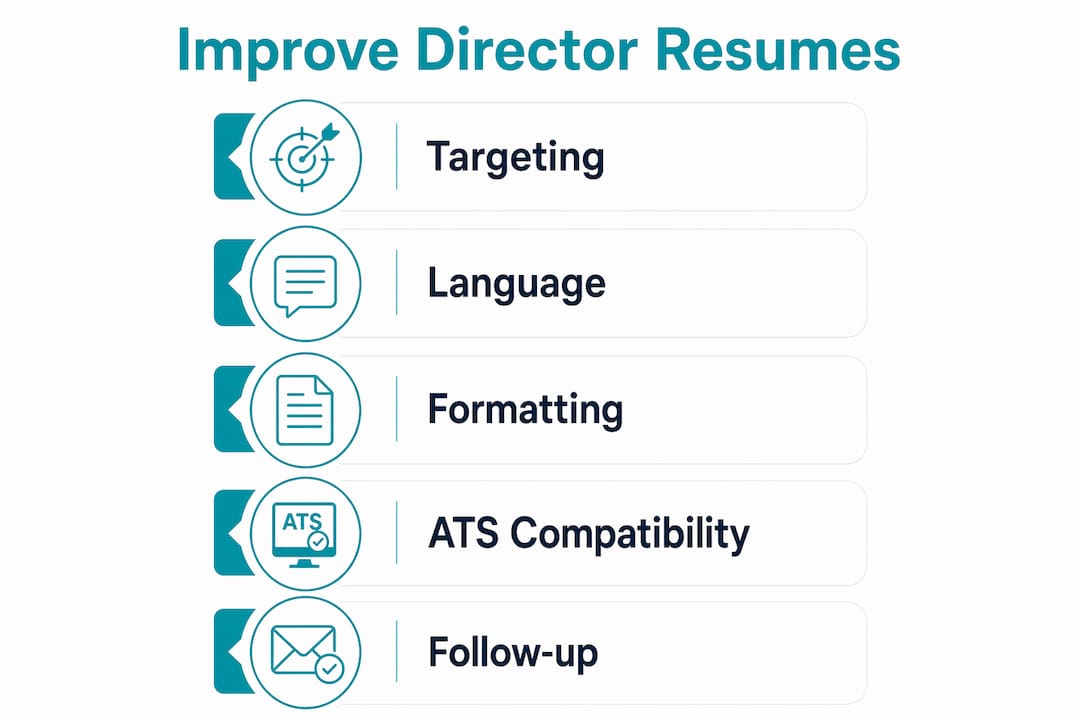
Why strategic targeting decides director-level interview rates
The most overlooked reason your resume isn’t getting interviews has nothing to do with the resume itself. Targeting less than 50% of applications to roles that meet your must-have criteria is a primary failure point. That means most professionals are sending strong resumes to the wrong jobs and wondering why no one calls back.
Audit your last 20 applications honestly. Ask yourself: did you meet every required qualification listed? Did you apply within the first 48 to 72 hours of the posting? Did you know anyone at the company? If the answer to all three is no, the silence you received was predictable.
Networking and internal referrals dramatically outperform cold applications for senior roles. Targeted networking can secure director-level interviews within two weeks, while cold applications to the same roles often return nothing. This is not a resume problem. It is a distribution problem.
Here is what strategic targeting looks like in practice:
- Apply only to roles where you meet 80% or more of the stated requirements
- Prioritize postings where you have a first or second-degree LinkedIn connection at the company
- Reach out to the hiring manager or a team member before submitting your application
- Apply within the first three days of a job posting going live
- Customize your resume summary for each specific role, not each industry
Pro Tip: Stop sending 30 applications a week. Send five that are genuinely targeted, with a warm contact at each company. Your response rate will improve faster than any resume rewrite.
Mass applying feels productive. It rarely is at the director level. Recruiters at this tier are looking for candidates who clearly want this role, not any director role.
What executive resume mistakes are blocking your calls?
The most common resume mistakes at the director level share one trait: they describe what you did instead of what changed because of you. 84% of executive-level resumes fail to quantify team or budget size, and 68% lack measurable results entirely. Those numbers explain a lot of unanswered applications.
Here are the specific mistakes that cost director candidates the most:
- Listing duties instead of outcomes. “Managed a team of 12” tells a recruiter nothing. “Led a 12-person product team that reduced time-to-market by 30% over two quarters” tells them everything.
- Omitting scale. Budget responsibility, headcount, and revenue impact are the three numbers recruiters use to calibrate seniority. If none appear, your resume reads as mid-level.
- Too many bullet points. Fifteen bullets per role dilutes your narrative. Six strong, results-focused bullets outperform fifteen weak ones every time.
- Keyword stuffing. 76% of recruiters prefer resumes with naturally integrated keywords. Stuffing penalizes you with both the ATS and the human reviewer.
- No strategic arc. Your resume should show a clear progression toward the director role you want, not a flat list of positions held.
The format that executive recruiters consistently prefer is called Results Clustering. Instead of listing every task under a job title, you group your most significant outcomes into two or three achievement statements per role. Each statement names the problem, your action, and the measurable result.
“Recruiters hire for demonstrated executive-level signal, not raw experience volume.” This means a shorter, sharper resume with three strong wins per role will outperform a dense two-page document every time.
Results Clustering forces you to think like a hiring manager. What did this person actually change? What would be missing if they had never been in that role? Those are the questions your resume must answer.
Does your resume language signal director-level authority?
Resumes that read as operational task lists cause candidates to be filtered out within 6 to 10 seconds. Recruiters are not reading your resume at the director level. They are scanning it for signals. If those signals say “manager” instead of “director,” you are screened out before anyone reads a single bullet point.
The language problem shows up most clearly in three places:
- The summary section. A vague summary like “results-driven leader with 15 years of experience” signals nothing. A strong summary names your specialty, your scope, and the level you operate at. Example: “Director of Operations with P&L ownership across three business units and a track record of scaling teams from 20 to 80 in under 18 months.”
- Verb choices. Words like “assisted,” “supported,” and “helped” signal support roles. Words like “directed,” “owned,” “restructured,” and “launched” signal leadership. Audit every verb in your resume.
- Outdated experience. Roles from the 1990s or early 2000s do not strengthen a director-level resume. They trigger age bias and push your most relevant work further down the page. Cut anything older than 15 years unless it is genuinely exceptional.
Vague summaries and mismatched job titles cause filtering by recruiters targeting director-level candidates. This is a structural problem, not a content problem. You can have the right experience and still be screened out because your language does not match the level the recruiter is sourcing for.
Role-specific vocabulary matters too. A Director of Marketing should use terms like “go-to-market strategy,” “pipeline contribution,” and “brand P&L.” A Director of Engineering should reference “architecture decisions,” “engineering org design,” and “delivery velocity.” Generic leadership language without domain-specific vocabulary reads as thin at the director level.
Pro Tip: Share your resume with two peers who hold director or VP titles. Ask them one question: “Does this read like a director resume or a manager resume?” Their gut reaction is more accurate than any checklist.
How should you format a director resume for 2026 ATS?
Resume formatting for director-level roles in 2026 requires satisfying two audiences: AI screening systems and human recruiters who spend seconds on first review. Getting both right is not complicated, but most candidates get at least one wrong.
| Feature | Ineffective Approach | Effective Approach |
|---|---|---|
| Length | Three or more pages | One to two pages maximum |
| Graphics | Heavy visuals, charts, icons | Clean text-based layout |
| Keywords | Stuffed keyword lists | Naturally integrated in context |
| Bullet structure | 10+ bullets per role | 4 to 6 results-focused bullets |
| Summary | Generic or missing | Specific, seniority-clear, role-targeted |
| File format | Designed PDF with columns | Single-column ATS-friendly PDF or Word |
Recruiter surveys show 82.1% prefer resumes of one to two pages, with 51% specifically favoring two pages for senior roles. Seniority does not earn you a third page. It earns you a tighter, more selective two pages.
Modern ATS use AI semantic analysis rather than simple keyword matching. This means a resume with naturally written sentences that include relevant terms will rank higher than one with a keyword dump at the bottom. For a deeper look at how keyword placement affects ranking, the guidance at Easy CV’s keyword guide is worth reviewing.
Pro Tip: Paste your resume into a plain text editor and remove all formatting. If it still reads clearly and logically, your ATS compatibility is strong. If it becomes a jumbled mess, your layout is likely causing parsing errors.
Silence from employers often signals misalignment or late application timing, not market rejection. Treat no response as diagnostic data. It tells you to refine your targeting and submit earlier in the hiring cycle, not to add more content to your resume.
Key takeaways
Director-level resume failures are almost always strategic, not cosmetic. Fixing your targeting, language, and format together produces results that fixing any one alone cannot.
| Point | Details |
|---|---|
| Targeting beats volume | Apply to fewer, better-fit roles with warm contacts to increase response rates at director level. |
| Quantify everything | Include team size, budget ownership, and measurable outcomes to signal executive credibility. |
| Language signals seniority | Replace task-based verbs with leadership verbs and write a specific, level-clear summary section. |
| Two pages is the limit | 82.1% of recruiters prefer one to two pages; seniority does not justify longer resumes. |
| ATS reads context | Use keywords naturally in sentences rather than in lists to rank well with semantic AI screening. |
What i’ve learned after 10 years of reviewing director resumes
The pattern I see most often is not a bad resume. It is a good resume for the wrong level. Qualified professionals spend years doing genuinely director-level work, then describe it in manager-level language because that is how they were taught to write resumes a decade ago. The job market at this tier has changed. The language requirements have not kept pace for most candidates.
The shift I coach clients through is moving from task documentation to transformational storytelling. Your resume is not a record of what you were responsible for. It is a case study in what you changed. That reframe alone has helped clients at Resumewiz go from zero callbacks to multiple first-round interviews within three weeks, without changing a single job title or adding new experience.
The AI screening piece is real and growing. Semantic ATS systems in 2026 are sophisticated enough to detect whether your resume reflects genuine strategic thinking or surface-level keyword matching. Candidates who try to game the system with keyword lists are penalized. Candidates who write clearly about real outcomes, using the natural vocabulary of their field, consistently rank higher.
My honest advice: stop treating your resume as a document and start treating it as a positioning statement. Every line should answer one question: why is this person the right director for this specific role? If a line does not answer that question, cut it.
The executive resume guidance at Cornerstone Search reinforces this point well. Strategic leadership evidence, not experience volume, is what moves candidates forward at the director level.
Kim
How Resumewiz helps director-level professionals land interviews
If your resume is technically correct but still not generating calls, the problem is almost certainly strategic positioning, not surface-level errors.
Resumewiz specializes in director and executive-level resume development, with a focus on ATS-compliant formatting, results-driven narrative, and role-specific positioning that signals seniority from the first scan. Kim Taynor brings over 10 years of recruiting experience to every engagement, which means your resume is built the way recruiters actually read them. From your summary section to your achievement statements, every element is calibrated to the director-level standard. Explore Resumewiz’s career services to see how targeted resume strategy translates into real interview volume.
Want a recruiter in your corner for your next senior role? Book a free call with Resume Wiz and we will map out your next move together.
FAQ
Why isn’t my resume getting responses at the director level?
The most common cause is a resume that signals manager-level thinking rather than director-level strategic impact. Vague summaries and missing quantified results cause recruiters to filter candidates out within seconds.
How long should a director-level resume be?
Two pages is the standard. 51% of recruiters specifically favor two pages for senior roles, and length beyond two pages does not earn an exemption based on seniority.
Does ATS treat director resumes differently than entry-level ones?
Modern ATS systems use semantic analysis to evaluate context and relevance, not just keyword presence. A director resume with naturally integrated leadership vocabulary and quantified outcomes ranks higher than one with keyword lists regardless of seniority level.
Should i include jobs from the 1990s on my director resume?
No. Roles older than 15 years trigger age bias and push your most relevant experience further down the page. Cut them unless the achievement is genuinely exceptional and directly relevant to the role you are targeting.
How do i improve my director-level resume response rate fast?
Combine two changes: rewrite your summary to clearly state your seniority and specialty, and add quantified results to your top three roles. Then apply only to positions where you meet 80% or more of the requirements and have a warm contact at the company.
