Why Your Experience Isn't Translating into Offers
Why Your Experience Isn’t Translating into Offers
The main reason your experience isn’t translating into offers is a communication gap, not a skills gap. You may have the right background, the right credentials, and the right track record. But if you can’t convey the impact of that experience clearly and quickly, hiring managers move on. Interview anxiety affects 93% of candidates, causing mental blanks and poor delivery at the worst possible moment. The problem isn’t what you’ve done. It’s how you’re presenting it.
Why your experience isn’t translating into offers: the positioning problem
Positioning and how experience is communicated on your resume directly affects whether you get called in the first place. Recruiters don’t read resumes. They scan them. Research shows recruiters filter candidates within the first 6 seconds, looking for executive signal and clear impact. If your resume reads like a job description, it gets treated like one.
The difference between execution language and results language is the difference between getting screened out and getting called. Execution language describes what you did: “Managed a team of eight.” Results language describes what changed because of you: “Led a team of eight to cut onboarding time by 30%.” Hiring managers at the executive and manager level expect the second version. They assume you can do the job. What they’re evaluating is whether you made things better.
Well-crafted applications emphasizing concrete impact generate more interviews and better fit. The real audience for your resume is a human being, not just an applicant tracking system. That human needs to see, within seconds, that you belong in the role. Your resume and your in-interview narrative must tell the same story. If your resume signals executive presence but your interview answers sound like a job description, the disconnect kills your credibility.
Pro Tip: Audit every bullet on your resume. If it starts with a verb but ends without a number or a named outcome, rewrite it. “Oversaw operations” becomes “Oversaw operations across three sites, reducing overhead by $200K annually.”
- Lead every bullet with a strong action verb tied to a business result.
- Replace phrases like “responsible for” with specific outcomes you drove.
- Quantify wherever possible: dollars saved, percentages improved, time reduced.
- Align your resume language with the exact terminology in the job posting.
- Make sure your LinkedIn summary mirrors the same narrative your resume tells.
What is the interview performance gap?
The interview performance gap is the disconnect between what a candidate can actually do and what they demonstrate during the interview. Qualified professionals lose offers every day because they narrate duties instead of strategic results. Interviewers hear what you did. They don’t hear why it mattered. That gap is what costs you the offer.
The most common pitfall is rambling. A candidate with 15 years of experience often has too much to say and no framework for saying it concisely. The STAR method (Situation, Task, Action, Result) exists precisely to solve this. It forces you to structure your answer around a specific outcome rather than a general description of your role. Interviewers remember stories. They forget job descriptions.
Generic interview answers signal a generic candidate. Specific, results-focused narratives impress interviewers far more effectively. The shift from “I managed product launches” to “I led a product launch that captured a new market segment and added $1.2M in first-year revenue” is the difference between a forgettable answer and one that gets you the offer.
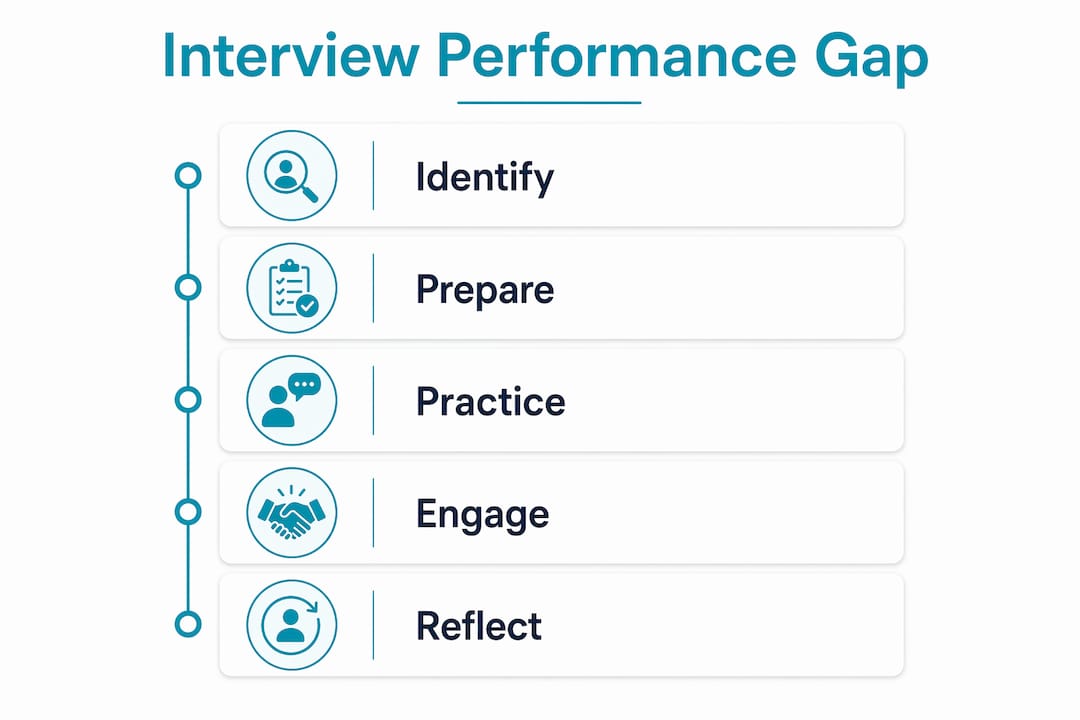
Poor storytelling also shows up in how candidates read the room. If an interviewer leans forward when you mention a specific result, that’s a signal to go deeper. If they glance at their notes, you’ve lost them. Developing this awareness takes practice, not just preparation.
Pro Tip: Record yourself answering three common interview questions. Watch it back without sound first. Your body language tells a story before your words do.
Here are the four most common reasons qualified candidates fail to convert interviews into offers:
- Narrating duties instead of impact. Interviewers already know your job title. They want to know what you changed.
- Answering the question asked, not the question behind it. “Tell me about yourself” is not a biography request. It’s an invitation to make your case.
- Rambling past the point. A strong answer takes 90 seconds to two minutes. Anything longer loses the room.
- Missing narrative inconsistencies. If your resume says you led strategy but your interview answers position you as an executor, interviewers notice the gap.
How does interview anxiety affect your chances?
Interview anxiety affects 93% of candidates and causes real, measurable performance problems: mental blanks, rushed speech, poor eye contact, and flat delivery. These symptoms don’t signal incompetence to the interviewer. They signal uncertainty. And uncertainty about a candidate is a reason to pass.
The brain’s fight-or-flight response during social evaluation is the same mechanism that fires in physical danger. Your body doesn’t distinguish between a bear and a panel interview. Cortisol spikes, working memory narrows, and your ability to retrieve well-rehearsed answers drops. Knowing this doesn’t fix it. But it does mean the solution is physiological, not just psychological.
Preparation is the most reliable anxiety reducer. Structured practice using the STAR method conditions your brain to retrieve answers in a predictable format under pressure. Mock interviews that simulate real conditions, including time pressure and unfamiliar questions, accelerate this conditioning faster than solo rehearsal. Realistic mock interviews with structured feedback close the performance gap faster than any other single intervention.
The most underused technique is reframing. Research shows that labeling anxiety as excitement, rather than trying to suppress it, produces better performance outcomes. The physiological state is identical. The interpretation is what changes. Telling yourself “I’m excited” before walking into an interview activates the same energy but directs it toward engagement rather than avoidance.
- Breathe before you enter. Four counts in, hold for four, out for four. This activates the parasympathetic nervous system and lowers your heart rate.
- Prepare three anchor stories. These are your best career results, told in STAR format, that you can adapt to almost any behavioral question.
- Practice out loud, not in your head. Thinking through an answer and saying it aloud use different cognitive pathways. Only one of them prepares you for the interview.
- Reframe the stakes. An interview is a two-way evaluation. You’re also deciding whether this company deserves your next five years.
How do closing questions seal the offer?
The closing argument in an interview is the candidate’s questions. Most candidates waste this moment on administrative topics: start dates, benefits, next steps. These questions signal that you’re thinking about logistics, not about the role. Interviewers notice.
Insightful closing questions do three things. They show you’ve thought deeply about the role. They demonstrate that you’re already thinking like someone in the position. And they give the interviewer a reason to advocate for you in the debrief. A question like “What does success look like in this role at 90 days, and what’s the biggest obstacle the person in this seat will face?” tells the interviewer you’re already planning your first quarter.
Most candidates squander the closing question opportunity, which expert recruiters identify as the candidate’s final impression. The questions you ask are the last data point the interviewer carries into the hiring decision. Make them count.
Strong closing questions that differentiate you:
- “What’s the most pressing challenge your team is facing right now, and how would this role address it?”
- “How does this team define success differently than other teams in the organization?”
- “What have the most effective people in this role done in their first 60 days that made a lasting impact?”
- “Is there anything about my background that gives you pause? I’d like the chance to address it directly.”
That last question is the most powerful and the least used. It invites the interviewer to voice an objection you can then resolve on the spot, rather than letting it sit unanswered in the debrief.
Key Takeaways
The gap between your experience and a job offer is almost always a communication problem, not a qualifications problem. Fix how you present your impact, manage your anxiety, and close with intention.
| Point | Details |
|---|---|
| Results language wins | Replace duty-based resume bullets with specific outcomes to pass the 6-second recruiter scan. |
| The interview performance gap is real | Narrating duties instead of strategic results causes qualified candidates to lose offers they deserve. |
| Anxiety is physiological, not personal | 93% of candidates experience interview anxiety; structured preparation and reframing reduce its impact. |
| Closing questions are your final argument | Ask questions that show strategic thinking, not just logistical interest, to leave a strong last impression. |
| Narrative consistency matters | Your resume, LinkedIn profile, and interview answers must tell the same impact story or credibility breaks down. |
What I’ve learned after 10 years of watching great candidates lose offers
I’ve reviewed thousands of resumes and coached professionals through hundreds of interviews. The pattern I see most often is this: the candidate is genuinely qualified, sometimes overqualified, but they walk out of the interview having described their career rather than sold it. They answered every question. They were polite, prepared, and professional. And they didn’t get the offer.
The uncomfortable truth is that interview skill is a separate skill from job skill. You can be exceptional at your work and still be a poor communicator of that work under pressure. Most professionals never practice the actual act of being interviewed. They prepare content. They don’t practice delivery. Those are not the same thing.
What I tell every client is this: get honest feedback from someone who will tell you the truth, not someone who will tell you that you did great. A friend who says “that was really good” after your mock interview is not helping you. You need someone who will say “you lost me at the two-minute mark” or “you never actually answered the question.” That feedback is what closes the gap.
The mindset shift that matters most is moving from “I need to get this right” to “I need to get better at this.” Interviews are a skill. Skills improve with deliberate practice. The professionals who convert the most offers are not the most qualified. They are the most prepared.
Kim
How Resumewiz helps you turn experience into offers
Turning your experience into offers requires more than a polished resume. It requires a clear narrative, practiced delivery, and a positioning strategy that holds up from the first recruiter call to the final panel interview.
Resumewiz was built by Kim Taynor, a recruiter with over 10 years of experience placing executives and managers into high-fit roles. The platform offers resume impact coaching and interview preparation designed specifically for professionals who have the experience but aren’t converting it into offers. From ATS-compliant resume rewrites to structured interview coaching and LinkedIn profile optimization, Resumewiz gives you the tools and feedback to close the gap between your qualifications and your next offer.
Want a recruiter in your corner for your next senior role? Book a free call with Resume Wiz and we will map out your next move together.
FAQ
Why am I not getting interviews despite strong experience?
The most common cause is execution language on your resume. Recruiters scan for impact and results within 6 seconds, and duty-based bullets don’t pass that filter.
What is the interview performance gap?
The interview performance gap is the disconnect between what a candidate can do and what they demonstrate during the interview. It closes fastest with structured mock interviews and honest feedback.
How do I manage interview anxiety before a big interview?
Use box breathing (four counts in, hold, four counts out) before entering, prepare three anchor stories in STAR format, and reframe anxiety as excitement rather than trying to suppress it.
What questions should I ask at the end of an interview?
Ask questions that show strategic thinking, such as what success looks like at 90 days or what the biggest obstacle in the role is. Avoid administrative questions about benefits or start dates.
Does my LinkedIn profile affect my chances of getting an offer?
Yes. Hiring managers and recruiters check LinkedIn before and after interviews. If your LinkedIn narrative contradicts your resume or interview answers, it creates doubt that can cost you the offer.
