Why Your Job Search Feels Harder Now in 2026
The modern job search is defined by longer hiring timelines, automated rejection systems, and a market flooded with listings that were never meant to be filled. If you are feeling stuck in your job hunt, the problem is structural, not personal. 25% of job seekers have been searching for over a year, and 45% for more than three months. That data reflects a market where the rules have changed significantly. Understanding why your job search feels harder now is the first step toward fixing your approach.
Why your job search feels harder now: the core reasons
Hiring has slowed to a pace that would have been unthinkable five years ago. 69% of professionals say their companies take too long to hire, with most roles now taking one to two months or more to fill. That delay creates a compounding problem. You apply, wait weeks for a response, and then face a multi-round interview process that can stretch another month. The uncertainty alone drains motivation and distorts your sense of progress.
The market has also shifted in favor of employers. 63% of employees report that employers now hold more leverage, resulting in longer and more demanding interview processes. That power shift means companies can afford to be selective, add interview rounds, and withdraw offers without much consequence. 1 in 5 candidates had job offers withdrawn in Q1 2026, nearly doubling the rate from 2025. An offer withdrawal after weeks of interviews is one of the most demoralizing experiences in a job search.
How prolonged hiring timelines affect your momentum
Extended hiring processes do more than waste time. They create false starts that erode confidence and distort your pipeline. You might have three strong conversations in week one, then hear nothing for three weeks, and assume you failed. In reality, the company may still be deliberating.
The practical risk is real too. When a process drags past six weeks, the chance of an offer being rescinded or the role being frozen increases. Budget changes, leadership shifts, and internal restructuring all happen during that window. None of those factors reflect your qualifications.
Pro Tip: Track every open application with a simple spreadsheet. Log the date applied, last contact, and next follow-up date. Following up once every 10 to 14 days keeps you visible without being aggressive, and it forces you to treat your search like the part-time job it needs to be.
Managing your expectations during long processes is not passive. It means staying engaged with multiple opportunities simultaneously so no single outcome carries too much weight. Treat each open process as one data point, not your entire future.
What are ghost jobs and why do they waste your time?
Ghost jobs are job listings that companies post without any active intention to hire. They represent 20 to 40% of all job listings on major boards at any given time. That means up to four out of every ten applications you submit may go into a void by design.
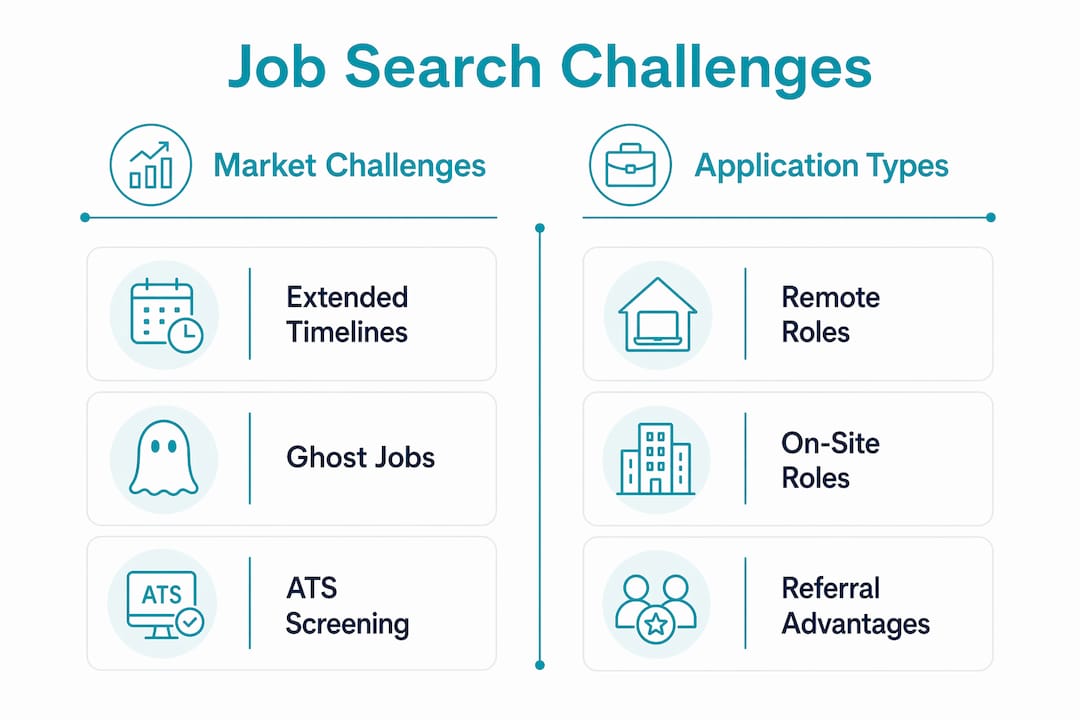
Companies post ghost jobs for several reasons. Some want to build a talent pipeline for future roles. Others leave old listings live because removing them requires internal approvals. Some post to gauge market salary expectations without committing to a hire. None of these reasons benefit you as a job seeker.
The table below compares the three main job channels by their realistic conversion potential.
| Job channel | Estimated conversion rate | Key challenge |
|---|---|---|
| Ghost or inactive listings | Near zero | No active hiring manager reviewing applications |
| Active open market listings | Low to moderate | High applicant volume and ATS filtering |
| Referral or network-based roles | Highest | Requires relationship building before the role opens |
The takeaway is direct. Referral-based opportunities consistently outperform open market applications. Referrals and networking outperform job boards in every measurable way, yet most job seekers spend 80% of their time on boards. Shifting even 30% of your effort toward direct outreach and relationship building changes your results faster than any resume tweak.
Market saturation compounds the ghost job problem. When hundreds of qualified candidates apply to the same listing, even legitimate postings become a numbers game. A role that attracts 400 applicants will realistically interview fewer than 10. Your application needs to clear multiple filters before a human ever reads it.
How does ATS filtering make the job search harder?
Applicant Tracking Systems, commonly called ATS, are the software platforms companies use to screen resumes before a recruiter sees them. Most mid-size and large employers use ATS tools to filter applications by keyword match, formatting compatibility, and role criteria. A resume that does not align with the job description language often gets rejected before any human reviews it.
The fix is specific. A clean, simple resume format optimized with keywords pulled directly from the job description is more likely to pass ATS filtering and reach a recruiter. That means no graphics, no text boxes, no tables inside the resume itself, and no unusual fonts. Standard section headers like “Work Experience” and “Education” are recognized by most ATS platforms. Creative formatting that looks impressive in a PDF often becomes unreadable data to a parser.
Key actions that improve ATS pass rates:
- Mirror the exact language from the job description in your resume, including specific tools, certifications, and role titles
- Use a single-column layout with standard fonts like Arial, Calibri, or Georgia
- Save your resume as a Word document or plain PDF, not an image-based file
- Avoid headers and footers for contact information, since many ATS platforms skip those fields entirely
- Tailor each resume submission rather than sending one generic version to every role
Pro Tip: Paste the job description and your resume into a free keyword comparison tool. Any term that appears multiple times in the posting but not in your resume is a gap. Fill those gaps with honest, specific language before you apply.
AI-assisted screening is now layered on top of traditional ATS at many large employers. These systems score candidates on criteria beyond keyword match, including career trajectory, tenure patterns, and skills adjacency. The result is that even a well-formatted resume can be filtered out if the AI scores your profile below a threshold. Tailoring your resume to each role is no longer optional. It is the baseline requirement.
Remote vs. on-site applications: which is harder to land?
Remote roles are significantly harder to land than on-site positions. Remote-only listings convert at 3.63%, which is 37% lower than on-site listings. That gap exists because remote roles attract a national or global applicant pool, while on-site roles draw from a smaller geographic area.
| Application type | Conversion rate | Primary challenge | Recommended approach |
|---|---|---|---|
| Remote-only | 3.63% | Global competition, high volume | Target niche roles; use referrals |
| On-site or hybrid | Higher than remote | Geographic limits | Emphasize local network and availability |
| Referral-based (any type) | Highest across all | Requires proactive networking | Prioritize warm outreach before applying |
The practical implication is clear. If you are applying exclusively to remote roles, you are competing in the hardest segment of the market. Mixing in hybrid and on-site opportunities, even if remote is your preference, raises your overall conversion rate. Many job seekers limit themselves to remote roles out of habit or convenience, not necessity. Widening your search criteria by even one category can meaningfully increase your interview volume.
What strategies actually work for overcoming job search obstacles?
The most effective shift you can make is moving from volume to precision. Targeted applications tailored to the role convert at double the rate of untailored, high-volume applications. Sending 50 generic resumes produces worse results than sending 10 carefully customized ones.
Five strategies that produce measurable results in 2026:
- Tailor every application. Rewrite your resume summary and bullet points to reflect the specific language and priorities of each job description. Generic resumes fail at the ATS stage before a human ever reads them.
- Prioritize referrals over job boards. Identify five to ten target companies and reach out directly to people in your network who work there. A referral moves your application past the ATS queue entirely at many companies.
- Track lead metrics, not application counts. Tracking coffee chats and referrals is more predictive of success than counting applications submitted. Aim for two to three meaningful conversations per week.
- Structure your search like a part-time job. Treating job searching as 20 to 25 hours per week of focused effort prevents burnout and maintains consistent output. Set daily blocks for applications, outreach, and follow-up.
- Prepare evidence stories for interviews. Only about 27% of interviews convert to offers. Candidates who prepare specific, quantified stories tied to the role’s core challenges convert at a higher rate than those who rely on general answers.
The common thread across all five strategies is intentionality. The job seekers who succeed in this market treat their search as a discipline, not a reaction to frustration.
Key takeaways
The job search is harder now because of structural market conditions, not individual failure. Fixing your approach requires targeting the right channels, formatting for ATS, and treating your search as a disciplined, part-time effort.
| Point | Details |
|---|---|
| Hiring timelines have lengthened | Most roles now take one to two months to fill, increasing uncertainty and offer withdrawal risk. |
| Ghost jobs waste significant effort | Up to 40% of listings are not actively being filled, making job board volume a poor strategy. |
| ATS filters reject before humans review | Tailoring resume language to each job description is the baseline requirement to get seen. |
| Remote roles are harder to land | Remote-only listings convert 37% lower than on-site roles due to global applicant competition. |
| Referrals outperform job boards | Networking and direct outreach consistently produce higher conversion rates than open applications. |
What I’ve learned after 10 years of watching job seekers struggle
The most damaging belief I see in job seekers is that more applications equal more results. It does not. I have worked with executives who sent out 200 applications over three months and got two interviews. I have also worked with professionals who sent 20 targeted applications with warm referrals and landed three offers. The math is not about volume. It is about fit, timing, and trust.
The current market is genuinely harder than it was in 2021 or 2022. That is not an excuse. It is context. When you understand that the system is slow, that ghost jobs exist, and that ATS filters are aggressive, you stop blaming yourself and start adjusting your method. That shift in thinking is where real progress begins.
What I tell every client is this: your job search is a sales process with a long cycle. You are the product, and you need to get in front of the right buyers through the right channels. Cold applications to job boards are cold outreach with a low response rate. Referrals are warm introductions with a much higher close rate. Spend your energy accordingly.
Mental health management is not a soft topic in this context. It is a performance issue. Job seekers who burn out in month two stop following up, stop tailoring, and stop networking. The ones who pace themselves, track their metrics, and celebrate small wins stay in the game long enough to land. Structure your week. Protect your energy. The search will end.
Kim
How Resumewiz helps you get past the filters
Getting your resume in front of a real hiring manager is harder than it has ever been. Resumewiz was built specifically for professionals who are tired of applying and hearing nothing back.

Resumewiz offers ATS-optimized resume writing developed by Kim Taynor, who brings over 10 years of recruiting experience to every engagement. The platform covers tailored resume development, LinkedIn profile optimization, personalized outreach templates, and interview coaching through Elevate. For executives and career changers who need results on a timeline, Resumewiz also offers a fully managed job search with tailored applications and outreach. If your current approach is not producing interviews, a professionally built resume and a clear strategy can help.
Want a recruiter in your corner for your next senior role? Book a free call with Resume Wiz and we will map out your next move together.
FAQ
Why is the job search taking so long in 2026?
Hiring timelines have extended significantly, with most roles now taking one to two months or more to fill. Employer hesitancy, multi-round interview processes, and budget uncertainty all contribute to the delay.
What are ghost jobs and how do I avoid them?
Ghost jobs are listings companies post without active hiring intent, representing up to 40% of all postings. Focus on referral-based opportunities and direct outreach to hiring managers rather than relying solely on job boards.
How does ATS affect my application?
ATS software screens resumes by keyword match and formatting before any human reviews them. Using a clean, single-column format and mirroring the exact language from the job description significantly improves your chances of passing the filter.
Are remote jobs harder to get than on-site jobs?
Remote-only listings convert at 3.63%, which is 37% lower than on-site listings, because they attract a much larger applicant pool. Mixing hybrid and on-site roles into your search raises your overall interview rate.
How many applications should I send per week?
Quality outperforms quantity. Targeted applications tailored to the role convert at double the rate of generic, high-volume submissions. Aim for five to ten carefully customized applications per week rather than dozens of generic ones.
