Why Your Job Search Isn't Working as an Experienced Pro
Why Your Job Search Isn’t Working as an Experienced Pro
A job search not working for experienced professionals almost always traces back to the same root cause: strong qualifications packaged in ways that modern hiring systems and busy recruiters cannot recognize. This disconnect, known in career development circles as a positioning failure, explains why talented directors, veterans, and senior managers send out dozens of applications and hear nothing back. Platforms like LinkedIn and Workday ATS have changed how candidates are found, not just evaluated. If your resume reads like a job description instead of a career story, and if your outreach strategy relies on job boards alone, the problem is not your experience. It is how you are presenting it.
Why your job search is not working: the positioning gap
The first thing most experienced professionals do wrong is treat their resume as a comprehensive record rather than a targeted sales document. Recruiters spend under 10 seconds on initial CV scans, which means your most relevant achievements need to appear immediately and in the exact language employers are searching for. A resume that lists responsibilities instead of outcomes gets filtered out before a human ever reads it.
The positioning gap widens when candidates fail to match their language to the job description. Experienced professionals often use internal titles, proprietary systems, or industry jargon that does not translate to the keywords a recruiter or algorithm is scanning for. The fix is straightforward: pull recurring phrases from five to ten target job postings and weave them naturally into your resume headline, summary, and bullet points. This is not keyword stuffing. It is speaking the employer’s language.
LinkedIn compounds the problem when it is treated as a digital resume rather than a searchable landing page. Your headline should not say “VP of Operations at [Company].” It should say what you do and for whom, such as “Operations Executive | Supply Chain Transformation | $500M+ P&L.” Your About section is your 30-second pitch to a recruiter who found you through search. Every word counts.
What role does ATS play in filtering out qualified candidates?
Applicant Tracking Systems, or ATS, are software platforms that manage and rank incoming applications before a recruiter reviews them. Workday is used by 60% of Fortune 500 companies, and its screening logic can eliminate candidates based on rigid knockout criteria before any human sees the file. The uncomfortable reality is that 8% of firms acknowledge their ATS rejects qualified applicants outright, meaning the system is not neutral.
For experienced professionals, the bias is often indirect. Employment gaps, salary history fields, and non-linear career paths all trigger filters designed for early-career candidates with predictable trajectories. Over 200 resumes arrive for the average job opening, which pushes companies to tighten automated filters rather than loosen them. That volume means even a minor formatting issue, like using a table or text box in your resume, can cause the ATS to misread your content entirely.
One critical misconception is that ATS systems simply match keywords to job descriptions. Modern ATS platforms rank candidates against each other, not just against the job posting. This means your resume competes with every other applicant in the pool, and career pattern markers like consistent progression, recognizable company names, and quantified results carry significant weight. Formatting your resume in a clean, single-column layout with standard section headers like “Experience” and “Education” removes the technical barriers that cause qualified candidates to disappear.
Pro Tip: Run your resume through a free ATS checker before submitting any application. Look for missing keywords, unusual formatting, and section headers that differ from standard labels.
How to communicate your value so employers actually listen
Shifting from a list-based resume to a career story is the single most effective change experienced professionals can make. Each role should answer three questions: What was the situation? What did you do? What was the measurable result? This structure, borrowed from behavioral interviewing frameworks, makes your impact concrete and memorable. “Led a team” becomes “Led a 14-person cross-functional team that reduced supply chain costs by 22% in 18 months.”
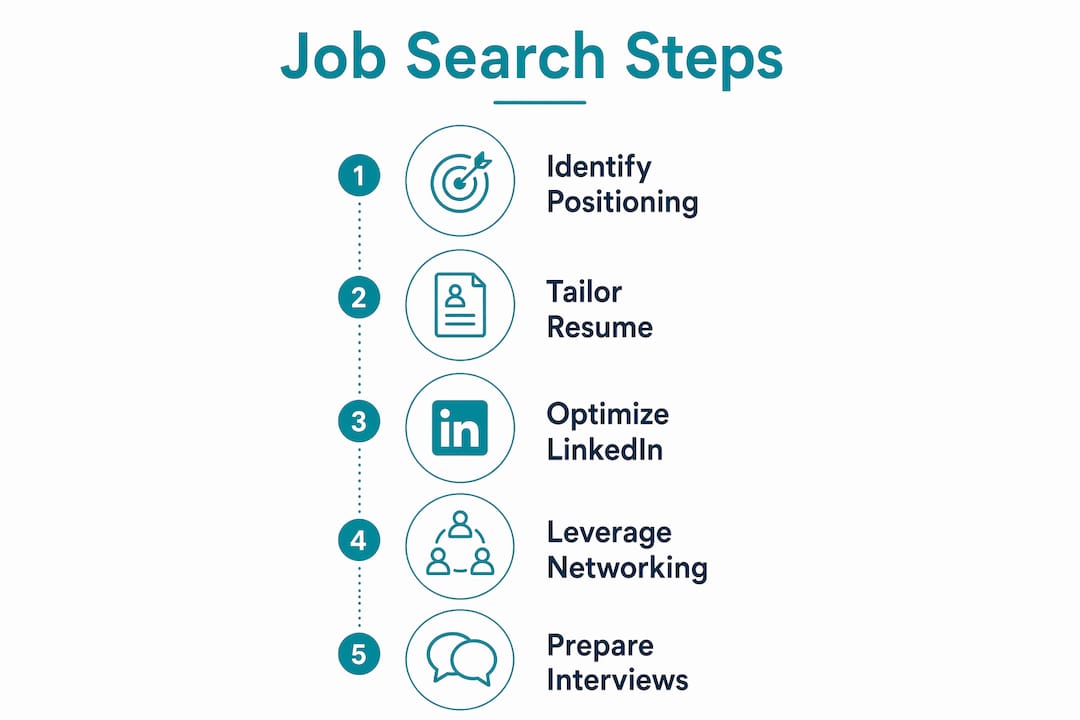
Translating skills into employer search terms is especially critical for veterans making civilian transitions. Military titles like “Battalion Commander” or “Logistics Officer” carry enormous scope but mean little to a civilian hiring manager without context. Map each role to its civilian equivalent by specifying budget managed, headcount led, and operational outcomes delivered. A logistics officer who managed $40M in assets and coordinated 200-person deployments is a senior operations executive. Say that explicitly.
For your LinkedIn profile, treat the headline and About section as prime real estate. The headline drives search visibility, so include your specialty, industry, and a key credential. The About section should open with your strongest career claim, not your job history. Recruiters at companies like Google, Deloitte, and McKinsey use LinkedIn Recruiter to search by keyword, location, and function. If your profile does not contain the terms they are searching, you are invisible to them regardless of your actual qualifications.
Pro Tip: Write a 90-second career summary out loud and record yourself. If you cannot clearly articulate your value proposition in under two minutes, neither can a recruiter advocating for you internally.
Why networking outperforms volume applications for senior candidates
The hidden job market is not a myth. About 70% of roles are never publicly advertised or are filled before a posting goes live. This means the entire strategy of applying to job boards is, at best, a partial approach. For senior professionals, it is often the least effective one.
Target lists of 25 to 40 companies consistently outperform mass applications in generating interviews and offers. The logic is simple: focused outreach to the right people at the right companies produces conversations, and conversations produce opportunities that never appear on LinkedIn Jobs or Indeed. Networking and relationship-building yield better outcomes than volume applying, particularly when you lead with value rather than a request.
Here is a practical framework for networking for experienced professionals:
- Build a target company map of 30 organizations where your background is a strong fit. Include the hiring manager’s name, a relevant contact in the department, and one specific business problem you could solve.
- Reach out with a personalized message that references their work, a recent company announcement, or a shared connection. Ask for a 20-minute conversation, not a job.
- In the conversation, give first. Share a relevant insight, make an introduction, or offer a perspective on their industry challenge. This positions you as a peer, not a petitioner.
- Follow up within a week with a brief note referencing something specific from the conversation. Stay in contact every four to six weeks with a relevant article or update.
- When a role opens, you are already a known quantity. The hiring manager is not reviewing a cold resume. They are considering someone they have already vetted.
This approach takes more time per contact than submitting an application. It also produces a response rate that is five to ten times higher, according to career coaches who specialize in specialist recruitment for experienced professionals.
What unique challenges do veterans face in the job market?
Veterans face a specific set of job search challenges that go beyond the standard positioning problem. One in three veterans are underemployed after leaving the military, and the primary driver is not a lack of skill. It is a late start and a communication gap. The ideal military-to-civilian transition begins 12 months before separation. Most veterans start 60 to 90 days out, which leaves no time to build a network, refine a civilian resume, or research target industries.
The communication gap is equally significant. Veterans undersell their scope and impact due to cultural norms around collective achievement and modesty. In a civilian job search, self-promotion is not bragging. It is a required communication skill. The solution is to translate every military role into civilian metrics: budget managed, personnel led, operational outcomes achieved, and geographic scope of responsibility.
Beyond the search itself, veteran retention is a documented challenge. Structured onboarding, cohort starts, and veteran community connections significantly improve first-year retention rates. Veterans who join companies with formal transition programs stay longer and advance faster. When evaluating offers, ask directly about onboarding structure and whether the company has an employee resource group for veterans. These are not soft benefits. They are predictors of whether the role will actually work.
How to prepare for interviews and salary conversations
Hiring decisions often form within the first seven minutes of an interview. The most effective candidates open with a 90-second career snapshot that answers three questions: who they are professionally, what they have achieved, and why they are the right fit for this specific role. This is not a rehearsed monologue. It is a structured, confident introduction that sets the tone for the entire conversation.
Build a library of six to eight career stories before any interview. Each story should cover a challenge you faced, the specific actions you took, and the measurable outcome you delivered. Use these stories to answer behavioral questions like “Tell me about a time you led through change” or “Describe a situation where you had to influence without authority.” Generic answers lose interviews. Specific, data-backed stories win them.
On compensation, research salary benchmarks using tools like the Bureau of Labor Statistics Occupational Outlook Handbook, LinkedIn Salary, and Glassdoor before any conversation about numbers. When asked about salary expectations early in the process, redirect with confidence: “I want to make sure we are aligned on the scope of the role first. Can you share the budgeted range?” This keeps you from anchoring too low and signals that you understand your market value.
Key takeaways
Experienced professionals lose job searches not from lack of qualifications but from poor positioning, outdated tactics, and underused networks.
| Point | Details |
|---|---|
| ATS filters eliminate before humans review | Format resumes in clean, single-column layouts and match keywords from job postings exactly. |
| Positioning beats credentials | Translate every role into measurable outcomes; recruiters need impact, not responsibilities. |
| The hidden job market is the real market | 70% of roles are never publicly posted; targeted networking at 25 to 40 companies outperforms mass applications. |
| Veterans must start transitions early | Begin 12 months before separation and map military roles to civilian metrics with budget and headcount data. |
| First seven minutes define interview outcomes | Open with a 90-second career snapshot that connects your background directly to the employer’s specific need. |
What I have learned after a decade of watching experienced professionals struggle
After more than ten years placing executives and senior professionals, I can tell you the most common mistake I see is not a bad resume. It is a passive mindset disguised as effort. Sending out 50 applications a week feels productive. It rarely is. The professionals who land roles fastest treat the job search as a structured project with a target list, weekly outreach goals, and a tracking system. They measure what is working and cut what is not.
The second thing I have learned is that storytelling is not a soft skill in a job search. It is the skill. The candidates who get offers are not always the most qualified. They are the ones who can clearly articulate why their specific experience solves the employer’s specific problem. That clarity comes from preparation, not talent.
I am also skeptical of the idea that AI tools like ChatGPT or resume optimization software can replace the hard work of self-positioning. These tools can help you draft and refine, but they cannot tell you which 30 companies are the right fit for your background, or how to frame a career pivot in a way that feels authentic rather than desperate. That thinking has to come from you, ideally with guidance from someone who understands both sides of the hiring table.
If your search has stalled, stop adding volume. Add precision instead.
Kim
How Resumewiz helps experienced professionals get back on track
If your applications are going nowhere, the issue is almost certainly fixable with the right support. Resumewiz was built specifically for executives, managers, and career changers who need more than a template. The platform offers ATS-compliant resume rewrites, LinkedIn profile optimization, and personalized outreach templates designed to get you in front of decision-makers rather than filtered out by software.

Kim Taynor and the Resumewiz team bring over a decade of recruiting experience to every engagement, which means your materials are built to match what hiring managers actually look for. Whether you need a full career search overhaul or targeted coaching on interview preparation and salary negotiation, Resumewiz delivers a structured, results-driven process with a clear, written process and verifiable results. If your job search is not producing results, this is the next step worth taking.
Want a recruiter in your corner for your next senior role? Book a free call with Resume Wiz and we will map out your next move together.
FAQ
Why is my job search not working despite years of experience?
The most common cause is a positioning failure: your resume and LinkedIn profile describe what you did rather than the measurable impact you delivered. Modern ATS platforms and recruiters filter for outcomes, keywords, and career progression markers, not tenure alone.
How does ATS screening affect experienced job seekers differently?
ATS systems like Workday apply knockout criteria that can penalize non-linear career paths, employment gaps, and salary history fields, all of which are more common among senior professionals. Formatting errors also cause ATS to misread content, removing qualified candidates before any human review.
What is the most effective networking strategy for senior professionals?
Build a focused target list of 25 to 40 companies, reach out to specific contacts with personalized messages, and lead with value before making any request. This approach generates response rates five to ten times higher than cold applications to job boards.
How should veterans translate military experience for civilian employers?
Map every military role to civilian equivalents using specific metrics: budget managed, headcount led, and operational outcomes achieved. Starting this process 12 months before separation, rather than 60 to 90 days out, significantly reduces the risk of underemployment.
When should I bring up salary in a job interview?
Delay the compensation conversation until the scope of the role is clearly defined. When asked early, redirect by asking for the budgeted range first. Use data from LinkedIn Salary, Glassdoor, and the Bureau of Labor Statistics to anchor your expectations in market reality.
