Why Your Senior Resume Isn't Working in 2026
Why Your Senior Resume Isn’t Working in 2026
A senior-level resume fails not because you lack qualifications, but because it doesn’t show why you are the obvious choice for that specific role at that specific company. Most executives submit resumes that read like thorough job histories. Hiring managers at the senior level need something different: a focused leadership narrative that proves strategic fit within seconds. The gap between being qualified and being shortlisted is wider than most senior professionals expect. Understanding why your resume isn’t working at senior level is the first step toward fixing it.
Why senior resumes fail to get interviews
The core problem is specificity. Many qualified professionals are passed over because their resumes don’t clearly show why they are the right person for this role and this company. A resume that works for one VP role rarely works for another without meaningful changes. Generic language, vague achievements, and a one-size-fits-all structure are the three most common reasons senior applications stall.
Recruiters at the executive level are not spending time decoding your experience. They are scanning for signals. According to former recruiters cited by the Economic Times, every unanswered question on a resume acts as a negative signal. A title that doesn’t match the scope of your bullet points, a gap with no context, or a role that seems like a step sideways all create what recruiters call “friction.” Friction gets resumes set aside.
The rise of AI-generated resumes has made this worse. When every resume sounds polished and uses the same corporate vocabulary, the ones that stand out are specific, personal, and clear. Recruiters now read with a sharper filter for authenticity. Phrases like “results-oriented leader passionate about driving synergies” no longer earn shortlists. They signal that you didn’t do the work of explaining what you actually did.
What hiring managers really look for in a senior resume
Senior hiring managers are not primarily checking for keyword density or ATS scores. Recruiters at the executive level look for clear scope, accountability separation, and measurable achievements within seconds of reading. That is a fundamentally different evaluation than what happens at the mid-level.
Here is what separates resumes that get calls from those that don’t:
- Scope and scale. Hiring managers want to know the size of the P&L you owned, the headcount you led, and the revenue you influenced. Without those numbers, they cannot calibrate your level.
- Accountability vs. achievement. Your responsibilities tell them what you were hired to do. Your achievements tell them what you actually changed. Both must appear, and they must be distinct.
- Quantified outcomes. In STEM and technical executive roles, specific technical outcomes like cycle time reductions or patent filings carry more weight than broad revenue figures. Domain-specific metrics signal credibility.
- Progression of judgment. Senior hiring managers want to see how your decision-making evolved across roles, not just that your titles got bigger.
- Authentic language. A natural voice describing specific decisions and their outcomes stands out sharply against buzzword-heavy submissions.
Pro Tip: Read your resume out loud. If any sentence sounds like it came from a corporate press release, rewrite it in plain language that describes exactly what you did and what changed because of it.
Common mistakes that cause senior resumes to fail
Most senior professionals make the same errors. These are not formatting problems. They are strategic problems.
-
Listing duties instead of outcomes. Every bullet point must answer three questions: what was the context, what did you do, and what was the measurable result. Recruiters want to know what you changed and what the outcomes were, not what your job description said.
-
Treating the resume as a job history. A senior resume is a leadership narrative, not a chronological record. Executive resumes should present a thesis on how you operate, with the most recent two roles carrying the most weight and earlier roles compressed.
-
Ignoring scope data. Omitting P&L size, team headcount, or revenue figures forces the reader to guess your level. Guessing creates friction. Friction ends applications.
-
Overclaiming personal credit. Saying “I delivered $40M in savings” when you led a team that delivered it signals insecurity. Better framing is “Led the team that delivered $40M in operational savings.” That phrasing shows leadership maturity.
-
Wrong length. The standard for senior professionals is two pages. A third page is only justified by distinct, substantive additions like board roles or governance experience. One page undersells you. Four pages loses the reader.
-
No tailoring. Submitting the same resume to every role is the single most common senior job application issue. Each role has a specific mandate. Your resume must reflect that mandate directly.
Pro Tip: Before you apply, write one sentence that describes the core problem this company needs the person in this role to solve. Then check whether your resume summary addresses that problem directly. If it doesn’t, rewrite the summary before you submit.
How AI is changing what senior resumes need to do
AI resume builders have flooded the market with polished, well-formatted, and completely generic documents. The proliferation of AI in recruiting has made authentic, personal narratives more valuable than ever because generic language now saturates every applicant pool.
This creates a specific challenge for senior professionals. You may use tools like Grammarly or an AI resume builder to clean up your language and check formatting. That is fine. The problem comes when you let those tools replace your voice with corporate filler. A resume that reads as though it was written by a committee is a resume that gets passed over.
What recruiters are now looking for in senior candidates includes:
- Specific decisions, not general responsibilities. “Restructured the North American distribution network, cutting delivery lead time by 22%” beats “Responsible for supply chain optimization” every time.
- Honest context for career moves. Brief, clean explanations of short tenures or gaps build credibility. Omitting them raises questions that kill applications.
- A clear leadership identity. Your resume should make it obvious what kind of leader you are, what environments you thrive in, and what mandate you are seeking next.
The AI resume builder landscape in 2026 is sophisticated enough to help with structure and keyword alignment. Use it for those purposes. Write the substance yourself.
Practical strategies to fix your senior resume now
The following framework addresses the most common failure points in senior resumes. Apply it role by role, not once across all applications.
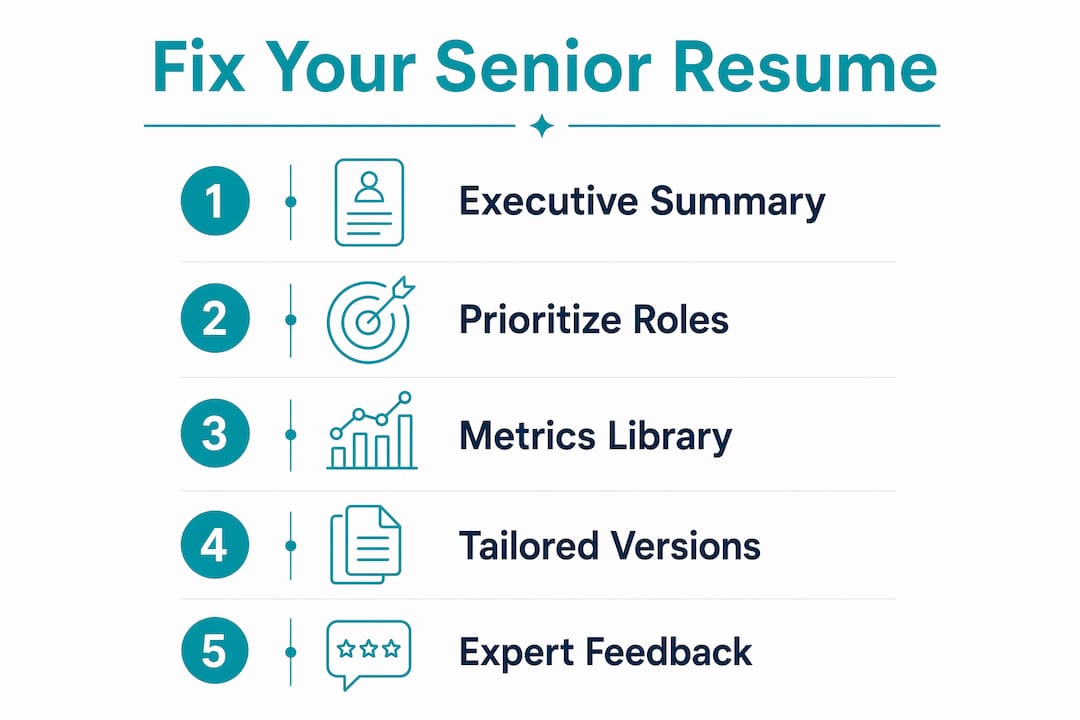
Lead with a real executive summary
Your summary must state the type of leader you are, what you have run, and what mandate you want next. Avoid phrases like “results-oriented strategic leader passionate about driving synergies.” Write something like: “Operations executive with 18 years leading manufacturing P&Ls up to $600M across North America and Europe. Next mandate: VP or SVP Operations in a high-growth industrial business.” That is specific. That earns a second look.
Compress and prioritize ruthlessly
Your last two roles should carry 70% of your resume’s real estate. Earlier roles get two to three lines each, focused on scope and one flagship achievement. This structure signals that you understand what matters at the senior level.
Build a metrics library before you write
List every quantifiable outcome from your career: revenue generated, costs reduced, teams built, projects delivered, patents filed, markets entered. Then match the most relevant metrics to each role you apply for. Quantification should include both commercial and operational KPIs to demonstrate credible domain authority.
| Weak phrasing | Strong phrasing |
|---|---|
| Managed a large sales team | Led 47-person sales team across 6 regions |
| Improved operational efficiency | Reduced manufacturing cycle time by 31% in 18 months |
| Oversaw budget planning | Owned $120M P&L; delivered 14% margin improvement in Year 1 |
| Responsible for product launches | Launched 3 products generating $28M in first-year revenue |
Use multiple tailored versions
Effective senior resumes exist in multiple versions, each emphasizing a different aspect of your background to suit different roles. A CFO candidate targeting a private equity portfolio company needs a different emphasis than the same candidate targeting a public company CFO role. One document cannot do both jobs well.
Pro Tip: Get resume feedback from executives who have recently been through a senior search. They will spot friction points you cannot see yourself because you are too close to your own story.
Key takeaways
Senior resumes fail because they present qualifications instead of a specific, evidence-backed leadership narrative tailored to the role and company.
| Point | Details |
|---|---|
| Specificity beats qualification | Show why you fit this role at this company, not just that you are experienced. |
| Eliminate friction | Every unanswered question on your resume is a reason to set it aside. |
| Quantify with domain metrics | Use financial, operational, and technical KPIs relevant to the specific role. |
| Write a leadership narrative | Focus on your last two roles; compress earlier experience; lead with your mandate. |
| Tailor every version | Maintain multiple resume versions targeting different roles and mandates. |
What I’ve learned after a decade of watching senior resumes fail
I have reviewed thousands of executive resumes over more than ten years in recruiting. The pattern that surprises most senior professionals is this: the resumes that fail are rarely bad. They are just not specific enough to do the job they need to do.
The executives who get shortlisted fastest are not always the most accomplished. They are the ones who can articulate their leadership identity clearly and connect it directly to the problem the hiring company is trying to solve. That takes self-awareness and revision, not just experience.
The other thing I have observed is that senior professionals often resist getting outside feedback. There is a sense that at this level, you should know how to present yourself. But the skills that make you an effective executive are not the same skills that make you an effective resume writer. The best candidates I have seen treat their resume like a business document: they test it, get feedback, and revise it based on what the market tells them.
One more thing worth saying directly. The rise of AI tools has not made resume writing easier for senior candidates. It has made it harder to stand out. If your resume sounds like it could have been written by anyone, it will be treated like it was written by no one. Your specific decisions, your specific results, and your specific leadership voice are the only things that cannot be replicated by a tool.
Kim
How Resumewiz helps senior professionals get shortlisted
If you have read this far and recognize your resume in these patterns, the next step is getting expert eyes on your document.
Resumewiz works specifically with executives, senior managers, and career changers who need more than a template. Kim Taynor and the Resumewiz team bring over ten years of recruiting experience to every engagement, translating your career into a targeted leadership narrative that reduces friction and gets responses. Services include tailored resume development, LinkedIn profile optimization, and a fully managed job search process with tailored applications and outreach. If your resume is qualified but not converting, Resumewiz is built for exactly that problem.
Want a recruiter in your corner for your next senior role? Book a free call with Resume Wiz and we will map out your next move together.
FAQ
Why isn’t my senior resume getting responses?
The most common reason is that your resume shows you are qualified but doesn’t show why you are the right fit for this specific role and company. Recruiters at the senior level set aside resumes that raise unanswered questions about scope, impact, or career progression.
How long should a senior-level resume be?
Two pages is the standard for senior professionals. A third page is only justified by substantive additions like board roles or governance experience. One page undersells your experience at this level.
Should I use AI tools to write my executive resume?
AI tools like Grammarly are useful for formatting and language cleanup. The substance, including your specific decisions, metrics, and leadership narrative, must come from you. Generic AI-generated language is now easy for recruiters to identify and filter out.
What metrics should I include on a senior resume?
Include both commercial metrics such as P&L size, revenue, and cost savings, and operational or technical metrics relevant to your domain. For STEM executives, cycle time reductions, patent filings, and technical KPIs often carry more weight than broad revenue figures alone.
How many versions of my resume should I have?
Senior professionals benefit from maintaining at least two to three tailored versions of their resume, each emphasizing different aspects of their background to match different role mandates and company types.
