Why You're Not Getting Senior-Level Interviews
Why You’re Not Getting Senior-Level Interviews
Senior-level interview silence is defined by a mismatch between how you’re searching and how senior hiring actually works. If you’re asking why am I not getting interviews at senior level, the answer is rarely your qualifications. The real problem is strategy. Over 80% of executive roles are filled before a job posting ever goes live. That means the job board approach that worked at mid-career is now working against you. Tools like LinkedIn, ATS systems, and recruiter networks control the senior hiring funnel, and most candidates don’t know how to use them.
Why applying to job boards alone kills your senior search
Cold applications are the least effective channel for senior professionals. Only about 15% of senior hires come from cold applications to public job boards. That number should stop you cold. It means that for every 100 applications you send through LinkedIn Easy Apply or Indeed, roughly 85 of those roles were already spoken for.
The phantom job problem makes this worse. Ghost jobs account for 18 to 22% of active senior-level listings. These are postings that exist for compliance or pipeline-building purposes, not because a seat is open today. You can spend weeks tailoring applications to roles that were never real.
The math compounds further when you look at finalist selection. 61% of applicants in the $75,000 to $150,000 salary range apply to roles where finalists have already been identified through referrals or recruiter pipelines. The posting is a formality. You are not in the running before you even click submit.
Here is what this means in practice:
- Job boards surface the roles nobody in the network wanted
- Senior postings often exist to satisfy HR compliance, not to find new talent
- Recruiters fill most director and VP roles before the job description is written
- Volume-based applications signal junior-level thinking to senior hiring teams
Pro Tip: Build a target company list of 20 to 30 organizations where you want to work. Reach out to decision-makers there directly, before any role is posted. That proactive contact puts you in the 15% who actually get hired this way.
How does your resume affect senior-level interview rates?
A resume that reads like a job description gets treated like one. Hiring managers screen senior resumes in about six seconds, scanning for evidence that you can solve their current business problems. If your resume lists responsibilities instead of results, it fails that scan.
The most common mistake senior professionals make is treating their resume like a checklist of duties rather than a value proposition. “Managed a team of 12” tells a hiring manager nothing about what changed because of you. “Reduced operational costs by restructuring a 12-person team, saving $2.4M annually” tells them exactly what they need to know.
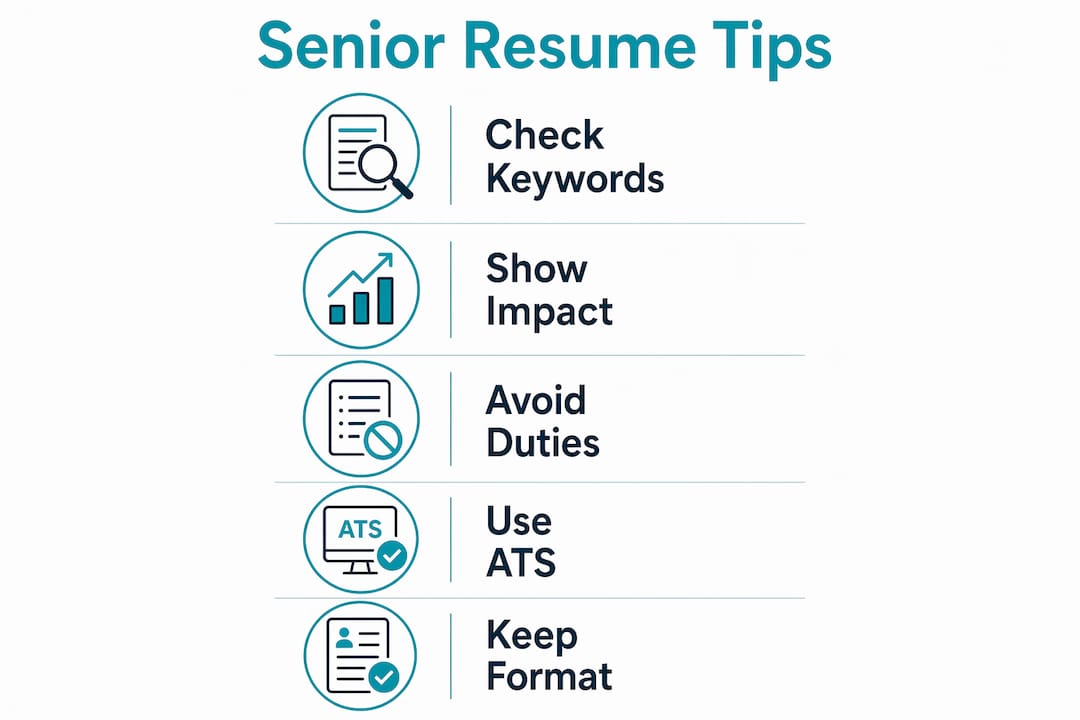
Your LinkedIn profile carries equal weight. LinkedIn profiles must be optimized with outcome-based keywords and industry expertise signals so recruiters can find you. Most senior professionals have profiles that read like a timeline, not a leadership narrative. Recruiters search for specific terms tied to business outcomes, not job titles.
Three resume and LinkedIn fixes that move the needle:
- Replace every duty-based bullet with a result: revenue, cost, time, or risk metric
- Write a LinkedIn summary that names the exact business challenges you solve
- Add a “Core Competencies” section using the keywords that appear in your target job descriptions
- Remove positions older than 15 years unless they are directly relevant to your target role
- Show AI fluency by naming tools you use to drive productivity or decision-making
Pro Tip: Run your resume through an ATS checker like Jobscan before submitting. Senior resumes get filtered by keyword-matching algorithms before a human ever sees them. A strong resume that fails ATS screening never reaches the hiring manager.
Why networking is the actual hiring channel for senior roles
Relationships are the primary hiring mechanism at the senior level. Recruiters focus on risk management, and a candidate introduced through a trusted contact carries far less perceived risk than an unknown applicant. That risk reduction is why referrals dominate senior hiring.
Building relationships before a role opens is the competitive advantage most senior professionals ignore. The professionals who get called first are the ones who stayed visible, engaged, and connected long before they needed a job. Thought leadership on LinkedIn, participation in industry events, and consistent engagement with peers all build the kind of reputation that generates inbound opportunities.
Here is a practical networking sequence for senior professionals:
- Identify 10 target contacts at companies on your target list. These should be peers, former colleagues, or people two levels above your target role.
- Send a direct, specific message that references their work or a shared connection. Ask for a 20-minute conversation, not a job.
- Prepare three talking points about the business challenges you solve. Make the conversation about their world, not your search.
- Follow up with value. Share an article, make an introduction, or comment on their LinkedIn posts. Stay on their radar without asking for anything.
- Engage executive recruiters who specialize in your function and industry. Build those relationships now, not when you are desperate.
- Attend two to three industry events per quarter. In-person credibility accelerates trust faster than digital contact alone.
Pro Tip: Coffee chats are underused by senior professionals who feel they should already know everyone they need to know. A 20-minute conversation with a VP at a target company is worth more than 50 cold applications. Ask for the conversation, not the job.
What mistakes are senior professionals making in interviews?
The most damaging interview mistake at the senior level is lack of role specificity. Candidates who walk in with a generic narrative about their career history signal that they have not done the work to understand what this company needs right now. Hiring teams at the senior level are buying a solution to a specific problem, not a biography.
Overqualification is a real objection, but it is a risk signal, not a compliment. Framing your narrative around specific business challenges you want to solve at this company directly addresses the fear that you will leave in 18 months out of boredom. Acknowledge the concern before they raise it. Tell them exactly why this role and this company are the right fit for where you want to go next.
Four interview pitfalls that cost senior candidates offers:
- No 30-60-90 day plan. Arriving without a clear picture of your first three months signals you have not thought seriously about the role. Prepare one and reference it naturally.
- Talking about past roles instead of future impact. Senior interviewers want to know what you will do, not just what you did.
- Failing to ask sharp questions. Asking about company culture or growth opportunities reads as junior. Ask about the specific business challenge driving this hire.
- Treating the interview as one-directional. Approaching interviews as a bilateral evaluation signals confidence and positions you as a peer, not a supplicant.
How does AI affect your senior job search in 2026?
AI is both a filter and a differentiator in senior hiring. AI screening tools require keyword alignment and specific formatting to pass resumes to human reviewers. A beautifully written resume in a two-column PDF format will fail ATS parsing and disappear. Senior candidates must understand that the first reader of their resume is often an algorithm.
The opportunity side of AI is equally significant. Senior professionals who demonstrate fluency with AI tools in their current roles stand out in interviews. Naming specific tools you use, such as ChatGPT for competitive analysis or Copilot for executive reporting, shows strategic thinking and adaptability. Hiring teams at the director and VP level increasingly want leaders who can guide their teams through AI adoption, not just tolerate it.
Using AI-generated insights in interviews can also demonstrate analytical depth. Walking into an interview with AI-assisted market research about the company’s competitive position signals preparation that most candidates skip entirely.
Pro Tip: Use a clean, single-column resume format saved as a Word document or simple PDF. Fancy design elements like text boxes, graphics, and tables break ATS parsing. Your resume needs to be machine-readable before it can be human-readable.
Key takeaways
Senior professionals who shift from volume applications to targeted relationship-building and outcome-focused positioning dramatically increase their interview rates.
| Point | Details |
|---|---|
| Job boards are not the channel | Over 80% of senior roles are filled before public posting; cold applications yield only 15% of hires. |
| Resumes must show impact | Replace duty-based bullets with quantified results that speak directly to business problems. |
| Networking precedes opportunity | Build relationships before roles open; referrals reduce hiring risk and move you to the front of the line. |
| Interviews are two-way | Arrive with a 30-60-90 day plan and sharp questions that position you as a peer, not a candidate. |
| AI fluency is now a differentiator | Demonstrating how you use AI tools in your current role signals leadership readiness to senior hiring teams. |
What I’ve learned after 10 years of watching senior searches fail
The senior professionals I see struggle most are the ones who are excellent at their jobs and terrible at marketing themselves. They believe their track record should speak for itself. It does not. Hiring managers are not archaeologists. They are not going to dig through your career history to find the gold. You have to put it on the surface.
The other pattern I see constantly is what I call the spray-and-pray approach at the wrong level. Sending 40 applications a week might work at the coordinator level. At the VP level, it signals desperation and a lack of clarity about what you actually want. Hiring teams notice. A focused candidate who applies to 10 roles with precision gets more callbacks than someone who applies to 100 with a generic resume.
The senior job search is a marketing and positioning challenge, not a numbers game. You need a clear target, a sharp value proposition, and relationships in the right rooms. The candidates who get interviews are not always the most qualified. They are the most visible, the most specific, and the most connected. That is a learnable skill set, not a personality trait. You can build it deliberately.
Kim
How Resumewiz helps senior professionals get more interviews
Senior professionals who are not getting interview calls often need more than a resume refresh. They need a complete repositioning of how they show up to hiring teams.

Resumewiz was built specifically for executives, directors, and senior managers who are serious about their next move. Kim Taynor brings over 10 years of recruiting experience to every engagement, which means the resume and LinkedIn profile she builds for you reflects how hiring managers actually think, not how career advice blogs say they think. Services include ATS-compliant resume writing, LinkedIn profile optimization for recruiter discoverability, and personalized outreach templates that open doors before a role is posted. If you are ready to stop sending applications into silence and start getting calls from the right companies, Resumewiz delivers exactly that.
Want a recruiter in your corner for your next senior role? Book a free call with Resume Wiz and we will map out your next move together.
FAQ
Why am I not getting interviews despite strong experience?
Strong experience does not guarantee interviews if your resume lists duties instead of business impact. Most senior candidates are filtered out before a human reviews their application because their resume fails ATS keyword matching or does not clearly demonstrate the value they bring to a specific role.
How many senior roles are filled before they are posted?
Over 80% of executive roles are filled before a public job posting goes live. This means networking and recruiter relationships are far more effective channels than job board applications for senior professionals.
What do employers look for in senior candidates?
Senior hiring teams look for candidates who can solve a specific, current business problem with minimal risk. They prioritize demonstrated outcomes, cultural fit at the leadership level, and evidence that you understand the company’s challenges before you walk in the door.
How can I improve my LinkedIn profile for senior roles?
Optimize your LinkedIn headline and summary with outcome-based keywords tied to the business problems you solve. Recruiters search for specific terms, not job titles, so your profile needs to reflect the language of your target roles rather than your career history.
What is a 30-60-90 day plan and why does it matter?
A 30-60-90 day plan outlines what you will accomplish in your first three months in a new role. Presenting one in a senior interview signals that you have thought seriously about the position and reduces the hiring team’s perception of risk in choosing you.
