
Executive Career Highlights: How to Choose and Write Them
Executive career highlights are the three to six accomplishments that prove you can do the job you are applying for. They are not a list of duties. Each one states the situation you faced, what you did and the measurable result, with enough context (company size, budget, team) that a reader can judge the scale. Place them near the top of page one, then back them up in your experience section.
This guide shows how to choose them for a specific role, how to write each in one or two lines, where to put them and how they differ from your summary. It includes sample highlights for sales, technology, operations, marketing and HR leaders.
Key Takeaways:
- Career highlights are your strongest 3 to 6 results, chosen for the target role, not your whole history.
- Write each one as situation, action, result, and state the scale: revenue, budget, headcount, geography.
- Put them in a short block directly under your summary on page one, so a recruiter sees them in the first scan.
- Keep a baseline resume, then swap highlights to match each job description.
- A highlight without a number or an outcome is a duty. Rewrite it or cut it.
Table of Contents
- What career highlights are, and how they differ from a summary
- How to choose highlights that fit the role
- How to write each highlight
- Example highlights by function
- Where career highlights go on the page
- A worked rewrite
- Perspective: what we see when executives come to us
- Match highlights to LinkedIn and interviews
- When to get help with your highlights
- Checklist before you send
- FAQ
- Sources
What career highlights are, and how they differ from a summary
Your summary tells the reader who you are: your function, your level, your strengths. Your career highlights prove it. The American College of Healthcare Executives says a career summary should cover functional expertise, strengths and notable accomplishments, and align with the job description. In practice, the summary makes the claim in three to five lines, and the highlights are the receipts.
A quick test: if a line could appear on a colleague’s resume unchanged, it belongs in the summary or in a competencies list. If only you can claim it, because it names your project, your numbers and your outcome, it is a career highlight.
If you want a deeper look at the summary itself, we cover it in our guide to the executive resume summary, including a template.
| Executive summary | Career highlights | |
|---|---|---|
| Purpose | Positions you for the role | Proves you can deliver |
| Length | 3 to 5 lines | 3 to 6 bullets, 1 to 2 lines each |
| Content | Scope, strengths, focus | Specific results with numbers |
| Changes per application | Lightly | Often, to match the job |
How to choose highlights that fit the role
Start with the job description, not your history. Robert Half’s advice for executive resumes is to review the posting and tailor the resume to its leadership scope, skills and experience. The U.S. Bureau of Labor Statistics describes a resume as a marketing tool that matches your strengths and accomplishments to specific job requirements. Harvard’s career office says much the same: highlight your strongest assets, differentiate yourself from comparable candidates and tailor to the position.
Here is a practical way to do it.
- Mine the posting. Underline what the employer needs in the first year: turn around a division, enter a market, integrate an acquisition, cut cost, build a team.
- List every result you can claim. Aim for 15 to 20 across your career. Do not edit yet.
- Score each one. Give a point for each of these: it matches a posting priority, it is recent (the last ten years), it is large relative to the company, it has a hard number, it was your decision rather than a team’s.
- Pick the top three to six. Mix types: one growth result, one efficiency or cost result, one people or change result. Boards and CEOs hire executives to handle all three.
- Check the story. Read the highlights in order. Do they say “this person has done exactly what we need”? If not, swap one.
Robert Half also suggests building a strong baseline resume first, capturing your core leadership scope, then tailoring from it. That baseline is where your full list of results lives. Each application then borrows the four or five that fit.
Highlights that rarely earn their place
- Awards with no context (“Top Performer 2019”) unless you state what the award measured.
- Results older than 15 years, unless you have nothing comparable more recently.
- Team results where your role is invisible. Say what you decided or built.
- Responsibilities phrased as achievements (“Responsible for P&L”). Add the size and the outcome.
We go further on which results get noticed in 12 board-ready executive resume achievements.
How to write each highlight
The most reliable structure is Situation, Action, Result. The ACHE guidance recommends the S-A-R model so each accomplishment gives specific context, the actions taken and the resulting impact, starting with an action verb.
In a bullet, the order can flex, but the three parts stay. A formula that works for most executives:
Action verb + what you did + scale + measurable result + timeframe
Compare:
- Weak: Responsible for regional sales strategy and team management.
- Strong: Rebuilt the Midwest sales organization (42 reps, $85M quota) around vertical teams, lifting attainment from 78% to 109% in 18 months.
The strong version tells the reader the size of the team, the size of the number, the change and how fast it happened. The example is illustrative, so replace every figure with your own, verified against your records.
Quantify the right way
The BLS lists the kinds of numbers that show impact: percentages such as sales growth, absolute values such as dollars saved or generated, and performance measures such as reduced cycle times. Use at least one of each type across your highlights, so the block does not read as one repeated trick.
Executives often get stuck because their work is hard to count. Three ways around it:
- Use before and after. If you cannot share absolute revenue, share the change: “cut onboarding time from 90 to 45 days.”
- Use ranges or proxies. “A nine-figure portfolio” or “top-three account in the region” is better than nothing when figures are confidential.
- Estimate honestly. If you must estimate, use a conservative figure and be ready to explain how you got it in an interview.
Always show scale
A 30% gain means something different at a 50-person company and a 5,000-person one. ACHE advises stating organizational size, budget scope and reporting structure so readers can calibrate your level of responsibility. Fold the context into the bullet or the line above it: “CFO, $400M manufacturer, 3 divisions, 6 direct reports.”
Example highlights by function
The examples below are illustrative templates, written by us to show structure and the type of metric each function tends to use. They are not real people or published results. Swap in your own facts.
Sales and revenue leaders
- Launched an enterprise tier and a channel partner program, growing new logo revenue from $12M to $31M in two years while holding gross margin above 70%.
- Replaced a territory model with account-based coverage for 60 strategic accounts, cutting average sales cycle from 9 months to 6.
Typical metrics: quota attainment, pipeline coverage, win rate, sales cycle, net revenue retention.
Technology leaders
- Led migration of 140 applications to the cloud across 4 data centers, reducing infrastructure spend by $3.2M a year with no unplanned downtime.
- Rebuilt engineering delivery into 12 product teams, moving release cadence from quarterly to weekly and cutting critical defects by 40%.
Typical metrics: uptime, cost per transaction, deployment frequency, security incidents, time to market.
Operations leaders
- Consolidated 5 distribution centers into 3, saving $6.5M annually and improving on-time delivery from 91% to 97%.
- Introduced lean practices across 8 plants (1,900 employees), reducing scrap by 22% and lowering unit cost 11% in 24 months.
Typical metrics: unit cost, throughput, on-time in full, inventory turns, safety rate.
Marketing leaders
- Repositioned a 30-year-old brand for a younger segment, lifting qualified leads 55% and cutting cost per lead 28% on a flat $9M budget.
- Built a lifecycle program that increased repeat purchase rate from 22% to 31% in 12 months.
Typical metrics: pipeline contribution, customer acquisition cost, brand awareness, retention, marketing ROI.
HR and people leaders
- Led a culture and retention program for 2,400 employees across 6 states, reducing regretted attrition from 19% to 11% in two years.
- Redesigned the leadership pipeline, filling 70% of director openings internally within 18 months.
Typical metrics: attrition, time to fill, engagement, internal promotion rate, cost per hire.
General management and C-suite
- Turned around a $220M division operating at a loss to an 8% operating margin in 24 months by exiting two product lines and resetting pricing.
- Led the acquisition and integration of three companies, adding $75M in revenue and retaining 90% of key staff.
Typical metrics: revenue, EBITDA or operating margin, enterprise value, shareholder return, successful integrations.
Where career highlights go on the page
Executive resumes typically include a header, a summary, experience, education and sections for accomplishments, competencies or certifications, according to ACHE. Career highlights fit best in one of two places:
- Directly under the summary on page one. This is the strongest position. A hiring manager’s first scan lands there. Label the block “Career Highlights,” “Selected Achievements” or “Leadership Impact.”
- Under each role in your experience section. Use two to four result bullets per job, and keep duties to a single scope line above them.
Most strong executive resumes do both, with no duplication: the top block holds your three to six best results across your career, and each role holds results specific to that job. If a result appears in the top block, rewrite it in the role section or leave it out.
Two cautions on format. Keep the layout simple so applicant tracking systems read it correctly: standard headings, no text boxes, no graphics holding key content. Our ATS-compliant formatting guide shows what to avoid. And match your structure to your level; our overview of executive resume formats explains when chronological or hybrid works best.
A worked rewrite
Here is how one raw entry becomes a career highlight. The figures are illustrative.
Raw: Managed supply chain and vendor relationships for the company.
Questions to ask yourself: How big was the company? How many vendors? What problem existed? What changed? Over what time?
Rewritten: Renegotiated contracts with 35 vendors and moved to dual sourcing for critical components at a $300M manufacturer, saving $4.1M a year and ending two years of stock-outs.
Notice that nothing fancy was added. The rewrite only answers the questions a board member or CEO would ask. If you can answer who, what, how much and what happened next, you have a highlight.
Perspective: what we see when executives come to us
We have spent more than ten years on the recruiting side, and the same pattern shows up in resumes that stall. The candidate has real results, but the resume buries them under responsibilities. A hiring manager gives a resume seconds on the first pass, and the results that would win the interview sit on page two.
Our view is that career highlights are a positioning decision before they are a writing task. You decide which story the reader should take away: the turnaround leader, the growth builder, the integrator. Then you pick the highlights that make that story obvious. Every extra, off-theme result dilutes it.
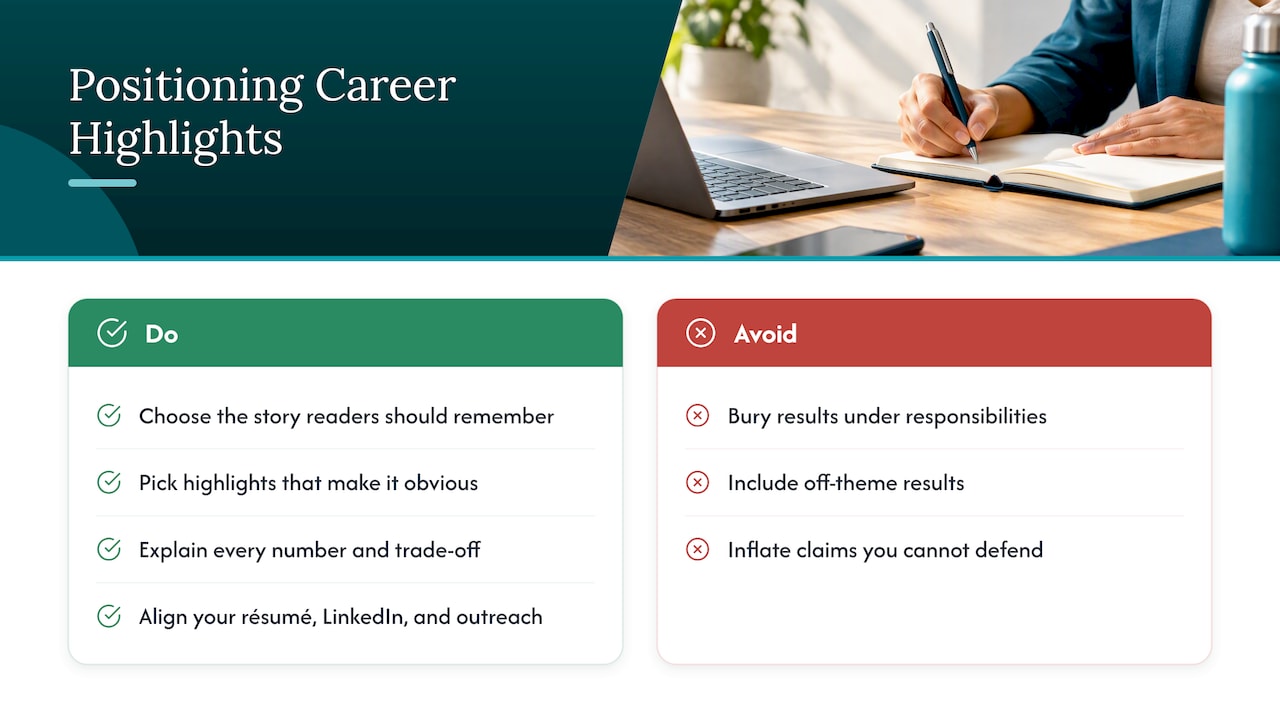
We also push clients to say what happened without inflating it. Hiring managers check, and interviewers will ask you to walk through every number. A highlight you can explain in two minutes, with the trade-offs, is worth more than a bigger claim you cannot defend.
Finally, treat the resume as one part of a search. Strong highlights help, but they need to reach the right people through your LinkedIn profile and direct outreach. That is why we build all three to tell the same story.
Kim
Match highlights to LinkedIn and interviews
Your highlights should not live only on a PDF. Reuse the top three in your LinkedIn About section and in the first line of the relevant job entries. Recruiters search and read there before they open a resume, and a consistent story builds trust.
In interviews, each highlight becomes a story. Because you wrote it as situation, action and result, you already have the structure. Prepare two minutes per highlight: the context, the obstacle, your decision, the outcome and what you would do differently. Add the people you led, since executives are hired for how they get results through others.
If your current resume is not producing interviews, our piece on what to fix first when an executive resume is not getting results is a useful next step. For the full document, see the executive resume writing guide.
When to get help with your highlights
If you want a recruiter to turn your strongest results into clear positioning, Evolution includes an executive resume, LinkedIn profile and cover letter for $699.
Checklist before you send
- Do you have three to six highlights, each tied to the job posting?
- Does every highlight carry a number, a scale and an outcome?
- Do the highlights mix growth, efficiency and people results?
- Are they on page one, directly under the summary?
- Does each start with a different strong action verb?
- Can you explain every figure in two minutes, and does the number match your records?
- Does your LinkedIn profile tell the same story?
Want a recruiter in your corner for your next senior role? Book a free call with Resume Wiz and we will map out your next move together.
FAQ
What are examples of career highlights?
A good example reads like this: “Turned around a $220M division from loss to an 8% operating margin in 24 months by exiting two product lines and resetting pricing.” It names the scale, the action and the result. The function-specific examples above show how the same pattern works for sales, technology, operations, marketing and HR.
How many career highlights should an executive resume have?
Three to six is the usual range. Fewer than three can look thin, and more than six dilutes the ones that matter. Keep each to one or two lines so the block fits in the top third of page one.
Are career highlights the same as an executive summary?
No. The summary positions you in a few lines, covering your function, strengths and focus. The highlights are the proof: specific, quantified results. Many strong resumes put the summary first and the highlights right below it.
What if my results are confidential or hard to quantify?
Use relative figures such as percentage change, before-and-after comparisons, or ranges, and describe scale by proxies like team size or number of locations. BLS guidance on quantifying results includes percentages, dollar values and performance measures, and any of the three can work without revealing sensitive absolutes. Never invent a number; be ready to explain each one.
Sources
- American College of Healthcare Executives: resume and interview tips
- Robert Half: how to create a captivating executive-level resume
- U.S. Bureau of Labor Statistics: résumés, applications, and cover letters (2009)
- U.S. Bureau of Labor Statistics: resumes, applications, and cover letters (1999)
- Harvard College guide to creating a strong resume
