Salary Expectations Answer for Executives: Scripts and Ranges
The best salary expectations answer for an executive is a researched range for base pay, given after you understand the role, and framed inside total compensation. If you can get the employer’s budget first, do that. If they will not share it, give a range whose bottom is a number you would truly accept, and say you are flexible on the package. The rest of this guide shows how to build that range, what to say at each stage, and what to do when the number comes back low.
Key Takeaways:
- Build three private numbers before any call: the minimum you would accept, a fair target, and a stretch figure. Share a range that runs from roughly target to stretch.
- Ask for the budgeted range first. If you must answer, give a tight base-salary range and name total compensation as the real conversation.
- Early screens test fit with the budget; final rounds are where money is actually discussed. Do not wait for the written offer to raise it.
- Never anchor on your current pay. Anchor on market data for the role, company size and location.
- If the range is low, evaluate the whole package (bonus, equity, severance, signing terms) before you say no.
Table of Contents
- Why employers ask, and when the question comes
- Build your range before anyone asks
- What to say at each stage
- Scripts for common situations
- Talk total compensation, not just base
- If the offered range is below your expectations
- Mistakes that cost executives money
- Perspective: what we see from the recruiter’s side
- Where we can help
- FAQ
- Sources
Why employers ask, and when the question comes
The question is a screening tool. According to Indeed’s guidance for employers, asking early saves time, helps benchmark pay ranges and supports consistency across candidates, and the company recommends asking during an application or phone screen and asking for a range rather than one number. In other words, the recruiter is checking whether you fit the budget before anyone spends a week of calendar time on you.
For executives, the question tends to show up at three points:
- The application form. A required salary field, often numeric.
- The recruiter or search-firm screen. Usually the first live ask, and the one most executives handle badly because it feels casual.
- The final rounds. UCLA’s career center notes that final-round interviews are typically when candidates talk money, and says you should know the market rate, what you would accept, and which benefits could offset lower pay.
Formal negotiation begins after an offer, according to Indeed’s compensation guidance. Everything before that is positioning. What you say at the screen sets the frame for what you can ask for later, which is why the answer deserves preparation rather than improvisation.
Build your range before anyone asks
Set three private numbers
Harvard’s Faculty of Arts and Sciences career office recommends separating three figures: the minimum you need to accept, a fair target for the role and market, and the highest amount you could reasonably expect. The range you communicate often runs from target to ideal. Keep the minimum to yourself, but make sure it is not far below the bottom of what you say aloud. Robert Half’s U.S. guidance says the low end of your range should still be an amount you would accept.
The CNBC piece on this question makes the same point from the executive side: the credible range puts the genuine minimum at the bottom, keeps the target toward the lower end, and sets a ceiling that leaves room to negotiate.
Research the market with more than one source
Binghamton University’s negotiation guide suggests filtering salary data by experience, geography, education and industry and treating roughly the 25th to 75th percentile as a broad working range. Harvard adds organization size, financial health and regional cost of living. Indeed’s list is longer still: leadership scope, seniority, certifications, local labor conditions, and supply and demand.
For executives, published salary pages are only a starting point. Pay at this level is built from base, annual bonus, long-term incentives, equity and severance terms, and public data rarely captures those. Talk to two or three peers, a retained recruiter in your function, and anyone who has recently joined a comparable company. Our piece on why executive compensation differs from mid-level pay covers the structural reasons your base number is only part of the picture.
Do not anchor on what you earn now
Robert Half’s guidance says your range should reflect current market pay, location, experience, skills and qualifications, not merely current or prior salary. The reason is practical. The New York State Department of Labor warns that employers may base future pay on current or previous salary, so an underpaid worker can stay underpaid. Many states restrict salary-history questions, but whether or not the question is legal where you live, your answer should be about the role’s value.
How wide should the range be?
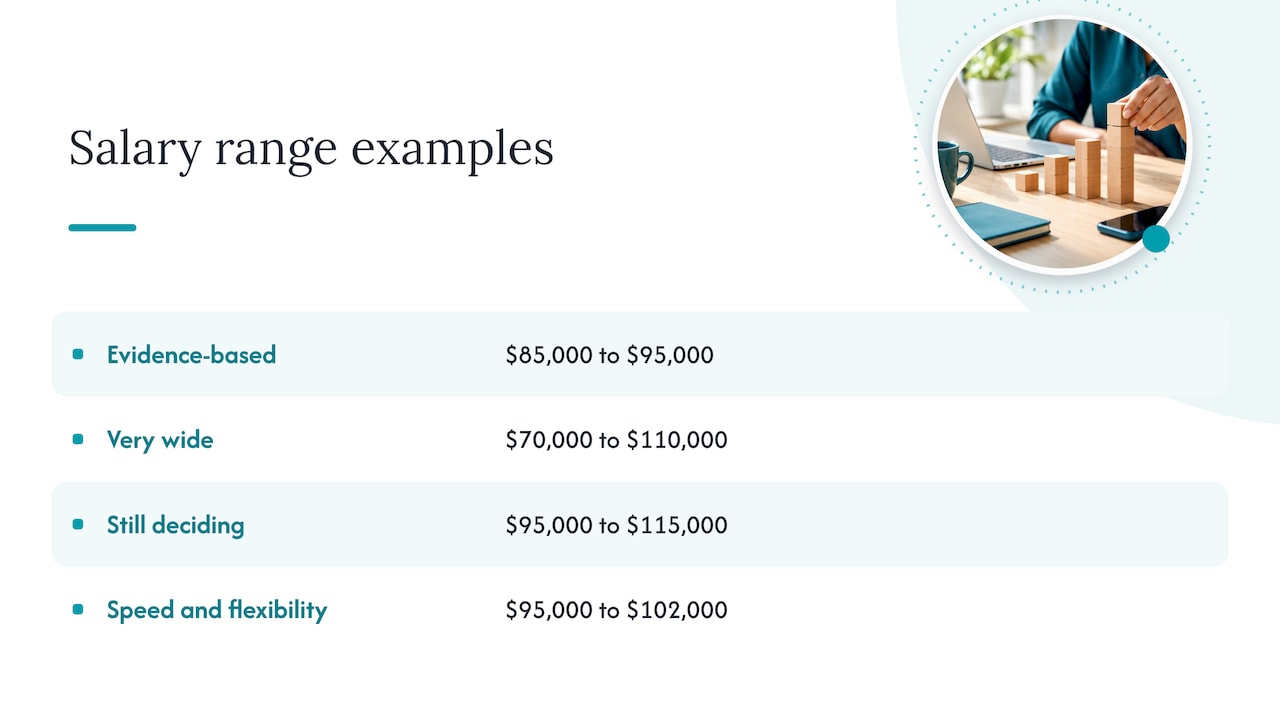
Width signals confidence. Robert Half’s view is that a tight, evidence-based range reads as market knowledge, while a very wide one suggests guessing. Its example contrasts a deliberate $85,000 to $95,000 with a broad $70,000 to $110,000. Indeed commonly illustrates a spread of $5,000 to $10,000, and Coursera’s examples sit at or below $10,000.
CNBC adds the useful nuance that width should reflect your leverage. Someone targeting $100,000 might say $95,000 to $115,000 while still deciding whether they like the job, or a tighter $95,000 to $102,000 when speed and flexibility on base pay matter more. At executive base levels, a spread of about 8 to 12 percent of the midpoint is a sensible way to scale the same logic, though that proportion is our rule of thumb rather than a published standard.
What to say at each stage
On the application form
If the field accepts text, enter “Negotiable” or “Open, based on total compensation.” If it forces a number, use the middle of your researched range and make sure it sits above your minimum. If the posting lists a range, work from it: Indeed advises referring to a posted range when one is available.
In the recruiter screen
Start by asking for the budget. CNBC, citing a recruiter, recommends asking the employer for the range instead of volunteering a number first, in language that acknowledges compensation has to work for both sides:
“I appreciate that compensation needs to work for both sides. What salary range has the company budgeted for this position?”
If they push back, defer until you know more. U.S. News advises delaying a figure in the early process and saying you want to learn more about responsibilities, the company and benefits before giving an informed number. An executive version:
“I’d like to understand the scope first: reporting line, team size, and what success looks like in year one. Then I can give you a range that’s grounded. Can we come back to it after that?”
If they still need a number, give the range. Indeed’s example for a senior-level answer is a base range such as $120,000 to $130,000 while staying open on how salary, benefits, bonus, equity and other terms fit together. Adapt it to your market:
“Based on the scope you’ve described and what I’m seeing for comparable roles, I’m looking at a base between $X and $Y, and I’m open to discussing how bonus and equity fit into the total package.”
Swap in your own figures. U.S. News offers a flexible variant for when the employer will not disclose its range: a researched, relatively strong range paired with an explicit statement that you are open to hearing their budget.
In final-round interviews
By this point you have leverage you did not have at the screen: the team wants you. Revisit the number with what you have learned about scope, headcount and the problems you would solve. UCLA’s guidance is to decide in advance what is negotiable and what minimum offer would be acceptable. At the executive level, that list usually includes base, target bonus, sign-on, equity, severance and start date. If you are heading into this conversation, our recruiter-backed guide to executive interview questions shows how to prepare the stories that justify the upper end of your range.
Scripts for common situations
| Situation | What to say |
|---|---|
| Asked before you know the role | “I’d like to learn more about the scope before naming a number. What range have you budgeted?” |
| Employer will not share the range | “I’m looking for a base between $X and $Y, depending on scope and the total package. I’m flexible.” |
| Several rounds with no clarity | “We’ve covered a lot of ground. Can you tell me what’s been allocated for the right person?” |
| Asked about current pay | “I’d rather focus on what the role is worth in this market. My range for this position is $X to $Y.” |
| Pressed to choose one figure | “If the scope matches what we’ve discussed, $Z base would be a fair number, with room to talk about bonus and equity.” |
The third row comes from Indeed’s interviewing guidance, which says candidates can ask what salary has been allocated for the right person if several interviews have passed without clarity.
Talk total compensation, not just base
U.S. News advises discussing total compensation: bonus, health insurance, retirement benefits, advancement and other meaningful benefits. For executives that frame is not optional. A lower base may be offset by other compensation, but a target bonus is not the same as earned pay. Compare payout conditions and downside risk, not only headline amounts.
So when you state a base range, add one sentence that opens the rest of the package. If the base is firm and low, shift the conversation to variable pay and protections. Our guides on signing bonuses and better clawbacks and on the two-to-four-week window for C-suite compensation negotiation go deeper on those levers.
If the offered range is below your expectations
Do not treat the first number as a verdict. UCLA’s perspective is that executive-level candidates should evaluate the entire offer rather than using base salary as the only measure of fairness. A practical sequence:
- Confirm what is fixed. Ask whether the range is a hard band for the level or whether scope, title or location could move it.
- Price the rest. Put bonus target, equity, retirement match, severance and sign-on beside the base in one view.
- Make one clear ask. Name the number and the reason, tied to market evidence and the results you will deliver.
- Know your walk-away. This is the minimum you set at the start. If the package falls below it even after negotiating, decline politely and keep the relationship.
When you reach the written-offer stage, the counter offer email scripts on our site give you wording for one clear ask.
Mistakes that cost executives money
Indeed’s 2026 interview guidance flags three: being the first to disclose a specific number, waiting until the final offer to discuss compensation, and focusing only on base pay. Add a fourth from experience: giving a range whose bottom is a number you would reject. The recruiter will hear the bottom, and so will the hiring manager.
A fifth is quieter. Executives often answer in a rush because the question arrives in a friendly, informal moment. Prepare the one-sentence deferral and the one-sentence range ahead of time, and say them in the same calm tone you would use for any other business answer.
Perspective: what we see from the recruiter’s side
Kim Taynor, our founder, has more than ten years of recruiting experience, and our view comes from that side of the table. When a recruiter asks for a number early, they are rarely trying to trap you. They are filtering against a budget they have been given, and the candidates who handle it best sound like they have run this process before: calm, specific and curious about the scope.
We also see strong candidates undersell themselves because their resume and LinkedIn profile do not show the scale of what they have led. A range is easier to defend when your documents make the case for it. That is why we treat compensation as part of the whole search, not a separate event at the end: the positioning, the outreach, the interviews and the money conversation all feed one another.
One habit we push clients toward: write your three numbers on paper before the first call, and say the range out loud twice. It sounds small. It is the difference between sounding certain and sounding like you are negotiating against yourself.
Where we can help
Resume Wiz offers Elevate, one-on-one executive job search coaching, for senior professionals who want help with positioning, interview preparation, and their search strategy.
Want a recruiter in your corner for your next senior role? Book a free call with Resume Wiz and we will map out your next move together.
FAQ
Should an executive ever give a single number?
Usually a range is better. Indeed and Coursera both recommend ranges over a single figure. If you are pressed for one, give the figure that would be fair for the scope discussed and say that the package, not only base, will decide your answer.
What is a good example answer?
U.S. News offers: “I’m looking for something in the $85,000 to $100,000 range, but this could change based on what I learn about the role.” For an executive, replace the figures with your researched base range and add a line about bonus and equity.
Is it okay to say I’d rather not discuss salary yet?
Yes, once, politely, and with a reason. Say you want to understand responsibilities and the company first, then ask for the budgeted range. If the recruiter insists, give your range rather than refusing, since a flat refusal can end the process early.
When should I bring up compensation if the employer has not?
Do not wait for the final offer. If you have had several interviews without clarity, ask what has been allocated for the right person. That keeps you from investing weeks in a role whose budget does not fit.
Sources
- How and When To Ask a Job Candidate About Their Salary Expectations (Indeed)
- How to Discuss Total Compensation Expectations (Indeed)
- Interview Question: What Are Your Salary Expectations? (Indeed)
- How to Prepare For A Final Interview With Senior Management (UCLA Career Center)
- HES: Evaluating and Negotiating Job Offers (Harvard FAS)
- A Practical Guide to Professional Negotiation (Binghamton University)
- How to answer What are your salary expectations? (CNBC)
- How to answer What are your salary expectations? (Robert Half)
- How to Answer Salary Expectations Questions in an Interview (Coursera)
- The Best Ways to Answer What Are Your Salary Expectations (U.S. News)
- Salary Negotiation Guide (New York State Department of Labor)
