Career Change Interview for Executives: How to Win the Room
An executive career change interview comes down to one job: make the move look like the obvious next step for your career, not a gamble the board has to underwrite. You do that with a short narrative about what you are moving toward, proof that your leadership transfers, and calm, specific answers to the doubts the panel will have. This guide walks through each of them.
Key Takeaways:
- Lead with what pulls you toward the new field, not what pushes you out of the old one.
- Translate your record into structural parallels: value creation, stakeholder complexity, operational levers. Skip industry jargon.
- Name the interviewer’s doubts (“can she ramp up fast enough?”) before they do, and answer each with evidence.
- Do board-level homework on the company, so you meet the panel as a peer and not as a candidate being tested.
- Prepare six to eight outcome stories and rehearse them out loud until they sound like you.
Table of Contents
- Why a career change is harder at the executive level
- Build your narrative: pull, path, plan
- Translate your experience, not just your titles
- The questions you should expect, and how to answer them
- Explaining departures, short stints and gaps
- Prepare like a board member, not a job applicant
- Use the 5 C’s as a checklist
- Red flags that sink career changers
- Perspective: what we see from the recruiting side
- Practice before it counts
- Get help where it pays off
- FAQ
- Sources
Why a career change is harder at the executive level
At the entry level, a pivot is a story about potential. At the executive level, it is a story about risk. The company is not hiring you to learn the business. It is hiring you to make decisions that move revenue, margin, people and reputation, usually within the first year.
That changes what interviewers listen for. Career change interview prep guides group the questions into seven themes: why the change, why now, why this role, what transfers, what is missing, how you will ramp up and the long-term rationale. Executives get all seven, plus a probing layer on judgment and fit.
The good news is that senior hiring is also more forgiving of a non-linear path. A pivot can read as adaptability and strategic maturity when you frame it well. The rest of this article is about framing it well.
Build your narrative: pull, path, plan
Your first answer sets the tone for the whole conversation. A useful structure is the Pull-Path-Plan frame described in this career change prep guide:
- Pull: what draws you to the new field or function.
- Path: the concrete steps you have already taken, such as board seats, advisory work, certifications, or conversations with leaders in the sector.
- Plan: what you intend to accomplish in the role.
The same source notes that candidates who only explain why they are leaving the old field signal possible instability. A narrative built on escape sounds like a fallback. A narrative built on direction sounds like a decision.
A worked example
Say you are a COO in industrial distribution moving into healthcare operations. A weak answer: “I’m tired of thin margins and I wanted something more meaningful.” A stronger one:
“For eleven years I’ve run multi-site operations where the lever was throughput and working capital. What draws me to healthcare operations is that the same levers decide whether patients get seen on time. Over the last year I’ve joined a hospital foundation board and spent time with two regional operations leaders to learn where the real constraints are. In this role, my first ninety days would go to scheduling and supply flow, because that’s where I’ve delivered the biggest gains before.”
Notice what it leaves out: no complaint about the old industry, no apology, no vague passion. Each sentence either shows direction or shows proof. The details are placeholders for you to replace with your own, and every claim in your version must be true and checkable, because panels check.
Translate your experience, not just your titles
The most common error, according to a Forbes Coaches Council piece on executive reinvention, is failing to reframe experience in terms the new audience cares about. Sector continuity is not your argument, since you don’t have it. Your argument is the ability to drive results, lead teams and solve complex problems.
The same article gives a clear contrast. “Managed 1,000 employees” says little to someone outside your industry. Leading cross-functional teams across multiple regions to a 20% increase in profitability says a lot to anyone.
Find the structural parallels
Hiring managers evaluate leadership portability. Mary Taylor & Associates describes the strongest narratives as those built on structural parallels, such as value creation models, stakeholder complexity or operational levers, instead of role-specific or industry-specific experience. Try this exercise before any interview:
- List your five largest results in plain numbers: revenue, cost, headcount, speed, risk.
- For each, write the lever you pulled (pricing, process, talent, partnerships, capital allocation).
- Write where that same lever exists in the target business.
- Cut every acronym a stranger would not know.
If you want a deeper walkthrough, our guide on how to reframe your experience for a new field covers the translation step by step. The documents that get you into the room matter too: see why career changers need a different resume strategy and these career change resume examples.
The questions you should expect, and how to answer them
| Question | What the panel is really testing | How to answer |
|---|---|---|
| Why this change, and why now? | Commitment and judgment | Pull, path, plan. One timeline, no complaints. |
| What do you not know yet? | Self-awareness | Name one or two real gaps and the specific way you will close them in the first 90 days. |
| How will you earn credibility with a team that knows the industry? | Leadership portability | Describe how you entered a new context before, and what you did in the first month. |
| Will you stay? | Retention risk | Point to your tenure record and the investment you have already made in the field. |
| What compensation do you expect? | Realism | Anchor on scope and market data, and stay flexible on structure. |
“What are you missing?”
Do not pretend there is no gap. Name it, size it, and show the plan. “I haven’t managed a regulated product line. I’ve worked beside our compliance function for six years, and I’d spend my first weeks with your head of quality before I changed anything.” That answer shows learning agility, which interviewers value more than a flawless record.
“Why should we take the risk on you?”
The question is often unspoken, so say it yourself: “You may be wondering how quickly someone from outside the sector can add value. Here’s what I’d deliver in the first six months, and here’s the precedent.” Naming a concern yourself takes away its power. Ivy Exec’s advice on addressing career change concerns makes the same basic points: be open about your motivation, talk through your transferable skills and confront worries about your work experience directly.
Failure and feedback questions
Pick a real failure, own it without hedging, and describe what you changed afterward. Expect a probe like “What feedback have you heard most consistently in your career?” Generic answers fail here. Use feedback you actually received, and say what you did about it. Our six-story method in recruiter-backed executive interview questions shows how to build these answers.
Explaining departures, short stints and gaps
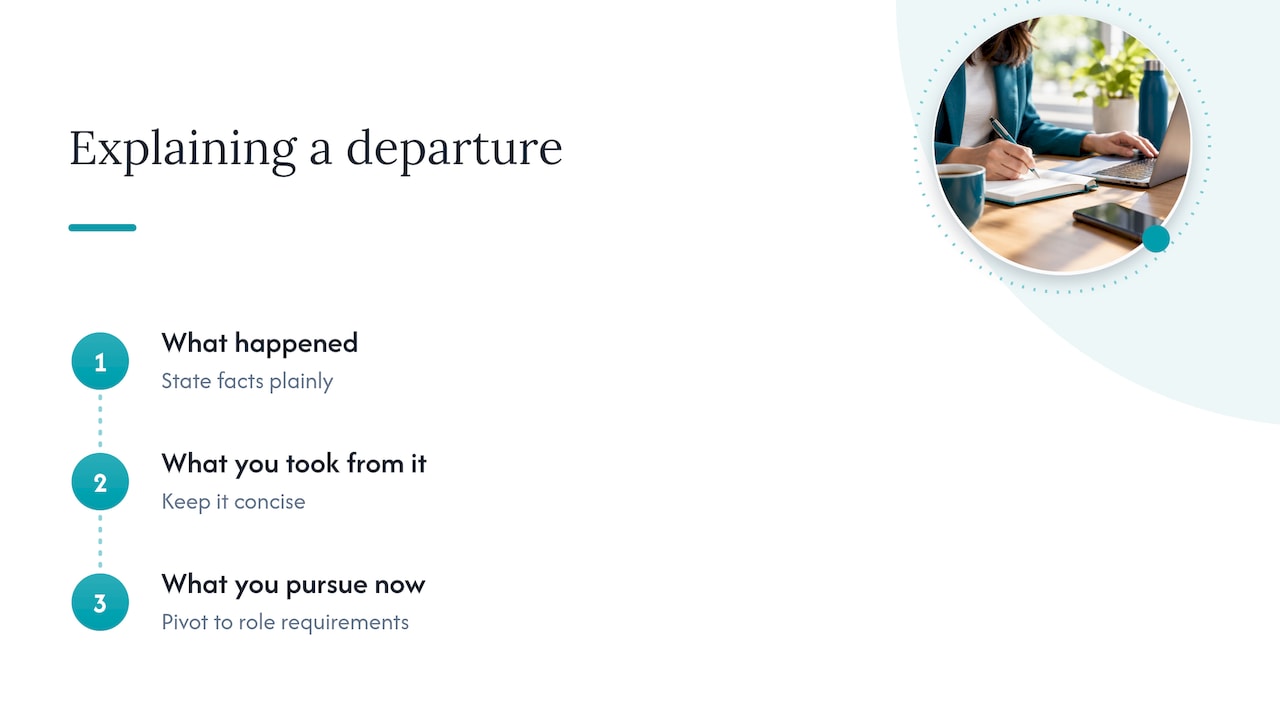
Career changers often carry a restructuring, a short tenure or a pause between roles. State the facts plainly, say nothing negative about the former employer, and pivot at once to what the new role requires. Boards and recruiters treat this as a test of judgment and discretion. Kerry Consulting’s guidance on career gaps and short tenures notes that hiring managers and boards want reassurance about stability and clarity in senior candidates.
A workable pattern is three sentences: what happened, what you took from it, and what you are now pursuing. Then stop talking. Over-explaining reads as defensiveness.
Prepare like a board member, not a job applicant
Senior candidates stand out when they diagnose the business before they pitch. Before the interview, find out:
- The company’s financial position: growth, margins, funding, debt.
- Why the role is open now, and what was happening before it opened.
- Who is on the leadership team and who you would report to.
- What the strategic mandate for the role is.
When you ask informed questions on those points, the conversation shifts from interrogation to exchange between peers. For a career changer this does double duty: it shows the diligence of someone who has already invested in the new field. Our overview of what hiring managers look for in executives explains what sits behind that evaluation.
Use LinkedIn to do the groundwork
Before the interview, your profile should already tell the new-field story. A headline and summary that still describe your old industry will undercut your narrative. We cover this in the role of LinkedIn during an industry switch.
Use the 5 C’s as a checklist
The popular 5 C’s of interviewing are confidence, competence, communication, culture fit and career direction. They work well as a self-audit for a career change, because the last one is exactly where you are exposed:
- Competence: do your stories show results in terms the new field understands?
- Confidence: can you handle a challenge without getting defensive?
- Communication: can you explain a complex decision in two minutes?
- Culture fit: can you describe how you decide and how you handle change, not just what you have done?
- Career direction: does the move make sense for your trajectory?
The culture fit item deserves attention. A study of why executive hires fail in the first 18 months argues that failures are rarely about technical skill. They often come from assessment methods that measure capability but not whether values and operating style fit the organization. Expect more questions about how you make decisions, since that is what interviewers are trying to learn. Give them concrete examples of how you decide under uncertainty and how you lead through change.
Red flags that sink career changers
Executive interviewers watch for a short list of warning signs. JRG Partners lists externalizing blame for past failures, defensiveness when claims are tested, generic self-awareness answers such as “I work too hard,” and a mismatch between how you describe yourself and what references say.
For career changers, add three of your own to avoid:
- Over-apologizing. Treating the pivot as a flaw invites the panel to treat it as one.
- Bluffing domain knowledge. One wrong term costs more than saying “I’m still learning that area.”
- Criticizing your old industry. It signals that your move is an escape.
Because references matter, brief them. Tell each reference what role you are pursuing and the story you are telling, so their account matches yours.
Perspective: what we see from the recruiting side
We built Resume Wiz on more than ten years of recruiting experience, and the same pattern shows up repeatedly with career changers. Candidates rarely lose because they lack capability. They lose because the first ten minutes of the conversation fail to resolve one question in the interviewer's mind: "Is this person a safe bet?"
You resolve that question by making the story easy to repeat. The hiring manager has to retell your story to colleagues who were not in the room. If it takes three paragraphs to explain why a logistics executive is suited to a software company, it will not be retold. If it takes one sentence, it will.
That is why we start with the documents and the narrative, not with interview tricks. Your resume, your LinkedIn profile and your spoken answer should all say the same thing in the same order. When a recruiter reads your resume, visits your profile and then hears your answer, any contradiction becomes the thing they remember.
The second thing we see is that executives under-prepare for the “what’s missing” question because it feels uncomfortable. The candidates who practice it aloud, to someone who will push back, almost always become the most credible people in the room.
Kim
Practice before it counts
Rehearse with a colleague who will interrupt you. Executive panels do, and a rehearsed monologue falls apart at the first follow-up. Build a bank of six to eight stories that each show a different capability: turnaround, growth, change leadership, a hard people decision, a failure, a cross-functional win. Our guides on outcome stories for executive panel interviews and leadership style answers using STAR show how to structure them.
Then run this final check on each story:
- Does it open with the situation in a sentence or two?
- Is there a number somewhere (revenue, savings, people, time)?
- Does it name a decision you made, not just what “we” did?
- Can you tell it in under two minutes?
- Does a listener from another industry understand it without a glossary?
If you also want to be positioned for the next level rather than just the next job, read how to position yourself for executive roles in 2026.
Get help where it pays off
If you want a second pair of eyes, we offer a few ways to work together, depending on how much support you need:
- Elevate suits you if you mainly need interview preparation.
- Evolution is $699 and covers your resume and LinkedIn profile, so your story is consistent before you start applying.
- Elevate is our fuller engagement. See the page for current pricing.
If you want us to run the search for you, see Elevate and Land. See the page for current pricing.
Practice out loud before the real thing. Try Recruiter Graded, the Resume Wiz interview simulator. Answer real interview questions by voice and get a recruiter style grade with feedback on every answer. Free to start.
Want a recruiter in your corner for your next senior role? Book a free call with Resume Wiz and we will map out your next move together.
FAQ
What should I say in an interview about my career change?
Give a short narrative: what draws you to the new field, what you have already done to prepare, and what you plan to achieve in the role. Back it with one or two results that translate across industries. Do not spend your answer explaining why you are leaving the old one.
How do I explain a career switch without sounding unstable?
Show a deliberate path. Describe the steps you took before applying, such as conversations with leaders, board or advisory work, or study. Keep it forward-looking, and stay neutral about your previous employer. Consistency between your resume, LinkedIn profile and spoken story also helps.
What are the 5 C’s of interviewing?
Versions vary, but a common one is confidence, competence, communication, culture fit and career direction, as laid out in this guide. For career changers, career direction is the one to prepare most carefully.
What is the biggest red flag in an executive interview?
Blaming others for past failures is among the most cited. Others include defensiveness under questioning and generic answers about your weaknesses, according to JRG Partners. Owning a real mistake and explaining what you changed does the opposite.
Sources
- Career Change Interview Prep with AI (Recruiter’s Guide)
- Navigating Your Executive Reinvention (Forbes Coaches Council)
- Positioning Career Transitions in Interviews (Mary Taylor & Associates)
- How to Address Concerns About a Career Change During an Interview (Ivy Exec)
- Explaining Career Gaps and Short Tenures at the Senior Level (Kerry Consulting)
- The 5 C’s of Interviewing (Resumly)
- Why Executive Hires Fail in the First 18 Months (KiTalent)
- Red Flags in Executive Candidates (JRG Partners)
