Metrics on an Executive Resume: What to Include and How
The metrics that belong on an executive resume measure scope and change: the revenue, budget, headcount and markets you were accountable for, and what moved under your leadership. Put the strongest ones in the top third of page one. Tie each to a business problem you solved, and only use numbers you could defend in an interview.
Most executives we talk with have the opposite problem from entry-level candidates. They have plenty of numbers and no idea which to use. This guide covers how to choose, where to place them, what to do when the numbers are messy, and the mistakes that make a metric hurt you.
Key Takeaways:
- Use scope metrics (P&L, budget, team size, geographies) to show the size of the job, and result metrics (growth, savings, time, risk) to show what you changed.
- Lead with the strongest figures in the top third of page one. Recruiters scan fast and you won’t get a second read.
- Pair every number with a challenge, an action and a result. A bare figure with no context proves little.
- No clean number? Use ranges, before and after comparisons, or scope. Never invent or inflate a figure.
- Aim for roughly one quantified accomplishment per bullet, not per word. Too many numbers read as noise.
Table of Contents
- Why metrics matter more at the executive level
- Two kinds of metrics: scope and impact
- Match the metric to your function
- Use challenge, action, result to give numbers meaning
- Where to place metrics on the page
- What to do when your results don’t have clean numbers
- Metrics mistakes that cost executives interviews
- Perspective: how we choose the numbers that go on the page
- A worked example: rewriting three bullets
- Put it together: a checklist before you send
- Getting help turning your record into numbers
- FAQ
- Sources
Why metrics matter more at the executive level
A resume is a marketing document, and an employer reading it is asking one question: how could this person help my organization? CareerOneStop frames accomplishments as the answer to exactly that question. For an executive, the answer has to be sized. “Led operations” fits a plant manager and a COO equally well. “Led operations across 14 facilities and a $220M cost base” does not.
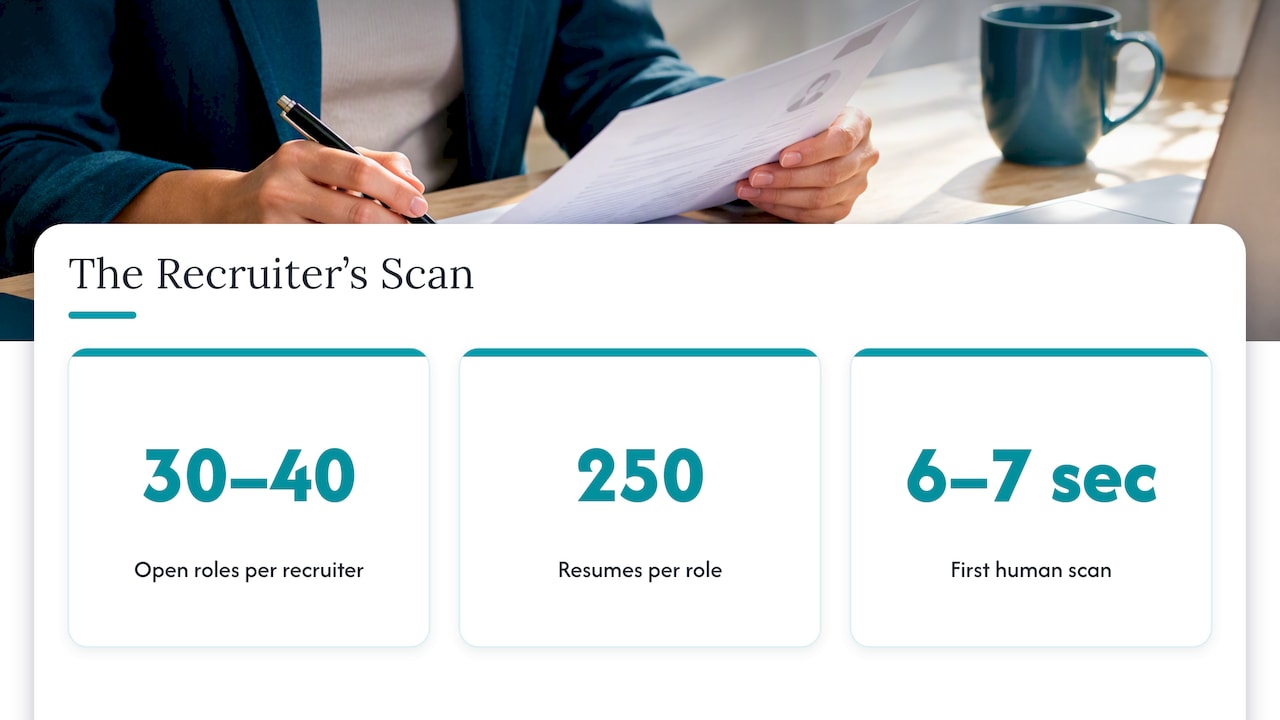
There is also a volume problem. NACE notes that the average recruiter juggles 30 to 40 open roles, and the average role attracts 250 resumes. Harvard’s career services team says the first human scan is commonly cited at six to seven seconds. At that speed, a reader doesn’t parse paragraphs. They catch numbers, titles and company names. Metrics are the one element that survives a skim.
That is the practical case. A quantified resume lets a reader compare you with the next candidate in seconds, and it gives a board member or search committee something concrete to repeat when they discuss you.
Two kinds of metrics: scope and impact
Executive resumes work best when they carry both kinds.
Scope metrics describe the size of what you were trusted with:
- Revenue or P&L owned
- Operating or capital budget managed
- Direct reports and total organization size
- Number of business units, sites, countries or customers
- Board, investor or regulator exposure
Impact metrics describe what changed because of your decisions:
- Revenue, margin or market share growth
- Cost reduction or overhead savings
- Cycle time, turnaround or time-to-market
- Retention, engagement or customer satisfaction
- Risk, compliance or audit outcomes
The U.S. Bureau of Labor Statistics gives plain examples of the format in its guide to resumes and applications: a 10-percent increase in sales, a 90-percent accuracy rate, a 25-percent increase in participation. Those are modest, but the pattern is right: a verb, a measurable outcome and a unit. Executive versions simply operate at a larger scale, such as “saved $500k in annual overhead” or “managed a $10M budget.”
Scope alone is not enough
“Managed a $40M budget” tells a reader you were trusted. It doesn’t tell them whether you were good. A $40M budget that you cut by 12% while shipping two product lines is a story. Use scope to set the stage and impact to close the line.
Match the metric to your function
The right numbers depend on what your seat is accountable for. Here is a working starting list. Treat it as a prompt for your own records, not a menu to copy.
| Function | Scope metrics | Impact metrics |
|---|---|---|
| CEO / GM | Revenue, EBITDA, headcount, markets | Growth rate, margin change, valuation or exit outcome |
| CFO / Finance | Budget, capital raised, audit scope | Cost takeout, forecast accuracy, days to close |
| COO / Operations | Sites, suppliers, cost base | Throughput, cycle time, defect or waste reduction |
| CMO / Sales | Quota, pipeline, marketing spend | Revenue influenced, win rate, customer acquisition cost |
| CTO / CIO | Engineering org size, platform spend | Uptime, delivery speed, migration savings |
| CHRO / People | Employee population, programs | Retention, time to hire, engagement scores |
If you want a deeper bench of examples by industry, our guide to quantifying resume impact with industry metrics goes through numbers you can defend in an interview. For the achievements boards and recruiters tend to notice, see board-ready executive resume achievements.
Use challenge, action, result to give numbers meaning
A number without context is easy to dismiss. The fix is a simple structure that CareerOneStop’s accomplishment guidance supports: name the problem, the action you took and the result.
Compare these two bullets:
- Before: Managed a team of 50 and oversaw operations.
- After: Restructured a 50-person operations department after a failed ERP rollout, cutting annual overhead 20%.
The second tells the reader the situation (a failed rollout), your decision (restructuring), the size (50 people) and the result (20%). One bullet answers four interview questions before anyone asks.
A quick drafting method
- Write the challenge in one phrase. What was broken, missing or at risk?
- Write your decision, not the team’s. What did you choose to do that someone else might not have?
- Find the result. Look for the number in a board deck, budget file, performance review or press release.
- State the baseline. “Grew revenue 18%” is stronger as “grew revenue 18% to $64M in 24 months.”
- Trim. Keep the scope, the verb and the result. Cut everything else.
Where to place metrics on the page
Harvard’s career services guidance describes modern resumes as fact-based, specific and active, and recommends scannable layouts. For executives, that means the top third of page one carries most of the weight.
CareerOneStop also advises matching the top third of the resume to each job posting, including the professional summary and skills summary. Combine the two ideas and the top third becomes your highest-value space:
- Headline or title line: your target role and one scope number (for example, “Operations executive, $300M manufacturing”).
- Summary: three or four lines with your scale, your signature results and your differentiator.
- Selected achievements: an optional block of three to five quantified wins, chosen for the role you are applying to.
- Experience: reverse chronological, with scope in a one-line role description and two to four result bullets beneath.
If you’re unsure how to arrange these pieces, our executive resume formats guide and the C-suite resume format article show layouts side by side.
Recent roles get the most numbers
Your last two or three roles deserve the heaviest quantification. Older roles can carry one or two lines of scope and a single headline result. A resume that gives a 2008 role the same depth as your current one buries your best material.
What to do when your results don’t have clean numbers
This is the most common objection from senior people, and it is fair. Culture change, turnarounds, board relationships and reorganizations rarely come with a tidy percentage. You still have options.
Use scope instead of outcome. “Led a 9-month integration of three acquired companies, 1,200 employees across five countries” is a number-rich bullet with no percentage in it.
Use time. “Reduced month-end close from 12 days to 6” is a measurable change even if you can’t share dollar values.
Use before and after. If you can’t share absolute figures, share the relative change: “Doubled enterprise pipeline in 18 months.”
Use ranges and rounding honestly. “$40M to $50M annual budget” is better than a false-precision figure you can’t source. Round down, not up.
Use confidential descriptors. “A Fortune 500 consumer goods company” and “a $2B healthcare system” protect an employer while still giving the reader the size.
Use proxy results. Awards, audit outcomes, regulatory approvals, a clean inspection record, successful IPO or exit, promotion of direct reports into larger roles. These are verifiable outcomes even when revenue attribution is murky.
If you are stuck on a particular accomplishment, our article on what to fix when an executive resume isn’t getting results walks through the usual causes.
Metrics mistakes that cost executives interviews
Numbers with no context
One popular critique of resume metrics is that figures without a reason behind them are often meaningless. We agree with the critique and not the conclusion. The answer isn’t fewer numbers. It’s numbers attached to a problem and a decision.
Inflated or unverifiable figures
Executive hiring involves reference checks, background screens and board conversations. A figure that doesn’t survive a phone call costs you the offer. NACE has written about a crisis of trust in applications driven by AI-generated, ghostwritten materials, and the practical lesson for executives is to use tools to format and surface real experience, not to manufacture accomplishments. If you can’t point to the source of a number, don’t use it.
Too many numbers
When every clause carries a figure, the reader’s eye stops registering any of them. Lead with your three or four biggest results and let other bullets carry scope or narrative.
Credit that isn’t yours
Write “led the team that delivered” when it was a team effort and “owned” only when you did. Hiring managers read verbs carefully, and they ask follow-up questions.
Metrics that don’t match the target role
Harvard’s career advisers point out that candidates often try to list everything they have done instead of tailoring the story to the problem the new organization faces. If you are applying for a turnaround role, lead with turnaround numbers, even if your biggest growth story is from another chapter.
Forgetting ATS and keywords
Metrics help human readers, but applicant tracking systems and recruiters search on terms. Pair your numbers with the right language for your function. Our piece on executive resume keyword clusters explains how to do that without stuffing.
Perspective: how we choose the numbers that go on the page
We come at this from the recruiting side of the desk. Our founder, Kim Taynor, has more than ten years of recruiting experience, and the pattern we see is consistent: executives undersell scope and oversell activity.
When we start with a client, we don’t ask for their duties. We ask for the three decisions that changed the business, and then we go looking for the evidence: a board deck, a budget variance, a before-and-after dashboard. The number comes second. The story comes first.
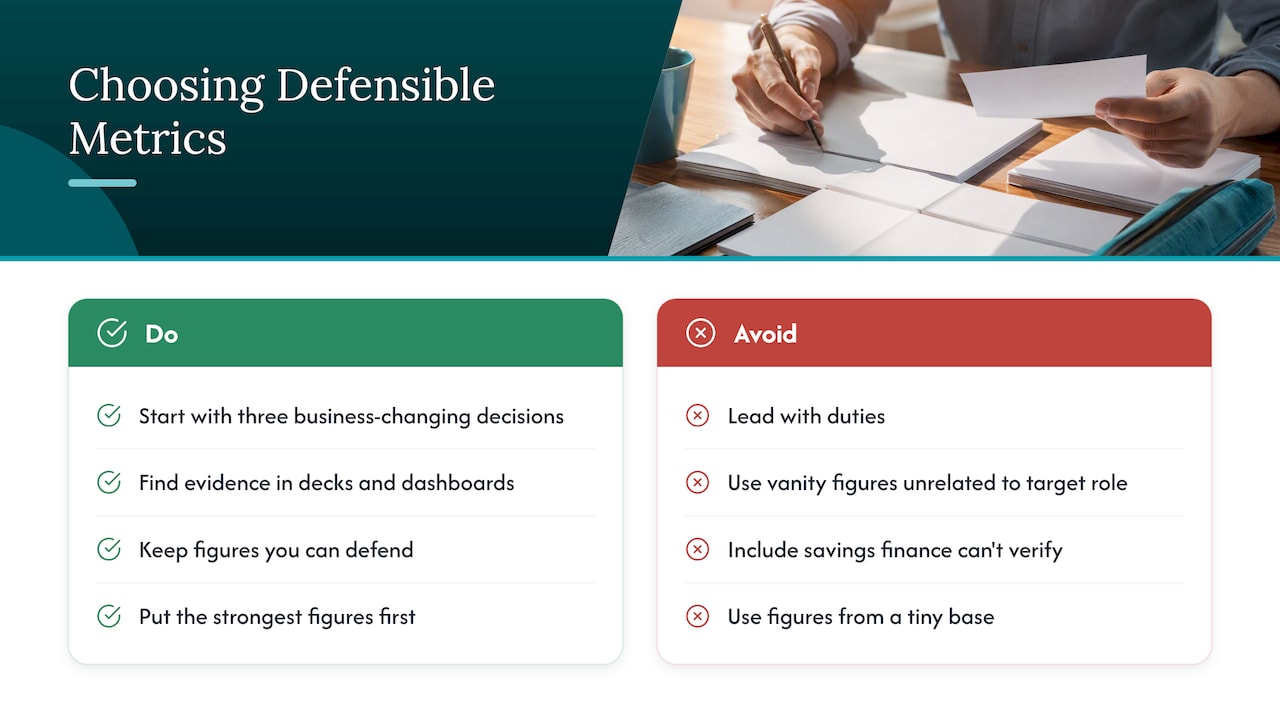
We also push back on metrics that look good and mean nothing. A 300% increase from a tiny base, a cost saving no finance partner would sign off on, a vanity figure unrelated to the role you want. Hiring managers notice, and a weak number can cast doubt on the strong ones around it.
Our rule of thumb: if you wouldn’t be comfortable explaining where a number came from to a skeptical board member, it doesn’t go on the resume. Keep it to the figures you can defend, put the best ones at the top, and let the rest of the page support them.
Kim
A worked example: rewriting three bullets
Here is how the method looks on a fictional operations executive. The numbers are illustrative, not client results.
Bullet one
- Draft: Responsible for supply chain operations across the company.
- Rewrite: Ran supply chain for a $380M consumer products company, 11 distribution centers and 640 employees, after two years of missed service targets.
Bullet two
- Draft: Improved on-time delivery.
- Rewrite: Rebuilt carrier contracts and slotting rules, lifting on-time delivery from 87% to 96% in 14 months.
Bullet three
- Draft: Saved the company money through vendor consolidation.
- Rewrite: Consolidated 140 vendors to 55, cutting annual procurement spend $4.2M without a service-level drop.
Notice what changed. Each rewrite names the scale, the lever you pulled and the result. None is longer than two lines. Together they take a reader about as long to absorb as a title and a company name.
Put it together: a checklist before you send
- Your top third contains at least two scope numbers and two result numbers.
- Every bullet in your last two roles states a result or its scale.
- Each figure has a baseline, a time frame or both.
- You can name the document or person that would confirm each figure.
- Your numbers match what appears on your LinkedIn profile. Mismatches get noticed.
- Metrics are targeted to the role you want, not simply the roles you’ve had.
For the full resume build around these numbers, our executive resume writing guide for senior leaders covers structure, length and tone. For a broader view of what has changed, see our resume strategy for senior professionals.
Getting help turning your record into numbers
Pulling quantified results out of a long career is the hard part, and it’s the part most executives do alone and late at night. If you’d like a second set of eyes, our Evolution package updates your resume and LinkedIn profile for $699. If you want a longer engagement that includes job search strategy and interview support, look at our Elevate programs; visit the page for details on options and pricing. If an interview is coming up soon, our Elevate program includes interview prep.
Want a recruiter in your corner for your next senior role? Book a free call with Resume Wiz and we will map out your next move together.
FAQ
What are good metrics to include on an executive resume?
Start with scope: revenue or P&L owned, budget, team size and number of markets or sites. Then add results such as growth percentages, cost savings, cycle-time reductions and retention gains. Choose the ones that match the role you want, and lead with the strongest.
How many metrics should an executive resume have?
There’s no fixed count, but every recent role should carry at least one scope number and one or two results. Your summary and top third should hold the biggest figures. Beyond that, if numbers appear in every clause, they stop standing out.
What if I can’t share exact figures because of confidentiality?
Use ranges, relative changes and descriptors. “A $2B healthcare system” or “doubled pipeline in 18 months” shows size without disclosing protected data. Round conservatively and be ready to explain the figure in an interview.
Do metrics help with applicant tracking systems?
Metrics mainly help the human who reads the resume after screening. Systems and recruiters search on terms such as job titles and skills, so pair your numbers with the right function-specific language. The numbers then do their job when a person picks up the document.
Sources
- Résumés, applications, and cover letters (U.S. Bureau of Labor Statistics)
- Highlight your accomplishments (CareerOneStop)
- Resumes and cover letters for 55+ workers (CareerOneStop)
- Create impactful resumes and cover letters (Harvard FAS Mignone Center)
- Harvard College Guide to Creating a Strong Resume
- Inside the ATS (NACE)
- The Ghostwritten Candidate (NACE)
