Competing Offers as Leverage: How to Use Them Well
A competing offer is the strongest leverage you can bring to a salary negotiation, but only when it is real, comparable and something you would actually accept. Used well, it moves an employer from “we can’t” to “let’s see what we can do.” Used badly, it makes you look like a risk. This guide covers what a second offer is worth, how to compare offers before you speak, the exact words to use, and what to do when you have no second offer at all.
Key Takeaways:
- A genuine offer from a comparable employer can prompt a match or improvement, but a bluff can cost you the job.
- Get every offer in writing and ask for time before you answer anyone.
- Compare total packages, not salary alone: bonus, equity, retirement, flexibility, growth and stability all count.
- Ask for one specific improvement, stay enthusiastic, and get any revised terms in writing.
- No second offer? A researched counteroffer and non-salary asks still work.
Table of Contents
- What a competing offer actually gives you
- Before you negotiate: get it in writing and buy time
- Compare the offers beyond the salary line
- When and how to tell an employer you have another offer
- What to say: a counter built on one clear ask
- What not to say or do
- What else to negotiate besides base salary
- If you have no competing offer
- Our perspective: leverage is built before the offer
- Build the second offer, not just the pitch
- FAQ
- Sources
What a competing offer actually gives you
Leverage in a negotiation is your credible alternative. If the employer believes you can walk away to a good job, they have a reason to improve their terms. That is all a competing offer is: proof that the market values you and that you have somewhere else to go.
Harvard’s Mignone Center for Career Success says a genuine offer can be used carefully against another offer, especially when the employers compete in the same industry and the roles should carry similar market rates. Comparability matters. A startup’s offer carries little weight with a large bank, and a director-level offer says little about a manager-level role.
There is a condition. Forbes reported in 2026 that an external offer gives stronger leverage because it is a real alternative, but you should not use it unless you are genuinely prepared to accept it if your current employer declines to match. That one test settles most of the ethical and tactical questions in this article. If you would not take the other job, you do not have leverage. You have a bluff.
CNBC reports that experts warn that hunting for an offer only as leverage can backfire, and that market-pay information can support a conversation without threatening the employer. Keep that in mind if you are tempted to collect interviews as a pressure tactic.
Before you negotiate: get it in writing and buy time
Leverage is worthless if you spend it too early. Three habits protect you.
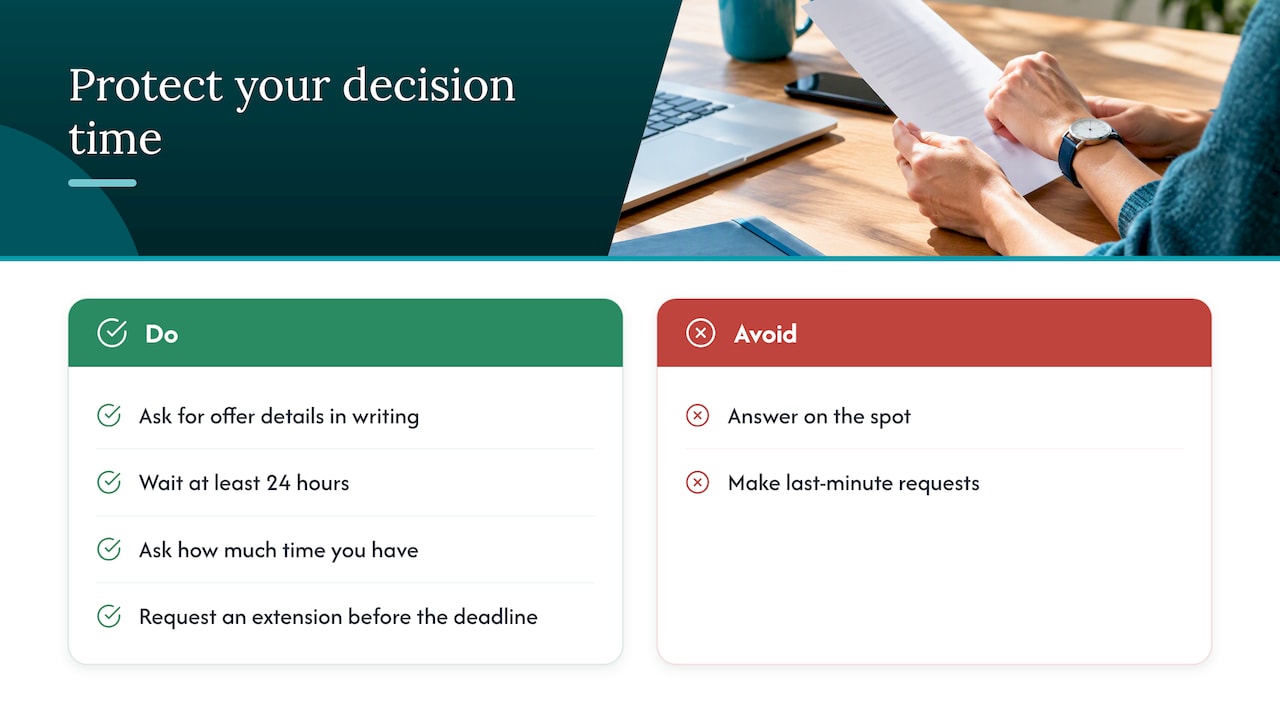
Ask for the offer in writing. Harvard FAS advises asking for the offer and compensation details in writing before you evaluate or negotiate them. A verbal number leaves out the bonus structure, the equity vesting schedule and the benefits, which are often where the real differences sit.
Do not answer on the spot. The University of Maryland Career Center recommends waiting at least 24 hours after a verbal offer and getting the offer in writing. Harvard suggests you thank the employer, reaffirm your interest and ask how much time you have to decide. That script is simple: “Thank you, I’m excited about this. Could you send the details in writing, and when would you need my answer?”
Line up your deadlines. MIT recommends timing negotiations around other offers’ deadlines and avoiding last-minute requests. Maryland says to request a reasonable extension before the deadline, explain why, and consider the employer’s needs. If one company’s deadline is Friday and another is still interviewing you, an extension on the first, and a nudge to the second, is the first move.
At senior levels the same logic applies with more moving parts. Executive packages often include bonus targets, equity and severance terms, which is why executive compensation differs from mid-level pay in ways that deserve a careful read before any counter.
Compare the offers beyond the salary line
You cannot negotiate well between two offers you have not compared honestly. Salary is one column. The research from university career centers and employers lists many more.
The University of Maryland recommends reviewing salary, benefits, retirement contributions, bonuses, equity, remote work, development, growth, reputation, layoffs and start date. Fidelity Careers makes the point that upward mobility, commute, remote flexibility, benefits and culture can change which offer is better even when one pays more.
Here is a practical comparison grid you can copy into a spreadsheet:
| Factor | Offer A | Offer B | What to check |
|---|---|---|---|
| Base salary | Is the number final or a range? | ||
| Bonus | Target, payout history, who decides | ||
| Equity | Vesting schedule, strike price, liquidity | ||
| Retirement | Employer match or contribution | ||
| Health and benefits | Premiums, deductibles, coverage start | ||
| Schedule and remote | In writing, or just promised? | ||
| Commute and location | Real travel time, relocation help | ||
| Growth | Next title, scope, who you report to | ||
| Stability | Layoffs, funding, leadership turnover | ||
| Start date | Flexible for either side? |
Score what matters to you
Colorado State University’s Career Management Center suggests a weighted scoring method: identify your priorities, give each a percentage weight so the weights total 100%, score each offer from 0 to 100 on each factor, and calculate weighted totals.
A quick example, with invented numbers for illustration only. Say you weight compensation 35%, growth 30%, flexibility 20% and stability 15%. Offer A scores 90, 60, 50, 80. Offer B scores 70, 90, 80, 60. A totals about 71.5 and B about 76.5, so B wins even though A pays more. Colorado State is clear that the number is only one input. Check it against your unanswered questions and your gut reaction. If you feel disappointed when B wins, find out why before you decide.
The scoring also tells you what to ask for. If Offer B wins on everything but pay, you know the one improvement that would close the gap.
When and how to tell an employer you have another offer
There are two conversations, and people often mix them up.
The company you prefer
Harvard’s guidance is to negotiate after you understand the written offers and when you are seriously considering that employer. Explain that another genuine offer affects your decision, state the specific improvement that would make this role more compelling, stay enthusiastic and flexible, coordinate deadlines, and get any revised terms in writing.
Timing matters. Say it after you have the written offer and before you accept, never after. Once you have said yes, you have no leverage left.
The company still interviewing you
Harvard says that once you hold an offer while pursuing other opportunities, you should promptly tell the other organizations, explain that you have an offer, express particular interest in them, and ask where your candidacy stands. This is often the quickest way to get a second offer on a compressed timeline, because it gives the hiring team a reason to move.
Do you have to name the company?
You are not required to, and a general description (“a comparable role at a company in the same space”) is usually enough to make the point. But be ready for the follow-up. Harvard warns that employers may ask for proof and may request a copy of the offer letter. If you cannot share it, you should not have implied you had it. When you do name the company, you are accepting that the two employers may be in the same industry and may even know each other. Decide in advance how much you are comfortable disclosing.
What to say: a counter built on one clear ask
The best scripts share three features: gratitude, a specific request and no threat. The University of Maryland’s sample counteroffer thanks the employer, cites market research and relevant experience, and asks for a specific higher salary range rather than making an ultimatum.
MIT adds practical guardrails: identify the appropriate contact, present requests enthusiastically, reassure the employer of your interest, avoid demands, get agreed terms in writing, and respond promptly.
Here is a template adapted to a competing offer. The figures are illustrative.
Thank you again for the offer. I’m excited about the scope of this role and the team, and it’s my first choice. I do have another written offer with a base salary of $185,000, and I need to respond to it by Friday. If you could bring the base to $185,000, I’m ready to accept and move forward. Could we also confirm the revised terms in writing?
Notice what it does. It names a number, a deadline and a clear outcome, and it says you are ready to commit. It does not say “match or I leave.” For more wording options, including how a recruiter reads each version, see our counter offer email scripts.
If the gap between what they offer and what you expect keeps appearing, it is worth understanding salary expectation mismatch from both sides before you sit down again.
What not to say or do
Harvard’s guidance on mistakes is blunt, and it is worth following to the letter.
- Never lie about an offer. Do not claim a higher offer than you hold. Assume the employer may call your bluff and ask for the letter.
- Do not negotiate unless you are seriously considering the job. Negotiation signals intent. Walking away after a concession wastes goodwill.
- Do not accept one job while you keep interviewing. Harvard warns this can harm your reputation or lead to the offer being rescinded.
- Avoid last-minute requests and ultimatums. MIT advises tact, and an eleventh-hour demand puts the employer in a corner.
- Do not collect offers purely for leverage. As CNBC’s reporting notes, this can backfire with your current employer too.
One more note on tone. If you cannot reach agreement, Maryland says to express gratitude, stay fair and understanding, and avoid burning bridges. Hiring managers change companies, and the recruiter you thank today may be the one who calls in three years.
What else to negotiate besides base salary
A competing offer often exposes flexibility you did not know existed. If base salary will not move, Harvard suggests asking about a signing bonus or an earlier performance and salary review. Maryland lists common negotiation subjects as base salary, start date, signing bonus, relocation expenses and professional-development support.
MIT sorts items by how likely they are to move:
| Usually negotiable | Sometimes negotiable | Usually not negotiable |
|---|---|---|
| Offer deadline | Telecommuting | Health insurance |
| Start date | Title | Retirement savings plans |
| Salary | Location | Benefits that apply to all employees |
| Signing bonus | Review timing | |
| Relocation expenses | Non-compete duration |
For senior roles, signing bonuses and clawback terms deserve their own preparation. Our guide on signing bonuses and better clawbacks for executives covers how to approach them.
If you have no competing offer
Most negotiations happen with a single offer, and they still work. Harvard’s advice here is to use market research and your relevant experience to make a researched counteroffer. Cite your scope, results and comparable pay data, not your personal needs.
CNBC’s reporting supports the same approach: market-pay information can anchor the conversation without threatening anyone. If the employer still will not move, decide whether the job meets your needs as it stands or whether to continue your search.
The strongest position without a second offer is a documented record of results. If your resume does not show them clearly, your leverage is weaker than it should be. Our pieces on quantifying resume impact and why experience does not always translate into offers explain how to fix that, and our guide to getting a higher-paying job at senior level covers the wider strategy.
Our perspective: leverage is built before the offer
We have watched many negotiations from the recruiter’s side, and the pattern is consistent. Candidates with competing offers rarely got them by luck. They started the search early, ran several conversations in parallel, and presented themselves as the obvious fit for each role.
That is why we treat negotiation as a result of the search, not a separate skill bolted on at the end. A tailored, ATS-compliant resume, a sharp LinkedIn profile and direct outreach to hiring managers create the second and third conversations. Those conversations create the timing overlap that makes a competing offer possible.
We also tell clients to protect their credibility above any single number. A recruiter remembers who bluffed, who communicated clearly and who handled a decline gracefully. The candidate who says “you are my first choice, and here is the one thing that would make it a yes” tends to get a better hearing than the candidate who issues a threat.
Finally, ask for the thing you actually want. If growth matters more to you than $10,000 in base pay, say so. A competing offer is most useful when it helps you get a role you would be glad to take.
Kim
Build the second offer, not just the pitch
If you are working with one offer and want more, the fastest fix is more qualified conversations. For senior professionals who want us to run the search, Elevate is a managed engagement, with pricing detailed on its page. If you only need to refresh your materials before outreach, Evolution covers your resume and LinkedIn for $699.
Want a recruiter in your corner for your next senior role? Book a free call with Resume Wiz and we will map out your next move together.
FAQ
Should I tell my current employer about a competing offer?
Only if you would accept the other job if they decline to match. Forbes reported that an external offer is stronger leverage because it is a real alternative, but it should not be used by someone unprepared to leave. CNBC’s reporting also notes that sharing market-pay data can work without implying a threat.
Do I have to name the company that made the other offer?
No. You can describe the offer’s role, level and compensation without naming the firm. Be ready for the employer to ask for the offer letter, since Harvard warns that employers may request proof. If you cannot provide it, do not make the claim.
How long can I take to respond to an offer?
Maryland recommends waiting at least 24 hours after a verbal offer, and Harvard suggests asking how much time you have. If you need longer to hear from another employer, request a reasonable extension before the deadline and explain why.
What if the employer will not match the other offer?
Ask about other terms. Harvard suggests a signing bonus or an earlier performance and salary review, and MIT lists start date, relocation and sometimes title or telecommuting as possibilities. If it still falls short, decide whether to accept or keep searching, and stay gracious either way.
Can I negotiate if I only have one offer?
Yes. Make a researched counteroffer based on market data and your relevant experience, and ask for a specific number or range. A single offer still gives you room to negotiate, and a polite request rarely costs you the job.
Sources
- HES: Evaluating and Negotiating Job Offers, Harvard FAS Mignone Center for Career Success
- Offers & Salary Negotiation, University of Maryland Career Center
- Negotiate job offers, MIT Career Advising & Professional Development
- Comparing Job Offers, Colorado State University Career Management Center
- Should You Get Another Job Offer Just To Negotiate With Your Current Employer, Forbes
- Should you leverage a job offer for a raise or promotion, CNBC
- How to compare job offers beyond just salary, Fidelity Careers
