International Executive Resume for the US Market
A US executive resume is shorter, more quantified and more impersonal than most international CVs. It runs two pages (three at most for a long career), leads with business results, and leaves out the photo, birth date and family details that many countries still expect. If you have led teams, P&Ls or markets outside the United States, the work is mostly translation: the same career, rewritten so a US recruiter understands its scale in about ten seconds.
This guide walks through that translation step by step: format, length, what to remove, how to explain foreign titles and degrees, how to show impact, and how to get through applicant tracking systems (ATS).
Key Takeaways:
- Send a resume, not a CV. Keep it to two pages, three at most for a very long career, in a clean reverse-chronological layout.
- Remove the photo, date of birth, marital status, nationality and similar personal details. Keep name, email, phone, city and state, and LinkedIn URL.
- Give every role a frame of reference: company size, revenue or budget, team size, and the measurable change you drove.
- Explain foreign employers, degrees and titles in plain US terms so nothing has to be guessed.
- Build a separate version for each target role, using keywords from the job description in a single-column, ATS-safe file.
Table of Contents
- What changes when you cross the border
- Length, layout and fonts
- What to leave off
- Translate your career for US readers
- Show scope and measurable impact
- Pass the ATS and the recruiter’s scan
- Tailor each version to the role
- Work authorization and the resume
- Our perspective
- Where we can help
- A final check before you send
- FAQ
- Sources
What changes when you cross the border
The first adjustment is the document itself. In the United States, most non-academic employers ask for a resume. A resume is generally a one- or two-page summary of experience, education and skills, while a CV is the longer document used for academic, scientific, research, healthcare, fellowship or grant applications.
Many executives arrive with a five-page CV that lists every project, publication, board seat and training course in a career. That document works in some markets. In the US it reads as a lack of editing. The US reader is asking one question: what did this person own, at what scale, and what changed because of them?
Three differences matter most:
- Selection over completeness. You choose the evidence that supports the role you want, and you drop the rest.
- Results over responsibilities. A bullet that says what you were responsible for loses to a bullet that says what you delivered.
- Neutral personal profile. US employers are cautious about information that could feed discrimination claims, so the resume carries almost nothing personal.
If you are also deciding how an executive document differs from a standard one, our guide on executive resume vs standard resume covers that gap in more depth.
Length, layout and fonts
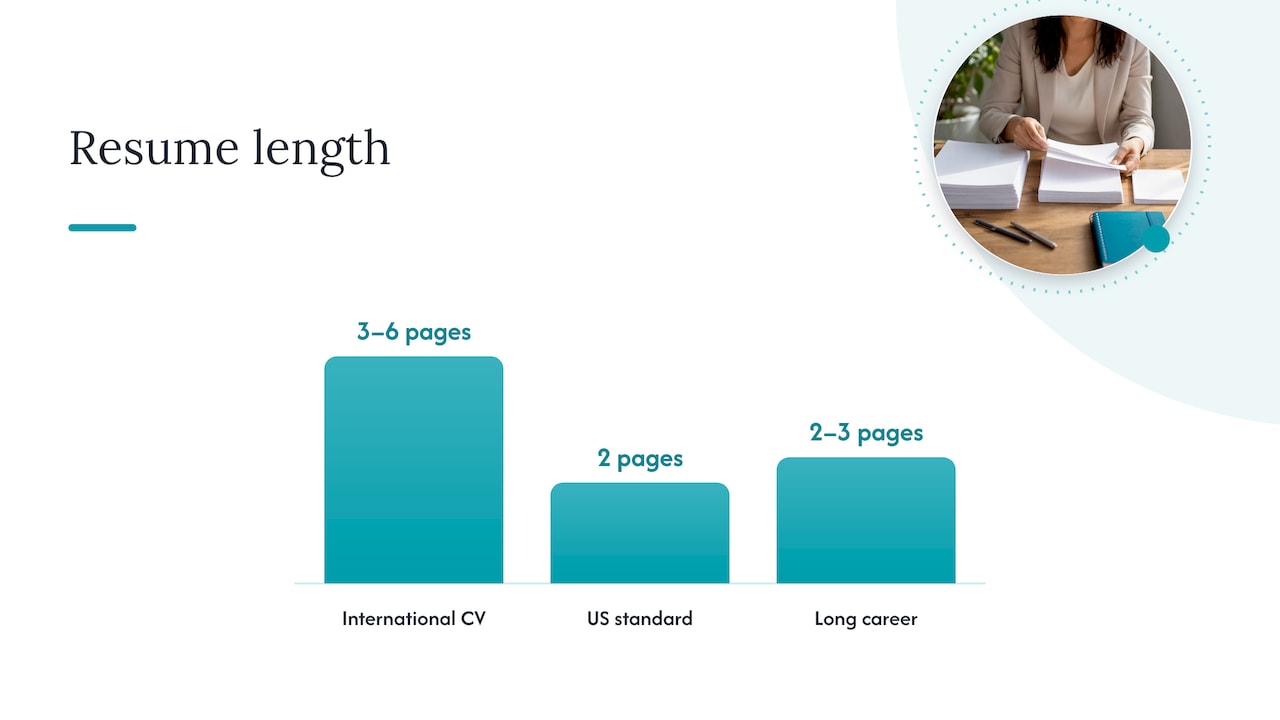
For executives, the working rule is two pages. Stanford Graduate School of Business advises no more than two pages in a clean reverse-chronological format, with readable 11- or 12-point type in Calibri or Arial, margins of at least 0.70 inch and left alignment. Even the federal Senior Executive Service process is strict: the Office of Personnel Management’s guide says competitive applicants submit only a two-page resume, with at least 11-point type and 0.8-inch margins.
There is some room above two pages for very long careers. One executive recruiting firm suggests no more than one page for every ten years of work experience, which commonly produces a two- to three-page executive resume. Treat three pages as the ceiling, and only when the third page carries real substance, such as earlier roles with large scope or board service.
| Element | International CV habit | US executive resume |
|---|---|---|
| Length | 3 to 6 pages | 2 pages, 3 at most |
| Photo | Common in many countries | Never |
| Personal data | Birth date, nationality, marital status | None |
| Address | Full street address | City and state, or just the LinkedIn URL |
| Opening | Objective or personal profile | Short summary of brand, scope and years of experience |
| Older roles | Full detail | Employer and title only after roughly 15 to 20 years |
| Tone | Duties and responsibilities | Quantified results |
Keep the design restrained. The same recruiting firm recommends a simple layout without pictures, graphs or distracting colors, with contact details prominent and your current employer easy to spot. For a deeper look at layout options for senior candidates, see our breakdown of executive resume formats.
The header
Put your name, email, phone number and LinkedIn URL at the top. Stanford notes that a street address is not necessary. If you are still abroad, use your international phone number with the country code and consider listing your target US city only if you are genuinely willing to relocate there. Do not invent a US address.
What to leave off
This is where international executives most often trip. Practices that signal thoroughness elsewhere can look like a risk in the US.
- Photo. Yale School of Management’s US resume guide says not to include a photograph, age or marital status. An executive search firm’s guide says the same, adding that an executive resume should omit headshots, marital status, age and personal interests.
- Government identifiers and family status. A university career guide says that for US positions you should omit personal information such as a Social Security number, birth certificate and relationship status.
- Date of birth, nationality, religion. The reason is legal caution. The US Equal Employment Opportunity Commission explains that federal law prohibits covered employers from discriminatory selection on protected grounds, and that avoiding inquiries about those grounds reduces the risk of improper use in hiring. A recruiter who receives a resume full of such details has reason to be uneasy, and an ATS or screening step may simply strip them.
- Personal interests. Unless a hobby is directly relevant to the role, such as a board position at a nonprofit, skip it.
One caution for the other direction: if you also apply for roles outside the US, check each application’s requirements. The same university guidance says that for positions outside the US you should check whether personal details are required. Keep a separate file for each market and never send one document to all of them.
Translate your career for US readers
A US hiring manager may never have heard of your former employer, may not know your country’s degree system, and may read your title differently from how your company meant it. Your job is to remove that friction without adding clutter.
Give every employer a frame of reference
The University of Maryland’s career center advises providing a frame of reference for overseas experience or education, such as naming a large firm’s standing in its country or a highly ranked program. For executives, the most useful device is a one-line company descriptor under each employer. Executive recruiters recommend stating what the organization does, its scale, employee count and whether it is public or private, and they report that this helps them make quick judgments during screening.
A descriptor might look like this:
Nordvik Industrial Group, Munich, Germany Privately held manufacturer of industrial pumps, 4,200 employees, operations in 18 countries
This example is illustrative, not a real company. Notice what it does: a US reader instantly understands the sector, size and international reach, even if the name is unfamiliar.
Make titles legible
Titles like Managing Director, General Manager, Country Head or Vorstand do not map neatly onto US titles. Keep the title you actually held, then clarify scope in the first bullet or the descriptor. If your official title undersells the role, do not inflate it. Instead, state what you ran: a regional P&L, a headcount, a number of countries. Recruiters verify titles, and a mismatch costs you far more than a modest title ever would.
Explain degrees and drop the unnecessary
University of Maryland guidance recommends explaining foreign degrees with a frame of reference where possible and converting a foreign GPA to the US 4.0 scale if you include one. At executive level, most people leave the GPA off entirely. A line such as “MBA, INSEAD” or “Master’s in Engineering, ETH Zurich” does the job. For a less recognizable school, add a brief clarifier, such as the national ranking or the degree’s US equivalent.
Cut older history
Stanford suggests moving experience older than roughly 15 to 20 years, or irrelevant experience, into an Additional Work Experience section listing only employer and title. This is the easiest way to bring a 30-year global career down to two pages.
Show scope and measurable impact
This is the core of a US executive resume. For each job, Stanford recommends including the size and scope of the organization, revenue or budget managed, and team size, then emphasizing measurable outcomes such as revenue growth, money saved or market-share gains. Staffing-industry guidance makes the same point: a recruiter should be able to see quickly what you owned, the scale of the operation and what changed because of your work.
Here is how a typical international bullet changes.
Before (CV style): Responsible for the commercial strategy and sales organization across the Middle East and Africa.
After (US resume style): Led a 140-person sales organization across 11 Middle East and Africa markets, growing regional revenue from $48M to $71M in three years while cutting cost of sales by 9%.
The example is illustrative, but the pattern is the point: scope first (team, markets), then the number, then the time frame, then a secondary result.
A few practical tips for global leaders:
- Convert currencies. Show figures in US dollars, with the original currency in parentheses only if it adds credibility. Use a stable, stated rate and never inflate.
- Use the same unit across the resume. Mixing euros, rupees and dollars forces the reader to do math.
- Show the cross-border element as an asset. Multi-country P&L, integration of an acquisition, market entry, regulatory navigation and cross-cultural team leadership are exactly what US companies with global footprints look for.
- Keep bullets short. Guidance for executive resumes recommends one- or two-sentence bullets with clear action verbs, quantified outcomes tied to business priorities, consistent formatting and white space.
If you need ideas for which wins belong on the page, our list of executive resume achievements recruiters notice is a good starting point.
The summary at the top
Replace the objective statement with a brief executive summary. Stanford says to limit it to four lines plus bullets, defining your distinctive brand, competencies relevant to the target role and often your years of experience. For an international executive, the summary is also where you state your scope in one line: for example, the number of countries, the revenue range, or the type of company you have led through growth or turnaround.
Pass the ATS and the recruiter’s scan
Most mid-size and large US employers run resumes through an applicant tracking system before a person reads them. Format matters because a parsing failure can scramble your work history.
The University of Texas career services office recommends a chronological resume, tailored to each job description, with matching keywords, and says to avoid tables, columns, graphics, objects, LaTeX and design websites such as Canva. Guidance for international applicants adds that photos, logos and complex layouts can create parsing errors in US systems.
In practice:
- Use a single column and standard headings such as Professional Experience, Education and Board Service.
- Submit a Word document or a text-based PDF unless the posting says otherwise.
- Avoid text boxes, icons, skill-rating bars and headers or footers that hold key information.
- Write dates in the US style (Jan 2019 to Mar 2023) and spell out abbreviations once.
- Use the terms US employers use. “Revenue” rather than “turnover,” “P&L” rather than “profit centre,” “headcount” rather than “staff strength.” American spelling helps keyword matches.
Keyword placement deserves care. Executives often assume ATS keywords are for junior roles, but they apply at every level, especially at the first screening by an in-house recruiter. Our piece on executive resume keywords shows how to group them into a few clusters so your bullets stay natural.
Tailor each version to the role
The University of Texas guidance is direct: read the job description, identify its important keywords, incorporate those that match your experience, use a chronological format and make a new version for each application. For an executive, tailoring is less about swapping words and more about reordering evidence:
- If the role is a turnaround, lead with the restructuring you led.
- If it is growth-stage, lead with market entry and scaling.
- If it is a US subsidiary of a foreign parent, lead with the cross-border coordination that made you valuable to both sides.
Keep a master document that holds every achievement, then build each submission from it. For the broader picture of how to position yourself at this level, see our resume strategy for senior professionals.
Work authorization and the resume
Work authorization is a reality of the US search for non-citizens. UC Berkeley’s career center notes that international candidates face limited job visas, governmental hurdles, cultural and language barriers, and unfamiliarity with US job-search practices. Its advice for students includes using Handshake’s work-authorization filters to find employers willing to sponsor visas.
For an executive, the practical approach is to keep the resume itself focused on qualifications and to handle status where applications ask for it, or in a short, factual conversation with a recruiter. For visa and eligibility specifics, speak with an immigration attorney, since the right path depends on your nationality, role and employer.
Our perspective
We see the same pattern with international executives again and again: the career is strong, but the document hides it. Years of recruiting have taught us that a US hiring manager gives a resume a very short first look. If the scale of your work is not obvious in that look, the rest of the document rarely gets read.
The fix is rarely about writing more. It is about choosing: which three or four results prove you can do the target job, which employer descriptors make your background legible, and which details to cut. Executives who have worked abroad often undersell themselves because they assume the numbers speak for themselves. In the US, you have to say the number, the scale and the timeframe in the first line of the bullet.
We also encourage a resume that works alongside a strong LinkedIn profile and direct outreach. At senior levels, many roles are filled through conversations before or alongside any formal application, so the resume should be built to be forwarded: clear enough that someone who has never met you can explain why you should be interviewed.
Kim
Where we can help
If you want an expert to rework your global career into a US executive resume, we offer several routes. Evolution covers a resume and LinkedIn profile for $699. If you would like hands-on support with a broader search, Elevate offers 1:1 executive job search coaching, see the page for details. Elevate and Land is a done for you, fully managed job search with tailored applications and outreach, see the page for pricing. If you are not ready for a full engagement, Elevate can help with interview prep as a starting point.
A final check before you send
Run your draft through this list:
- Two pages (three only if justified), single column, 11- or 12-point standard font.
- No photo, birth date, marital status, nationality or street address.
- City and state, email, phone with country code, and LinkedIn URL in the header.
- A summary of four lines or fewer, naming your brand, scope and years of experience.
- A one-line descriptor under every employer unlikely to be known in the US.
- Every role showing scope (team, budget, markets) and at least one quantified result.
- Figures in US dollars, US spelling and US business vocabulary.
- Roles older than 15 to 20 years reduced to employer and title.
- Keywords from the target job description, used where they are true.
- A file name such as FirstName-LastName-Resume.docx, with no tables or text boxes.
If your current resume is already in circulation without results, our guide on what to fix first when an executive resume is not getting results can help you diagnose the problem.
Want a recruiter in your corner for your next senior role? Book a free call with Resume Wiz and we will map out your next move together.
FAQ
Should an international executive send a CV or a resume to US employers?
Send a resume for nearly every corporate role. Cornell’s Graduate School notes that most non-academic US employers use resumes, while CVs are reserved for academic, scientific, research and healthcare settings. If you hold a board or advisory seat, add it as a short section rather than writing a longer document.
How long should my US executive resume be?
Two pages is the standard, and the federal Senior Executive Service application is capped at two pages. A third page can be justified for a very long career, but only if it carries relevant, high-scope experience. Move older roles to a short list of employers and titles to save space.
Do I need to remove my photo and date of birth?
Yes. Business-school and recruiting guidance consistently says to leave out photographs, age and marital status. US employers are cautious about information tied to protected characteristics, and including it can work against you.
How do I explain a degree or employer nobody in the US has heard of?
Add a short frame of reference. Name the employer’s industry, size and public or private status in one line, and for a degree, note the school’s ranking or the equivalent US level. This approach is recommended by university career offices for overseas experience and education.
Will an ATS reject a creative or designed resume?
Not always, but it is a risk you do not need. Tables, columns, graphics and design-tool templates can scramble how a system reads your content. A plain single-column document with standard headings is the safer choice for executives.
Sources
- Resumes and CVs, Cornell Graduate School
- Resumes & Cover Letters, Stanford Graduate School of Business
- Guide to SES Qualifications, US Office of Personnel Management
- Preparing a Great Executive Level Resume, Lochlin Partners
- Yale SOM Resume Writing Guide
- Executive Resume Guide, Kirby Partners
- Resumes vs CVs, Ithaca College
- EEOC Informal Discussion Letter
- International Students: Resumes, University of Maryland Feller Center
- How to Create a Captivating Executive-Level Resume, Robert Half
- Applicant Tracking Systems, UT Austin Career Services
- How to Beat ATS Algorithms: A Guide for International Applicants, Careers Global
- International Students, UC Berkeley Career Engagement
