Transferable Skills for Executives: What to Claim and How
Transferable skills for executives are the capabilities that keep their value when the title, the industry or the company changes: leading people, steering change, owning results, reading a business and building alliances. They only convince a hiring committee when you tie them to the problems the new organization has. This guide shows which skills travel, how to find yours in your own record, and how to present them so a board or search firm sees fit instead of a gap.
Key Takeaways:
- At the C-level, firms weigh business acumen and soft leadership skills such as communication, collaboration, strategic thinking and a global mindset more heavily than technical expertise.
- A skill is portable only if it maps to the challenges of the new environment. Naming it is not enough; you have to show where it applies.
- Find your skills by mining accomplishments: for each result, ask what you did, who you influenced and what changed.
- Prove them with quantified, first-person stories in STAR or CCAR format, using the language of the target job description.
Table of Contents
- What transferable skills mean at the executive level
- The skills employers look for in executive candidates
- Five categories to sort your experience
- How to identify your transferable skills
- Which skills carry best into a new industry
- How to show transferable skills on your resume
- How to prove them in interviews
- How to close a skills gap before you move
- Our perspective on transferable skills
- Get help turning your experience into an offer
- FAQ
- Sources
What transferable skills mean at the executive level
For an early-career candidate, transferable skills are a list: teamwork, communication, problem-solving. For an executive, the list is the least interesting part. Transferable skills span soft skills like collaboration and problem-solving as well as hard skills like data analytics and project management, and both can apply across a wide range of jobs. What matters at your level is the scale at which you used them and the result they produced.
The trend favors people who can move. Yale’s career development office notes that CEOs moving across sectors rose 45 percent between 2015 and 2019, because cross-disciplinary skills apply in more than one context. The same source says a switch can sharpen people-management and process-streamlining skills, and that an outsider can bring a fresh view of business objectives and processes.
There is a caution, too. Harvard Business Impact’s research on whether leaders are portable frames the issue: management talent transfers only if it maps to the challenges of the new environment. A turnaround specialist moving into a stable, mature business may be solving a problem the company does not have. Your job is to pick the skills that match the new context and lead with them.
The skills employers look for in executive candidates
Research on the path to the C-suite points the same way. Harvard Business School faculty found that, at the top, business acumen and soft leadership skills outrank technical and functional expertise. The American Enterprise Institute’s review of the evidence adds that companies increasingly prioritize social skills, especially for CEOs: self-awareness, listening and communicating well, working with different people and groups, and theory of mind.
In plain terms, boards are buying judgment about people and strategy. If you want to see how performance and leadership strategy connect at the top of a mid-market company, this overview of CEO performance and leadership strategy shows the kind of measures leaders are held to.
The federal government offers a useful, public model. The Office of Personnel Management defines five Executive Core Qualifications for the Senior Executive Service: Leading Change, Leading People, Results Driven, Business Acumen and Building Coalitions. OPM says they assess executive experience and potential rather than technical expertise, and measure broad skills needed across many SES positions. That is the definition of transferable. Even if you never apply for a federal post, those five headings are a solid skeleton for auditing your own career.
Five categories to sort your experience
A useful way to organize what you have is by category. Forbes describes the common groupings as interpersonal skills, leadership and collaboration, cognitive and problem-solving skills, and functional or operational skills. Here is how they translate for a senior leader, combined with the OPM headings above.
| Category | Executive examples | What it looks like as evidence |
|---|---|---|
| Interpersonal and social | Negotiation, stakeholder communication, empathy, board and investor relations | Closed a partnership, resolved a union dispute, rebuilt a strained client relationship |
| Leadership and collaboration | Coaching leaders, building a succession bench, aligning a leadership team | Promoted internal successors, reduced regretted turnover, merged two teams |
| Cognitive and problem-solving | Strategic thinking, analytical reasoning, risk judgment | Chose a market to exit, rebuilt a pricing model, diagnosed a margin leak |
| Functional and operational | Process optimization, financial management, technology adoption | Cut cycle time, delivered a budget turnaround, led an ERP migration |
| Change and coalition building | Leading change, building coalitions, integrating acquisitions | Delivered a restructuring with retained key talent, aligned regulators and partners |
If you want a deeper breakdown of the leadership layer, our guide to senior leadership competency types goes through each one.
How to identify your transferable skills
Most executives undersell themselves here, because the skills feel like ordinary parts of the job. The way around that is to start from results, not from a skills list. This process works well in about an hour.
- List 8 to 12 major accomplishments. Include turnarounds, launches, restructurings, hires, cost programs and anything where the outcome was measurable.
- Write the problem each one solved. One sentence: what was broken, at risk or missing?
- Name what you personally did. Not what the team did. Did you negotiate, redesign, persuade, decide, recruit?
- Tag the skill behind each action. Use the five categories above. You will notice the same three or four skills recurring. Those are your signature strengths.
- Attach a number. Revenue, margin, headcount, time saved, risk avoided. If you lack the exact figure, use a defensible range and be ready to explain it. Our piece on quantifying resume impact shows how to do this without overstating.
- Read the target role. Highlight the three or four problems the new company must solve, then keep only the skills that map to them.
Don’t ignore experience outside paid work. One guide on recognizing executive skills makes the point that caring for a family member can reflect resilience and crisis management, and that going back to school shows learning agility. Gaps and detours often hold evidence you have not claimed. It will be strongest when the story is specific and connected to leadership you would bring to the role.
Which skills carry best into a new industry
Not every skill travels equally. A rough test: the more a skill depends on industry vocabulary, the less it carries; the more it depends on judgment about people, money and change, the more it carries.
Carries well:
- Leading and developing leadership teams
- Turning strategy into operating priorities
- P&L ownership and capital allocation
- Leading change, mergers and restructurings
- Building coalitions with boards, investors, regulators and partners
- Crisis decision-making under uncertainty
Carries only with translation:
- Sales and go-to-market experience (channels and buying cycles differ)
- Operations and supply chain (constraints differ by sector)
- Technology leadership (a platform strategy in one sector may not match another’s regulatory limits)
Usually does not carry on its own:
- Product knowledge, regulatory fluency and relationships tied to one niche. Treat these as a gap to close, not a strength to claim.
If data is part of your story, be specific about the tools and methods you actually used. A good model is how analysts frame spreadsheet competence, as in this guide to Excel skills for your resume, which separates what to list from how to prove it. The same logic applies to any hard skill you put in front of a hiring committee.
How to show transferable skills on your resume
The resume is where a transfer either lands or dies. Three habits make the difference.
Reframe accomplishments around the new buyer. Forbes coaches advise quantifying impact, such as specific dollar savings or percentage gains in profitability, and mirroring the language of the job description to show alignment with the target organization. If the posting says “integrate acquisitions,” and you integrated two, say so in those words.
Write in your own voice. The same guidance recommends moving from “we” to “I” language, describing leadership actions you took personally and contrasting before and after to show the measurable difference you made. Credit your team where it is due, but make sure your decision, your call and your result are clear.
Lead with a summary that names the transfer. Two or three lines at the top should tell the reader what problem you solve and for whom, not recite your last title. Then use a focused skills section, not a dump of keywords. See our resume skills section best practices for 2026 for structure, and our career change resume examples for how the summary and bullets work together. For the achievement bullets themselves, 12 board-ready executive resume achievements shows what recruiters notice.
A before-and-after example:
- Before: Responsible for leading the operations team through a period of change.
- After: Led a 140-person operations restructuring across three sites, cutting cycle time by 22% and holding voluntary attrition under 8% through the transition.
The second version is an illustration of format, so replace the figures with your own verified numbers. It names scale, action, result and a risk that was managed, and it would read the same in healthcare, logistics or financial services.
How to prove them in interviews
Executive interviews test whether your claims hold up under follow-up questions. Forbes recommends that executives use STAR (Situation, Task, Action, Result) or CCAR (Challenge, Context, Action, Result) frameworks to present accomplishments as structured, verifiable evidence, using “I” statements and quantified results while avoiding long, unfocused anecdotes.
Interviewers expect this structure. One executive search firm describes STAR as a foundational framework for evaluating candidate responses, and says interviewers should steer abstract generalizations toward specific, verifiable behaviors and their consequences. If you answer with a philosophy of leadership, expect to be pulled back to a real example.
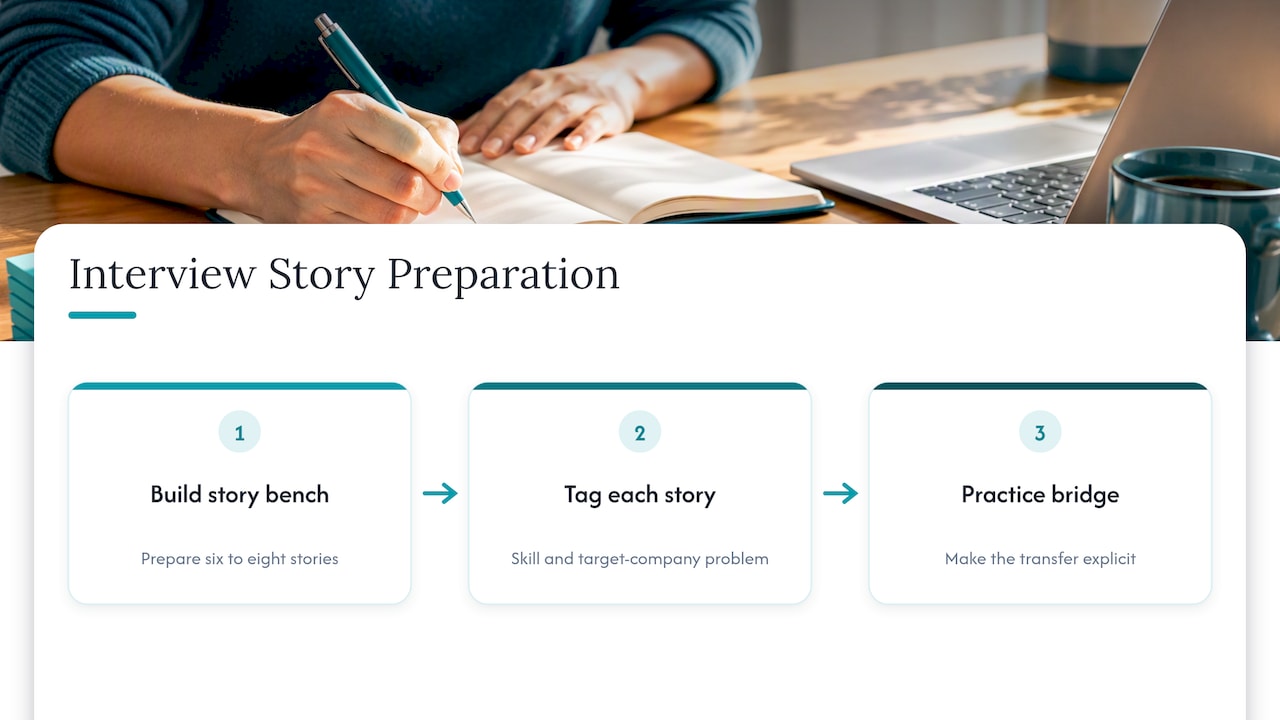
Prepare a bench of six to eight stories, each tagged to a skill category and to a likely target-company problem. Then practice the bridge sentence that makes the transfer explicit: “The situation you described, a distributed team and a margin squeeze, is close to what I faced at…” For the mechanics, read our guides to STAR versus CAR, leadership style interview answers and executive interview questions. If you expect assessments, six metric STAR stories will help. To pull everything into one arc, see how to build an executive career narrative.
How to close a skills gap before you move
Every transition has a gap, so name yours before an interviewer does. Forbes coaches suggest that executives build capability by seeking diverse experiences such as turnarounds, restructurings or scaling projects, and by pursuing continuous learning through executive education, lateral moves or mentorship.
In practice, that can mean:
- Taking a board, advisory or committee seat in the target industry
- Completing a focused executive program on the regulation or economics of the new sector
- Interviewing five leaders in the target industry to learn its vocabulary and its biggest unsolved problems
- Choosing a lateral role that bridges the two worlds, then moving again
When you speak about the gap, show a plan: what you have already done to close it and how quickly you learn. A credible plan converts a weakness into evidence of adaptability.
Our perspective on transferable skills
We see the same pattern in executive search after search. Strong leaders get passed over not because they lack the skills but because their documents describe their old job instead of the new one. Hiring managers rarely do the translation for you. If the resume says “VP of Operations, retail,” a healthcare recruiter often stops reading, even when the underlying work is a close match.
Our approach comes from more than 10 years of recruiting experience: start from what the decision-maker needs, then choose the evidence. That means fewer skills, backed by sharper proof. We would rather see four transferable strengths with real numbers than twenty keywords. It also means making your documents readable by applicant tracking systems without watering them down, then going beyond the application by reaching the right people directly through your LinkedIn profile and outreach.
The last point is the one executives resist: a transition is a search strategy, not just a resume rewrite. Most senior roles are won through conversations, and those conversations go well when you can state your transferable value in two sentences.
Kim
Get help turning your experience into an offer
If you want a second set of hands on the hardest part, Elevate is our 1:1 executive job search coaching program, built to help senior professionals position their experience and run a focused search.
Want a recruiter in your corner for your next senior role? Book a free call with Resume Wiz and we will map out your next move together.
FAQ
What transferable skills do employers look for in executives?
Research from Harvard Business School finds that at the C-level, firms value business acumen and soft leadership skills, including communication, collaboration, strategic thinking and a global mindset. The AEI review adds social skills such as self-awareness, listening and working with different groups. Technical expertise matters less once you reach the top.
What are the five categories of transferable skills?
There is no single official list, but a common grouping is interpersonal skills, leadership and collaboration, cognitive and problem-solving skills, and functional or operational skills. Many executives add a fifth for change and coalition building, which mirrors OPM’s Executive Core Qualifications. Use whichever grouping helps you sort your accomplishments.
How do I identify transferable skills if I have only worked in one industry?
Start from accomplishments, not job titles. For each result, write the problem, your personal action and the measurable outcome, then tag the skill behind it. Skills that recur across several stories, such as leading change or P&L ownership, are the ones to lead with.
Should I use “I” or “we” on an executive resume?
Describe your own actions with “I” thinking, even if the bullet itself omits the pronoun. Forbes coaching guidance recommends focusing on leadership actions you took personally and contrasting before and after. Acknowledge the team where it is relevant, but make your contribution unmistakable.
Sources
- Yale School of Management: Why Executives Should Consider Switching Industries
- GMAC: What Are Transferable Skills and How Can You Leverage Them
- Harvard Business Impact: Are Leaders Portable?
- Harvard Business School: The New Path to the C-Suite
- American Enterprise Institute: The C-Suite Skills That Matter Most
- OPM: Guide to Senior Executive Service Qualifications
- Forbes: How to Showcase Transferable Skills in Your Job Search
- Forbes Coaches Council: How to Handle Executive Role Transitions Across Industries
- JRG Partners: Mastering the Executive Interview
