Executive Follow-Up Email: Timing, Templates, Examples
A good executive follow-up email is short, specific and tied to one clear next step. Send the thank-you within 24 hours of an interview, wait a week or so before nudging about silence, and give the reader a reason to answer that is more than “just checking in.” Below you will find the timing rules, the structure, and copy-ready templates for the five situations senior candidates face most.
Key Takeaways:
- Send a post-interview thank-you within 24 hours, individually to each interviewer, and mention something specific from the conversation.
- If you hear nothing, wait until any promised date has passed, then add a buffer of a few days before the first nudge. Cap it at two follow-ups.
- Skip “just following up.” Lead with one strategic hook: a result, an insight or a useful attachment.
- Use a subject line that names the earlier interaction, and keep the body to roughly 50 to 125 words for nudges.
- Only chase employers you would actually accept an offer from.
Table of Contents
- Why executive follow-up is different
- When to send each type of follow-up
- The anatomy of an executive follow-up email
- Template 1: Thank-you within 24 hours of an interview
- Template 2: A nudge when the timeline has passed
- Template 3: After applying with no response
- Template 4: Following up with a recruiter or search consultant
- Template 5: Following up after a networking conversation
- Our perspective: what we see from the recruiter’s side
- Mistakes that weaken a follow-up
- A simple follow-up routine
- Getting more from your follow-ups
- FAQ
- Sources
Why executive follow-up is different
At the VP or C-suite level, a follow-up email is rarely a formality. Searches are slower, committees are larger, and the person you are writing to is often a board member, a CEO or a search consultant who gets hundreds of messages. The email is a small sample of how you communicate under pressure.
That cuts both ways. A sharp note can move you ahead of equally qualified peers. A needy one can quietly cost you the role. Executives should avoid daily check-ins and generic “just following up” messages, which weaken professional presence and read as overly persistent.
The stakes of skipping the note entirely are real, too. A TopResume survey cited by the University of Georgia Career Center found that 68% of hiring managers said a post-interview note affects their decision, and nearly 20% of employers admit to dismissing a candidate for not sending one. Treat those numbers as survey data rather than a law of hiring, but the direction is clear: a thoughtful note helps, and silence rarely does.
When to send each type of follow-up
Timing depends on the relationship stage. Here is a working schedule built from career-center and executive-search guidance.
| Situation | When to send | Notes |
|---|---|---|
| Thank-you after an interview | Within 24 hours | Individual email to each interviewer |
| Nudge after interview silence | After any promised date passes, plus a few days | Search guidance suggests 5 to 7 days when no date was given |
| Application with no timeline | Around 2 to 3 weeks | Only for roles you truly want |
| Second nudge | 1 to 2 weeks after the first | Then move on |
| Ongoing recruiter or network contact | About every 2 weeks | Share something useful, not a status request |
The 24-hour window comes up everywhere. MIT’s career office advises sending a thank-you to your interviewers within 24 hours, and Dartmouth’s Center for Career Design adds that if you miss that window, you should still send the note, because a late thank-you beats none.
There is a floor as well as a ceiling. Executive search practitioners caution that writing within the hour of leaving the room can feel scripted or over-eager, while waiting several days suggests low interest. Aim for that evening or the next morning.
For silence after the interview, Northwestern’s law career office suggests that if a response deadline passes, you wait roughly 2 to 7 days before chasing, because companies often run later than they say. Emailing the morning after a missed date signals impatience, not poise.
The anatomy of an executive follow-up email
Every effective version has the same five parts, and none needs more than a sentence or two.
- A subject line that names the context. “Following up on our Tuesday call about the COO role” tells the reader exactly why you are writing. UGA’s guidance notes that a subject line referencing the previous interaction works better than vague ones like “Checking in.” Our own guide to job inquiry subject lines recruiters prefer goes deeper on wording for mid- and senior-level candidates.
- An opening that proves you were listening. Refer to a problem they described, a priority they named, or a phrase they used. Specific beats polite.
- One strategic hook. A single idea that connects your experience to their problem. We cover this in detail in how to build one strategic hook into an executive follow-up.
- One clear ask or next step. A date, a short call, a document review. Not three requests.
- A plain close. Your name, title and number if appropriate. No “Hope this finds you well” padding.
If you promised something in the interview, attach it. Adobe’s guidance on follow-ups makes the point that sending the requested material right away rather than promising it separately shows you deliver on commitments. For an executive, that might be a 90-day plan outline, a case study, or a reference list.
Template 1: Thank-you within 24 hours of an interview
Use this for each person you met, and change the middle so no two emails are alike. MIT’s career office specifically recommends sending individual notes to each interviewer rather than copying everyone on one message.
Subject: Thank you, and one thought on the supply chain integration
Dear Ms. Alvarez,
Thank you for the time yesterday. Your point that the integration has stalled at the plant level, not the leadership level, stayed with me. In my last role I faced the same split at a three-site manufacturer, and the fix was a shared operating cadence, not a new org chart. I’ve attached a one-page summary of how we ran it.
I’m very interested in the COO role and confident I can help your team close that gap. I’m glad to walk through the details whenever useful.
Best regards, Jordan Reyes
Notice what is missing: no recap of your resume, no “I believe I am a great fit.” The names and figures here are illustrative, so replace them with your own.
Template 2: A nudge when the timeline has passed
Keep it under about 100 words. A short, specific email with one clear ask gets more answers than a long recap.
Subject: Following up on our conversation about the CFO search
Dear Mr. Chen,
I enjoyed our conversation on October 7 and remain very interested in the role. You mentioned a decision by mid-month, so I wanted to ask whether the timeline has shifted and if there is anything else I can provide.
I recently read your investor update on margin pressure and have a short perspective on the hedging approach I’d be glad to share.
Best, Jordan
The hook at the end gives the reader a reason to reply that is not about you. If you do not have a hook yet, think about what you learned in the interview that you could add value on.
Template 3: After applying with no response
For applications with no stated timeline, general guidance recommends waiting about 2 to 3 weeks before following up. At the executive level, an application portal alone is a weak channel. Our piece on why executives hear nothing after applying explains why, and the follow-up is where you change channels.
Subject: VP Operations application: a relevant result
Dear Ms. Patel,
I applied for the VP Operations role on September 24 and wanted to put a face to the application. I led a distribution network consolidation that cut cycle time by 18% (I can share the context). The role’s emphasis on fulfillment speed made me think it might be relevant.
Would a 15-minute call next week make sense?
Regards, Jordan Reyes
Only include a figure you can defend in an interview. The 18% above is a placeholder for your own number.
If you do not know the hiring manager, our templates for emails to a hiring manager and emails to executive recruiters cover the first approach.
Template 4: Following up with a recruiter or search consultant
Recruiters are a relationship, not a single transaction. Executive search guidance suggests a cadence of roughly every two weeks for long-term recruiter relationships, and each touch should give them something.
Subject: Update: open to Chief Revenue Officer searches in healthcare IT
Hi Daniel,
Quick update since we spoke in September. I’ve closed out my current project and I’m now open to CRO roles in healthcare IT, ideally mid-market. My target range and a refreshed one-page profile are attached. If a search comes up where my background in payer contracts fits, I’d welcome an introduction.
Best, Jordan
Notice the update is information a recruiter can act on. “Any news?” gives them nothing to do.
Template 5: Following up after a networking conversation
Dartmouth’s career guidance covers networking conversations and info sessions as well as interviews, so the same 24-hour habit applies. Then, a week or two later, send something of value.
Subject: The article we discussed on board governance
Dear Tom,
Thanks again for the coffee last Thursday. You asked about approaches to board reporting for a carve-out; I’ve linked the framework I used below. If it would help, I’m happy to introduce you to the CFO who built it with me.
Warm regards, Jordan
For the follow-on ask, such as a referral, see our executive referral email examples and networking email templates.
Our perspective: what we see from the recruiter’s side
Kim Taynor, our founder, spent more than 10 years recruiting before building Resume Wiz, and the same pattern keeps showing up. The executives who lose ground in follow-up are rarely rude. They are vague. “Just checking in” asks the reader to do the thinking: remember who you are, find your file, decide what you want.
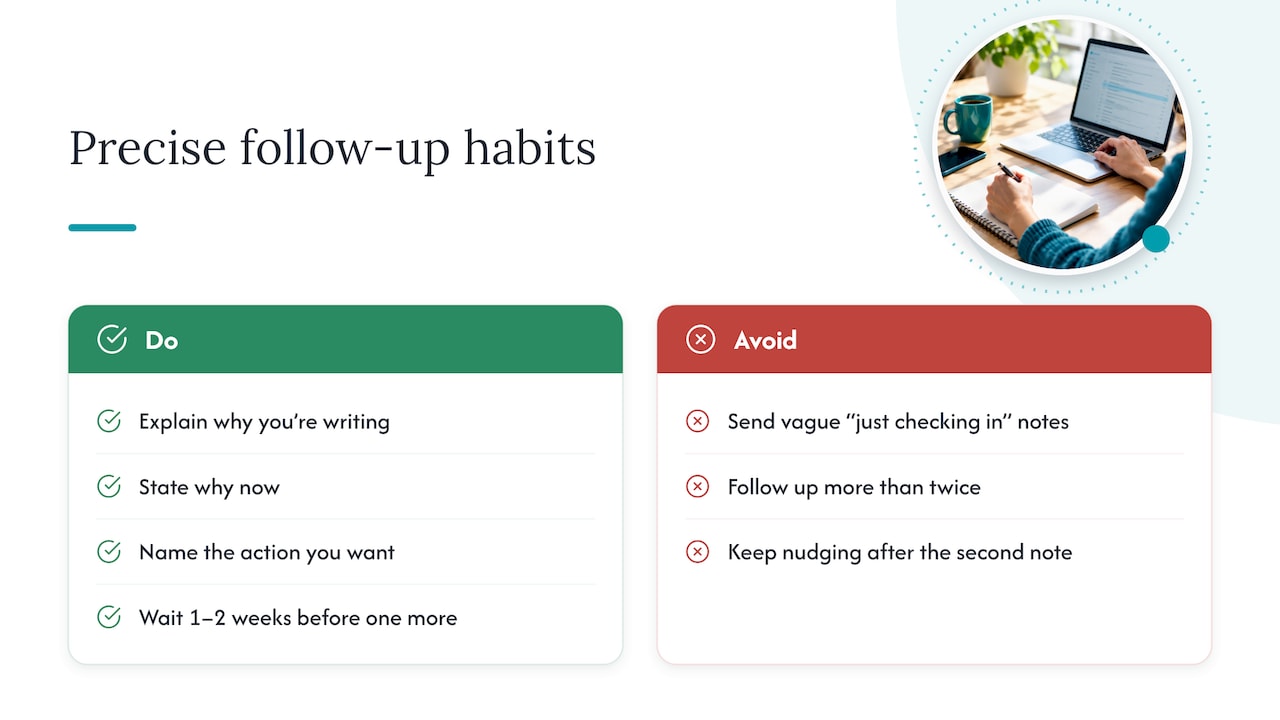
We coach clients to flip that. Every message should answer three questions before the reader asks them: why are you writing, why now, and what do you want me to do? When we help executives run a search, the follow-up email is part of a larger system. It lines up with a resume tailored to the role, a LinkedIn profile that backs up the claims, and outreach aimed at decision-makers rather than portals.
We also push back on the instinct to follow up more. One precise note, a gap of a week or two, then one more is usually the right ceiling. After that, the better use of your energy is opening new conversations. If you want the broader picture, read how an executive job search works.
Kim
Mistakes that weaken a follow-up
- Sending the same note to every interviewer. Interviewers compare notes. Identical thank-yous look automated.
- Copying a whole panel. Individual emails make each person feel addressed.
- Pressure without a reason. Nudging an employer about timing signals that they are a top choice, and Northwestern’s guidance says it is unprofessional to push for a decision if you would not accept an offer. If you have a competing offer deadline, say so honestly, and only then.
- Following up on every application. The same source advises sending follow-ups only to your top-choice employers.
- Attachments you promise “later.” Attach them now.
- Typos in a short email. In 80 words, one error is a large share of the content. Read it aloud before sending.
- Long recaps of your career. They already have your resume. Use the email to add something new.
A simple follow-up routine
Consistency beats inspiration. Here is a routine you can run in under ten minutes per interview.
- Right after the interview: write down the three things the interviewer cared about most, in their words.
- That evening: draft the thank-you, choose one hook, and attach anything you promised.
- Next morning: reread, send, and note the date in your tracker.
- Calendar the nudge: set a reminder for the day after any promised decision date plus a few days. If no date was given, set it about a week out.
- Plan your second touch: decide now what new information you can offer, so the nudge is not empty.
- Close the loop: if you get no answer after the second nudge, stop and redirect your effort.
Some of the same material is in the University of California, Davis guidance, which advises sending a thank-you within 24 hours and, if you have heard nothing in two weeks, a follow-up reiterating your interest. Different schools and search firms set the dial a little differently, so choose a rhythm and stick to it.
Getting more from your follow-ups
A strong follow-up cannot rescue a weak first impression. If your emails go unanswered, the problem may sit upstream: a resume that does not show results, a LinkedIn profile that does not match, or outreach that reaches the wrong person. If you want help across the whole search, we offer several routes:
- Elevate is a low-cost way to sharpen your interview preparation and communication.
- Evolution updates your resume and LinkedIn profile for $699 one-off.
- Elevate is our guided search program. See the page for details.
- For a done-for-you search, see Elevate and Land, where you can review the current options.
You can also start at Resume Wiz and choose the level of support that fits.
Want a recruiter in your corner for your next senior role? Book a free call with Resume Wiz and we will map out your next move together.
FAQ
How do you politely send a follow-up email?
Name the earlier interaction in the subject line, acknowledge the reader’s time, and make one specific request. Offer something useful, such as an attachment or a relevant insight, so the message is not only a request for an update. Keep it brief and warm without flattery.
How do I professionally say I’m following up?
Skip the announcement and lead with the substance. Try “I enjoyed our conversation about the expansion plan and wanted to share one idea,” or “I’m writing to ask whether the timeline has shifted.” Both give context and purpose in the first sentence.
How do I politely ask for an update via email?
Wait until any promised date has passed, plus a few days of buffer. Then ask whether the timeline has changed and whether you can provide anything further. Avoid phrases that sound like pressure, such as “I haven’t heard back.”
How many times should an executive follow up?
Two times is a sound limit: one nudge after the expected date, and one more about one to two weeks later, per Northwestern’s career guidance. After that, move on and keep a light, useful touch with the contact every few weeks if the relationship is worth keeping.
Sources
- The 24-Hour Rule and Other Timing Secrets for Effective Follow-Up, TWM Executive Search
- Following Up with Employers, Northwestern Pritzker School of Law
- Professional correspondence guidelines, MIT Career Advising & Professional Development
- Email correspondence examples, UGA Career Center
- Follow up emails: best practices, Adobe Acrobat
- Interview and Networking Follow-Up, Dartmouth Center for Career Design
- Interviews and Offers Guide, UC Davis Internship and Career Center
