Midlife Career Change for Executives: A Practical Guide
A midlife career change at the executive level works when you stop treating it as starting over and start treating it as a repositioning. You keep the judgment, the leadership record and the relationships. You change the problem you solve, the industry you solve it in, or the way you work. The hard parts are rarely skills. They are how your story reads on paper, who you can reach, and how hiring teams react to a senior résumé.
This guide covers how to decide what to change, how to package a long career for a new target, how to find roles that never get posted, and how to handle age bias. It is written for executives and senior managers who have already done well and want the next chapter to be a deliberate one.
Key Takeaways:
- Decide what you want to stop doing before you pick a destination. The pivot should be built around a through line in your work, not a blank slate.
- Most executive moves come through people, not job boards. Rebuild your network deliberately and treat online applications as a side channel.
- Your résumé should show the last 10 to 15 years, fit on two pages and speak the language of the new field.
- Age bias is real, and so is legal protection from age 40. Prepare for it with evidence of current skills rather than apologies.
- A change takes months. Plan on a structured, multi-month push, not a weekend of applications.
Table of Contents
- Why so many executives are rethinking their careers now
- Start with what you want to stop doing
- Find the through line before you tell anyone
- Learn outside-in before you leap
- Build a résumé for the new target, not the old one
- Update LinkedIn before you start reaching out
- Work the hidden market, not just job boards
- Handle age bias head on
- A 90-day plan for the transition
- Our perspective: where we see executives stall
- When help is worth paying for
- FAQ
- Sources
Why so many executives are rethinking their careers now
You are not unusual. AARP’s research on workers 50 and older found that 24% planned a job change in 2025, up from 14% the year before. Of those, 40% wanted a new job, 16% planned to start a business and 12% wanted to move from full-time to part-time work.
That split matters. “Career change” covers very different moves, and each needs a different plan:
- A new employer, same function. Often called a role redesign. You stay in finance, operations or sales, but in a different sector or at a company with a different culture.
- A new function or industry. A COO moving into healthcare operations, or a marketing executive moving into a technology company.
- A portfolio or advisory path. Board seats, fractional roles, consulting.
- A founder path. Starting or buying a business.
- A reduced-load path. Part-time or project-based leadership.
Be honest about which one you are actually considering. Executives who say “I want a change” and mean “I want a better boss” will spend a year chasing the wrong target.
Start with what you want to stop doing
Most advice begins with “follow your passion.” That is vague, and at 48 or 55 you have real constraints: income, benefits, family, a reputation. A more useful opening exercise has three parts.
- List what drains you. Not what you dislike in general, but the specific tasks, meetings and decisions that leave you flat. Budget fights, managing a particular kind of conflict, constant travel.
- List what you would do for free. Look at the moments in the past five years when you lost track of time. Turning around a team, building a product line, mentoring a rising leader.
- Write down your non-negotiables. Minimum compensation, location, hours, equity, title level. Be exact.
The overlap between the second and third lists is your search space. It is usually narrower than people fear and more specific than “something meaningful.”
Find the through line before you tell anyone
A through line is the thread connecting your past jobs to your next one. It is the reason a hiring manager can say, “Of course this person belongs here.”
A few examples of how a through line sounds:
- “I fix underperforming operations,” which works in manufacturing, healthcare or logistics.
- “I build the revenue engine for companies at the scaling stage,” which works across industries.
- “I translate between technical teams and the business,” which works almost anywhere.
A skills audit helps you find yours. Girlboss describes the method as listing your last three to five roles and pulling out what you did, separate from the job titles that housed those abilities. For executives, push further: what outcomes did you own, what decisions did you make under uncertainty, and which of those would a different industry pay for?
Know what transfers and what does not
Executive skills do not all move equally well. Research from Harvard Business School on how the path to the C-suite has changed points to a shift toward general management and business acumen over narrow functional expertise at the top. In practice, that is good news for a career changer: strategy, capital allocation, talent, and stakeholder management travel. Knowledge of your old company’s routines and internal culture does not, and you will need to let it go.
A quick test: take each major accomplishment on your résumé and ask whether it depended on your old company’s systems and relationships, or on a skill you carry with you. Lead with the second kind.
Learn outside-in before you leap
Long-tenured executives often carry a directive style that worked in one organization. Spencer Stuart’s Leadership Odyssey research with Harvard Business Review emphasizes people skills such as asking good questions and listening, which matter across small groups, networks and entire organizations. In a new industry, you will have less positional authority at first and more need to persuade.
You can build that muscle before you switch:
- Join a nonprofit board or advisory committee in the target field.
- Take a short project, advisory engagement or fractional assignment.
- Interview ten people already doing the job you want, and ask what surprised them.
These steps give you vocabulary, proof of interest and, often, the first warm introduction.
Build a résumé for the new target, not the old one
The résumé that got you here describes a career in one industry. A career change résumé has a different job: to make a stranger see a fit. We cover the logic in detail in why career changers need a different résumé strategy, and there are worked layouts in our career change résumé examples. The core rules:
- Open with a headline and summary aimed at the new role. Name the target and the through line in the first three lines.
- Show the last 10 to 15 years. AARP’s guide to getting hired after 50 advises trimming the résumé to recent roles when decades of experience point to a role that needs far fewer, which avoids looking like a flight risk or a budget problem. Keep it to two pages.
- Translate the jargon. Replace sector-specific terms with plain business results: revenue, margin, headcount, speed, risk reduced.
- Quantify. Numbers carry across industries when titles do not.
- Keep the format ATS-safe. Single column, standard headings, no text boxes or graphics holding key content.
For a deeper look at current expectations, see our guide to résumé strategy for senior professionals.
A before and after, in structure
Imagine a 52-year-old VP of supply chain moving into healthcare operations. The old summary says “Seasoned supply chain leader with 25 years in consumer goods.” The new one leads with the through line: “Operations executive who cuts cost and delivery time in complex, regulated networks,” followed by two or three results stated without consumer goods vocabulary. Same person, same facts, different reader.
Update LinkedIn before you start reaching out
Every introduction you earn will end with someone checking your profile. If it still reads like your old industry, the story breaks. Your headline, About section and featured items should all point the same direction as your résumé. We explain the details in the role of LinkedIn during an industry switch and executive LinkedIn profile best practices.
Two changes pay off fast: a headline that names what you do for the new audience rather than your last title, and a recent photo and activity that signal you are current.
Work the hidden market, not just job boards
At the executive level, many roles are filled through referrals, search firms and conversations before a posting ever exists. AARP’s guide, quoting career coach John Bates, describes the path as restocking the inventory of your professional network instead of relying on online applications. Executive networks often shrink over time or become concentrated among people at the same stage, so a deliberate rebuild helps.
A simple weekly rhythm:
- Make a list of 40 to 60 people. Former colleagues, board contacts, vendors, alumni, people who left your company for the target industry.
- Send five to ten short, specific messages a week. Ask for a 20-minute conversation about their field, not a job.
- Offer something. An article, an introduction, a view on a problem they mentioned.
- Ask each person for two other names. This is how the circle widens into decision-makers.
- Track everything in a simple sheet: date, last topic, next step.
Our pieces on the hidden job market for senior roles, why applying without a network rarely works and whether applying online is a waste of time for senior roles go deeper on the mechanics. For a view of the whole process, read how an executive job search works.
There is also a demand picture worth knowing. The Bureau of Labor Statistics projects about 305,100 annual openings for top executives over the current decade, mostly from replacement needs. Positions exist, but they are competitive, which is why targeting and referrals matter more than volume.
Handle age bias head on
Age bias is part of the picture and pretending otherwise does not help. AARP’s research on age discrimination reports that 74% of older Americans believe their age is a barrier to being hired, and 64% of workers 50 and older have seen or experienced age-based bias, including assumptions that they are less tech-savvy or resistant to change.
You also have legal protection. The Age Discrimination in Employment Act of 1967 protects applicants and employees age 40 and older, including in hiring and promotion. If you believe you were rejected because of your age, an employment attorney or the Equal Employment Opportunity Commission is the right place to take specifics. Nothing in this article is legal advice.
What you can control is the evidence you present:
- Show current tools and methods. Name the platforms, analytics and AI-assisted workflows you actually use.
- Tell a story about working for or with someone younger, since interviewers often probe this indirectly.
- Show appetite to learn. A recent course, certification or project beats a general claim of adaptability.
- Drop graduation years and early roles from the résumé, and avoid dated email addresses.
- Frame the move around the problem you want to solve, not around winding down.
Overqualification is the other common objection. Address it directly in the first conversation: why this role, why now, and what you will bring at this level of scope. A clear answer turns a worry into a reason to hire you.
A 90-day plan for the transition
A change of this size is a project. Here is one way to sequence it.
| Phase | Weeks | Focus | Output |
|---|---|---|---|
| Clarify | 1 to 3 | Skills audit, through line, target list of 15 to 25 companies | One-page positioning statement |
| Package | 3 to 5 | Résumé, LinkedIn, outreach templates | Documents tested on three trusted readers |
| Reach out | 5 to 10 | Networking conversations, recruiter contacts, targeted applications | Eight to ten conversations a month |
| Convert | 8 to 13 | Interviews, case stories, salary discussion | Offers or clear feedback to adjust |
Expect to loop back. If conversations are warm but no interviews follow, the positioning is usually the issue. If interviews happen but no offers follow, practice your stories and your answer on why you are changing.
Our perspective: where we see executives stall
We work with executives, managers and career changers, and the founder, Kim Taynor, brings more than 10 years of recruiting experience to that work. From the recruiter’s side of the desk, the pattern is consistent. Senior candidates rarely fail because they lack capability. They stall for three reasons.
First, the documents describe the past instead of the target. A hiring manager spends seconds deciding whether you look like the person for the job, and a résumé built around your old industry answers the wrong question.
Second, the search leans on applications. A senior person sending 80 applications into portals gets silence and concludes the market is closed. The market is open, but through people. Moving even half of that effort into targeted outreach changes the results.
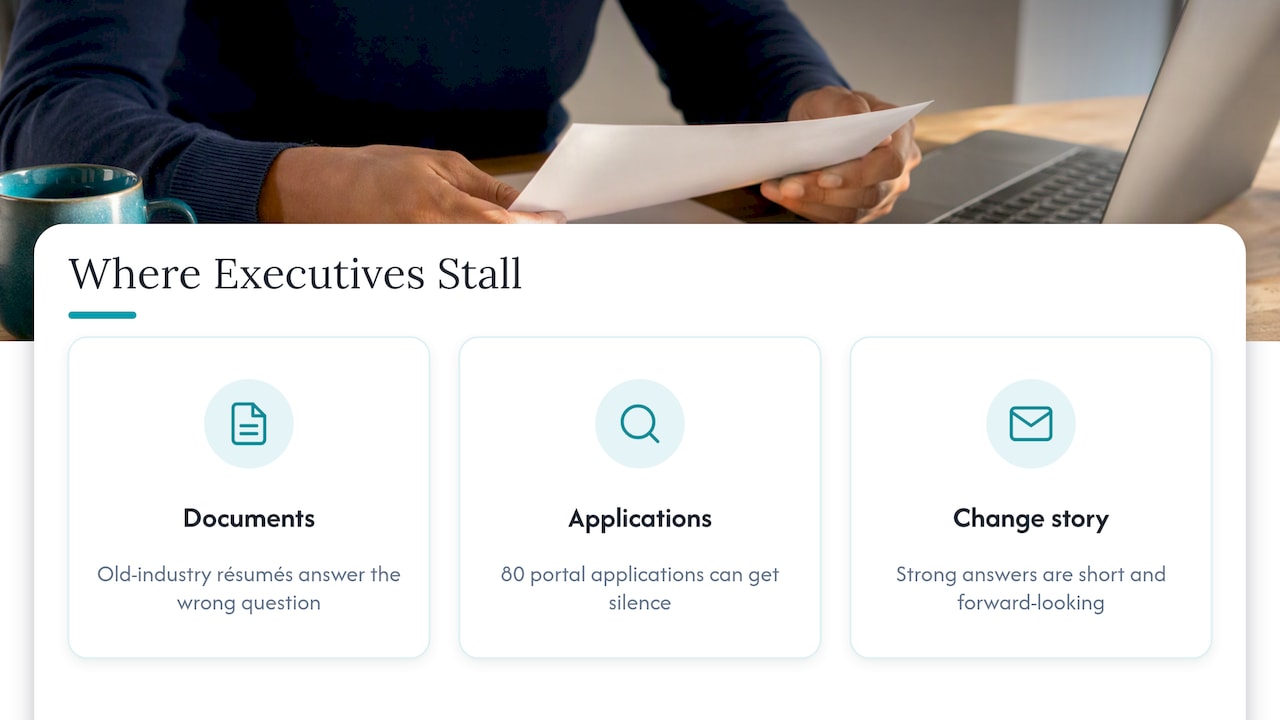
Third, candidates under-prepare the change story. “Why are you leaving a successful career?” is the first thing every interviewer wonders. The strongest answers are short, forward-looking and tied to a problem the new employer has.
Our advice: spend your first two weeks on positioning, not on applying. Everything else gets easier once you can say in two sentences who you are and what you solve.
Kim
When help is worth paying for
Some executives run this entire process alone, and the steps above will serve you if you do. Others want a specialist to write the documents, sharpen the story and keep the search moving while they run a demanding day job.
We offer options at different levels:
- Evolution, a résumé and LinkedIn refresh, is $699 one-off. It suits you if you will run the outreach yourself.
- Elevate adds job search strategy and coaching. Visit the page for current pricing.
- Elevate and Land is our fully managed search. See the page for current pricing.
- Elevate offers interview prep to help you sharpen your interview answers.
If you are not sure where to begin, start at Resumewiz and tell us your target.
Want a recruiter in your corner for your next senior role? Book a free call with Resume Wiz and we will map out your next move together.
FAQ
Is it too late to change careers as an executive in my 50s?
No. AARP found that nearly one in four workers 50 and older planned a job change in 2025. The path is harder than a lateral move and takes planning, but your leadership record is an asset when it is translated for the new field.
What are the best career changes for executives at midlife?
There is no single best one. The moves that tend to work build on a through line you already have: a new industry with the same function, advisory or fractional work, board service, or leading an organization whose mission matters to you. Choose by matching what you want to stop doing, what you would do for free and your financial needs.
Should I remove early jobs from my résumé?
In most cases, yes. AARP’s guidance is to trim to the last 10 to 15 years and keep two pages. If an older role is directly relevant to the new target, summarize it briefly without dates rather than dropping it.
Is age discrimination illegal in hiring?
Under federal law, the ADEA prohibits age-based discrimination against applicants and employees 40 and older. If you suspect it happened to you, speak with an employment attorney or contact the EEOC about your specific facts.
How long does a midlife executive career change take?
Plan on several months, since networking-led searches at this level are slower than applying to posted roles. A structured push for positioning, documents and outreach is a reasonable starting frame, and many searches run longer depending on your target and market.
Sources
- AARP: Money Is Still a Driver of Job Change Among Older Workers
- AARP: Age Discrimination Persists Among Older Workers
- AARP: Smart Guide to Getting Hired After 50
- U.S. Bureau of Labor Statistics: Occupational projections and worker characteristics
- EEOC: Age Discrimination in Employment Act of 1967
- Harvard Business School: The New Path to the C-Suite
- Spencer Stuart and HBR: The Leadership Odyssey
- Girlboss: Career Change at 50
